Questions Worth Asking a Park Office
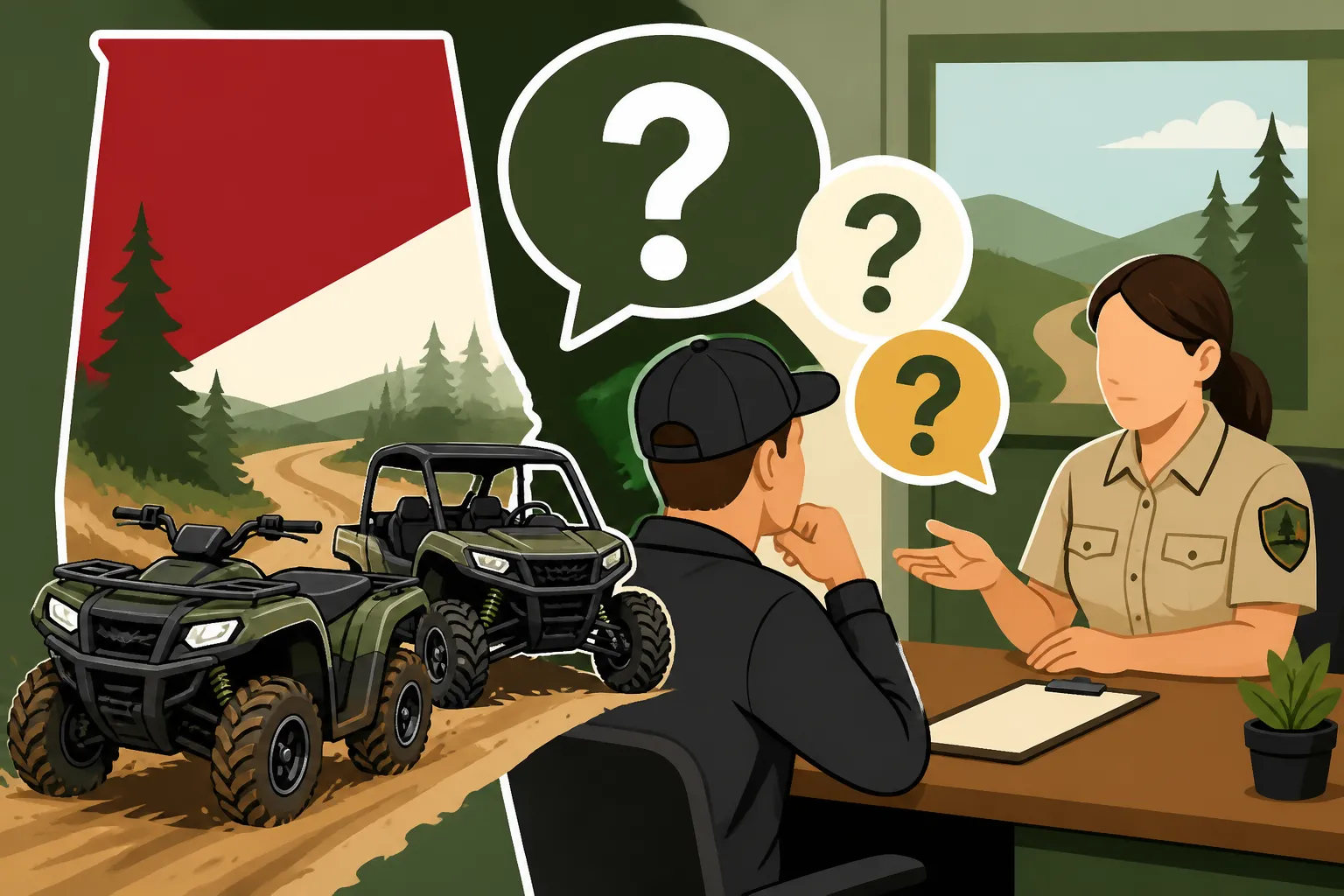
Before towing an ATV or UTV to an Alabama riding park, it is worth calling the park office with more than a question about hours. Rules can differ on permits, machine size, passengers, minors, camping and weather closures. A short call can confirm what you need to bring, what your admission covers and whether your machine and riding plans fit the park’s rules.
Start with access, permits and out-of-state paperwork
A park admission pass, an Alabama public-land permit and permission to ride on private property are not interchangeable. Ask the office which rules apply to the land you plan to ride and what you must show at check-in. If your visit includes more than one riding area, confirm the requirements separately; a pass or permit for one location may not cover another.
Ask what you need to ride that day
A useful first question is: “What do I need to bring or complete before I can ride?” The office may tell you to prepare a waiver, show identification, provide information about the machine or obtain a pass. Ask whether the process can be completed online or whether everyone must check in at the gate.
Then clarify exactly what a park pass covers. It may grant access to park property under that operator’s rules, but it should not be assumed to replace a permit required for public land. If you are planning to ride on a wildlife management area or federal forest land as well, ask the relevant land manager what applies there. Alabama National Forest Riding Permits and Alabama WMA Rules Vary by Area cover separate public-land questions.
For a privately operated riding park, ask whether every rider needs to check in, including passengers who will not drive. Confirm whether the park requires a waiver for each person, and whether a parent or guardian must complete paperwork for a minor. Review Alabama Private Park Waivers and Rules before your visit if you want a fuller checklist.
Confirm whether out-of-state documents matter
If you are visiting from another state, ask whether the park requires proof of ownership, registration, insurance or any particular decal. Do not assume an out-of-state registration automatically meets a park’s own check-in rules. The park may have requirements that are separate from state registration or public-land permit rules.
You can also ask whether the park accepts the type of machine you have and whether its staff checks identification or paperwork at the entrance. For broader state-specific context, see Alabama Visitors From Out of State and Alabama Rules for an Out-of-State Machine. Those topics help distinguish a park’s private rules from the rules that may apply elsewhere in Alabama.
| Question for the office | Why it matters | What to confirm |
|---|---|---|
| What permits or passes do I need today? | Park admission may not cover other land or permit requirements. | Which land and activities each pass covers |
| Does every rider need to check in? | Passengers and minors may have separate paperwork. | Waivers, identification and guardian requirements |
| What machine information should I bring? | The park may check machine type, dimensions or paperwork. | Any required documents or machine details |
| Are the trails open for my machine? | Not every route necessarily suits every vehicle. | Vehicle categories, route limits and closures |
| What happens if conditions change? | Rain or maintenance may affect access. | Closure notices, refunds or rescheduling options |
Ask about what the fee includes
Before paying, ask what admission includes and whether there are separate charges for parking, camping, reservations or other facilities. Current fees and what they cover can change, so confirm the details directly with the park rather than relying on an old post or a listing that may not have been updated. Alabama Park Admission Fees and Alabama Park Camping Fees explain why those items are useful to check separately.
If you are unsure whether you need to reserve a space, ask whether the park sells passes at the entrance, requires advance booking or limits daily access. A reservation system can affect when you need to arrive and what happens if your plans change. See Alabama Park Reservation Systems for more on the questions to check before booking.
Check machine eligibility, trails and rider rules
A park may limit which types or sizes of vehicles can use particular routes. Its rules may also set conditions for passengers, children, helmets and equipment. Ask about your exact machine rather than describing it only as an ATV or UTV: model type, seating capacity and dimensions can all help the staff give a useful answer.
Give the office the details of your machine
Tell the staff whether you have a quad, a side-by-side, a dirt bike or another off-highway machine. If the vehicle is unusually wide, heavy, modified or fitted with an enclosed cab, mention that too. Ask whether it can enter the park and whether any trails or facilities are off-limits to it.
Do not rely on a general rule for “ATVs” to answer a question about every machine. A park’s vehicle categories may differ from legal definitions used elsewhere, and one trail may have tighter limits than the park overall. Alabama Park Rules for Passengers can help you identify seating questions to raise, while Alabama ATV Width and Weight Limits and Alabama ROV Width and Weight Limits provide background on state definitions. A park’s own limits still need to be confirmed with its office.
Ask if the park has one-way routes, designated trails for certain vehicle types or restrictions on riding outside marked areas. You should also ask where to find the current map and whether temporary closures are posted at the entrance, online or both. A map from a previous visit might not reflect current conditions.
Confirm rules for passengers and minors
If you plan to carry passengers, ask whether the machine must be designed for that number of riders and whether the park adds its own passenger restrictions. An ATV with one seat should not be treated as suitable for an extra rider just because the passenger is willing to ride. The park can explain its admission policy, but safe seating and the manufacturer’s intended capacity matter too.
For a young rider, ask about minimum ages, supervision, youth riding areas and any limits on machine size or power. Confirm whether the parent or guardian must stay on-site, accompany the child on the trail or sign a waiver at check-in. Do not assume that a child’s ability to ride at home means the park permits the same setup.
Helmets and protective equipment deserve a direct question as well. Ask what the park requires for drivers and passengers, whether requirements differ by age or vehicle, and whether the park rents or lends any equipment. Even where a park does not require a particular item, riders should make their own safety decisions rather than treating the minimum rule as a complete safety standard. For park-specific rules, see [Alabama Park Rules for Helmets] and Alabama Park Rules for Minors.
Ask about equipment and riding conditions
A machine that meets entry rules may still need certain equipment for a particular route or event. Ask whether the park checks for working lights, a spark arrester, sound limits or other equipment. If the park has a noise rule or performs a sound check, ask how it is enforced and whether aftermarket exhaust systems are allowed.
Conditions can matter as much as equipment. Ask whether recent rain, standing water or trail maintenance affects access, especially if you are towing a machine a long distance. A park may close certain routes even when the grounds remain open. Find out where closure updates appear and whether staff can tell you which trails are currently suitable for your machine and experience level.
Plan for timing, weather, camping and changes
A park’s regular schedule may not tell the whole story. Operating days, gate times, trail access and services can vary by season, event or conditions. A phone call shortly before departure is often more useful than relying on a schedule saved from an earlier trip.
Verify hours and same-day status
Ask what time the gate opens, when riders must stop or leave the trails, and whether the hours differ on your chosen day. If you are arriving near closing time, ask whether the park stops selling admission before the listed closing time. Also confirm whether the office, fuel availability or other services follow the same schedule as the riding area.
Ask whether the park is open to the public on the date you plan to visit. Special events, maintenance, weather or seasonal schedules may affect access. If the park posts updates online, ask which page or system is the official source for day-of changes. A general search result or third-party listing might not reflect a last-minute closure.
Ask what happens after rain or a closure
Before leaving home, ask how the park handles heavy rain, storm damage or unsafe trail conditions. Is the whole park closed, or only certain routes? Does the park notify visitors by phone, website or social media? If your admission or reservation is affected, ask whether the park offers a refund, credit or rescheduled visit. Policies vary, so do not assume a closure automatically qualifies for a particular remedy. Alabama Park Refund Policies explains the kinds of terms to confirm.
If you have a reservation, ask what happens if you arrive late, need to cancel or cannot make the trip because of weather. Confirm the cancellation deadline, how to request a change and whether the same policy applies to camping and riding admission. Write down the answer or save the confirmation so you can refer to it later.
Check camping and group logistics
For an overnight visit, ask whether camping requires a separate reservation and fee, what types of sites are available and whether you can park a trailer at or near your site. Confirm whether the campground has limits on generators, campfires, quiet hours, pets or vehicle movement after dark. These rules can affect how you pack and where you set up.
Groups should ask whether they need a group reservation, whether the park has a limit on group size and whether everyone must arrive together. Ask if there is a designated place to unload trailers and stage machines. A large group arriving without a plan can create a bottleneck at the entrance even if each rider has completed the required paperwork.
If you are bringing a dog, ask about leash rules, restricted areas and whether pets are permitted in the campground or riding area. For a larger gathering, ask whether event approval is needed. A regular admission pass may not cover an organized ride, fundraiser or commercial activity.
Make the call useful and keep a record
A quick, specific call is easier for park staff to answer than a broad question such as “Is it okay to ride there?” Have your visit date, machine type, rider ages, group size and camping plans ready. If you are calling about a machine that might fall outside the usual categories, describe its dimensions and seating clearly.
Use a short checklist during the call:
- Confirm the park is open on your planned date and ask about current trail conditions.
- Describe your machine and ask about vehicle eligibility, trail access and equipment checks.
- Ask what each rider needs for admission, including forms for minors and passengers.
- Confirm fees, reservations, camping arrangements and what admission includes.
- Ask where the park posts closures and how it handles cancellations or weather changes.
- Repeat any important requirement back to the staff member and note where to verify it later.
If the answer is unclear, ask which written rule, map or form explains it. A staff member may use a term such as “permit” to mean park admission rather than a government permit, so clarify who issued it and what land it covers. If your trip crosses from a private park onto public land, contact the public land manager separately. Alabama Public Land Rules Compared to Private offers useful context on why the distinction matters.
A simple record can prevent confusion at the gate. Save a reservation confirmation, note the date and time of the call, and keep any required paperwork accessible. If staff give you a verbal exception or explain a special event rule, ask whether they can point you to a written notice. The goal is not to collect paperwork for its own sake; it is to arrive knowing which requirements apply to your ride.
The best questions are the ones tied to your actual plan: your machine, the riders coming with you, the land you intend to use and the date of your visit. Confirming those details with the park office helps avoid a wasted drive and makes it easier to follow the park’s rules once you arrive.
Disclaimer
This article is for general informational purposes only and does not constitute professional advice. Laws, prices and regulations vary by location and change over time. Consult a qualified professional for guidance on your specific situation.