Alabama Visitors From Out of State
Bringing an ATV or UTV to Alabama can involve more than loading it onto a trailer and picking a trail. Your home-state registration may not answer whether a particular Alabama riding area allows your machine, and public land can have separate access rules. The practical approach is to check the destination, permits, and road rules before you travel.
Does Your Home-State Registration Work in Alabama?
There is no single out-of-state decal or registration that guarantees access everywhere in Alabama. A credential issued where you live may document your machine or satisfy your home state’s rules, but it does not automatically replace the requirements of an Alabama riding park, wildlife management area, or federal land manager.
The first distinction is between machine registration and permission to ride a particular place. Registration identifies or records a vehicle under a state program. A permit or land-use authorization gives you access under the rules for a specific area. You may need to satisfy one, both, or neither, depending on where you ride and how the machine is classified.
Alabama generally treats off-highway vehicle registration as voluntary, but that does not mean every machine and every riding location has the same requirements. Check whether your ATV or UTV falls under the state’s off-highway vehicle definitions and whether the destination has a registration or proof-of-ownership rule. Alabama Registration Is Voluntary explains the state registration context, while Alabama Rules for an Out-of-State Machine covers the broader issue of bringing a machine from another state.
Use this comparison as a starting point, not as a substitute for the destination’s current rules:
| Where you plan to ride | What to check before traveling | Why an out-of-state credential may not be enough |
|---|---|---|
| Private OHV park | Admission rules, waiver, machine limits, age and helmet policies, and any required paperwork | The park can set its own operating conditions |
| Wildlife management area | Whether riding is allowed on that tract, which routes are open, and what permits or check-in steps apply | Access can vary by area, season, and land-management rules |
| National forest | The current motor-vehicle map, open routes, vehicle type restrictions, and permit requirements | A forest road or trail is not automatically open to ATVs or UTVs |
| Private land | The landowner’s permission, boundaries, and any written conditions | Public registration does not provide permission to cross or use private property |
| Public road | Whether that specific road use is lawful and whether the vehicle meets applicable equipment and licensing rules | Off-road registration does not make a machine street legal |
Before leaving home, gather the machine’s ownership documents and any home-state registration or permit records. A bill of sale, title if one exists, or other ownership record can help answer questions about who owns the machine. Keep the serial number available and make sure it is legible. If the machine has no title, that does not by itself settle whether you may ride it in Alabama, but it can make proof of ownership more difficult. See [Alabama Proof of Ownership on the Trail] for practical recordkeeping considerations.
Do not assume that a license plate, trail sticker, or registration from another state is equivalent to Alabama road registration. Nor should you assume that an Alabama registration, if you choose to obtain one, grants access to a managed area. Confirm the separate requirements with the place you intend to ride.
Permits and Access Rules Depend on the Riding Area
Your destination matters more than your mailing address. Alabama’s private parks, wildlife management areas, national forests, and private land all operate under different rules. A permit that applies in one setting may have no effect in another.
Private OHV parks
A private park can require a waiver, admission payment, proof of age, safety equipment, or compliance with machine-size and sound rules. It may also restrict passengers, pets, alcohol, or certain types of tires. These are park policies, not a promise of statewide reciprocity.
Read the park’s current rules before your trip, especially if you are bringing a side-by-side, a youth machine, or a modified ATV. Ask whether the park requires proof of ownership or registration, whether the rules differ for minors, and whether a permit or pass must be purchased in advance. Park rules can change, and a visitor who arrives without the required waiver or equipment may not be allowed to ride. See Alabama Private Park Waivers and Rules and Alabama Park Rules for Helmets.
Wildlife management areas
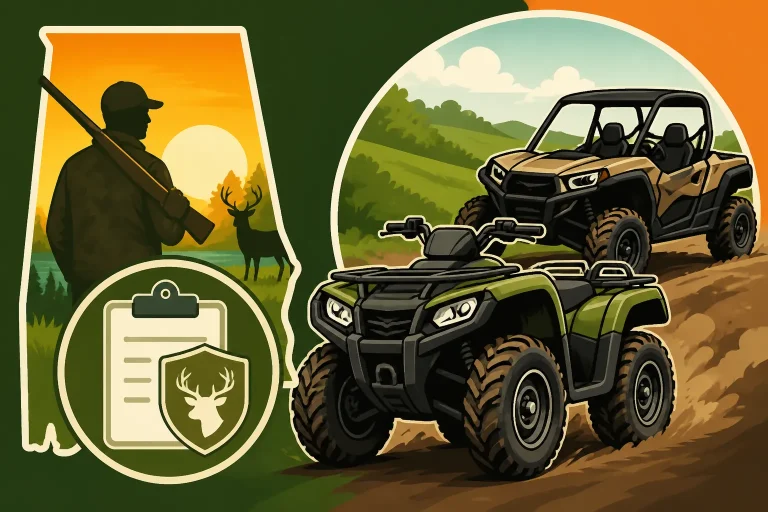
A wildlife management area is not simply an open trail network. Riding may be limited to particular roads or routes, specific times, or designated seasons. Some areas may have additional permits, check-in requirements, or instructions posted on an area map. Rules can differ from one tract to another.
Before riding, confirm all of the following with the area’s current official information:
- Whether ATV or UTV riding is permitted on that area at all.
- Which roads or routes are open to your machine.
- Whether access is limited by season, hunting activity, or temporary closure.
- Whether you need a permit, license, or daily authorization to enter or ride.
- Whether you must check in, display a permit, or follow a route-specific condition.
Do not treat a hunting license as automatic permission to ride, and do not treat an area permit as permission to ride anywhere on the property. The type of credential and the purpose it covers matter. Alabama WMA Riding Rules for Quads and Which Permits to Carry on an Alabama WMA are useful starting points, but verify the current rules for the exact tract.
National forests and other federal land
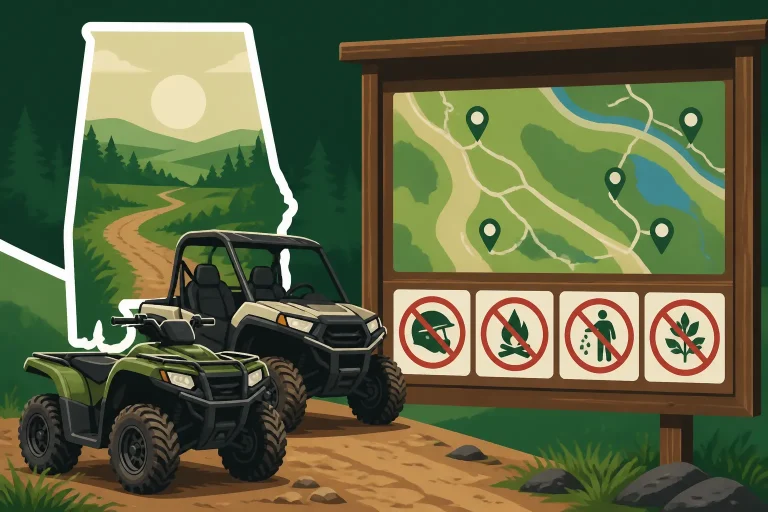
Federal land has its own route and vehicle restrictions. A road visible on a map may be closed to motorized use, and a route open to a street-legal vehicle may not be open to an ATV or UTV. Forest maps and travel-management information are more useful than a general trail map when deciding where a machine can go.
Check the relevant forest office’s current motor-vehicle map and ask whether the route is open to your vehicle type. Also confirm whether any local permit, seasonal restriction, or temporary closure applies. Do not rely only on a navigation app, an old map, or another rider’s description. See Alabama National Forest Riding Permits and Which Forest Roads in Alabama Are Open to ATVs.
Private land and riding clubs
Permission from a landowner or club is separate from state registration. Ask where the permitted riding area begins and ends, whether the permission covers guests, and whether there are restrictions on routes, dates, passengers, or recovery vehicles. If permission is given in writing, carry a copy.
A hunting lease, timber road, or utility right-of-way is not automatically open to recreational riding. A gate that is unlocked is not proof of permission. When land boundaries or access rights are unclear, stop and get confirmation rather than assuming that a route is public.
Road Use Is a Separate Question
A machine that can be ridden legally on a private trail or designated off-road route is not automatically legal on a public road. Out-of-state registration does not by itself make an ATV or UTV street legal in Alabama, and adding mirrors or lights does not necessarily change the vehicle’s legal classification.
Before using a road, distinguish among riding on it, crossing it, and traveling along its shoulder or right-of-way. Those are different situations and may be governed by different rules. A route that connects two trail sections may still include a public-road segment where off-road machines are not allowed. Check local restrictions as well as statewide requirements; a city or county may have rules that differ from the area where you usually ride at home.
For a planned route, verify the road segment with the relevant local authority or land manager. Do not rely on a trail map that merely shows a road as a line. If road use is not clearly allowed, arrange a trailer route or choose a riding area that does not require public-road travel. Alabama Rules for Riding a County Road and Alabama Rules for Crossing a Highway explain why road riding and road crossing should be checked separately.
If you are bringing a machine built and equipped for road use, check the requirements for that vehicle category rather than assuming off-highway rules apply. A machine’s label, manufacturer specifications, and safety equipment can matter. An aftermarket conversion does not necessarily make a vehicle eligible for road use. For the distinction between off-road machines and low-speed vehicles, see Alabama Low-Speed Vehicle Rules.
A Pre-Trip Checklist for Out-of-State Riders
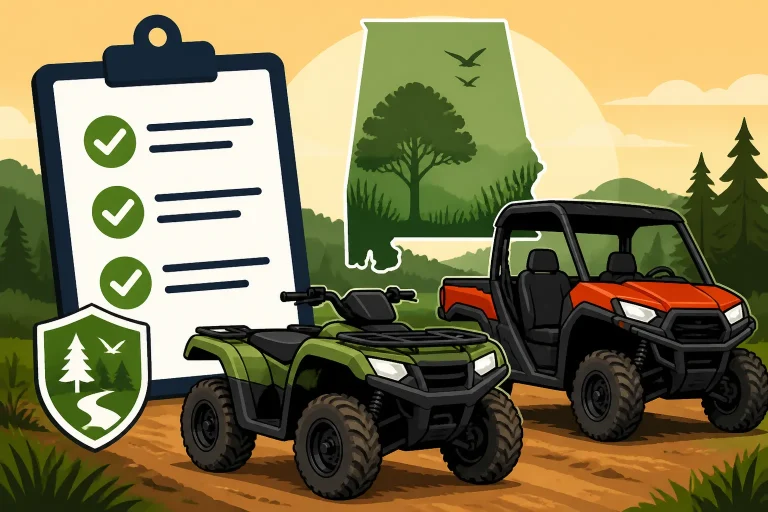
A short confirmation call or message can prevent a wasted trip. Start with the actual riding destination, then check any public route you must use to reach or connect with it.
- Name the exact riding area. “Public land near town” is too broad. Identify the park, WMA tract, forest, club, or landowner.
- Confirm that your machine type is allowed. Ask whether the rules cover your ATV, side-by-side, dirt bike, or youth machine. Width, passenger capacity, and other machine limits may matter.
- Ask what paperwork is required. Find out whether the area wants home-state registration, an ownership document, an Alabama registration record, a permit, or a combination.
- Check access permits separately from vehicle records. Ask whether you need an area permit, daily permit, park pass, waiver, or check-in.
- Verify the route itself. Use current official maps and confirm that the route is open to your vehicle type on the day you plan to ride.
- Check rules for everyone riding. Confirm age restrictions, supervision requirements, helmets, passenger limits, and any required safety equipment.
- Check temporary conditions. Closures after rain, hunting activity, maintenance, fire restrictions, or special events can affect access.
- Carry records and contact details. Keep ownership documents, permits, written landowner permission, and the destination’s contact information with you.
- Plan for the return trip. Make sure the trailer and tow vehicle are ready, and avoid relying on an unconfirmed road connection between riding areas.
When asking an office or park, be specific: “I’m visiting from out of state with this type of machine. Is it allowed on this route, and what documents or permits must I carry?” That question is more likely to get a useful answer than simply asking whether Alabama has reciprocity.
If you cannot get a clear answer, choose a destination with published rules or postpone riding until the requirements are confirmed. The inconvenience of checking ahead is small compared with arriving at a closed area, entering a restricted route, or discovering that your machine is not permitted.
Disclaimer
This article is for general informational purposes only and does not constitute professional advice. Laws, prices and regulations vary by location and change over time. Consult a qualified professional for guidance on your specific situation.