Alabama Rules for an Out-of-State Machine
Oh, the open road – or, more accurately, the open trail! It's an exciting prospect to load up your ATV or UTV and head out to explore new territory. But if you're an out-of-state rider eyeing Alabama's beautiful landscapes, you might be scratching your head, wondering if your machine's current registration or title from back home is enough. Navigating a new state's off-road vehicle laws can feel like hacking through dense undergrowth, but this guide is here to clear the path, explaining exactly what you need to know before your wheels touch Alabama soil.
Navigating Alabama's Off-Road Landscape as an Out-of-State Rider
Bringing your trusty ATV or UTV from another state into Alabama for a riding adventure or even a permanent move can stir up a lot of questions. The biggest one often is, "Does my current registration or title still count?" It's a valid concern, because nobody wants to unknowingly break a rule and face a fine or, worse, have their fun cut short. Alabama's off-road vehicle laws have their own quirks, especially when it comes to machines crossing state lines.
The Core Question: Can I Bring My Machine to Alabama?
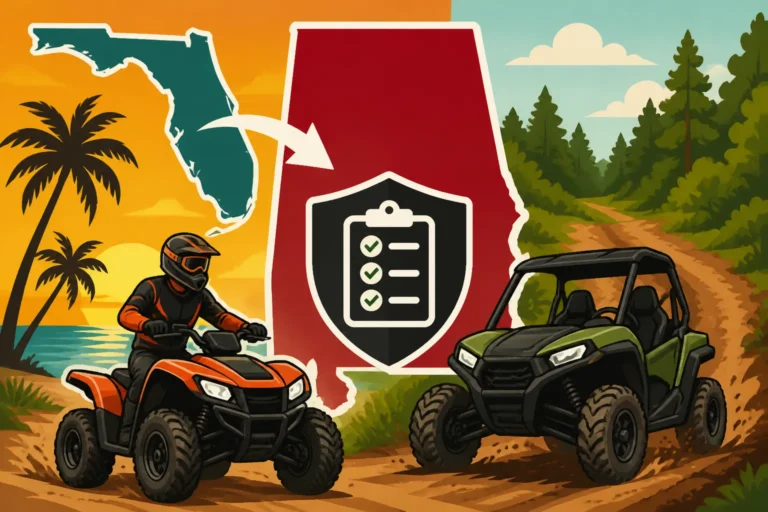
Absolutely, you can bring your off-road machine to Alabama! Alabama is a welcoming state for riders, with a fantastic array of trails and riding opportunities, from public OHV parks to vast stretches of private land. The good news is that if your ATV or UTV is properly registered, titled, or otherwise legally owned in your home state, Alabama generally respects that. You won't typically need to obtain an Alabama title or registration for temporary visits, especially if your primary residence remains out of state. Think of it like driving your car here – your home state's license plate and registration usually suffice for a visit. However, the caveat, as always, lies in where and how you intend to ride. Your machine being legal in your home state allows it to be here, but it doesn't automatically grant you permission to ride everywhere in Alabama. That's where specific local rules come into play.
For instance, if you're planning a trip to a place like Stony Lonesome OHV Park, they're typically concerned with your machine being in good working order, having a spark arrestor, and meeting their park-specific safety rules, rather than demanding an Alabama registration. They'll want to see proof of ownership, sure, but your out-of-state documentation is usually fine. The core pain point for many visitors is the uncertainty, fearing their out-of-state paperwork might be deemed invalid. Rest assured, for casual visits, it generally holds up.
Understanding Alabama's Unique Registration System
Alabama has a unique approach to ATV and UTV registration, which can sometimes be confusing even for its own residents, let alone visitors. Unlike many states where registration is mandatory for almost all uses, Alabama's system is voluntary. This means that if you're riding exclusively on your own private property, you are not required by state law to register your machine. However, if you plan to use any designated public lands or trails, even if you're just passing through on your way to private property, then a voluntary registration with the Alabama Law Enforcement Agency (ALEA) is required.
There are two tiers for this voluntary registration: "Public Use" and "Private Use." The "Private Use" registration is cheaper and is intended for those who might occasionally cross a public road or use a short public trail to get to their hunting camp, but primarily ride on private land. The "Public Use" registration is for those who regularly access public trails and parks. What's crucial for out-of-state riders is that Alabama's voluntary registration requirement typically applies to Alabama residents. So, while your machine may not need an Alabama registration, if you're using public lands, you'll need to check the specific requirements of that land management agency. Sometimes, they might have their own permit system that applies to everyone, regardless of home state registration. It's not about replacing your home state's registration, but about understanding what additional permits or fees specific Alabama riding areas might require from all users. For more on this, you might find [Alabama Public Use ATV Registration Explained] and [Alabama Private Use ATV Registration Explained] helpful.
Reciprocity and Its Limits for ATVs/UTVs
Reciprocity is the idea that states recognize each other's laws, and for things like driver's licenses and vehicle registrations, it usually works smoothly. However, when it comes to ATVs and UTVs, especially regarding road use, reciprocity often hits a wall. While Alabama generally recognizes your home state's ownership documents, it doesn't extend to allowing your machine to operate on Alabama public roads just because it might be considered "street legal" in your state.
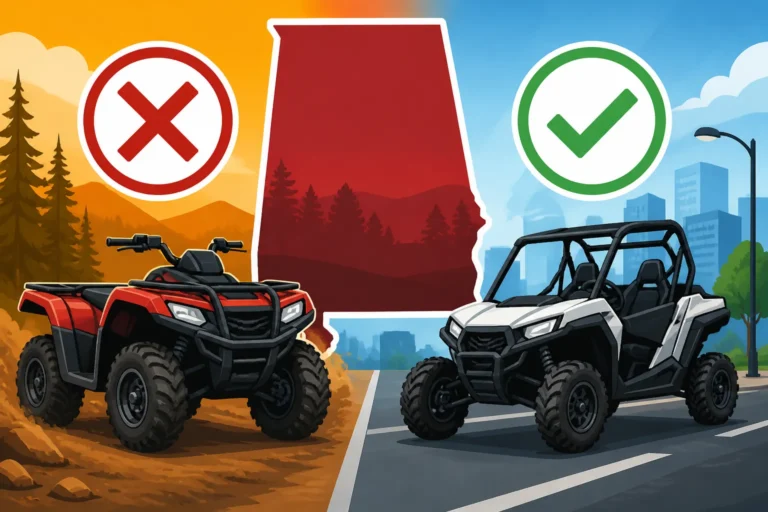
Alabama's stance on this is pretty clear: most ATVs and UTVs simply don't meet the federal safety standards required for highway use. This means that even if you've added turn signals, mirrors, and a horn – perhaps using parts from a company like SuperATV that sells conversion kits for states with different laws – your machine is still fundamentally an off-road vehicle in Alabama's eyes. The state prioritizes the core federal safety standards over individual state-level modifications. So, don't assume that because your neighbor rides his UTV on the main street back home, you can do the same in Fairhope or Jasper. The rules are strict, and ignorance of them won't prevent a citation. It’s a point of frequent frustration for visiting riders, who expect consistency across states but encounter vastly different interpretations of road-worthiness for these types of vehicles. This is a critical distinction that can prevent a lot of headaches, so always default to the assumption that your off-road machine is not street legal on Alabama public roads, regardless of its status elsewhere.
Road Rules and Public Land Access for Visitors
This is often the biggest point of confusion and frustration for out-of-state riders. In many states, especially out west, it's common to see ATVs and UTVs legally traversing county roads or even paved highways to get from one trail section to another. Alabama, however, operates under a much stricter interpretation of federal law regarding off-road vehicles on public roadways. This distinction is vital for every visitor to understand.
Why Street Legal Conversions Don't Work Here
Let's address this head-on, because it's a common misconception. Many companies, including aftermarket parts providers like SuperATV, offer "street legal kits" that include lights, horns, mirrors, and other accessories designed to meet the minimum requirements for road use in some states. These kits are fantastic if you're in a state where local laws permit such conversions for your ATV or UTV to be driven on public roads. However, Alabama law is quite clear: a standard ATV or UTV, regardless of added accessories, does not meet the stringent Federal Motor Vehicle Safety Standards (FMVSS) that are necessary for a vehicle to be registered and operated on public highways here.
The Alabama statute refers to [Alabama's 49 CFR 571.500 Standard], which is essentially the federal standard dictating what makes a vehicle truly "street legal" at its core manufacturing level. This standard covers everything from crashworthiness to emissions, and recreational off-road vehicles simply aren't designed to pass it. So, while you might have invested in a great SuperATV windshield, some bright LED light bars, or even a full signal kit, these additions, while excellent for improving your visibility and functionality on the trail, do not magically transform your off-road machine into a road-legal vehicle in Alabama. If you're pulled over on a public road in Alabama on an ATV or UTV that isn't specifically manufactured as a "low-speed vehicle" (LSV) and registered as such, you'll likely face a citation for illegal road operation. This is why you rarely see standard quads or side-by-sides on paved roads in Alabama, outside of very specific, limited exceptions like crossing at an intersection. For more information, you can check out [Why a Street Legal Kit Will Not Make It Legal].
Designated Public Riding Areas and Permits
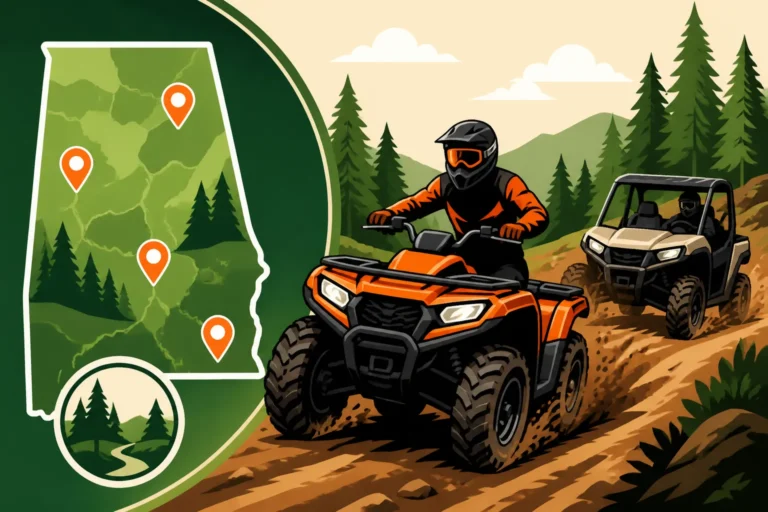
While Alabama's public roads are largely off-limits, the state boasts some fantastic designated public riding areas where your out-of-state machine is more than welcome. These include places like Stony Lonesome OHV Park in Cullman County or Minooka Park in Chilton County. These parks often have their own specific rules, which might include requiring a park permit or day pass, regardless of your home state's registration. It's always a smart move to check the park's official website or call ahead before you hitch up your trailer.
Some of these parks might require a specific type of spark arrestor on your exhaust to prevent wildfires, or they might have noise limits. They'll definitely want to see proof of ownership (your out-of-state title or registration is fine for this) and often proof of liability insurance. For larger federal lands like National Forests, riding is typically restricted to designated, marked trails only, and often requires a specific permit for that forest. For instance, you might need a daily or annual permit issued by the U.S. Forest Service or an Alabama Wildlife Management Area (WMA) permit if you're riding on WMA lands. These permits are separate from your home state's registration and are mandatory for all riders, including visitors. Always research the specific land management agency's rules for where you plan to ride. Remember, just because you can legally transport your machine here doesn't mean you can just pick any patch of woods and start riding.
Private Land Riding: Permission is Key
For many, Alabama means private land riding—hunting leases, family farms, or friends' properties. When you're riding exclusively on private land with the landowner's explicit permission, the rules simplify considerably. Here, your out-of-state registration or title is simply proof of ownership, and generally, Alabama's voluntary state registration requirements don't apply. This is where most off-road enthusiasts get to truly enjoy their machines without the headache of public access restrictions.
However, "permission" is the operative word. Never assume you have permission, even if gates are open or it looks like a well-used trail. Always get clear, explicit consent from the landowner. This might mean a written permission form, especially if you're riding on a large timber company's property or a hunting club lease. Trespassing is a serious offense in Alabama, and it can quickly turn a fun day into a costly legal nightmare. Deputies take [Alabama Trespass Law for Riders] very seriously. Even if you're just crossing a corner of someone's field to get to your friend's property, secure that permission first. It saves a lot of potential grief and keeps those relationships with landowners positive, which is essential for continued access. This is also where things like local noise ordinances could still come into play, even on private land, if your machine is particularly loud and disturbing neighbors.
Essential Gear and Safety Considerations for Out-of-State Riders
Just like the rules of the road, safety gear and age requirements can vary significantly from state to state. What might be perfectly acceptable where you live could be a no-go in Alabama. It’s always best to err on the side of caution and adhere to Alabama’s specific safety guidelines, which are designed to keep everyone safe on the trails.
| Requirement/Consideration | Alabama Rule for Out-of-State Riders (General) | Your Home State's Rule (Likely Varies) |
|---|---|---|
| Registration | Not required for temporary visits, unless specific public areas mandate a separate permit. Home state reg accepted. | Varies: Mandatory, voluntary, or not required depending on state and use. |
| Titling | Not required for temporary visits. Home state title/proof of ownership accepted. | Varies: Mandatory, voluntary, or not required depending on state and age of machine. |
| Road Use | Generally prohibited for standard ATVs/UTVs. Does not recognize street-legal conversions from other states. | Varies wildly: Some states allow extensive road use, others none. |
| Helmets | Recommended for all, especially for youth. Mandatory in some designated public parks, or for operators under 16 on public land. | Varies: Some states mandate for all, others only for youth, some none. |
| Spark Arrestor | Generally required on public lands to prevent wildfires. Check park-specific rules. | Often required, especially on public lands. |
| Proof of Ownership | Needed for park entry or law enforcement inquiries. Out-of-state title/registration sufficient. | Always good to have. |
| Insurance | Liability insurance often required for entry into public riding parks or federal lands. | Varies: Some states mandate liability, others do not. |
| Age Requirements | Strict rules for youth operators, especially on public lands. Under 14 usually requires adult supervision. | Varies considerably by state and machine size. |
Helmet Requirements and Eye Protection
This is another area where state laws diverge. While Alabama does not have a universal helmet law for all ATV/UTV riders across all types of land, it's wise for out-of-state riders to pack and wear them anyway. Safety first, right? Specifically, if you're riding on any public land or designated public trail, [Does Alabama's Motorcycle Helmet Law Cover ATV Riders?] indicates that operators under the age of 16 must wear an approved helmet. Many private riding parks also mandate helmets for all riders, regardless of age.
Even if not legally required for you, wearing a helmet is just plain smart, especially when tackling Alabama's sometimes unpredictable terrain – think red clay after a rain, or unexpected roots and rocks. Plus, strong eye protection, like goggles or a full-face shield, is highly recommended to shield you from dust, flying debris, and even low-hanging branches. If you're riding with an enclosed cab on a UTV, some folks feel they don't need a helmet, but the law's interpretation for [Does an Enclosed Cab Get You Out of a Helmet?] is usually tied to meeting full automotive safety standards, which most UTVs do not. So, don't take chances.
Age Restrictions for Operators and Passengers
Alabama has clear guidelines regarding who can operate an ATV or UTV and who can be a passenger, especially when it comes to younger riders. For out-of-state visitors, it’s important to understand these limits. Generally, children under 14 years old are not permitted to operate an ATV on public lands unless under direct adult supervision and riding a machine appropriate for their size. Some public parks or specific regulations might be even stricter, often setting minimum age limits for operators and prohibiting child passengers on single-rider ATVs.
Side-by-sides (UTVs) are usually more forgiving for passengers, but you should only carry the number of passengers for which the vehicle was designed by the manufacturer. Never carry more people than there are designated seats and seatbelts. It’s a bad idea and potentially illegal. Always match the machine size and power to the rider's age and experience level. A powerful sport quad is definitely not suitable for a young, inexperienced rider. When visiting, ensure all riders, especially youth, meet Alabama's age and supervision requirements for the specific area you'll be riding. For detailed information, you can reference [Alabama Rules for a Teen Rider] or [Alabama Rules for a Child Passenger].
Machine Equipment: Spark Arrestors and Lighting
When riding in Alabama, particularly on public lands or in forested areas, your machine needs to be equipped with a U.S. Forest Service-approved spark arrestor. This is a critical piece of equipment designed to prevent hot carbon particles from escaping your exhaust and igniting dry vegetation, which is a very real concern in Alabama's woods, especially during dry seasons. Many parks will visually inspect for this, and you could be turned away or fined if you don't have one. [Does Alabama Require a Spark Arrester on an ATV?] confirms this for public lands.
Furthermore, if you plan to ride anywhere near dusk, dawn, or at night, ensure your machine has adequate lighting. While off-road machines often come with headlights and taillights, consider adding auxiliary lighting if you're doing serious night riding. Brands like SuperATV offer a wide range of robust lighting solutions, from light bars to pod lights, which can significantly enhance visibility and safety when the sun dips below the horizon or when you're navigating dense trails. Even if you only plan to ride during the day, having reliable lights is good practice in case you're delayed on the trail. It's better to be over-prepared than under-prepared when it comes to visibility in the backwoods.
Disclaimer
This article is for general informational purposes only and does not constitute professional advice. Laws, prices and regulations vary by location and change over time. Consult a qualified professional for guidance on your specific situation.