Are ATVs Street Legal in Alabama?
It's a common dream for so many ATV and UTV owners in Alabama: the freedom to hop on your machine and ride straight from your property onto the public roads, whether it's to grab groceries, meet friends, or just cruise to the nearest trail. Unfortunately, the reality of making your off-road vehicle truly "street legal" in the Yellowhammer State is far more complex and often leads to significant frustration and disappointment. This guide is designed to cut through the confusion and meticulously detail Alabama's laws concerning ATVs and UTVs on public streets, highways, and county roads, clarifying exactly what's permissible and, more importantly, what isn't.
The Fundamental Barrier: Federal Motor Vehicle Safety Standards (FMVSS)
When we talk about whether an ATV or UTV can be driven on public roads in Alabama, the conversation has to start at the federal level, not just state laws. This is often the most overlooked and misunderstood aspect, leading many owners down a path of costly modifications that ultimately don't change their machine's legal status. The core issue lies with the Federal Motor Vehicle Safety Standards, or FMVSS.
What the FMVSS 500 Standard Means for Your ATV/UTV
The federal government sets the baseline for what constitutes a "motor vehicle" that can be legally operated on public roads and highways. These standards, particularly those outlined in [Alabama's 49 CFR 571.500 Standard], dictate everything from brake performance and lighting requirements to crashworthiness and emissions. They are comprehensive and designed to ensure vehicles are safe for shared road use, interacting with cars, trucks, and other traditional road vehicles. For an ATV or UTV to be "street legal" in the federal sense, it must have been manufactured to meet these stringent requirements from the ground up, a classification that applies to very few machines typically sold as ATVs or UTVs.
Most ATVs and UTVs, by their very design and manufacturing intent, are not built to comply with these federal standards. They are engineered for off-road performance, traversing rough terrain, mud, rocks, and trails, not for sustained speeds on asphalt highways or navigating complex traffic situations. This fundamental difference in design purpose is why the federal government doesn't classify them as highway-legal vehicles. It's not just about a few missing lights; it's about the entire structural integrity, safety features, and performance specifications that are simply not present in most off-road machines.
Why Off-Road Machines Don't Meet the Standard
Think about the specific demands of highway driving: high-speed braking, impact resistance in collisions, standardized lighting patterns, designated crumple zones, and specific tire ratings for road use. Most ATVs and UTVs lack these essential features. Their tires, for instance, are typically designed for maximum traction in dirt, mud, or sand, not for stability and wear on hard pavement. Their suspension systems are built for absorbing severe off-road impacts, which can lead to a less stable ride on smooth, high-speed roads. The frames often aren't designed to withstand the types of collisions expected on highways.
Furthermore, traditional ATVs are often single-passenger machines, with exposed handlebars and no enclosed cabin, offering minimal protection in a crash. Even UTVs, with their roll cages and seatbelts, are designed for rollover protection in off-road scenarios, not head-on or side impacts with vehicles traveling at 55 mph. [Why a Standard Quad Can Never Pass the Standard] is because the standards are set for a completely different class of vehicle with different operational risks and safety expectations. This is the core reason why, despite what many might wish, most off-road vehicles simply cannot be made truly street legal through aftermarket modifications alone.
The Impossibility of "Street Legal Kits" for Full Road Legality
This brings us to the popular, yet often misleading, concept of "street legal kits." You can find countless aftermarket kits from companies like SuperATV and others that offer turn signals, horns, mirrors, and even windshields for your ATV or UTV. These accessories are fantastic for enhancing safety and visibility off-road or in limited, specific circumstances where local ordinances allow for certain road use. They are undoubtedly valuable additions for any rider. However, purchasing and installing such a kit does not magically transform your off-road machine into a federally compliant "motor vehicle" for highway use.
[Why a Street Legal Kit Will Not Make It Legal] boils down to the fact that these kits address symptoms (missing lights, mirrors) but not the underlying disease (failure to meet comprehensive FMVSS safety and design standards). A kit cannot change the fundamental design of your frame, the crashworthiness of your vehicle, the type of tires, or the braking performance to meet federal highway standards. Therefore, while these kits might make your machine look more like a road vehicle and certainly improve its safety profile in general, they do not confer full street legality in Alabama, nor do they exempt you from the foundational federal requirements. Ignoring this distinction can lead to tickets, fines, and even serious legal trouble if you're involved in an accident on a public road.
Alabama's Off-Road Vehicle Statute: Public vs. Private Use
Beyond the federal standards, Alabama has its own specific statutes governing off-road vehicles, including ATVs and UTVs. These state laws further clarify where and how these machines can be operated, placing a significant emphasis on the distinction between private property and public roads. Understanding these definitions and the restrictions they impose is crucial for any owner in Alabama.
How Alabama Defines ATVs and ROVs (UTVs)
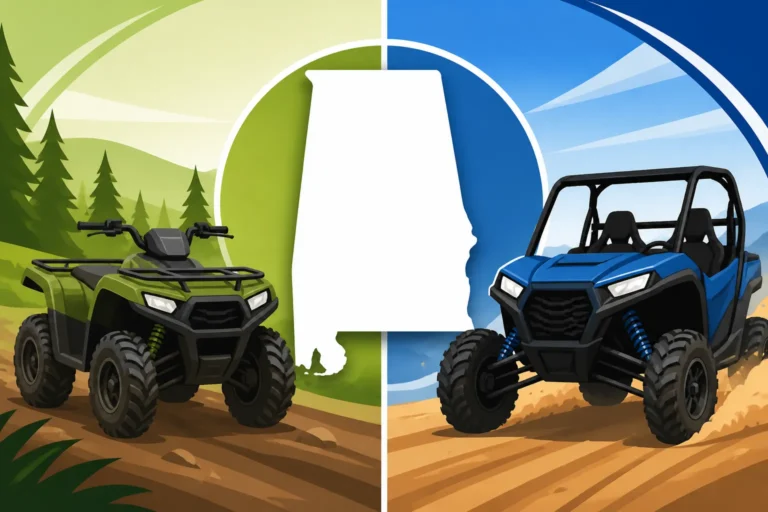
Alabama law has specific definitions for various types of off-road vehicles. An "All-Terrain Vehicle" (ATV) is generally defined as a motorized, off-highway vehicle designed to travel on four or more low-pressure tires, having a seat designed to be straddled by the operator, and handlebars for steering. "Recreational Off-Highway Vehicles" (ROVs), which often include what people commonly call UTVs or side-by-sides, are generally broader, encompassing vehicles designed for off-road use, typically with a steering wheel, non-straddle seating, and often capable of carrying multiple passengers. These definitions are important because they determine which set of rules applies to your particular machine.
It's easy to assume all off-road machines are treated identically, but [Alabama's ATV and ROV Legal Definitions] show subtle but important differences. These definitions dictate things like width and weight limits, influencing where a machine might theoretically be allowed, even if only on designated trails. The critical takeaway here is that both ATVs and ROVs are primarily classified as off-highway vehicles, meaning their intended and legal use is generally not on paved public roads. This distinction is foundational to how Alabama regulates their operation and where you can legally ride.
The Critical Distinction: Riding on Your Own Land vs. Public Roads
This is where many owners encounter the most confusion and frustration. Alabama law, like that in many states, makes a very clear and critical distinction: you can almost certainly ride your ATV or UTV on your own private property or on private land where you have explicit permission from the landowner. This includes farms, hunting leases, timberland, and private off-road parks. On your own land, you have significant freedom (though basic safety rules, like not operating while impaired, still apply).
However, as soon as your tires touch a public road, highway, or right-of-way, a completely different set of rules comes into play. The general rule in Alabama is that ATVs and UTVs are not permitted on public roads. The legal intent is to keep off-road machines in their designated environment. This means that while you might own extensive private land, the moment you decide to take your machine down the county road to a neighbor's house or to access another part of your property, you are likely breaking the law unless a very specific exemption applies. This often means trailering your machine even for short distances on public thoroughfares.
Penalties and Consequences for Illegal Road Use
Ignoring Alabama's rules regarding ATV and UTV operation on public roads can lead to a host of unpleasant and costly consequences. The most immediate is typically a traffic citation, resulting in fines and potentially court costs. These penalties can add up quickly, making that "short ride" a very expensive mistake. But the repercussions can be far more severe.
If you are involved in an accident while illegally operating your ATV or UTV on a public road, you could face significant liability. Your insurance policy might not cover damages if the machine was being operated in a manner expressly forbidden by law or if it's not insured for road use. This could mean you're personally responsible for medical bills, property damage, and legal fees, which can be financially devastating. Furthermore, an officer could impound your machine, leading to additional fees for towing and storage. In some cases, repeated violations or dangerous operation could even lead to more serious charges. It's a stark reminder that while the desire to ride on roads is understandable, the legal and financial risks are substantial.
Limited Exceptions: When an ATV/UTV Might Touch a Public Road
While the general rule in Alabama is that ATVs and UTVs are not street legal, there are a few very narrow and specific circumstances under which these machines might legally operate on or cross public roads. These exceptions are critical to understand because they are often misinterpreted or stretched beyond their legal intent.
Crossing a Highway: The Strict Rules
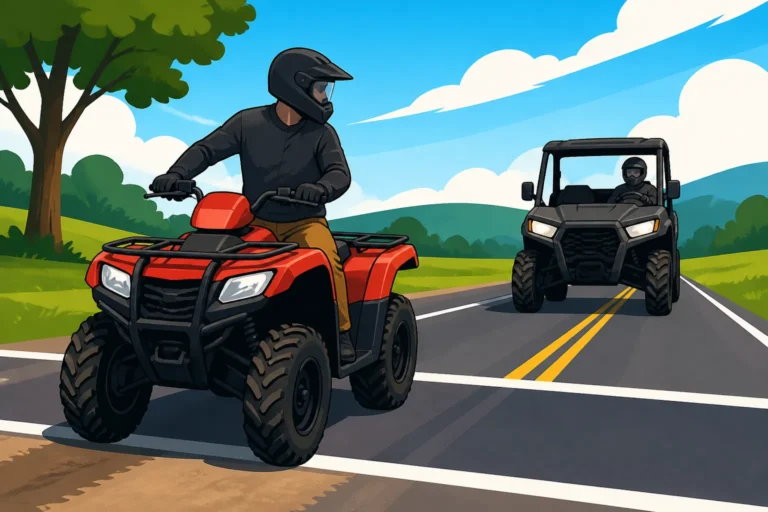
One of the most common questions riders have is about simply crossing a paved road or highway to get from one piece of private property to another. Alabama law does provide for this, but with very stringent conditions. You cannot just ride across wherever and whenever you please. Generally, the rules for [Crossing a Road on an ATV in Alabama] stipulate that the crossing must be done at approximately a 90-degree angle to the road, essentially making the shortest possible transit. You must also come to a complete stop, yield to all oncoming traffic, and proceed only when it is safe to do so, without impeding the flow of traffic.
Furthermore, these crossings are typically allowed only on unpaved roads or secondary roads, and usually not on major highways or interstates. The intent is to facilitate access to private land, not to create new avenues for road use. It is absolutely crucial to exercise extreme caution, as visibility can be poor for both the rider and motorists, and the speed differential between an ATV/UTV and road traffic is significant. Any deviation from these strict crossing rules can result in a citation for illegal road use and immediately escalate liability in the event of an accident.
Farm Use: Specific Agricultural Exemptions
Alabama law does offer specific exemptions for the use of ATVs and UTVs for bona fide agricultural purposes. If your machine is primarily used for farming, ranching, or other agricultural operations, it may be allowed on public roads for limited distances to move between fields or properties directly related to the farm's operations. This is often referred to as [Alabama Farm Use and Road Riding]. However, this exemption is not a blanket license to ride your farm quad or side-by-side to town for supplies.
The key here is "bona fide agricultural purpose." This means the machine's primary function must be directly tied to working the land, tending livestock, or other tasks critical to a legitimate farm. Riding for recreation, even if you own a farm, does not fall under this exemption. When operating under this exemption, the machine should typically be equipped with appropriate safety flagging, reflective materials, and potentially slow-moving vehicle emblems, making it as visible as possible to other road users. Law enforcement often looks closely at whether the operation is truly agricultural or merely convenience disguised as farm work.
Emergency and Utility Use: Designated Operational Circumstances
Another set of limited exceptions applies to ATVs and UTVs used by authorized personnel in emergency situations or for utility maintenance. This includes machines operated by law enforcement, fire and rescue services, paramedics, or utility companies (such as power line crews, forestry services, or pipeline inspectors) while performing their official duties. These machines are often critical for accessing remote areas that traditional road vehicles cannot reach, especially during natural disasters or for routine infrastructure checks in difficult terrain.
In these specific scenarios, the operation of an ATV or UTV on or across public roads is permitted because it serves a vital public safety or infrastructure maintenance function. These vehicles are typically clearly marked, and their operators are trained and authorized for such specific duties. This exception is not transferable to private citizens or for general recreational riding. It strictly pertains to essential, designated operational circumstances where the public benefit outweighs the general prohibition of off-road vehicles on public thoroughfares.
Local Ordinances: The County and City Wildcard
While state and federal laws set the broad framework, it's crucial for ATV and UTV owners in Alabama to understand that local governments—counties and cities—can also play a significant role in regulating where and how these machines can be ridden. This is often where some confusion arises, as rules can vary drastically from one municipality to another.
How Local Governments Can Create Limited Access
Alabama state law generally gives local governments the authority to regulate traffic and public ways within their jurisdictions, as long as those regulations don't directly conflict with state law. This means a city council or county commission could, through a specific ordinance, designate certain roads or areas within their limits where ATVs or UTVs might be permitted under very specific conditions. For example, a small rural town might designate certain low-traffic county roads for ATV access to connect residential areas with a local trail system, or to allow easier access for farmers.
However, these local ordinances are exceptions to the general state prohibition, not a negation of it. They typically come with strict limitations: specific hours of operation, speed limits, required safety equipment (like helmets, which [Are Helmets Required for ATV Riders in Alabama?] often depends on local rules and age), age restrictions for operators, and sometimes even a local registration or permit system. It's a nuanced area, and simply seeing a "golf cart friendly" sign in a community doesn't automatically mean your side-by-side is welcome on all streets.
What to Look For in a City or County Ordinance
If you suspect your local city or county might have an ordinance allowing some form of ATV or UTV road use, you absolutely must do your homework. Do not rely on hearsay or what a friend "heard." [Alabama Local Ordinances on ATV Riding] means actively seeking out the official published ordinance. This typically involves checking the city or county clerk's office, or their official website. Look for language that explicitly mentions "all-terrain vehicles," "recreational off-highway vehicles," or "off-road vehicles." Pay close attention to:
- Designated Roads: Are specific roads or districts named where operation is allowed? Is it all county roads or just certain ones?
- Time Restrictions: Are there hours of the day or days of the week when operation is permitted or prohibited?
- Equipment Requirements: Does the ordinance specify additional lighting, mirrors, turn signals, or even an orange safety flag?
- Permit/Registration: Is a local permit or registration required, perhaps with an annual fee?
- Speed Limits: Are lower speed limits enforced for off-road vehicles on designated roads?
- Operator Requirements: Are there age limits, or do operators need a valid driver's license?
Any single deviation from the ordinance's rules could put you in violation, regardless of the allowance.
The Importance of Checking Before You Ride
This cannot be stressed enough: always verify local rules before riding an ATV or UTV on any public road. What's legal in one county or city in Alabama might be strictly forbidden just across the county line or in the next town over. Relying on assumptions or anecdotal evidence is a recipe for trouble. Imagine riding your UTV down a county road, assuming it's allowed because you saw someone else doing it, only to be pulled over by a deputy who informs you that that particular county has no such ordinance.
Not only could you face fines and citations, but the risks of an accident are still very real, and your liability could be substantial. A quick call to the local sheriff's department (for county roads) or the city police department (for city streets) or a visit to their respective websites to review ordinances can save you a lot of headache and expense. It’s better to spend a few minutes verifying the rules than to spend hours in court or dealing with the aftermath of an incident. This proactive approach ensures you're riding safely and legally, respecting both the law and other road users. This applies equally to [Alabama Rules for Riding a County Road] and [Alabama Rules for Riding a Dirt Road].
Understanding "Low-Speed Vehicles" (LSVs) vs. ATVs/UTVs
One area of particular confusion for many riders is the distinction between ATVs/UTVs and "Low-Speed Vehicles" (LSVs). While they might appear similar in some respects, particularly certain UTV models that look more enclosed, the legal classification and, crucially, their street legality, are fundamentally different.
What Qualifies as a Low-Speed Vehicle in Alabama
In Alabama, a Low-Speed Vehicle (LSV) is a specific class of vehicle that is allowed on certain public roads. However, an LSV is not an ATV or a UTV. According to [Alabama Low-Speed Vehicle Rules], an LSV is typically defined as a four-wheeled vehicle with a maximum speed capability greater than 20 miles per hour but not greater than 25 miles per hour. It must also meet all federal safety standards for LSVs (FMVSS 500 – yes, that standard again!), which include headlamps, stop lamps, turn signal lamps, taillamps, reflex reflectors, parking brakes, rearview mirrors, windshields, seat belts, and a vehicle identification number (VIN).
This is a critical distinction: LSVs are manufactured from the factory to meet specific federal safety standards for limited road use. They are designed with road safety in mind, even at lower speeds, unlike most ATVs and UTVs which are built for off-road environments. They are often seen in planned communities, on college campuses, or in small towns where their lower speed limits are appropriate. A regular ATV or UTV, even with all the aftermarket bells and whistles, typically cannot be reclassified as an LSV because it wasn't built to the LSV standard from the outset.
The Factory-Built Difference: Why an LSV Isn't an ATV
The key differentiator between an LSV and an ATV/UTV is the manufacturing process and the intent of the design. A true LSV comes off the assembly line having already met the specific federal requirements. Its frame, braking system, lighting components, and overall safety structure are all engineered and tested to comply with FMVSS 500 standards for low-speed road operation. This is what [What a Low-Speed Vehicle Standard Requires] at its core.
Most ATVs and UTVs, conversely, are manufactured under different safety standards – those for off-highway vehicles. While some high-quality UTVs might have excellent lighting or robust roll cages (like those from SuperATV), these features alone do not mean they meet the full suite of federal road safety standards required for an LSV. It's about the entire package, from the chassis up, being certified for road use, even if limited. Trying to convert an off-road UTV into an LSV with aftermarket parts is generally not feasible from a legal compliance standpoint, as it would require fundamental changes to the vehicle's certified design and manufacturing.
Registration and Operation Requirements for LSVs
Because LSVs are considered road-legal vehicles (albeit with speed restrictions), they have different registration and operational requirements compared to ATVs and UTVs. In Alabama, an LSV typically must be titled and registered with the appropriate state agencies, just like a car or truck, though the specific process may vary. They are often issued a standard license plate.
Operators of LSVs usually need a valid driver's license, and the vehicle must be insured for road use. They are restricted to roads with posted speed limits of 35 mph or less, and they are generally prohibited from operating on major highways or interstates. Some local ordinances may further restrict where LSVs can be operated within a city or county. It's essential to recognize that meeting LSV requirements is a complex process starting at the factory, not an aftermarket modification. If you're looking for a low-speed vehicle for neighborhood travel, it's far safer and more compliant to purchase a purpose-built LSV than to try to convert an ATV or UTV.
Safety Considerations and Best Practices, Even When Allowed
Even in those rare or specific instances where an ATV or UTV is legally permitted on an Alabama public road, or during a legal crossing, safety should always be the absolute top priority. These machines handle differently than cars, have less protection, and are far less visible to other motorists. Taking precautions is not just about avoiding a ticket; it's about preventing serious injury or worse.
Helmets, Eye Protection, and Rider Safety Gear
While Alabama's general motorcycle helmet law doesn't explicitly cover ATVs, and [Does Alabama's Motorcycle Helmet Law Cover ATV Riders?] is a common question, it is an undeniable fact that helmets are crucial for rider safety. When operating an ATV or UTV on or near public roads, where interactions with other vehicles are possible, a DOT-compliant helmet should be considered mandatory for all riders, regardless of age or legal requirement. The risk of head injury in a collision or rollover is incredibly high without one.
Beyond helmets, eye protection is also vital. Whether it's goggles or a face shield, keeping dust, debris, insects, and glare out of your eyes ensures you maintain full visibility and control. Sturdy over-the-ankle boots, long pants, and a long-sleeved shirt or jacket can provide critical protection against abrasions, cuts, and impacts, even in minor incidents. Riding gear isn't just for looking cool; it's a layer of defense that can make a profound difference in the outcome of an accident.
Visibility: Lights, Reflectors, and Hand Signals
ATVs and UTVs are inherently smaller and often less visible than cars and trucks, especially to motorists who aren't expecting them on the road. Enhancing your machine's visibility is paramount. If you're using a machine with a street legal kit, ensure all lights (headlights, taillights, brake lights, turn signals) are fully functional and clean. Consider adding extra reflective tape to the front, rear, and sides of your machine, particularly if you're operating during dawn, dusk, or in low-light conditions.
For machines used on farms, a slow-moving vehicle (SMV) triangle emblem is essential. Always use your turn signals well in advance, and if your machine isn't equipped with them, practice clear and distinct hand signals. Make eye contact with drivers whenever possible to ensure they see you. Assume that other drivers do not see you, and always be prepared to take evasive action. A good set of mirrors, even from a company like SuperATV, can significantly improve your awareness of traffic around you.
Insurance and Liability Concerns
Operating any vehicle on public roads without adequate insurance is a dangerous gamble, and this holds true for ATVs and UTVs, especially if they are technically not permitted. While ATV insurance is not mandatory for off-road use in Alabama, if you somehow obtain local permission to use your machine on roads, or even if you're just crossing, having a robust insurance policy is a non-negotiable safeguard.
Your standard homeowner's policy or auto policy typically will not cover an accident involving your ATV or UTV on a public road, especially if it's illegally operated. You need a dedicated off-road vehicle policy that specifically addresses liability for road use, if such a policy is even available for your particular machine and usage. An accident on a public road can lead to massive expenses for property damage, medical bills, and legal defense. Confirm with your insurance agent that your policy provides coverage for any specific road operations you undertake, even if limited to a legal crossing or a locally permitted road. This due diligence can save you from financial ruin.
Common Misconceptions and Costly Mistakes
Despite the clear laws and safety concerns, many ATV and UTV owners fall victim to common misconceptions or make easily avoidable mistakes when it comes to road use in Alabama. Understanding these pitfalls can help you avoid fines, accidents, and legal headaches.
The "Just for a Little Bit" Mindset
Perhaps the most common and dangerous misconception is the "just for a little bit" mindset. "I'm just going a few hundred yards down the road," or "I'll just cross the highway quickly," or "It's only to the gas station." This mentality is incredibly risky. A short distance doesn't negate the law, nor does it reduce the danger. Accidents can happen in a split second, whether you're traveling a quarter-mile or ten miles. A law enforcement officer can issue a ticket for illegal road use regardless of how far you traveled.
This casual approach often stems from the perception that "no one will notice" or "everyone does it." While you might see others riding illegally, that doesn't make it legal or safe. Relying on others' bad habits is a poor strategy for your own safety and legal compliance. The temptation to take a shortcut on a public road can lead to disproportionately severe consequences compared to the minor inconvenience of trailering your machine.
Assuming an Out-of-State Plate is Reciprocal
Some ATVs or UTVs registered in other states, particularly those manufactured as LSVs, might carry a license plate from their home state. A common, yet incorrect, assumption is that this plate grants automatic reciprocity and street legality in Alabama. While many states have reciprocal agreements for standard automobiles, this usually does not extend to off-road vehicles that don't meet federal highway standards. [Alabama Rules for an Out-of-State Decal] and similar rules mean that Alabama law generally applies to all vehicles operating within its borders, regardless of their origin.
Unless your out-of-state vehicle is a genuine, federally compliant LSV that meets Alabama's specific LSV requirements, or is a standard automobile, its out-of-state registration likely holds no weight for street legality here. This is especially true for machines that are clearly off-road vehicles. Always check Alabama's specific regulations regarding out-of-state registrations for non-traditional vehicles, and assume that if your machine isn't street legal for an Alabama resident, it likely isn't for an out-of-state visitor either. This is a crucial point for [Alabama Visitors From Georgia] or [Alabama Visitors From Mississippi] who might be used to different rules back home.
Ignoring Local Authority Advice
When in doubt about local ordinances or specific road use, the best course of action is to contact the local law enforcement agency (sheriff's office for counties, police department for cities) or the relevant city/county clerk's office. However, some riders choose to ignore the advice given, perhaps because it's not the answer they wanted to hear. This is a costly mistake.
The local authorities are the ones who will be enforcing the laws. If they tell you a particular road is off-limits to ATVs, then it's off-limits. Arguing with an officer based on your own interpretation of a vague ordinance, or what you heard from a friend, will not only be fruitless but could also escalate the situation. Their guidance is based on their interpretation and enforcement of existing laws and ordinances. Taking their advice seriously and adhering to it is the only way to ensure you stay within the bounds of the law and avoid fines, vehicle impoundment, or more serious legal issues. Your safety and legal standing are simply too important to disregard official advice.
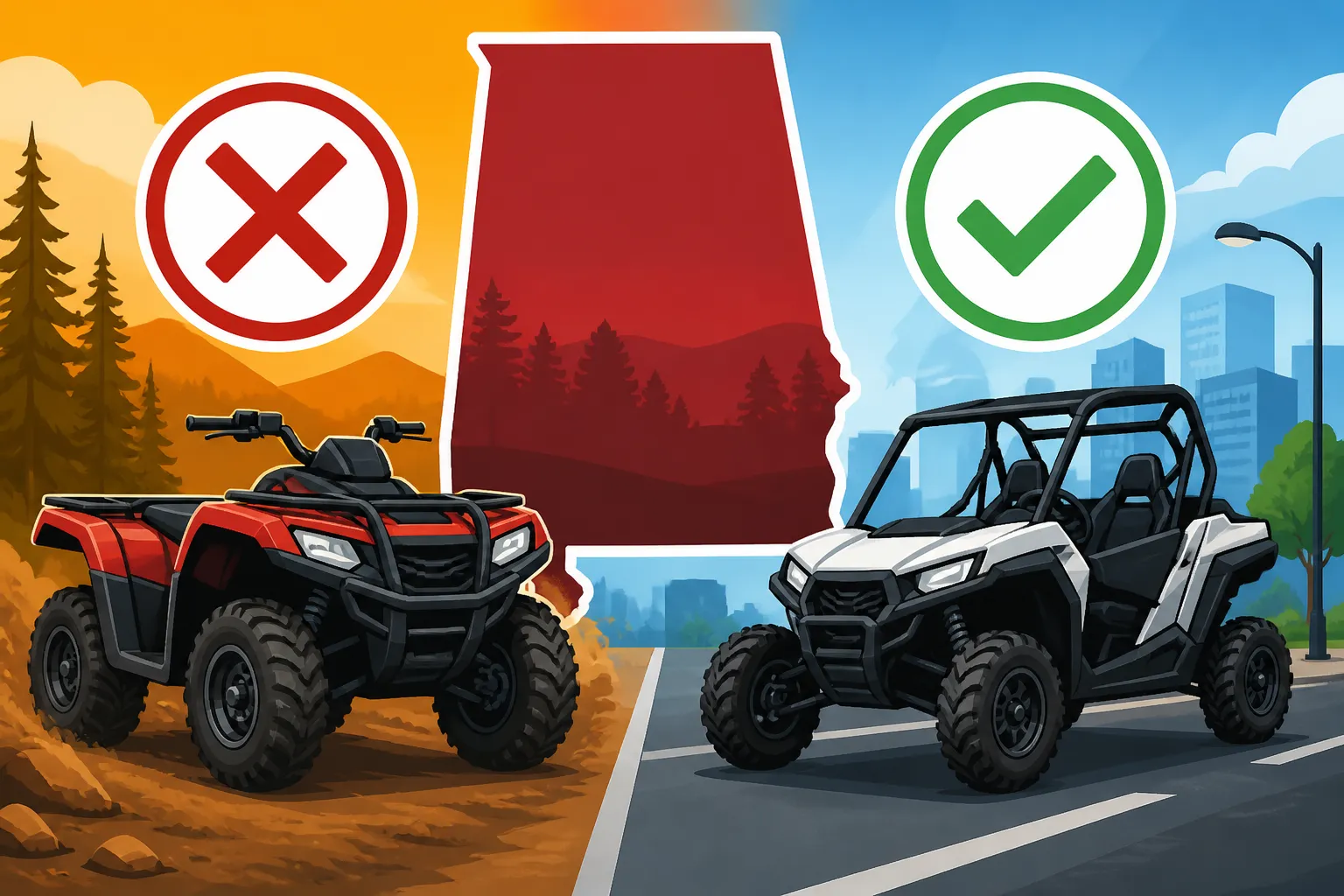
| Vehicle Type | General Street Legality in Alabama (Default) | Common Use Case | Key Defining Feature (Legal) |
|---|---|---|---|
| ATV | Generally NOT street legal | Off-road recreation, farm work | Straddle seat, handlebars, designed for off-highway |
| UTV/Side-by-Side | Generally NOT street legal | Off-road recreation, farm work | Steering wheel, non-straddle seating, designed for off-highway |
| Low-Speed Vehicle | Street legal on roads <= 35 mph | Neighborhood transit | Max 25 mph, factory-built to FMVSS 500 |
| Golf Cart | Generally NOT street legal (state law) | Golf courses, private property | Max 20 mph, often exempt from state ORV laws |
Disclaimer
This article is for general informational purposes only and does not constitute professional advice. Laws, prices and regulations vary by location and change over time. Consult a qualified professional for guidance on your specific situation.