Rules a Hunting Lease Sets Beyond State Law
A hunting lease can give you access to land without giving you permission to ride however or wherever you like. In Alabama, a lease or club’s rules may be more restrictive than state law. The practical challenge is knowing which rules apply, who can authorize your ride, and what to confirm before you unload.
State law is the baseline, not the whole agreement
Alabama law sets rules that apply to riding in the state, but it does not guarantee access to a particular private property. A hunting lease is a separate arrangement: the landowner grants certain rights to a leaseholder or group, and the lease may limit how those rights are used. A hunting club can also set member rules for access and conduct.
That means a ride can be prohibited by the lease or club even if no statewide ATV rule specifically forbids it. A lease might limit riding to certain roads, days, seasons, or purposes. It might bar recreational riding altogether. A landowner may also have granted the club hunting rights without granting it the authority to allow members’ guests to ride.
The written terms matter. Some agreements spell out vehicle access; others are vague or say that the leaseholder must get permission for particular uses. Ask for the current agreement or the relevant rules rather than relying on a member’s recollection. If the lease is held by a club, check whether its bylaws, member handbook, or seasonal notices add requirements.
| Source of a rule | What it may cover | What to check |
|---|---|---|
| Alabama law | General legal requirements that apply to riders and machines | Whether the location, activity, and vehicle are covered by the rule |
| Landowner’s agreement with the leaseholder | The rights the leaseholder has been granted | Whether vehicle use is included and whether guests may ride |
| Hunting club rules | Member conduct and access arrangements | Current written rules, approvals, and any seasonal restrictions |
| Local or land-management rules | Additional limits for a particular road, tract, or area | Signs, official maps, permits, and the relevant office’s guidance |
A lease rule does not replace state law. If state law prohibits an activity, a landowner’s permission does not make it legal. Conversely, a statewide rule allowing an activity does not automatically give you permission to ride on leased land. For a closer look at the private-property distinction, see Riding Exclusively on Private Property in Alabama.
The right question is not only “Is ATV riding legal?” It is also “Does the person inviting me have authority to allow it here, and under what conditions?” That distinction is especially important when a leaseholder invites a guest, a club member lends you a key, or the route crosses more than one parcel.
What lease and club rules may restrict
A hunting lease can be more specific than state law about where, when, and why a machine may be used. The exact terms vary, so treat these examples as topics to check, not as rules that apply to every Alabama lease.
Routes, gates, and boundaries
A lease may allow machines on designated roads while prohibiting travel through timber, fields, food plots, or other areas. It may also restrict access to a particular trail or gate. A route that looks like an established road is not necessarily included in the leaseholder’s rights.
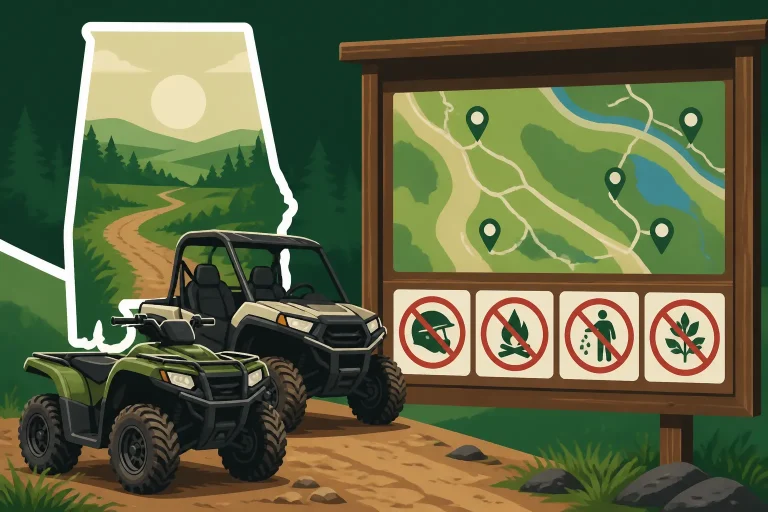
Ask for a map or clear directions, and confirm which gates may be opened. Do not assume that a path connects two parts of the same lease just because it is passable. It might cross another owner’s land, a neighboring lease, or a road with separate restrictions. For broader guidance on boundaries and permission, see Alabama Timber Land Access Rules and Alabama Posted Land Rules for Riders.
Timing and purpose
Some clubs limit vehicle use during hunting periods, after dark, during wet weather, or when roads are soft. A lease may allow a machine for reaching a stand or carrying supplies but not for trail riding. It may also reserve access for hunters on particular days.
Those limits can protect hunting opportunities and reduce damage to roads and habitat. Follow the lease’s conditions even if the machine is being used for a practical reason. If the rules are unclear about a specific trip, ask before riding rather than assuming an exception applies.
Machines, riders, and guests
A club may specify which types of machines are permitted, who may operate them, and whether guests need prior approval. It may restrict passenger use, require riders to stay with a member, or set rules for minors. It may also impose safety expectations, such as helmets, speed limits, or no riding while impaired. These may be lease or club requirements even when a particular requirement is not imposed by statewide law for that situation.
If you are bringing a side-by-side, ask whether the lease permits its width, weight, or use on the roads. A route suitable for a narrow quad may not be suitable for a larger machine. The leaseholder may also restrict equipment that could damage a bridge, rut a trail, or block access for other members.
Property care and conduct
Rules may cover closing gates, avoiding crops and planted areas, staying out of wetlands, limiting noise, or repairing damage. They may also require riders to pack out trash and report downed trees, washouts, or damaged fences.
These conditions are not merely etiquette when they are part of the access agreement. Ignoring them can lead to a loss of riding privileges, conflict with the landowner, or a request to leave. A club may have its own process for handling violations, so ask who to contact if you see a problem or cause damage.
For a more focused discussion of club-specific access, see Alabama Hunting Club Riding Rules. Rules for hunting on private land and rules for operating a machine there overlap, but they are not identical. Alabama Machines on Hunting Land covers that broader distinction.
Confirm that permission covers your whole route
Permission should come from someone who has the authority to grant it. A club member may be able to invite you under the club’s rules, but may not be able to authorize a guest ride alone. A leaseholder may also have limited rights under the agreement and may not be entitled to let visitors use every road or parcel.
If permission is verbal, clarify the details and consider asking for written confirmation, especially for a first visit or a route that crosses multiple properties. A short message can record who approved the ride, the date, the machine, the riders, and the permitted route. It does not replace a valid agreement, but it can reduce confusion. Alabama Landowner Permission Letters explains why clear, documented permission can be useful.
Before riding, check:
- Who controls access. Identify the landowner, leaseholder, club contact, or other person responsible for approving the ride. If you are a guest, ask whether the member must accompany you.
- Which parcel is included. Confirm the boundaries and whether the permission covers every section of your planned route. A lease may cover one tract but not an adjoining field or timber road.
- Where you may ride. Get permission for specific roads or trails, and ask about gates, restricted areas, and any route map.
- When riding is allowed. Check for hunting-season limits, quiet periods, weather restrictions, and time-of-day rules.
- Who and what may come. Confirm approval for guests, children, passengers, and the type of machine you plan to use.
- What to carry or display. Ask whether you need a member’s contact information, written permission, a key, or another document while on the property.
Do not treat a hunting lease as permission to ride neighboring land. Nor does permission for a single route automatically allow you to explore other trails on the property. If your trip leaves the lease area, stop and verify that the next landowner or land manager permits access.
Public land has its own rules and is not an extension of a private lease. For example, permission from a hunting club does not authorize access to a wildlife management area or federal land. Those areas may have designated routes, access conditions, or permit requirements that differ from the club’s policy. See Alabama WMA Riding Rules for Quads for the separate WMA context.
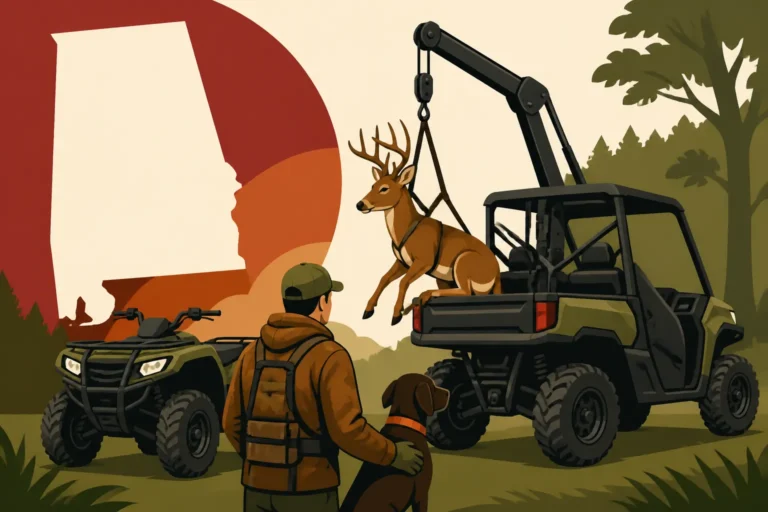
Also separate permission to ride from permission to hunt, retrieve game, or carry a firearm. A lease may authorize one activity but not another, and each can have its own restrictions. For game-retrieval questions, see Alabama Game Retrieval Rules.
When rules conflict or remain unclear
Start with the most direct, current source for the place where you will ride. If a club member gives you one set of instructions but the written lease or posted notice says something different, pause and ask the club contact or leaseholder to clarify. Do not assume a casual verbal exception overrides a written restriction.
If two documents appear to conflict, ask who issued each one and whether a newer rule supersedes the older one. A seasonal notice may change where members can ride, while the lease itself may set limits the club cannot waive. If the disagreement concerns the scope of a legal right or a possible trespass issue, get advice from a qualified local professional rather than relying on assumptions.
Keep the question specific. Instead of asking, “Can I ride here?” ask: “May I bring this machine with these riders on this date, use the marked road to reach this stand, and return by the same route?” Specific questions are easier for a leaseholder to answer and less likely to leave a key restriction unstated.
A few precautions help avoid misunderstandings:
- Save the current club rules and any written approval with your trip information.
- Photograph or note posted restrictions before riding, without treating a map or sign as proof of permission by itself.
- Stay on the approved route and turn around if you encounter a closed gate or an unmarked boundary.
- Contact the leaseholder if conditions have changed, such as a new closure, severe rutting, or a hunting activity that could make riding inappropriate.
- If permission is withdrawn, leave the property promptly and discuss the issue later.
Access rules can change when a lease is renewed, a landowner changes terms, or a club adjusts its policy. Confirm permission before a new trip, especially if you have not ridden the property recently. The safest approach is to treat the lease as a limited grant of access, not a general invitation to use every road or bring any guest.
Disclaimer
This article is for general informational purposes only and does not constitute professional advice. Laws, prices and regulations vary by location and change over time. Consult a qualified professional for guidance on your specific situation.