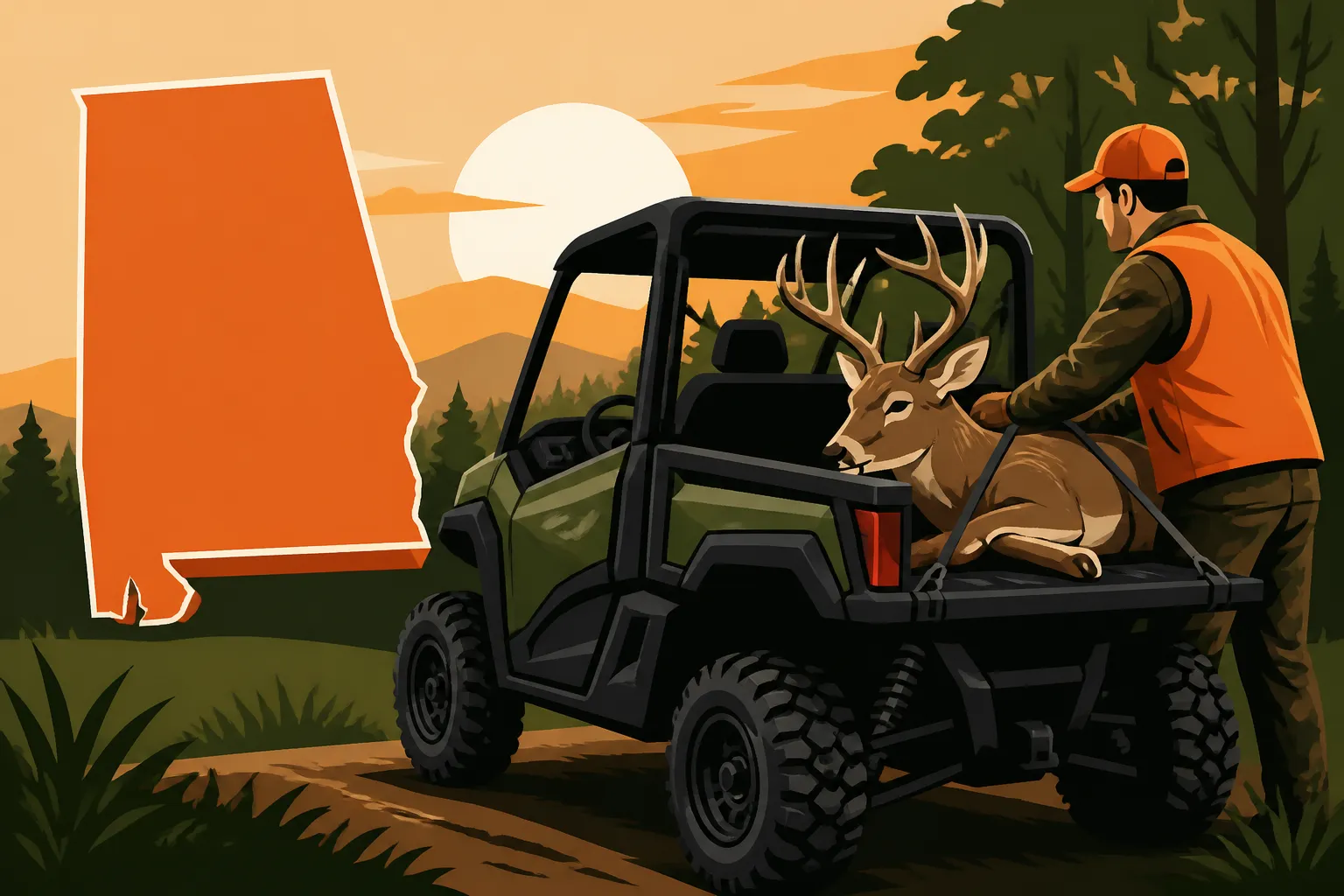
Retrieving a Deer on an Alabama WMA
A deer down on an Alabama Wildlife Management Area can leave you with an urgent question: may you use an ATV or UTV to retrieve it, and which route can you take? The answer depends on more than owning a machine or having a hunting license. Check the current rules for that WMA, the season, and the specific access route before riding.
What retrieval permission does and does not mean
Permission to retrieve a legally taken deer is not automatically permission to ride anywhere on a Wildlife Management Area (WMA). Game recovery and general off-road riding are different activities, and the rules that apply to one do not necessarily authorize the other.
A tract may restrict machine use to certain roads, routes, dates, or purposes. A gate that is open, a road that appears on a map, or an established trail does not by itself show that ATV or UTV travel is allowed. Likewise, a hunting license or WMA permit does not necessarily provide unrestricted vehicle access.
The practical question is not simply, “Can I take a machine onto this WMA?” It is: “Under the current rules for this area and season, can I use this kind of machine on this route for retrieving game?” Check the area’s posted rules and map, and confirm any unclear point with the responsible WMA office or area biologist before relying on machine access. Rules can vary by area and may change.
This distinction matters even when the deer is close to a road. A route may be open to ordinary vehicles but closed to off-highway machines, or a machine may be allowed only on designated roads. If a rule allows a limited retrieval exception, treat it as limited: follow its conditions rather than assuming it opens other roads or trails. For details specific to machine access, see Alabama Game Retrieval Rules and Alabama WMA Riding Rules for Quads.
Check permits, season, and tract rules before hunting
Do your access check before the hunt, not after a deer is down. A few minutes with the current WMA information can help you avoid a bad decision under pressure and make a recovery plan that fits the rules.
Start with the current materials for the exact WMA you plan to hunt. Look for the area map and rules, the dates and conditions for access, and any instructions about vehicles or game retrieval. Do not rely only on an old map, an online discussion, or a rule you remember from a different tract. An area’s posted instructions may include details that do not apply statewide.
Also confirm what permits or licenses apply to your trip. Requirements can depend on the activity, the area, and the person hunting. A hunting license and a WMA access permit are not interchangeable terms, and having one does not necessarily satisfy every requirement for the other. Review Alabama Hunting License Requirements, Alabama WMA Riding Rules for Quads, and How an Area Permit Differs From a Daily Permit as you plan.
| Before the hunt | What to verify | Why it matters |
|---|---|---|
| Area access | Current rules and map for the specific WMA | Rules can differ among tracts |
| Permits and licenses | Which documents apply to you and your activity | One credential may not cover every requirement |
| Machine use | Whether an ATV or UTV is allowed, and where | General access does not mean every route is open |
| Retrieval conditions | Any limits, exceptions, or reporting instructions | A narrow allowance should not be treated as broad access |
| Route and gates | Which designated roads or routes are open | A visible road or open gate is not proof of permission |
| Harvest documentation | Applicable tagging and reporting steps | Recovery does not replace required harvest procedures |
If the area uses a permit or check-in process, complete it as directed. Keep required documentation available while you are there, whether in the format the area accepts on your phone or in paper form. For app-based steps, Pulling a WMA Permit on Your Phone may help with preparation, but the current official instructions for your area should control.
Pay attention to seasonal access. A tract can have different rules during different hunting seasons, and access may also be affected by closures or other area conditions. Review Alabama WMA Access During Deer Season and Rules Printed on an Area Map, then check for updates shortly before leaving. If the rules do not clearly address retrieving a deer with a machine, ask the area office or biologist rather than inferring permission from silence.
Plan the recovery route and use a machine carefully
A recovery plan is useful even if you expect the deer to fall near your stand. Before hunting, identify where you can park legally, which routes are open to the kind of machine you have, and how you will move the deer from the recovery site to an authorized route. If a route is not clearly open, do not plan on using it simply because it seems like the shortest path.
A machine can make transport easier, but it can also cause damage or create a separate access problem. Wet ground, soft shoulders, steep banks, and narrow trails can be difficult to navigate and may be vulnerable to rutting. Stay on authorized surfaces, avoid widening a path around mud or a barrier, and do not drive across planted areas, sensitive ground, or closed routes. Keep other hunters and visitors in mind, especially around parking areas and busy access points.
Before the hunt, think through a non-machine option too. Depending on the terrain and distance, that might mean hand-carrying the deer, using a permitted handcart, or asking a hunting partner for help. Those options may be slower, but they avoid turning a difficult recovery into an unauthorized ride. Do not assume that a private-land custom or another WMA’s practice applies to the tract you are visiting.
A simple plan can help:
- Identify the WMA and current rules. Use the current area map and any posted instructions, not just a general map app.
- Mark an authorized access point and route. Confirm that the route is open to the particular machine you plan to use.
- Check permit and reporting steps. Know what must be carried, completed, or reported and when.
- Choose a backup recovery method. Be ready to retrieve the deer without riding into an area where machine use is uncertain.
- Recheck conditions before riding. Closures, weather, gates, and posted notices can affect whether a route is usable.
For longer or less familiar trips, let someone in your group know the planned route and meeting point. Carry a charged phone where service is available, but do not rely on cell coverage as your only navigation method. A downloaded or paper area map can be useful when a signal drops. If you use an electronic map, compare it with the official WMA map; a consumer mapping app may show a road without showing whether machines may use it.
Use the machine in a way that limits disturbance. Travel slowly near other hunters, yield where appropriate, and avoid unnecessary trips back and forth. Keep the deer secured for transport and make sure the load does not block your view or interfere with safe control of the vehicle. Follow the machine manufacturer’s loading and towing guidance. Never carry more passengers or cargo than the machine is designed to handle.
If you need to cross a gate or pass a barrier, stop and check the rule. Do not move a barrier, cut a lock, or treat an open gate as permission to continue. A gate may be open for authorized traffic or maintenance while the route remains closed to recreational riding. When in doubt, stop and contact the area office.
If the route or rules are unclear
It is easy to feel rushed when a deer needs to be recovered. Still, uncertainty is a reason to pause, not a reason to take a machine onto a route and hope the rule allows it. If the relevant instructions are unclear, stay on a route you know is authorized or use another method while you confirm the rule.
Ask a focused question when you contact the area office or biologist. Give the WMA name, the season or date, the type of machine, and the route or access point you are considering. Ask whether machine use is allowed specifically for retrieval and whether there are limits on where you may ride. If the answer depends on a posted map or a particular condition, ask where to find that instruction. Keep a note of the guidance and check whether a later notice has changed it.
Do not assume a general answer about “ATV access” settles every detail. A machine may be allowed on some routes but not others, or the rules may distinguish between travel for hunting access and retrieval of game. The relevant question is the one that matches what you intend to do. For related considerations, see Alabama Machines on Hunting Land and Checking In and Out of a Tract.
If you discover that your planned route is closed, do not cross the closure to save time. Use an authorized route or arrange another way to recover the deer. If a machine becomes stuck or a recovery creates damage, avoid making the problem worse by driving around the obstacle or opening a new path. Follow area instructions and contact the appropriate staff if assistance or reporting is needed.
Finally, complete all applicable harvest documentation and reporting steps. Retrieving the deer is only one part of the process; it does not replace any required tagging, check-in, or reporting procedure. Verify the current instructions for the season and keep required records with you during transport. See Alabama WMA Permit Questions Riders Ask for related access questions, but rely on the official information for the specific tract.
The safest approach is straightforward: confirm the current WMA rules before the hunt, treat retrieval permission as separate from general riding access, and use only a route you know is authorized. That preparation makes it easier to recover game without creating a separate problem with access, property damage, or compliance.
Disclaimer
This article is for general informational purposes only and does not constitute professional advice. Laws, prices and regulations vary by location and change over time. Consult a qualified professional for guidance on your specific situation.