Alabama Game Retrieval Rules
Recovering a deer or hog with an ATV can save time and effort, but it does not automatically give you permission to ride wherever the animal went. In Alabama, the rules depend on the land, the route, and any area-specific restrictions. The safest approach is to confirm access before hunting, then treat game recovery as a separate task from the right to operate a machine.
The rule depends on where the animal is
A recovery plan that works on private land may not work on a wildlife management area, national forest, or timber tract. The first question is not simply whether you may retrieve the animal. It is whether you may travel to it by ATV or UTV on that particular land.
| Location | What to check before using a machine |
|---|---|
| Private land | Permission from the landowner or person who controls access, plus any conditions they set |
| Wildlife management area | Current area rules, required permits, and which roads are open to motor vehicles |
| National forest or other public land | The applicable land manager’s map, route designations, and seasonal closures |
| Timber or hunting-club land | Written access terms, gates, and the land manager’s or club’s rules |
On private property, permission to hunt does not always include permission to drive an ATV. A landowner may allow hunting but require you to retrieve game on foot, stay on specified roads, or call before entering a field. If access comes through a lease or club, read its terms rather than assuming a hunting membership includes vehicle use. Alabama Landowner Permission Forms and [Alabama Hunting Club Riding Rules] cover permission questions that can affect a hunt.
Public land has another layer: rules may limit machines to roads or routes marked open to vehicle traffic. A downed animal does not, by itself, turn a closed road into an open one or authorize travel off-road. Some areas may have specific provisions or restrictions for game retrieval, so check the current rules for the exact tract before relying on a general understanding of Alabama hunting law.
If you are hunting a wildlife management area, review the area’s current map and regulations before the season. Rules can vary by area and may change with closures, hunting seasons, or access conditions. Alabama WMA Riding Rules for Quads explains the need to check local restrictions, while Alabama WMA Access During Deer Season addresses why access can depend on the season and tract.
Do not assume that a route is open because it appears on an older map, has tire tracks, or is passable. A gate, sign, map legend, posted notice, or area manager’s instruction may control access. If the status is unclear, ask the land manager or area biologist before riding. Alabama Area Biologists and Their Maps can help with the right questions to ask.
Wildlife management areas need extra checking
A wildlife management area is not one continuous, unrestricted riding area. It is public hunting land with its own access rules. Those rules may distinguish between walking, driving on an open road, and operating an ATV away from a designated route. Do not treat a hunting permit as an off-road riding permit.
Before the hunt, identify the boundary of the tract and the roads that are open to motor vehicles. Check whether access is restricted during a particular hunt, whether a road is closed by a gate or sign, and whether the area has a specific process for retrieving harvested game. If the rules do not clearly address your situation, contact the area manager or biologist. A quick clarification before the hunt is safer than trying to resolve a boundary or road question while recovering an animal.
Permits also need to be understood separately. A hunting license, a WMA license or permit, and any area-specific daily permit may serve different purposes. Carry the documents or records the area requires, and make sure each person in your hunting party has met their own requirements. For a starting point, see Three Things You Need Before Riding a WMA, Alabama WMA Daily Permit Steps, and Alabama Hunting License Requirements.
A permit does not necessarily authorize every activity or every route. Read the conditions printed on it and the rules posted for the tract. If the permitted route ends before the animal’s location, do not assume you can continue by machine through woods, a field, or a closed road. You may need to recover the animal on foot or ask the manager what options are allowed.
This distinction matters when the animal crosses a boundary. A shot may be taken legally on one tract, but the animal can travel onto another property before it falls. You need permission to enter the land where it lies, and you need to follow that land’s vehicle rules. A WMA boundary, private parcel line, timber-company boundary, or closed-area boundary remains relevant during recovery. If you cannot establish access, stop and contact the landowner or manager instead of crossing first and explaining later.
When a WMA’s posted rules and a general description online seem to conflict, use the current official rules for the specific area and ask the responsible office for clarification. Keep a note of who you spoke with and what route or procedure they approved. Do not rely on a verbal assumption from another hunter when the area’s written rules say something different.
Plan the recovery before the shot
A little planning can prevent a difficult recovery from becoming a trespass, a damaged trail, or an unsafe ride. Before hunting, decide which machine will be used, who will operate it, and where it can legally travel. A recovery plan should include a walking route as well as a machine route, in case the animal is beyond the area where vehicles are allowed.
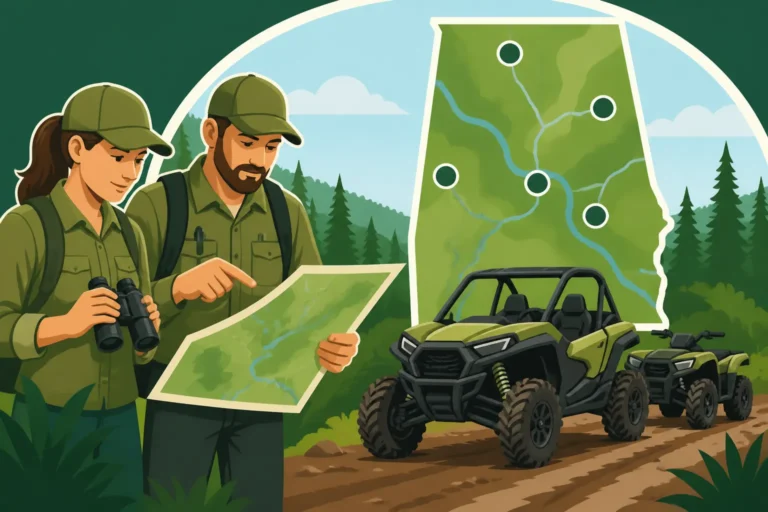
- Confirm the land boundary. Know which parcel or public tract you are hunting and where nearby boundaries lie. Carry a current map or use a reliable mapping method, but do not treat a GPS display as proof that access is allowed.
- Ask about machine access. On private land, get permission for the ATV or UTV specifically. On public land, verify the current route designations and any retrieval provisions.
- Identify a lawful staging point. Park where vehicles are permitted and where the machine will not block a gate, road, or emergency access.
- Agree on who will operate the machine. The driver should be sober, capable, and familiar with the route. Keep riders within the machine’s intended seating capacity.
- Bring suitable recovery gear. A rated winch or recovery strap may help with a lawful extraction, but neither gives permission to travel into a restricted area. Check the manufacturer’s instructions and use attachment points intended for recovery.
- Make a plan for a boundary crossing. Get contact details for the adjoining landowner or manager when possible. If the animal crosses onto land you cannot enter, request permission before going after it.
Once an animal is down, approach carefully and make sure it is no longer a danger. Keep firearms handled safely and do not use a vehicle as a platform for shooting. If the animal is wounded and has moved, follow the applicable hunting and weapon rules while tracking it. Avoid sending several people or machines in different directions without a clear plan; that can make it harder to track the animal and easier to cross a boundary accidentally.
Harvest reporting and tagging requirements are separate from vehicle access. Complete the required recordkeeping and reporting steps for the species you take, and check current Alabama instructions for when and how to report. Do not assume that putting the animal on an ATV, loading it into a truck, or returning to camp satisfies those obligations. Alabama WMA License Requirements is useful for understanding that access credentials and hunting requirements are not interchangeable.
If you need to move the animal with a machine, use a route that is allowed and avoid creating a new path. Keep wheels on the authorized road or route, do not widen it to get around mud, and do not drive through a planted field, wet area, or stream crossing unless that use is expressly allowed. A route that looks convenient can leave ruts, damage habitat, or violate a landowner’s conditions. After heavy rain, consider carrying the animal by hand or arranging another lawful method rather than making a recovery trail worse.
Common mistakes and safer alternatives
The most frequent problem is confusing the right to recover an animal with the right to drive to it. They are not the same. A lawful harvest does not automatically authorize entry onto another person’s land or travel on a closed road. If you cannot reach the animal by a permitted route, ask for permission or recover it on foot where lawful.
Other avoidable mistakes include:
- Assuming every ATV rule is the same across public land. A rule for one WMA or forest route may not apply to another.
- Treating a gate as optional. A gate or closure sign is a clear reason to stop and check access, not a challenge to work around.
- Relying on old maps or tracks. Routes can close or change, and tire marks do not establish permission.
- Taking a machine onto adjoining land without asking. Contact the owner or manager first, even if the animal was hit on land where you had permission.
- Using recovery equipment without checking its limits. A strap or winch can fail if it is damaged, poorly attached, or used for a load it was not designed to handle.
- Rushing through safety steps. Keep people clear of a tensioned line, use the machine’s approved recovery points, and follow the equipment instructions.
A basic map and a written access note can make a recovery plan easier to follow. Keep the area name, open route, contact information, and any permission conditions together with your hunting documents. A waterproof map case, available from outdoor retailers and online sellers such as Amazon, can help protect a paper map from rain and mud. It is a practical convenience, not a substitute for current official maps or permission.
If you are unsure whether an ATV may be used for a particular recovery, do not ride first and ask later. Contact the landowner, club, WMA manager, or relevant land office and describe the exact route and situation. Ask whether the machine may travel there, whether it must remain on a marked road, and whether any additional permit or seasonal rule applies. For WMA access more broadly, Alabama WMA Rules Vary by Area explains why checking the individual tract matters.
The safest rule is straightforward: secure permission for the land, confirm the route for the machine, and follow the current harvest and reporting requirements. If any one of those answers is uncertain, pause the recovery and get clarification. That is better than risking a citation, losing access, or damaging land while trying to save time.
Disclaimer
This article is for general informational purposes only and does not constitute professional advice. Laws, prices and regulations vary by location and change over time. Consult a qualified professional for guidance on your specific situation.