Alabama Visitors From Florida
Alabama Visitors From Florida
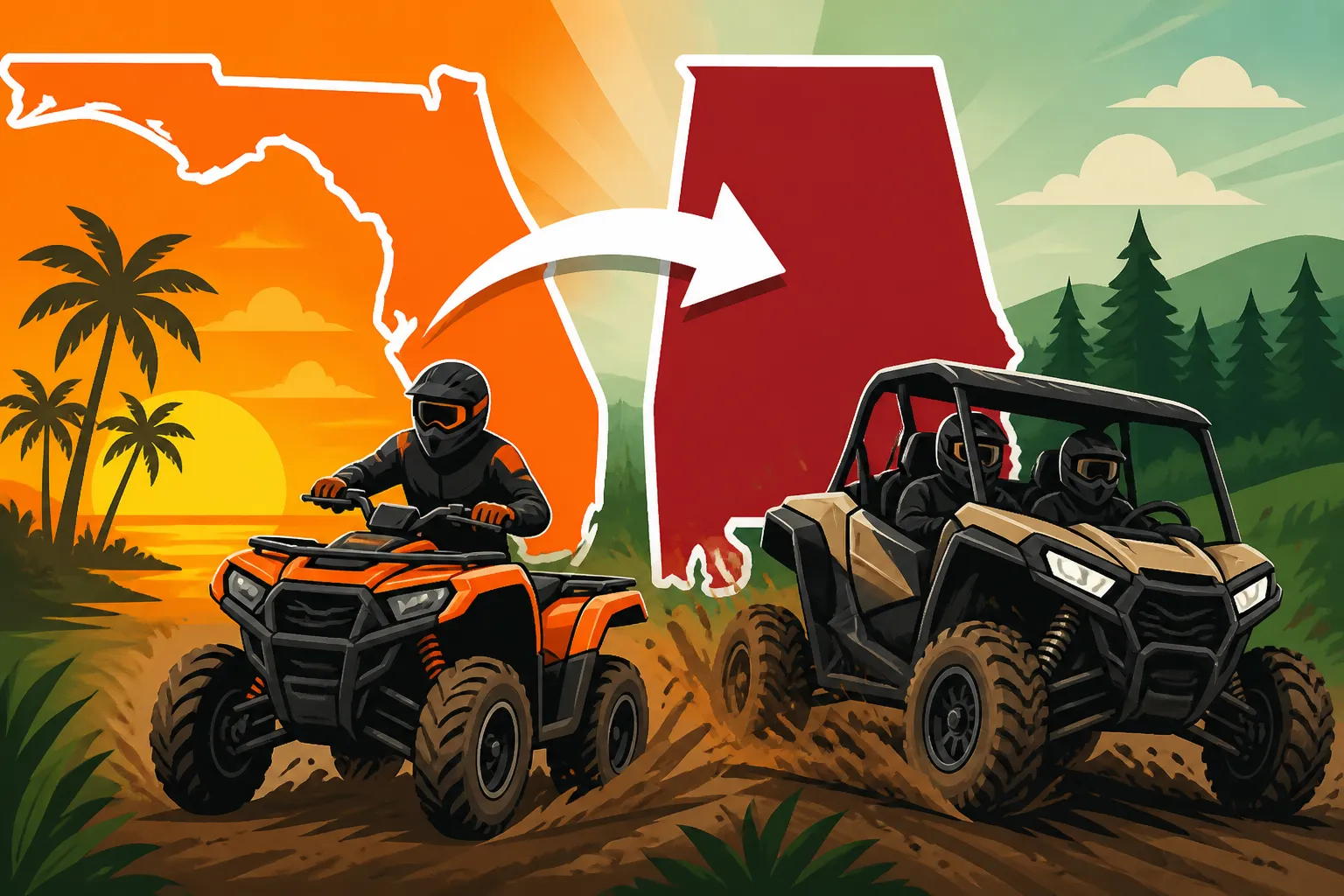
Bringing an ATV or UTV from Florida to Alabama does not mean your Florida paperwork automatically gives you permission to ride. The key is to match your plans to the land you will use: a private riding park, a wildlife management area, or a national forest can each have different access rules. Here is what to check before you tow north.
What Florida visitors need to know about Alabama permits
There is no single Alabama riding permit that covers every trail, park, or public parcel. Your requirements depend on who manages the land and what kind of riding is allowed there. A Florida title, registration, decal, or other document can help identify your machine, but it should not be treated as permission to ride in Alabama.
Alabama’s ATV registration system is voluntary in many situations, but that does not mean every public riding area is open without paperwork. Registration and land access are separate questions. Registration records information about the machine; a permit or land manager’s approval addresses whether you may use a particular area. Neither automatically makes a machine legal on public roads.
If you are planning to ride on public land, start with the exact area rather than a general search for “Alabama ATV permits.” Find the land manager’s current rules, then confirm what applies to your machine and the dates you plan to visit. A forest road, a wildlife management area, and a privately operated OHV park do not necessarily use the same system.
A useful way to organize the issue is:
| Where you plan to ride | What to check before leaving Florida | What not to assume |
|---|---|---|
| Private OHV park | Admission, reservation, waiver, machine limits, age rules, and park-specific equipment requirements | That another park’s rules apply |
| Wildlife management area | Current area map, vehicle access, any required license or permit, season restrictions, and check-in instructions | That a hunting license or Florida decal alone grants access |
| National forest | Open routes, current motor-vehicle map, seasonal closures, and any area-specific requirements | That every road or trail shown on a general map is open to ATVs |
| Private property | Landowner permission and any lease or club rules | That nearby public access or a hunting lease includes riding rights |
| Public road | Whether the machine and the specific road qualify for legal road use | That registration or a street-legal kit by itself makes the ride lawful |
For a broader overview of state requirements for nonresident riders, see Alabama Visitors From Out of State. The practical takeaway is simple: treat Florida paperwork as proof about your machine, not as a substitute for Alabama land access approval.
Sort out the type of land first
Before asking whether you need a permit, identify the owner or manager of the place you want to ride. “Public land” is not one uniform category. A state-managed wildlife area, federal forest, county recreation area, and private park may each have separate rules. Even two areas managed by the same agency can have different routes, closures, and permit procedures.
If you already have a destination in mind, look for the official map or rules page for that specific property. Check the map’s date or revision information, and look for notices about temporary closures. A third-party trail map can help you plan, but it should not replace the current access information from the land manager.
If you are still comparing areas, use Alabama ATV Trails: Where to Ride as a starting point, then verify access with the park or agency you intend to visit. A trail description is not the same thing as current permission to ride.
Separate machine paperwork from riding permission
A title, bill of sale, registration card, or serial-number record can help establish who owns the ATV or UTV. That can be useful at a park gate, during a roadside stop, or if a machine is lost or stolen. It does not establish that a route is open, that you have the required land permit, or that the machine meets a park’s size and equipment rules.
Alabama’s registration process is separate from access permits. For context on that system, see Alabama Registration Is Voluntary. If you are bringing a machine with Florida documents, keep them together and make sure the serial number on your paperwork matches the number on the machine. If a document is missing or the serial number is difficult to read, resolve that issue before traveling rather than hoping it will not matter at check-in.
Riding Alabama wildlife management areas
Wildlife management areas, often called WMAs, need more careful planning than a private park. They are managed for specific public uses, and rules may differ by area, season, road, and activity. A map that shows an area’s boundaries does not necessarily show that every road is open to ATVs or UTVs.
Start with the current information for the exact WMA you want to visit. Check whether off-highway vehicle use is allowed at all, which roads or routes are open, and whether access changes during hunting seasons or other management periods. A route that is open for one purpose or at one time may be closed for another. Do not infer that a gate, road, or track is open simply because it appears on a phone map or because other riders have used it.
The permit terminology can also be confusing. Depending on the area and the activity, the rules may refer to a WMA license, an area permit, a daily permit, or a check-in process. Those terms are not interchangeable, and requirements can vary. The best reference is the current area map and the instructions from the Alabama agency that manages the WMA. See Alabama WMA Licenses Explained, Alabama WMA Area Permits, and Alabama WMA Daily Permits for more on how these requirements can differ.
A hunting license should not be assumed to cover every kind of access. Likewise, a permit used for one WMA may not authorize riding at a different one. Before leaving Florida, confirm whether your planned use is covered, whether each rider needs separate paperwork, and whether any daily check-in or check-out step applies.
Check the rules that can change during your trip
WMA access can be affected by more than the riding season. Hunting activity, habitat work, weather damage, road maintenance, and temporary closures can change where vehicles may go. A route that was open on a previous visit may not be open today.
Before setting out each day:
- Check the current map and notices for the WMA you are visiting.
- Confirm that the exact vehicle type is allowed on the route. A rule for an ATV may not automatically cover a wider side-by-side.
- Review any permit instructions, including whether you must check in, carry a permit, or display documentation.
- Look for seasonal restrictions and closures that apply to the planned date.
- Contact the area office or listed staff contact if the map does not answer a specific question.
For more context, Alabama WMA Rules Vary by Area explains why a general answer may not be enough. If you are unsure who can interpret a local restriction, Alabama Area Biologists and Their Maps can help you understand the role of area-specific information.
Do not rely on a hunting club, landowner, or another visitor to interpret a WMA’s public rules unless that person is authorized to do so. A private lease can set rules for leased land, but it does not necessarily override the rules for a neighboring public area.
Forest land has a different rulebook
A national forest is not a WMA, and WMA permit information should not be used as a substitute for federal route information. In Alabama, riders may be interested in places such as Bankhead or Talladega National Forest, but being inside a national forest does not mean every road or trail is open to motorized use.
Check the current motor-vehicle map and access notices for the forest you plan to visit. Confirm that your machine is permitted on the specific route, not just that the road appears on a general navigation map. Pay attention to vehicle classes, closures, gates, and seasonal restrictions. If the route status is unclear, ask the appropriate Forest Service office before riding.
See Alabama National Forest Riding Permits and Which Forest Roads in Alabama Are Open to ATVs for more on federal access and route checks. A public-land permit or registration from another jurisdiction should not be assumed to override a federal closure or route restriction.
Private parks, private land, and organized rides
A private OHV park is often the simplest setting for a Florida visitor because it can provide a defined riding area and a clear set of entry rules. It still does not mean you can arrive without checking. Each park sets its own requirements, and those requirements may cover admission, reservations, waivers, machine dimensions, helmets, passengers, age limits, noise, alcohol, pets, or camping.
Read the park’s rules before you tow. Confirm that the park is open on your planned dates, that it accepts your type of machine, and that you have completed any required reservation or waiver. If a minor is riding, ask what parent or guardian paperwork is required. If a UTV has extra seats or carries passengers, check the park’s passenger rules rather than assuming the machine’s seating capacity settles the question.
Use Alabama Private Park Waivers and Rules as a general reference, but rely on the park’s current instructions for the final answer. Rules can differ even between nearby parks. A waiver is not a permit for riding outside the property, and paying admission does not make roads to the park legal riding routes.
Private property outside a commercial park also requires direct permission. A sign, gate, established trail, or informal invitation from someone who does not control the property is not reliable permission. Ask the owner or authorized manager where riding is allowed, what boundaries apply, and whether the permission covers every person and machine in your group.
This is especially important when a route crosses several parcels. Permission for one section does not necessarily extend across the entire trail. Keep the agreed route clear, respect locked gates and posted boundaries, and do not assume that a hunting lease includes recreational riding. See Alabama Landowner Permission Letters and [Alabama Hunting Club Riding Rules] for related access questions.
If you are joining an organized ride, ask the organizer who has arranged access and whether each participant needs to take any separate steps. An event invitation does not guarantee that every rider has the required permission, permit, or waiver. Check the event’s instructions, and confirm whether the route crosses public land, private land, or both.
Florida paperwork, Alabama registration, and road use
Bring the paperwork that identifies your machine and supports your ownership claim. Depending on what you have, that may include a title, bill of sale, registration record, insurance information, or a written record of the serial number. Store copies separately from the originals, and keep a digital copy available as a backup. Copies are useful for planning, but an area or park may ask to see particular original documents, so check its instructions.
If you bought the machine recently, make sure the seller’s paperwork is complete and that the serial number matches the machine. A Florida document does not necessarily resolve a missing ownership record or a mismatch in the serial number. For a used machine, see Alabama Rules for an Out-of-State Machine and Alabama Proof of Ownership Without a Title for related documentation issues.
Alabama’s voluntary ATV registration is not the same thing as a permit to enter public land. Nor should a registration record be mistaken for a license plate authorizing general road travel. The registration system distinguishes between public-use and private-use contexts; check the details at Public Use Versus Private Use Tiers and Alabama Public Land Rules Compared to Private. If you choose to register a machine, confirm the current application process and category with the responsible Alabama office.
The reverse is also true: having no Alabama registration does not mean that every riding area is automatically available to you. A WMA or park can impose its own access requirements. Confirm those requirements separately, even if your machine is registered in Florida or Alabama.
Do not plan an ordinary road ride between trails
ATVs and UTVs are off-highway machines. Registration, ownership paperwork, a park decal, or an aftermarket lighting kit does not automatically make a machine legal to drive on public streets or highways. Road use depends on the machine’s legal classification, the relevant state and local rules, and the specific road involved.
Do not use public roads as a convenient connector between a campground, trailhead, fuel stop, or riding area unless you have confirmed that the machine may lawfully use that road. Rules about crossings, local ordinances, and qualifying vehicles can differ from rules for off-road access. A machine allowed on a particular public-land route is not necessarily allowed on the nearby county road.
For the road-use question, see Can You Drive an ATV on the Road in Alabama? and Alabama Rules for Crossing a Highway. If your plan depends on using a road, confirm it with the relevant local authority before the trip. When in doubt, trailer the machine to a lawful staging point rather than riding along the shoulder.
Insurance is another separate issue. Do not assume a Florida policy covers every activity, passenger, or location in Alabama. Ask your insurer how the policy applies when the machine is used out of state, and whether it covers liability, theft, transport, or damage at the planned riding site. Insurance does not grant land access, but it can matter if an accident or loss occurs.
A pre-trip checklist for Florida riders
A little verification before departure can prevent a long tow to a closed route or a gate where the group lacks required paperwork. Use this checklist for each destination, not just once for the whole trip.
- Name the exact riding area. Record the park, WMA, forest, or private property name, along with the entrance or staging location.
- Identify the land manager. Find the official website, current map, or contact information for the organization that controls access.
- Confirm that your machine is allowed. Ask whether the rules cover your ATV or UTV, including its width, passenger arrangement, and any modifications.
- Check permits and access steps. Ask whether you need a license, daily or area permit, reservation, waiver, check-in, or other documentation. Confirm whether the requirement applies to every rider.
- Check closures and seasonal rules. Review current notices shortly before travel and again before riding.
- Pack ownership records. Carry the documents you have for the machine and check that the serial number is consistent across the paperwork.
- Review park or event rules. Confirm age, helmet, passenger, noise, alcohol, camping, and pet requirements where relevant.
- Plan transportation to the riding area. Do not assume you can legally ride on a public road to connect routes.
- Check insurance and emergency arrangements. Confirm coverage for out-of-state use and know how to contact park staff or local emergency services.
- Keep a backup plan. If the route is closed or the permit process is unclear, have another confirmed riding location rather than entering an unauthorized area.
For a group, share the rules before anyone gets on a trailer. One rider’s permit or waiver may not cover the rest of the group. Make sure every adult understands the route boundaries and that a parent or guardian completes any required paperwork for a minor.
A small document pouch or waterproof case can keep printed permits and ownership records from getting soaked or covered in mud. If you use a digital copy as backup, download it before leaving home so you are not depending on a signal at the trailhead. Whatever method you choose, keep documents secure and avoid leaving sensitive personal information visible in an unattended vehicle.
The safest assumption for a Florida visitor is that Alabama access is location-specific. Florida paperwork may help show what you own, but the Alabama land manager decides whether, where, and under what conditions you can ride on that property.
Frequently Asked Questions
Does a Florida ATV registration let me ride anywhere in Alabama?
No. A Florida registration or decal should not be treated as statewide riding permission. Confirm access and paperwork requirements with the specific park, WMA, forest, or private landowner.
Do Florida visitors need an Alabama ATV permit?
There is no single permit that covers all Alabama riding areas. Requirements depend on the land manager and the specific activity. Check the current rules for each destination before traveling.
Can I use my hunting license to ride a WMA?
Do not assume that a hunting license alone covers vehicle access. WMA rules and permit procedures can vary, so check the current map and requirements for the particular area.
Can I ride my ATV on a public road to reach a trail?
Not automatically. Off-road registration or a park decal does not by itself authorize public-road use. Check the rules for the machine and the specific road, or transport the machine to a lawful access point.
What paperwork should I bring from Florida?
Bring the ownership and machine records you have, such as a title, bill of sale, or registration record, and confirm the serial number matches the machine. Also carry any destination-specific permits or confirmations required by the land manager.
Disclaimer
This article is for general informational purposes only and does not constitute professional advice. Laws, prices and regulations vary by location and change over time. Consult a qualified professional for guidance on your specific situation.