Alabama Visitors From Tennessee
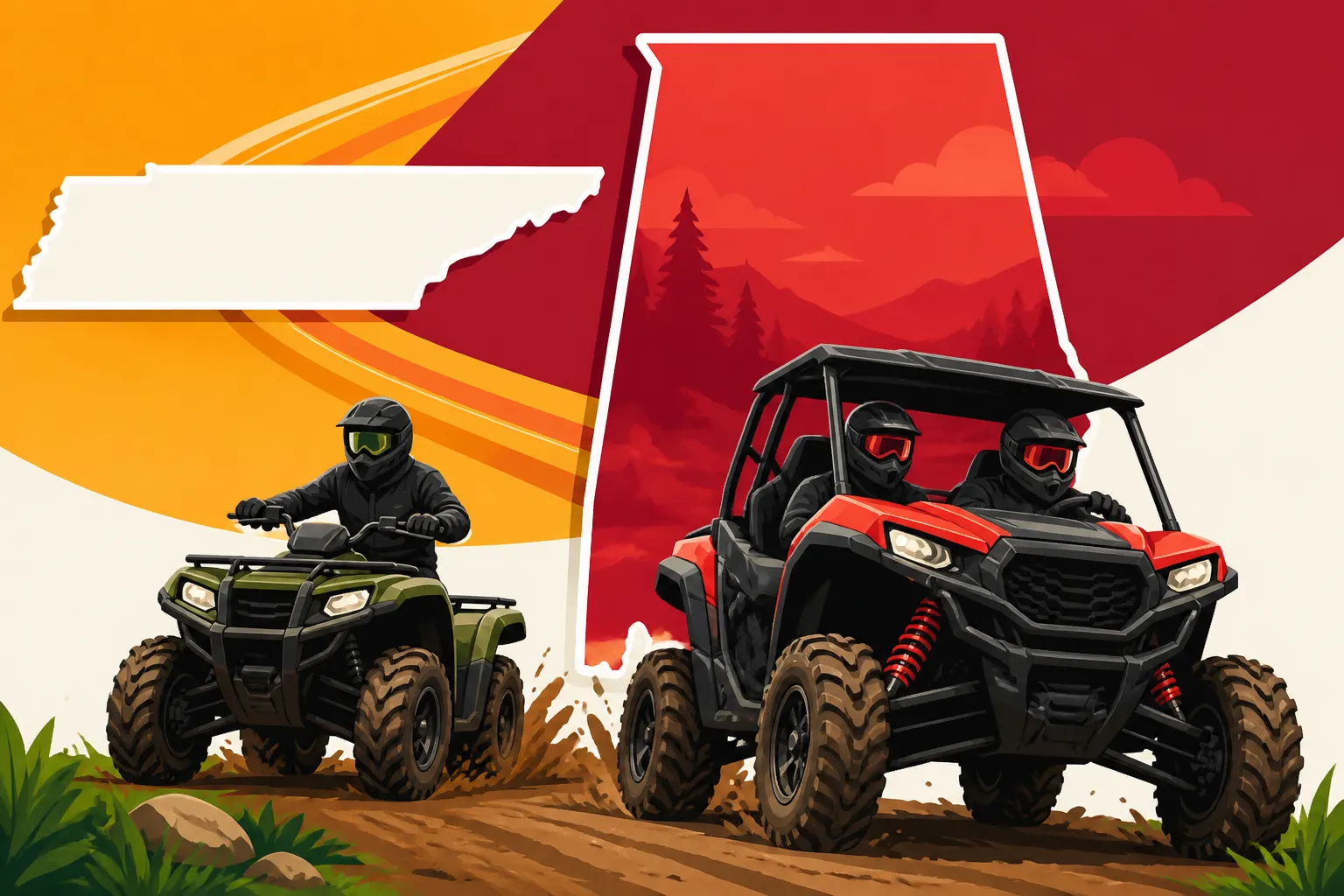
A Tennessee registration decal can help identify your ATV or UTV, but it does not automatically give you permission to ride everywhere in Alabama. Before crossing the state line, check what the riding property requires, whether a permit or Alabama registration tier applies, and which routes are open to your machine. This distinction can save a wasted trip—or an avoidable citation.
Start With the Place You Plan to Ride
Alabama does not have one visitor permit that covers every trail, forest, wildlife management area and private riding park. Access is decided by the land manager, and the requirements can differ even between two places that both allow off-highway vehicles.
That means the first question is not simply, “Is my ATV registered in Tennessee?” It is, “What does this specific Alabama property require from a visiting rider?” Make a list of each place you hope to ride and check its rules individually. A park’s admission or waiver does not necessarily cover a nearby public road, and permission to ride on private property does not authorize access to public land.
For a Tennessee visitor, keep these requirements separate:
- State or home-state records: registration, decal, title or other ownership documents associated with the machine.
- Land-access requirements: a permit, license, daily check-in, fee, waiver or written permission required by the property.
- Machine and rider rules: which vehicles and routes are allowed, and any requirements for helmets, passengers, safety equipment or age supervision.
- Road rules: whether a route is an approved off-highway route or a public road where ordinary ATV or UTV use is restricted.
Alabama’s registration system is described as voluntary, but that does not mean every public riding area accepts every machine without registration or other paperwork. A property can set its own access conditions. Start with What Visiting Riders Need to Ride Legally in Alabama for the broader visitor checklist, then confirm the current rules directly with your destination.
A Tennessee decal should be treated as evidence that your machine has a home-state registration record—not as a universal Alabama riding permit. Whether a particular Alabama agency or property accepts it for a particular purpose is a separate question. If the written rules do not clearly address out-of-state machines, contact the land manager before you travel.
A simple comparison helps keep the different permissions straight:
| Where you plan to ride | What to verify before leaving Tennessee |
|---|---|
| Private riding park | Whether the park is open, which machines it admits, its fee and waiver requirements, and its rules for helmets, passengers and minors |
| Wildlife management area | Whether riding is allowed on the tract, which routes and dates are open, and which licenses or permits apply |
| National forest | Whether your machine is permitted on the route, whether the route is currently open, and whether any site-specific requirements apply |
| Private farm, timberland or hunting lease | That the landowner or authorized manager has given permission, preferably in writing, and any limits on where or when you may ride |
| Public road or roadside connection | Whether that exact road or crossing is legally open to your machine; do not assume a trail permit makes the road legal |
A map, a trail listing or an old social-media post may not reflect a closure or a landowner’s current policy. Confirm access close to your departure date, especially if your plan depends on a seasonal route or a specific tract.
Tennessee Registration, Alabama Registration and Reciprocity
Visitors often use “registration” to mean several different things: a state record for the machine, a decal, proof of ownership, or permission to ride a particular area. Those are not interchangeable. A registration record may help establish who owns a machine, but it does not by itself grant access to a trail or public property.
Alabama has a voluntary ATV and ROV registration system with different use categories. The existence of a voluntary system does not settle whether your Tennessee paperwork meets the conditions for riding at a particular destination. Public-use and private-use categories can matter, and an area’s own access rules can add another layer. For an overview of the state system, see Alabama Registration Is Voluntary and Public Use Versus Private Use Tiers.
The practical point for a Tennessee visitor is to avoid assuming that your home-state decal substitutes for an Alabama registration record, an area permit or a park’s admission requirements. At the same time, do not assume you must register your machine in Alabama simply because you are visiting. Ask the agency or property that controls the place where you intend to ride which rule applies to a nonresident and what documentation it will accept.
If the property’s rules refer to an Alabama “public use” registration tier, ask specifically whether a Tennessee registration or decal is accepted instead. A general answer such as “out-of-state riders are welcome” might mean visitors may enter the property; it may not answer whether the machine needs an additional decal or record. [Alabama Rules for an Out-of-State Decal] explains why the decal question should be checked rather than guessed.
Have the following information ready when you call or send a message:
- Your state of residence.
- The machine’s make, model, model year and vehicle type.
- Its serial number or VIN, if requested.
- Whether it has a Tennessee registration decal or other state-issued record.
- The property, tract or trail system you plan to use.
- The date or season of your visit.
- Whether you will ride with children, passengers or a group.
Ask whether the requirement applies to the rider, the machine or both. For example, a property may require a permit for each person while also restricting the type of machine allowed on its routes. A response about one requirement does not necessarily answer the other.
Carry whatever documentation the property says to bring. That might include your state registration, proof of ownership, a permit or a confirmation of a reservation. Keep a digital copy as a backup, but do not rely on a phone if the property has poor reception or requires a printed document. If your machine has no title or registration record, ask what proof of ownership it will accept before you arrive; a bill of sale may be useful but is not guaranteed to meet every property’s rules.
For questions about Alabama’s registration process itself, contact the agency responsible for that process and describe the machine as an out-of-state visitor’s vehicle. For questions about entry, routes or local permits, contact the land manager. These are different questions and may have different answers.
Permits and Rules on Alabama Public Land
Public land is not one single riding system. Wildlife management areas, national forests and other public properties may have different routes, seasons, permits and vehicle restrictions. A permit that is valid for one area should not be treated as permission to ride another.
Wildlife management areas
Before riding on an Alabama wildlife management area, verify that off-highway riding is allowed on the specific tract and that your planned route is open. Rules can depend on the area, season and purpose of access. Some tracts may limit machine use to designated roads or restrict access during particular activities or periods.
Ask the area manager whether a nonresident rider needs a license, area permit, daily permit or other authorization. Also ask how to obtain it, whether you need to check in or out, and whether a permit must be displayed or carried. Do not assume that a hunting license, a Tennessee registration or a permit for another tract covers your ride. The details are addressed in Alabama WMA Permits for Riders and Alabama WMA Rules Vary by Area.
A wildlife management area map can be useful, but treat it as a starting point. Check the rules printed on the current map or permit and ask about closures, gates and routes that may not be open to ATVs or UTVs. If the instructions are unclear, contact the area office or the responsible biologist before entering. Do not ride around a closed gate or use a road just because it appears on a general map.
National forests
National forest access also depends on the route, not just the boundary line. A road shown on a map may be closed to motor vehicles, may have a seasonal restriction, or may not be suitable or authorized for your machine. Check the current motor-vehicle map and the forest’s rules for the specific route you want to ride.
Ask whether the route is open to your vehicle type and whether any permit or site-specific requirement applies. A general forest recreation pass, if one is relevant to your visit, is not necessarily an off-highway vehicle permit. Likewise, an ATV permit from another public property does not automatically apply in a national forest. Use Alabama National Forest Riding Permits as a starting point, and confirm the current information with the responsible forest office.
Bring a map that works without mobile service. Remote areas can have limited reception, and a navigation app may not show temporary closures or the legal status of a forest road. If a gate is closed or a sign conflicts with an older map, follow the posted restriction and ask the land manager rather than continuing.
Do not treat the road between trails as part of the trail
A permitted off-highway ride does not automatically authorize riding on a public road to reach the next trail segment, gas station or parking area. Alabama’s road-use rules are separate from access rules for trails and private land. A standard ATV or UTV should not be assumed street legal because it has lights, mirrors, a windshield or a Tennessee decal.
Check the exact road, crossing and connection you plan to use. Some local rules or specific vehicle classifications may affect what is allowed, but modifications alone do not necessarily make a machine legal for public-road use. See Can You Drive an ATV on the Road in Alabama? and Alabama Public Land Rules Compared to Private before planning a route that leaves the riding property.
Private Parks, Private Land and Park Paperwork
A private OHV park may be the simplest option for a visitor because its staff can explain the entry process directly. It still has its own rules. A park can require admission payment, a signed waiver, a rider wristband, a safety briefing or proof that the operator meets its age requirements. It can also limit machine width, passenger numbers, speed or operating hours.
Contact the park before setting out, especially if you are bringing a youth rider, a passenger, a large side-by-side or a group. Ask whether your specific machine is permitted, what paperwork you need, how check-in works and whether the park is open on your planned day. Rules can vary by property, and a waiver is an agreement with that park—not a substitute for a public-land permit or permission from a landowner elsewhere.
Check whether every rider must sign a waiver or whether a parent or guardian must sign for a minor. Ask about helmets, passenger seating and supervision rather than relying on a Tennessee rule or an assumption that the same requirements apply across state lines. A park may set stricter conditions than state law. Alabama Private Park Waivers and Rules covers the kinds of requirements to check.
If the park provides rules online, save them or take a screenshot before traveling. If the website is unclear, call. Confirm opening status, admission arrangements and any temporary closures directly with the park. A reservation or payment confirmation may establish that you booked a visit, but it does not necessarily answer whether your machine is allowed or which routes are open.
Private land requires a different kind of permission. A hunting lease, timber road, farm entrance or informal invitation is not necessarily permission to ride every road on the property. Get permission from the owner or authorized manager and clarify the boundaries, dates, routes, gates and any restrictions on passengers or equipment. If a lease or club controls access, ask that organization rather than assuming an individual member can authorize you.
Written permission is especially helpful when you are visiting from out of state. It can identify who granted access and the land or routes covered. It does not override posted closures, another owner’s boundary or a public road restriction. Follow signs, close gates as instructed, and avoid riding across adjoining land to connect two permitted areas.
For any location, make sure you know where the riding permission ends. The legal difference between a private trail, an access road and a public road can be easy to miss on the ground. If a route crosses a public road, ask the property manager how the crossing is handled and check the applicable road rules separately.
A Before-You-Leave Checklist for Tennessee Riders
Use this checklist for each Alabama destination, not just once for the whole trip. If your plans include a private park and public land, treat them as separate visits with separate rules.
- Name the exact destination. Record the park, tract, forest route or private property—not just the county or nearest town.
- Confirm it allows your machine. Give the land manager the machine type and, if requested, its dimensions or model information. Do not assume that an ATV approval also covers a side-by-side.
- Ask about Tennessee paperwork. State whether your machine has a Tennessee decal or registration record. Ask whether the property accepts it and whether Alabama registration or another document is required.
- Identify every rider requirement. Check for individual permits, age limits, supervision, passenger rules, helmets, waivers and check-in procedures.
- Check routes and dates. Confirm the route is open on the day you plan to ride and that your machine is allowed on it. Ask about seasonal closures, weather closures and gates.
- Separate riding access from road use. Identify any road crossing or public-road connection and verify that it is legal for your machine.
- Get private permission in advance. For private land, clarify who has authority to grant access and which routes and dates the permission covers.
- Carry the required records. Bring permits, proof of ownership or registration, park confirmations and written landowner permission when requested.
- Save directions and maps offline. Mobile service may be limited. Use the land manager’s current map or route information rather than relying only on a general navigation app.
- Recheck before departure. Closures and operating conditions can change. A quick confirmation can prevent a long tow to a closed or restricted area.
If two sources give different instructions, ask the entity that controls the property to clarify the current rule. A park employee can answer for that park, a wildlife-area contact for that tract, and a forest office for its roads. Keep a record of the answer and the name or office you contacted, especially if the requirement is unusual or the public information is ambiguous.
When you arrive, follow posted signs even if they differ from an older map or a past visit. Stay on authorized routes, respect gates and closures, and do not assume another rider’s access means your machine or permit is covered. Local rules are part of the trip plan, not an optional detail.
Frequently Asked Questions
Does my Tennessee ATV registration let me ride in Alabama?
Not automatically. It may identify your machine or show its home-state record, but Alabama property access and registration requirements are separate. Ask the land manager whether Tennessee paperwork is accepted for the place you plan to ride.
Do Tennessee visitors need an Alabama ATV registration?
Do not assume either that you must obtain one or that you are exempt. Alabama has a voluntary registration system, while individual public properties may set access conditions. Confirm the requirement for your machine and destination with the responsible agency or property.
Does one Alabama permit cover a park, a WMA and a national forest?
No. Permits and access conditions are tied to the issuing property or program. Check each destination separately, including routes, dates and machine restrictions.
Can I ride my ATV on an Alabama road between trails?
Do not assume you can. Trail access does not itself make a public road legal for ATV or UTV use. Check the rules for the exact road or crossing and review [Alabama Rules for an Out-of-State Decal] only for the separate decal question.
What should I bring on the ride?
Bring the documents and permits the property requires, plus proof of ownership or registration if requested. Carry current route information and any written private-land permission. Save digital copies, but keep an offline map or printed backup if you may lose service.
Disclaimer
This article is for general informational purposes only and does not constitute professional advice. Laws, prices and regulations vary by location and change over time. Consult a qualified professional for guidance on your specific situation.