Alabama WMA Daily Permits
A daily permit can look like a simple check-in, but it does not automatically mean every Alabama Wildlife Management Area is open to ATV or UTV riding. The tract, date, route and activity all matter. Here’s how to figure out whether you need a daily permit, how to get one, and what to verify before you unload your machine.
What an Alabama WMA daily permit does
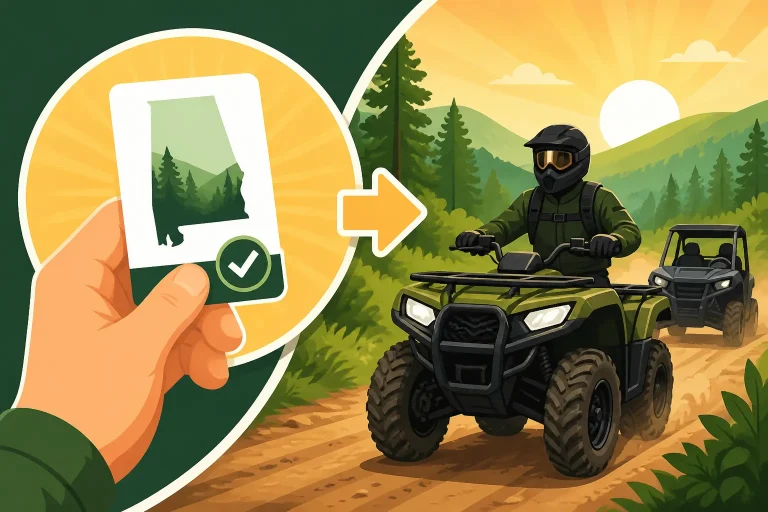
A daily permit is a tract- and date-specific record associated with access to a Wildlife Management Area. Depending on the area and the reason for your visit, you may need one even if you are not hunting. It helps the agency manage use of the tract and lets visitors document their presence under the rules that apply there.
The important limit is that a permit is not blanket permission to ride wherever you want. It does not make a closed road open, authorize off-route travel, or replace a required license or other permit. It also does not override signs, seasonal restrictions, area-specific rules or a land manager’s direction.
Think of the daily permit as one part of a larger access check:
- Is the WMA open to visitors on your planned date?
- Does the area permit motorized recreation, and is ATV or UTV use allowed?
- Are the particular roads or routes you plan to ride open to your machine?
- Do you need a WMA license, an area permit, a daily permit, or more than one?
- Are hunting-season or other temporary rules in effect?
These questions are easy to mix up because a WMA may be open for one kind of use while motorized access is limited or unavailable. A daily permit generally documents your access under the applicable process; it does not determine which activities are allowed.
Daily permit, WMA license and area permit are different
A WMA license, an area permit and a daily permit can serve different purposes. Do not assume that holding one automatically covers the others. The requirements can depend on what you plan to do, the specific tract and your circumstances.
| Item | What it may cover | What to check |
|---|---|---|
| WMA license | A license requirement connected to WMA access or a particular activity | Whether it applies to you and your planned activity |
| Area permit | Authorization or access conditions for a particular area | Which tract it covers, its dates and restrictions |
| Daily permit | A dated record or authorization associated with a visit | Whether it is required for your visit and how the area issues it |
| Hunting license | Hunting privileges, when required | Whether your trip involves hunting and whether other WMA permissions are also required |
| Road or route permission | Use of an open route by an eligible vehicle | Whether the route is open to your machine on that date |
For a fuller explanation of the separate requirements, see How an Area Permit Differs From a Daily Permit and Alabama WMA License Requirements. If you are planning a riding trip, Three Things You Need Before Riding a WMA is a useful companion.
It is safest to identify the exact tract and activity before you buy a license or set out. “I’m riding on a WMA” is not enough information to determine every requirement. A weekend trip might involve a daily permit and a route restriction, while a hunting trip could add separate licensing and season rules.
How to get a daily permit before you ride
The process can vary by area and by the system being used. Start with current information from Alabama’s official wildlife agency channels, then follow the instructions for the specific WMA. Avoid relying solely on an old screenshot, a social-media post or a permit someone obtained for a different tract.
A practical process is:
- Choose the exact WMA and date. Confirm the tract name and the part of the area you intend to visit. Nearby tracts may have different rules.
- Check whether motorized riding is allowed. Look for current information about ATV and UTV access, open routes, dates and any seasonal closures.
- Identify every required credential. Determine whether the trip requires a WMA license, an area permit, a daily permit, a hunting license or another authorization. A daily permit may not replace the others.
- Use the official method specified for that area. That may be a state online or mobile process, or instructions posted at an area kiosk. Follow the current directions rather than assuming every WMA uses the same system.
- Enter the requested information carefully. Check the selected tract, date, permit type and any other details the system requests before submitting.
- Save proof of completion. Keep the confirmation accessible. If a phone is your only copy, save it in a way you can retrieve without a reliable data connection.
- Read the rules tied to the permit. Check for open-season limits, route restrictions, check-in requirements and any other conditions.
- Recheck shortly before leaving. Closures and access rules can change. Confirm the area has not posted a temporary restriction since you planned the trip.
For additional practical detail, see Alabama WMA Daily Permit Steps, Pulling a WMA Permit on Your Phone and Filling Out a Paper Permit at a Kiosk.
If the permit is handled on a phone
A phone-based permit can be convenient, but do not assume you will have cell service at the gate or trailhead. Complete the process before you reach a dead zone, and keep the confirmation available offline if the system permits it. Take a screenshot or save a digital copy, but remember that a screenshot is a backup for your own records, not a substitute for following the official process.
Bring a charged phone and a charging option. A compact power bank is useful if your day includes long rides, navigation or repeated permit checks. If you shop for one through Amazon, compare capacity, charging compatibility and weather protection rather than choosing by size alone. Keep electronics secured against water, mud and vibration.
If the official instructions require you to check in or out, complete those steps exactly as directed. A permit saved on your phone does not necessarily mean the agency has recorded every required check-in action. See Checking In and Out of a Tract for more on why those steps can matter.
If you use a kiosk or paper process
Some areas may provide instructions or a permit process at a kiosk. Do not count on the kiosk being available, stocked or easy to locate when you arrive. Check the current area directions first and, if there is a required online step, complete it before traveling.
If the process involves paper, use a pen and keep the completed permit where you can access it without unpacking the whole machine. A waterproof document pouch can protect it from rain and mud. If you buy a pouch through Amazon, check that it can hold the permit without folding important information out of view.
Whether digital or paper, make sure the permit matches the place and day you are visiting. A permit for a different WMA, a previous date or another person’s trip is not a reliable substitute.
Check that the WMA actually allows ATV or UTV riding
This is the step most likely to prevent a wasted trip. Some WMAs have motorized routes, while others may restrict vehicles, limit access to particular roads, or have rules that change with the season. The fact that an area appears on a map does not tell you that every road is open to every vehicle.
Use the current rules for the individual tract and look for answers to these questions:
- Is ATV or UTV riding allowed at all?
- Is riding limited to designated roads or routes?
- Are routes open only during certain periods?
- Does access differ during hunting seasons?
- Are there vehicle-width, vehicle-type or other restrictions?
- Are there temporary closures because of weather, road conditions, maintenance or management activity?
- Does the permit process require you to identify your activity?
A route that is open to a passenger vehicle may not be open to an ATV. Likewise, permission to use a road is not permission to cut across a field, follow an unmarked trail or enter a gated road. Treat gates and signs as meaningful, and do not ride around a barrier because a route appears passable.
The phrase “open to the public” is not the same as “open to motorized recreation.” A WMA may allow access for hunting, wildlife viewing or walking while limiting the places where a machine can travel. Read the rules for the use you plan to make of the area, not just a general description of the WMA. Alabama WMA Rules Vary by Area and Machines Confined to Open Roads explain why area-specific rules and route boundaries matter.
Permits do not cancel hunting-season restrictions
Hunting activity can change how a tract is used and which routes are available. A road that was accessible on a previous visit may be restricted during a particular season or on a particular date. Hunting activity can also make a busy area less suitable for recreational riding, even where riding is otherwise permitted.
Before you go, check the current area map and notices for the dates you plan to ride. If you are unsure whether a route is open, contact the appropriate area office or agency contact before loading the machines. A permit confirmation alone may not show every temporary notice or route condition.
Give hunters room, keep to permitted roads and avoid disturbing wildlife or hunting activity. If a WMA rule says vehicles must stay on certain roads, follow that rule even when the road is rough or inconvenient. Do not treat a hunting access route as an invitation to explore adjoining ground.
Riding on a WMA is not the same as riding in a private park
A private OHV park sets its own admission, waiver, age, passenger and trail rules. A WMA is public wildlife-management land with its own access conditions, which may be different from a private park’s rules. Do not assume that a permit used for a WMA works at a private park, or that a private park’s posted policies describe WMA requirements.
Nor should you assume that a machine’s registration status settles WMA access. Alabama registration rules and public-land access rules address different issues. If you need help separating those questions, see [Alabama WMA Riding Rules for Quads] and Alabama Public Land Rules Compared to Private.
What to carry and how to handle the ride
Once you have confirmed your permit and route, make the proof easy to show and the trip easy to manage. A little preparation is especially valuable in a remote area where phone coverage, fuel and help may be limited.
Carry or have accessible:
- The daily permit confirmation or completed paper permit, if required
- Any other license or area authorization that applies to your visit
- The current WMA map and rules for the tract
- A phone with the permit saved and enough battery for the day
- A paper backup or offline map if you may lose service
- A first-aid kit, water and basic recovery gear appropriate to your route
- Contact details for the person who knows your plan
A printed map can be a useful backup when a phone battery dies or navigation service drops out. If you choose a waterproof map sleeve or document holder through Amazon, make sure it fits the map you actually use and can be secured so it will not fall off while riding. Keep the official WMA map legible; a general trail map or a route shared by another rider may not show current closures.
Do not rely on a downloaded map as proof that a road is open. Maps can be old, and a line on a map may represent a road without confirming that it is currently open to your vehicle. Use maps to understand the area, then compare them with current rules and notices.
At the WMA, follow the posted instructions for check-in, check-out, parking and permitted routes. Stay on the authorized route and be ready to turn around if you encounter a closure, a gate or a sign that conflicts with your plan. Never assume that a route is open because another rider is using it.
Keep the machine’s sound, speed and behavior appropriate for the setting. Yield to people on foot and other lawful users, and avoid creating dust or damage that could affect roads and wildlife habitat. Wet soil can rut easily; if the route is soft or visibly deteriorating, do not force a pass that makes the damage worse. When access rules are unclear, stop and verify rather than guessing.
Common daily-permit mistakes to avoid
Treating the permit as permission to ride anywhere
A daily permit does not erase route rules. Stay on roads or trails specifically open to your vehicle and activity. Do not use an unmarked track just because it appears to connect two permitted roads.
Getting a permit for the wrong tract or date
WMAs can have similar names, and a small selection error can leave you holding a permit that does not match your visit. Check the tract and date before completing the process. If your plans change, find out whether you need to update, replace or obtain a different permit.
Assuming one permit covers the whole group
Do not assume that one person’s permit automatically covers everyone traveling with them. Check whether each person must complete a permit or whether the system allows one permit to record a group. Follow the current instructions and make sure each rider has the proof they are expected to carry.
Assuming a hunting license is enough
A hunting license may be relevant if you plan to hunt, but it does not automatically prove that every WMA access or riding requirement has been met. Similarly, a daily permit may not replace a hunting license or WMA license. Check each requirement separately. For hunting-related questions, see Alabama Hunting License Requirements and Why You Need Both a Hunting and WMA License.
Assuming a WMA license is a ride permit
A license and a daily permit are not interchangeable just because both relate to WMA access. Confirm which credentials apply to your exact activity and tract. If the official instructions use a particular term, follow that term rather than relying on how another rider describes the process.
Waiting until the gate to figure it out
A weak signal, an unavailable kiosk or a confusing map can turn a simple check-in into a problem. Verify the process before leaving home, complete any required online step in advance and keep the directions handy.
Relying on old information
A post from a prior season may describe a route, permit process or open date that has since changed. Treat older advice as a lead, not as current authorization. Recheck the official area information close to your trip.
Confusing property access with road access
Being allowed to enter a WMA does not necessarily allow you to use every road or ride across every part of it. If a sign, map or rule limits vehicles to particular routes, follow that limit. Permission to access public land is not unrestricted off-road permission.
A quick pre-ride checklist
Before you load the ATV or UTV, confirm each item:
- Exact location: You have the correct WMA and tract.
- Date: The area is open for your planned visit.
- Activity: The rules allow your intended use, including motorized riding.
- Route: The route is open to your vehicle and not blocked by a seasonal or temporary closure.
- Credentials: You know whether you need a daily permit, WMA license, area permit, hunting license or another authorization.
- Permit record: Your completed permit matches the tract and date, and you can retrieve it without depending on cell service.
- Additional instructions: You know whether check-in, check-out or another area-specific step is required.
- Backup: You have the current map and a plan if the route is closed or conditions are unsafe.
When the answer to any item is unclear, verify it with the current official information for that WMA before riding. A permit is useful only when it matches the area, date and activity—and when you follow the restrictions that come with it.
Disclaimer
This article is for general informational purposes only and does not constitute professional advice. Laws, prices and regulations vary by location and change over time. Consult a qualified professional for guidance on your specific situation.