Alabama Hunting Club Lease Riding
A hunting club lease can make a property feel like a private trail network, but permission to hunt does not always mean permission to ride. Members and guests need to know what the landowner actually authorized, whether the property is private land or a public wildlife area, and what rules apply if a route reaches a public road. This guide helps you sort out those distinctions before unloading your ATV or UTV.
Start With What the Lease Actually Allows
A hunting club lease is an agreement between a landowner or land manager and a club. It may give the club permission to hunt, camp, maintain stands, retrieve game, or travel on certain roads. It does not automatically give every member, guest, or visiting rider permission to drive any machine anywhere on the property.
The agreement itself is the best place to start. Look for language about:
- ATV, UTV, or other motorized vehicle access
- Which roads, trails, gates, or areas are open to machines
- Whether riding is allowed outside hunting activities
- Who may ride, including guests and minors
- Seasonal restrictions, quiet hours, or closures
- Whether the landowner must approve new trails or road work
- Rules for crossing neighboring parcels or timber roads
If the written lease is silent about machine access, ask the club officer who handles landowner relations to confirm the policy. A club may have an established practice that is not spelled out in the lease, but a longstanding custom is not a substitute for permission from the person authorized to grant it. The landowner may also have separate rules that apply to timber operations, fire conditions, or other users.
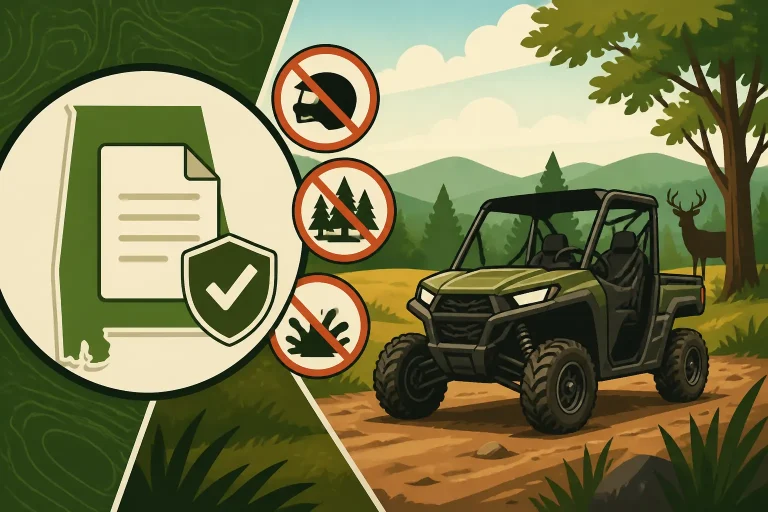
A hunting membership is not necessarily an all-purpose recreation pass. The club may allow a member to ride to a stand during a hunt but prohibit recreational trail riding. It might allow machines on established roads but not through planted areas, food plots, stream crossings, or young timber. Rules can differ from one lease to another, even within the same club.
Confirm the landowner’s authority
A club often leases property from a timber company or another large landowner. In that arrangement, the club has only the rights the lease grants. A club president or member may not have authority to approve a new route, invite outside riders, or waive a restriction set by the landowner.
Ask who can approve:
- A guest’s machine access
- A new trail or shortcut
- Use of a locked gate or service road
- A route across a neighboring parcel
- Riding during a timber harvest or other operation
The answer may be the club’s designated contact, the landowner’s local manager, or another person named in the agreement. When the route crosses more than one ownership boundary, get permission for each section. A club’s access to one tract does not extend to adjoining land just because the roads connect.
For a closer look at access questions on leased timber property, see Alabama Timber Land Access Rules. If you need a simple way to document approval, Alabama Landowner Permission Letters can help you think through what written permission should cover.
Distinguish access from hunting privileges
A club may allow a guest to ride along without granting that person the right to hunt. Hunting access and machine access are separate questions. A hunting license, club membership, or invitation may be relevant to hunting, but none should be treated as automatic permission to operate an ATV or UTV on the lease.
Likewise, being allowed to retrieve a harvested animal does not necessarily authorize general riding. Ask whether the club permits a machine for that specific purpose, which route to use, and whether there are limits on timing or vehicle type. Follow the landowner’s conditions, including any restrictions on driving across fields or using roads that are soft after rain.
Identify Which Rules Apply to the Property
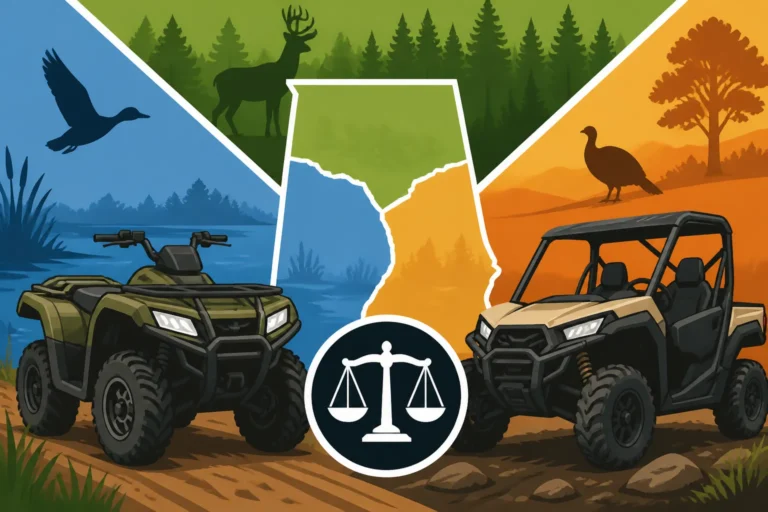
The most important distinction is whether you are on privately leased land, a wildlife management area, or a public road. People sometimes use “lease,” “hunting land,” and “WMA” loosely, but they do not mean the same thing. Each can have a different permission process.
| Where you plan to ride | Permission to confirm | Other rules to check |
|---|---|---|
| Private hunting club lease | Club and landowner authorization, including guest access | Lease conditions, gates, closed areas, and safe routes |
| Wildlife management area | Current access and permit requirements for that specific area | Area map, seasonal closures, open routes, and activity restrictions |
| Public road or highway crossing | Whether the route and crossing are lawful | Road-use rules, local restrictions, and any applicable equipment requirements |
| Private road outside the lease | Permission from the person controlling that road | Posted restrictions, neighboring property boundaries, and operating conditions |
A private lease is not automatically a WMA
A privately leased hunting tract does not become a Wildlife Management Area just because it is used for hunting. Conversely, a club may hunt on, near, or within an area that has separate public-land rules. Do not assume a club’s lease permission replaces a permit required for public land, or that a hunting license is the same thing as an area access permit.
If any part of your planned route lies on a WMA, check the current rules for that exact area and activity. Requirements may depend on the tract, season, route, and purpose of the visit. Some areas limit machines to designated roads or impose seasonal restrictions. The area map and current official rules matter more than a general understanding of what is allowed elsewhere. Start with [Alabama WMA Riding Rules for Quads] and Alabama WMA Area Permits.
A WMA permit also does not grant access to nearby private land. It works the other way around as well: permission from a private club does not authorize riding on a WMA road or trail that has its own restrictions.
Registration and permission solve different problems
Alabama ATV registration is generally voluntary, but registration is not the same as land access permission. A registration record does not give you permission to enter a leased tract, and a club invitation does not make a machine legal to ride on every public road. For the registration distinction, see Alabama Registration Is Voluntary.
If you are visiting from another state, do not assume your home-state registration or decal functions as an Alabama riding permit. Nor should you assume that an Alabama registration document provides access to private or public land. Ask the landowner or club about access, then check the rules for any public land or road you plan to use. What Visiting Riders Need to Ride Legally in Alabama is useful for separating visitor questions from landowner permission.
Roads inside a lease still need attention
A route can look like an ordinary dirt road and still be private, restricted, or part of a neighboring property. Confirm which roads the club is allowed to use and whether machines may travel on them. A logging road may be active, closed, or unsuitable for recreational traffic. Do not move a gate, cut a lock, or ride around a barrier because the road appears to lead toward the lease.
Routes that connect to a county road or highway deserve extra care. Permission to ride on the tract does not by itself authorize travel on a public roadway. Check the rules for the specific road and any crossing before you make it part of your route. See Alabama Rules for Crossing a Highway and Are ATVs Street Legal in Alabama? for the separate road-use question.
Handle Guests and Out-of-State Riders Clearly
A guest should not have to guess what the club has allowed. Before inviting another rider, confirm that the club permits guests on machines and that the landowner’s agreement allows it. Some clubs allow a guest to ride only with a member present; others may restrict the number of visitors, require advance notice, or prohibit guest riding altogether.
Give each guest practical information before the ride:
- The property entrance and the gate procedure
- Where riding is permitted and where it is not
- Which roads are shared with trucks or other users
- Who to contact if a gate is locked or a route is blocked
- Whether there are restrictions on passengers, dogs, or riding after dark
- What to do if the group becomes separated or someone is injured
When a guest is arriving from out of state, explain that state reciprocity is not a substitute for the club’s permission. A registration, permit, or course credential issued elsewhere may not answer whether a particular Alabama property allows that rider or machine. There is no single “reciprocity pass” that grants access to all Alabama hunting leases.
The practical questions are narrower: Is the rider allowed on this lease? Is the machine allowed on this route? Does any part of the ride enter a WMA, another private tract, or a public road? Are there local or area-specific rules that apply? Answer those questions separately rather than relying on a state decal or a member’s assumption.
Put the permission in a form people can understand
For an informal ride, a clear message from the person authorized to approve access may be enough for the club’s own process. For recurring access, a group ride, or a route that crosses several parcels, written confirmation is easier to share and remember. It can identify the dates, riders, machines, authorized roads, and any conditions.
Keep the wording factual. Permission to ride an established road should not be represented as permission to build a trail, enter a closed area, or cross a neighboring tract. If the club uses a map, mark the authorized route and identify prohibited areas. A digital map is convenient, but save a copy that works without cell service. A printed copy can be useful when riders’ phones are dead or there is no signal; if you need basic field supplies, Amazon is one option for finding map sleeves or waterproof notebooks.
Do not circulate a landowner’s contact information or a lease document more widely than necessary. Share the access instructions and emergency contact details with the riders who need them, and follow the club’s privacy practices.
Verify current rules for public areas
If the trip includes a WMA or other public land, ask about the requirements that apply to the particular activity. A hunting license, WMA access license, area permit, or daily permit may be relevant depending on the place and purpose. Avoid treating one credential as a substitute for all the others. [Alabama WMA License Requirements] explains why the type of access matters, while What an Area Permit Covers can help distinguish an area-specific permission from general access.
If the group cannot determine whether a route is on private land or public land, pause and verify it before riding. A map line or old trail does not establish current access rights. The club contact, landowner, or relevant public-land office is a better source than another rider’s recollection.
Plan a Ride That Respects the Lease
A good club ride is predictable for the people who own, manage, hunt, and work on the property. A little planning can prevent a route conflict from turning into a trespass problem or a damaged road.
Agree on the route and riding conditions
Choose a route that stays on roads or trails the club has permission to use. Avoid making new shortcuts across fields, creek banks, food plots, young timber, or planted areas. A route that is passable in dry weather may cause serious damage when the ground is wet. Red clay can rut quickly, and a UTV’s extra weight can make damage worse even when the driver is moving slowly.
Before setting out, ask whether any roads are closed for:
- Timber hauling or road work
- Hunting activity or a scheduled club event
- Wet conditions or erosion concerns
- Fire danger or other temporary restrictions
- Landowner maintenance or access by another user
Follow gates and barriers as they are found. If a gate is open, that does not necessarily mean every visitor has permission to ride through it. If a gate is locked, do not assume the lock is accidental or that a member’s key is authorization for a guest. Ask the club contact what to do.
For a route that follows a timber road, review Alabama Rules for Riding a Timber Road. The lease may have stricter conditions than the general rules for riding on a road, and the landowner’s current directions should control your route on that property.
Keep noise, speed, and timing reasonable
A hunting lease is a working landscape, not a dedicated off-road park. Riders may share it with hunters, land managers, timber crews, neighbors, and people checking property. Keep speeds low around buildings, gates, parked vehicles, people, and blind corners. Avoid revving or repeated passes near stands and camps, especially during hunting activity.
Ask whether the club has quiet hours or a no-riding period. A landowner may also limit riding during particular seasons or operations. Those rules can be stricter than general state requirements, and the club should communicate them before the ride.
If the machine is loud, consider whether it is appropriate for the lease at all. A noisy group can disrupt hunting and create conflict with neighbors even when riders stay on an authorized road. Do not assume that the absence of a posted sound limit means there is no noise restriction in the lease or local rules.
Match the machine and gear to the route
Choose a route that suits the machine, the rider, and the ground conditions. A narrow trail may not accommodate a wide side-by-side. A steep or muddy section may be unsafe for an inexperienced operator or a passenger. The group should agree on a turnaround point rather than press into a route that becomes difficult.
Before leaving, check:
- Tires, brakes, steering, lights, and fuel
- That each rider knows the route and meeting point
- Whether the machine has any load or passenger limits
- The weather and likely ground conditions
- A way to communicate if cell coverage is poor
- Basic first aid and recovery equipment appropriate to the terrain
Amazon can be a convenient source for comparing items such as a first-aid kit or a waterproof map case, but the important part is choosing equipment that is suitable for the trip and knowing how to use it. Do not treat accessories as a substitute for permission, training, or a recovery plan.
Wear protective gear even when the lease does not impose a specific gear rule. A helmet, eye protection, gloves, boots, and clothing suited to the terrain can reduce common riding risks. For a group of mixed experience, set a pace that lets the least experienced rider keep up safely, and do not pressure anyone to attempt an obstacle.
What to Do When Permission or Boundaries Are Unclear
If you discover that a road may leave the lease, stop before continuing. Do not ride farther just to see where it goes. Use the club map, contact the designated person, and confirm the boundary and authorized route. GPS maps can help with navigation but do not prove ownership or access rights.
If a landowner, timber worker, or neighboring property owner tells you to leave or identifies a route as closed, comply and contact the club afterward. Do not argue roadside or assume that a club member’s prior permission overrides a current closure. The club can resolve the question with the landowner before another ride.
For a gate, sign, or boundary marking that seems inconsistent with the club’s instructions, take a note of the location and ask the club contact to clarify it. Do not remove signs or markings. A posted restriction may apply to a larger area than the club’s usual route, and the club may need to confirm its rights before allowing access.
If someone is injured or a machine breaks down, prioritize safety and contact emergency services when appropriate. Share the property’s entrance location and the nearest identifiable road or landmark. If the machine can be recovered without creating further damage or risk, follow the landowner’s rules; otherwise, ask the club contact for help. Do not leave a machine blocking a gate, timber road, or emergency access route.
A useful pre-ride checklist is:
- Confirm that the lease allows machine riding, not just hunting access.
- Get permission for each guest and machine.
- Identify the authorized roads and property boundaries.
- Check whether any part of the route enters a WMA or other public land.
- Confirm separate rules for public-road crossings.
- Review temporary closures, weather, and landowner notices.
- Give every rider the route, gate instructions, and emergency contact.
- Turn back if access, boundaries, or conditions are uncertain.
The simplest rule is also the most dependable: ride only where the person with authority has clearly allowed you to ride. A club lease, a guest invitation, an out-of-state decal, and a public-land permit each address different parts of the problem. Confirming them separately keeps the ride within the club’s rights and avoids putting the landowner relationship at risk.
Disclaimer
This article is for general informational purposes only and does not constitute professional advice. Laws, prices and regulations vary by location and change over time. Consult a qualified professional for guidance on your specific situation.