Winches for Steep Clay Climbs
Steep Alabama clay climbs can turn from a fun trail challenge into a stuck machine in seconds, especially after rain or when the surface is polished by repeated traffic. A winch can help you recover a quad or side-by-side, but only if it is suited to the machine, anchored correctly, and used with a safe plan. Here’s how to prepare and make better decisions on the trail.
Why Alabama clay climbs are hard to recover from
Clay changes grip as conditions change
Red clay can feel firm and predictable when it is dry, then become slick and adhesive after rain. A machine may lose traction on the climb, slide sideways, or settle into ruts. The surface can also cling to tires and pack into tread, reducing the grip you expected to have.
A steep trail adds a second problem: gravity keeps pulling the machine downhill while the tires struggle to move it uphill. Spinning the tires often makes the situation worse by digging them into the slope. If the machine starts sliding, continuing to apply throttle can deepen the ruts, damage the trail, and make recovery harder.
Conditions vary across Alabama. A rocky section near Talladega may behave very differently from a clay-heavy climb at a private riding area, and a shaded Bankhead trail can remain wet after a more exposed section has dried. Before committing to a climb, consider recent rain, shade, rut depth, traffic, and whether there is room to turn around safely.
For a broader sense of what terrain may demand from your machine and riding skills, review Alabama Trail Difficulty Ratings. If the weather has been wet, Alabama Trail Riding After Heavy Rain and Alabama Trail Closures After Rain can help you think through whether the trip or a particular route is worth attempting.
A winch is one part of recovery, not a reason to push on
A winch can provide controlled pulling power when the tires cannot climb, but it does not make every slope safe. It cannot correct a poor anchor, an unstable machine, or a cable routed across a hazard. Nor should it be treated as permission to attempt an obstacle that exceeds the vehicle, rider, or trail’s limits.
Before driving onto a steep section, look for a way back. If the climb is already slick, deeply rutted, or blocked by another vehicle, stopping at a safe place may be the better choice. A recovery is easier when you plan it before the machine is stuck, rather than trying to invent a route while it is sliding.
A useful rule of thumb is to stop early when traction starts disappearing. Ease off the throttle, avoid sudden steering, and assess where the machine could move if it slips. If you are riding with others, ask everyone to stay clear of the expected path of the vehicle and winch line. A passenger should get off only if there is a safe place to do so and doing so will not destabilize the machine.
Choosing and preparing a winch for your machine
Match the winch to the vehicle and the recovery task
Choose a winch based on the machine manufacturer’s guidance and the winch maker’s specifications. Consider the vehicle’s weight, accessories, cargo, passengers, and the kind of terrain where you ride. A loaded side-by-side on a steep slope presents a different recovery challenge from a lightly equipped youth quad on level ground.
Pay attention to more than the winch’s headline capacity. Check that the mounting system is designed for your machine, the electrical system is compatible, and the line and fairlead are suitable for the setup. A winch that is poorly mounted or connected may fail when you need it most. If installation involves electrical or structural work you are not comfortable doing, ask a qualified shop to handle it.
Inspect the whole recovery setup before a ride. Look for damage, loose fasteners, corrosion, frayed synthetic rope, kinks or broken strands in wire rope, and worn hooks or shackles. Check the remote control, wiring, and winch operation according to the manufacturer’s instructions. A quick test in a safe, level place is much better than discovering a problem halfway up a muddy hill.
Carry the recovery gear that makes the winch usable
The winch alone is rarely enough. A basic kit should be selected for your machine and the recovery points you have. Common items include sturdy gloves, a tree-saver strap, a compatible shackle or connector, and a line damper. Some riders also carry an extension strap or a pulley block when their equipment and recovery plan call for one.
| Item | What it helps with | Check before riding |
|---|---|---|
| Winch and mounting system | Pulls the machine toward a suitable anchor | Confirm the mount is secure and compatible |
| Tree-saver strap | Wraps around an appropriate tree without using the winch line directly against bark | Inspect stitching and choose an anchor with suitable strength |
| Compatible shackle or connector | Joins recovery components as designed | Check the rated working limits and condition |
| Line damper | Helps reduce the risk from a moving or failed line | Make sure it is in good condition and placed as directed |
| Gloves | Protects hands while handling line and gear | Keep them dry enough to grip and free of holes |
| Extension strap or pulley block | Can help reach an anchor or change the pull direction when appropriate | Confirm compatibility and understand the setup |
Use only manufacturer-approved recovery points. A tow ball, rack, bumper, suspension arm, or random frame opening may not be designed for winching forces. If you are unsure whether a point is rated for recovery, do not assume it is safe. Check the vehicle and accessory instructions or ask a qualified mechanic.
Keep the recovery kit accessible, not buried under camping gear or tools. Before a trip, make sure each item fits the others and that everyone in your group knows where it is. For terrain preparation, Choosing Tires for Alabama Red Clay and Treading Lightly on Erodible Alabama Clay are useful companions to a recovery plan.
How to use a winch on a steep clay climb
Stop, assess, and choose an anchor
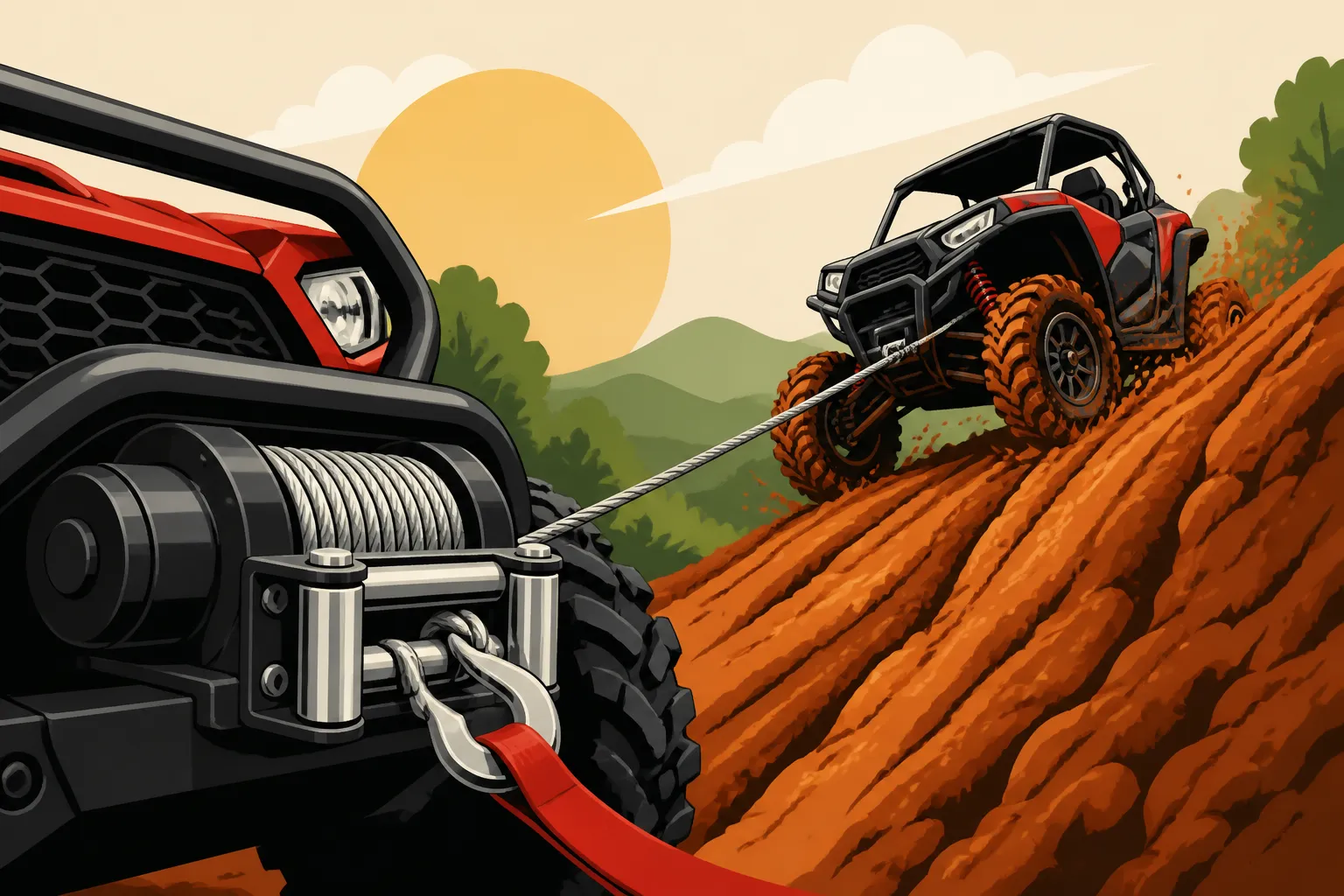
If the machine loses traction, stop spinning the tires. Set the brake as appropriate for the vehicle, keep the machine stable, and look around before touching the line. Identify the direction the machine needs to move, where it might slide, and whether the chosen anchor is positioned to pull it without dragging it into a tree, rut, drop-off, or another vehicle.
A healthy, suitably sized tree may be an option if the trail and land rules permit using it. Wrap a tree-saver strap around the trunk rather than putting the winch line directly against the bark. Do not use a dead, leaning, damaged, or obviously undersized tree. If there is no trustworthy anchor, stop and consider a different recovery method or ask for assistance rather than improvising.
Plan the cable path carefully. Avoid sharp edges and any route that could pinch the line. Keep the winch line as straight as practical and use equipment only in the configurations its manufacturer allows. If a pulley block is part of the plan, understand how it changes the direction of the pull and confirm that every component is suitable for the loads involved.
Keep people out of the danger zone
Agree on who will operate the winch and who will watch the machine. Everyone else should move well away from the line, anchor, and vehicle’s likely path. No one should stand over, step across, or lean over a tensioned line. Keep hands clear of the fairlead and moving parts, and use gloves when handling the line.
Place a line damper as directed by its manufacturer. A damper is not a guarantee against injury, so distance and positioning still matter. Keep the operator in a safe location where they can see the machine and stop the pull promptly. If the remote control allows the operator to stand clear, use it from a position outside the line’s path.
Pull gradually. Use short, controlled winch movements while watching the anchor, line, mounting point, and vehicle. Stop if anything shifts, snags, bends, or starts to fail. Avoid abrupt throttle or steering inputs while the winch is pulling, and do not keep winching if the machine begins to tip or slide in an unexpected direction. If the setup feels unstable, release tension only in the manner described by the manufacturer and reassess from a safe position.
Recover only as far as needed
On a climb, the safest recovery may be to move the machine back to level ground or a stable section rather than trying to winch all the way to the top. Once the machine is secure, reassess traction and the trail. If the surface remains slick or rutted, turn around if possible, wait for conditions to improve, or choose another route.
Do not use another machine as an anchor unless the equipment, attachment points, and recovery plan are specifically suitable for that purpose. A second vehicle can be pulled, rolled, or dragged if it is not securely positioned. Avoid connecting to a person, loose object, or unverified part of another vehicle.
After recovery, inspect the winch, line, connectors, anchor area, and vehicle mounting points. Look for fresh damage, unusual movement, overheated components, or loose hardware. Clean mud from equipment according to its manufacturer’s care instructions, and let wet gear dry before storing it. If anything is damaged or its condition is uncertain, repair or replace it before relying on it again.
Plan the ride to avoid a difficult recovery
Check the route and conditions before you arrive
A map can help you understand where a route goes, but it cannot guarantee that a climb is open, passable, or suitable for your vehicle on the day you ride. Check the riding area’s current rules and trail information, and ask park staff or land managers about recent rain, closures, or known trouble spots when that information is available.
Apps such as onX Offroad can be part of your planning routine. Before leaving home, review the route and save the map information you may need for areas with weak or absent cell service. Check that the map covers the location you plan to ride, and do not treat a mapped line as proof that a route is open or appropriate. onX Offroad is a planning aid; posted signs, land-manager instructions, and on-the-ground conditions still matter.
It is also worth planning where your group can safely regroup and turn around. A narrow ridge or a steep, muddy climb may not offer space to stop once you are committed. If you are hauling to a new area, Alabama Trail Conditions Before You Tow can help you think through the checks to make before loading up. For places that welcome side-by-sides, confirm the vehicle rules with the riding area and consult Alabama Trails That Allow Side-by-Sides.
Set a group plan before anyone gets stuck
Before the ride, agree on basic signals and roles. Decide who will lead, who will stay behind, and how riders should respond if a machine stops on a slope. Keep communication simple: one person gives instructions, and the winch operator stops immediately if another rider signals a problem.
Carry a charged phone, but do not assume it will have service on every trail. Tell someone outside the group where you are riding and when you expect to return. Save relevant route information ahead of time; onX Offroad can be useful for organizing a planned route and marking a point you may want to revisit, provided you have checked the app’s offline options before losing signal.
Respect trail closures and avoid creating new routes around mud. Detouring off a marked trail can damage fragile ground, increase erosion, and put riders onto land where access may not be allowed. If a climb is too slick to ride without tearing it up, waiting or choosing another trail is often the more responsible call. For additional preparation, Alabama Trail Etiquette Locals Expect offers useful context, and First Aid on a Long Stony Lonesome Loop can help you plan for problems beyond a stuck machine.
Disclaimer
This article is for general informational purposes only and does not constitute professional advice. Laws, prices and regulations vary by location and change over time. Consult a qualified professional for guidance on your specific situation.