Which Parent Has to Sign for a Minor
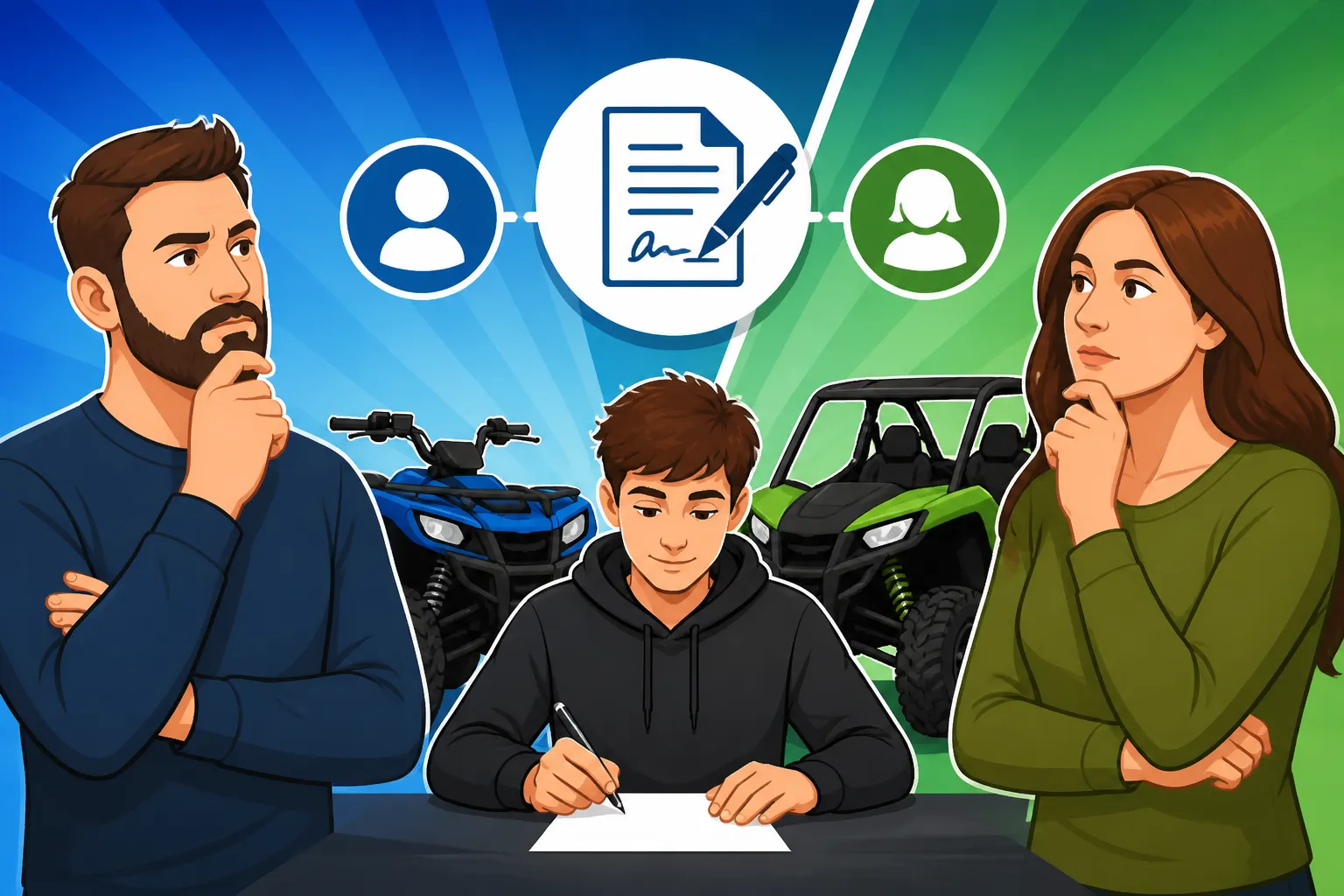
A minor riding at an Alabama off-road park may need more than an adult beside them: the park may require a parent or legal guardian to sign its waiver. Who can sign depends on the park’s policy and the adult’s legal authority. Confirm the requirement before traveling, especially if a parent cannot attend.
Start with the park’s waiver policy
There is no single signature procedure that every Alabama riding park must use for minors. A private park sets its own admission and waiver requirements, so one park may require a parent or legal guardian to sign in person while another may offer a process for completing paperwork ahead of time. The park may also set separate rules for a minor riding alone, riding with an adult, or being a passenger.
The waiver is separate from any state or land-access permit. Paying admission or obtaining a permit does not automatically satisfy the park’s requirement for a parent’s signature. Likewise, signing a waiver does not mean the minor meets the park’s age, supervision, or equipment rules.
Before you leave, ask the park directly:
- Does a parent or legal guardian have to sign, or can another adult sign?
- Must the signer be physically present?
- Can the waiver be completed online or submitted in advance?
- Does the minor also have to sign?
- What identification or proof of authority does the park require?
- Are there different rules for riders and passengers?
Do not assume that a general online waiver covers every visit, every child, or every machine. Parks may require a current form, a separate form for each minor, or a new signature at check-in. The park’s own process is the best guide; Signing the Waiver Every Riding Park Requires covers why this paperwork is distinct from other riding requirements.
| Adult who may be available | Is that adult automatically allowed to sign? | What to confirm with the park |
|---|---|---|
| Parent | Not necessarily; the park may require in-person signing or a particular form | Whether either parent can sign and whether both must attend |
| Legal guardian | Not automatically; the park may ask for proof of authority | Which documents it accepts |
| Stepparent | No, not solely because of the family relationship | Whether written authorization or guardianship documents are required |
| Grandparent or other relative | No, not solely because the child is in their care for the day | Whether the park accepts an authorized adult and what form is needed |
| Coach, group leader, or family friend | No, unless the park accepts their authorization | Whether a parent must sign beforehand and whether supervision rules still apply |
These are practical distinctions, not a guarantee that a particular park will accept a given signer. If the park says only a parent or legal guardian may sign, plan around that rule rather than relying on another adult’s permission.
Which parent can sign when parents are separated?
If both parents are available, ask the park whether one parent’s signature is enough. Some forms may provide space for one signer; others may request signatures from both parents or impose additional conditions. A form’s layout alone does not settle the park’s policy, so check before arriving.
When parents are separated or divorced, the child’s custody documents may matter. Legal authority can depend on the applicable order and the circumstances, and the park may have its own documentation policy. Do not assume that the parent who brought the child, pays for the trip, or has the child that day is automatically the only person authorized to sign. Nor should a park’s willingness to accept a signature be treated as a ruling about custody rights.
If one parent has sole legal authority or a court order limits who may make particular decisions, review the order and ask the park what it needs to see. If the order is unclear, get advice from a qualified professional rather than guessing. A park may choose not to admit the minor until its requirements are met.
A parent who cannot attend should contact the park well in advance. Ask whether the park accepts a signed form sent ahead, an electronic signature, or a written authorization naming the adult who will accompany the child. These options are park-specific. Do not count on a text message, phone call, or a photocopy of an unsigned form unless the park confirms that it accepts it.
The same care applies to a stepparent, grandparent, foster caregiver, or other adult who routinely looks after the child. Being responsible for transportation or supervision does not, by itself, establish that the adult can sign a liability waiver on the parent’s behalf. If the adult has formal guardianship or another legal authorization, ask what documentation the park requires. The park may still require its own form or the parent’s signature.
For more on age and adult oversight at a private riding facility, see Alabama Supervision at a Private Park and Alabama Private Park Minimum Ages. A child meeting the minimum age does not necessarily mean the accompanying adult can sign, and a valid signature does not override an age or supervision rule.
What the signature does—and does not—mean
A waiver usually records that the adult has reviewed the park’s conditions and acknowledges risks associated with riding. Depending on its wording and the circumstances, it may also include terms about the minor’s participation, the adult’s responsibilities, or release of certain claims. Read the actual form; do not rely on a verbal summary or assume all parks use the same language.
Signing is not the same as certifying that a minor is ready to ride. It does not ensure the child can safely control a particular machine, that the machine is appropriate for the child, or that the child can ride in every area of the park. The park may have separate rules for helmets, passengers, machine size, or adult supervision. Parents should check those rules independently, including Alabama Park Rules for Minors and [Alabama Rules for Young Riders].
The minor may also be asked to sign or initial the waiver. That signature may acknowledge that the minor received instructions or understands the rules. It does not replace the parent’s or legal guardian’s signature when the park requires one. If the child is too young to understand the form, ask staff how the park handles that situation rather than signing for the child without direction.
Keep a copy or a clear photo of completed paperwork if the park permits it, and keep the park’s confirmation with your trip details. Still, bring any originals or identification the park specifically requests. A completed waiver from a previous visit may not be valid for a new visit, a different child, or a changed policy.
If a form is confusing or appears to ask an adult to certify something they cannot verify, pause and ask the park for clarification. A parent can ask what a clause means in practical terms, but the park may not be able to provide legal advice. For concerns about a waiver’s legal effect, consult a qualified professional.
Keep waivers, permits, and riding rules separate
A private park’s waiver is not the same thing as a public-land permit or a state registration record. They answer different questions: the waiver concerns the park’s admission process and its stated conditions; a permit relates to access under the rules for a particular public area; and registration or ownership documents serve other purposes. Carrying one does not automatically satisfy the others.
This distinction matters when a ride includes more than one location. A child may meet a private park’s waiver requirements but still need to follow the rules that apply to a wildlife management area, forest route, or other public riding area. Requirements can vary by location and activity. Check the relevant land manager’s current rules before the trip, rather than assuming the private park’s paperwork applies elsewhere. Alabama WMA Rules Vary by Area explains why public-land requirements need their own check.
For a public wildlife management area, a parent should verify any permit, license, or check-in requirements that apply to the minor and the specific tract. Do not assume an adult’s permit covers a child, or that a child’s waiver at a riding park counts as permission to use public land. See Alabama WMA Permit Requirements for related permit information, and confirm details with the appropriate official source for the area.
A simple pre-trip process can prevent a wasted drive:
- Choose the park or public riding area and identify whether it is private or public land.
- Contact the park or land manager and ask which rules apply to minors.
- Confirm exactly who must sign the waiver and whether they need to be present.
- Ask about acceptable advance or electronic paperwork if a parent cannot attend.
- Check age, passenger, supervision, helmet, and machine requirements separately.
- Verify any permits or other access documents required for the specific location.
- Bring the requested paperwork and identification, and allow time to resolve questions at check-in.
For a private park, the operator’s rules control the admission process. For public land, the applicable agency or land manager’s rules control access. Neither route should be treated as a substitute for the other. If you are planning a visit with a group, make sure every minor’s paperwork is complete; one adult’s signature should not be presumed to cover several children unless the park explicitly says so. Alabama Private Park Waiver Forms and Which Permits to Carry on an Alabama WMA can help you keep these separate requirements straight.
Disclaimer
This article is for general informational purposes only and does not constitute professional advice. Laws, prices and regulations vary by location and change over time. Consult a qualified professional for guidance on your specific situation.