Where a Private Park Runs a Youth Rider Course
Finding a youth rider course at an Alabama private park can take more than checking a park’s trail page. Some parks may host instruction or youth events, while others offer riding access but no formal course. Here’s how to find out what a park actually provides, what to ask before booking, and how to tell a skills lesson from a waiver or orientation.
What “youth rider course” can mean at a private park
A private off-highway vehicle park may run a course itself, host an outside instructor, or simply provide trails where families ride together. Those are different offerings. A park’s youth event might include organized instruction, but the word “course” can also be used loosely for a guided ride, a skills area, or a basic safety briefing.
In Alabama, an ATV safety course is not generally a state-mandated prerequisite for riding. A private park can still set its own conditions for minors, including age limits, supervision rules, required gear, and whether a child may ride a particular type of machine. A course offered by a park does not automatically replace those park rules or create permission to ride somewhere else.
It helps to separate four things that are often confused:
| Offering | What it usually provides | What it does not automatically provide |
|---|---|---|
| Youth rider course | Planned instruction and supervised practice | A permit, a legal exemption, or permission to ride every trail |
| Park orientation | Information about that park’s rules, layout, and hazards | A full riding-skills course |
| Guided group ride | A route led by a guide or experienced rider | Individual instruction or a recognized course completion record |
| Skills area | Space to practice basic maneuvers | An instructor, a structured lesson, or supervision |
A real course should have a clear description of what students will do, who will teach them, how much practical riding is included, and what safety equipment they need. If a listing only says “family ride” or “youth day,” ask whether it includes instruction rather than assuming it does.
The course may also be intended for a particular age range, experience level, or machine type. A session designed around small youth quads may not suit a child who rides a side-by-side, and an introductory lesson may not help a young rider who already has substantial trail experience. Ask how the instructor groups students and whether the course is appropriate for your child’s machine and ability.
For a broader look at course formats and other ways to build riding skills, see Alabama Safety Course Options and What an ATV Rider Course Teaches. If you are checking whether a class is required by law rather than by a park, Alabama Has No Mandatory ATV Safety Course explains that distinction.
How to find a park that offers instruction
There is no single statewide directory that reliably identifies every Alabama private park offering youth instruction. Course dates can be occasional, seasonal, or arranged through an outside instructor, so a park’s main trail page may not tell the whole story. Treat an old social media post or event listing as a lead, not confirmation that a course is currently available.
Start with parks that advertise family riding, youth areas, training days, or organized events. Search the park’s official website and its current announcements, then contact the office directly. If a park does not offer a course, staff may know whether an instructor or local riding organization has scheduled a session there. A recommendation is useful, but confirm the date, instructor, and requirements with the organizer.
Use a direct question rather than asking only, “Do you have a youth course?” For example: “Does this event include instructor-led riding instruction for children, or is it a group ride?” That wording helps distinguish a structured lesson from an event where families simply ride together.
When calling or messaging a park, ask:
- Is the course actually scheduled? Confirm the date and whether enrollment is open. A past event announcement does not confirm a new session.
- Who runs it? Ask whether park staff, an independent instructor, or another organization provides the instruction.
- What does the lesson cover? Find out whether it includes hands-on practice, basic controls, braking, turning, stopping, and trail awareness, or only a short safety talk.
- Who is eligible? Check age and experience expectations, as well as whether a parent or guardian must remain on site.
- Which machines can participate? Ask about youth quads, adult-sized ATVs, and side-by-sides separately. Confirm that the child’s machine is allowed in the practice area.
- What equipment is required? Ask about helmets, eye protection, footwear, gloves, and any additional gear the instructor or park requires.
- What paperwork is needed? Confirm registration, waivers, proof of age if requested, and whether a parent must sign in person.
- What happens if weather changes? Ask how cancellations, rescheduling, and refunds are handled, and where updates will be posted.
It is also worth checking whether the course is open to visitors or only to members, campers, or people who have already paid for park admission. Course registration and park access may be handled separately. Ask whether trail access is included, whether the lesson takes place before regular riding, and whether the family needs to reserve a spot in advance.
The safest approach is to rely on the park or course organizer’s current information. If an event is promoted through a third-party page, verify it with the park before traveling. This matters especially when a course has a limited enrollment, an age cutoff, or special machine requirements.
Confirm the rules for minors before you book
A course does not override a private park’s own rules. Parks set their operating conditions, and those can differ from one property to another. A child may be eligible for instruction but still be too young for certain trails, machines, or passenger arrangements under that park’s policy.
Read the rules for minors before paying or hauling a machine to the park. If the wording is unclear, ask staff to explain it for your specific situation: the child’s age, the machine, whether an adult will ride along, and whether the child plans to use trails after the class. Alabama Private Park Minimum Ages, Alabama Park Rules for Minors, and Supervision at a Private Park cover the kinds of park-level requirements families should check.
Do not assume that a parent’s presence means a child can ride any machine or enter every trail. A park may limit youth riders by age, machine size, experience, or trail difficulty. It may also require direct adult supervision, define how close the adult must stay, or restrict children from certain areas. Ask how the rule works during the lesson and after it ends.
Confirm the helmet and clothing policy as well. A park may require a helmet even where state law does not require one for a particular off-road situation. The instructor may have additional gear standards for the class, and an event organizer may refuse participation if a child arrives without the required equipment. Check Alabama Private Park Helmet Rules before you pack, and then verify the course’s own list because its requirements may be stricter.
A parent or guardian may need to sign a waiver for a minor. A waiver is not proof that a child has completed a course, and signing one does not guarantee that every activity is appropriate for that child. Read it before the event and ask what activities it covers. Alabama Private Park Waiver Forms explains why this paperwork deserves attention before arrival rather than at the gate.
The machine matters as much as the child’s age. Match the child to an ATV or UTV they can control, not simply one they are tall enough to sit on. They should be able to reach and operate the controls, understand how the machine responds, and stop it reliably. If the lesson organizer has machine-specific limits, follow those rather than treating them as optional.
Before the course, check the machine’s condition. Brakes, throttle, tires, steering, and the engine cutoff should work correctly. Make sure protective equipment fits and is in good condition. A course is a chance to practice safe habits, not a substitute for basic maintenance or sound judgment about whether a young rider is ready.
What to expect from a useful youth course
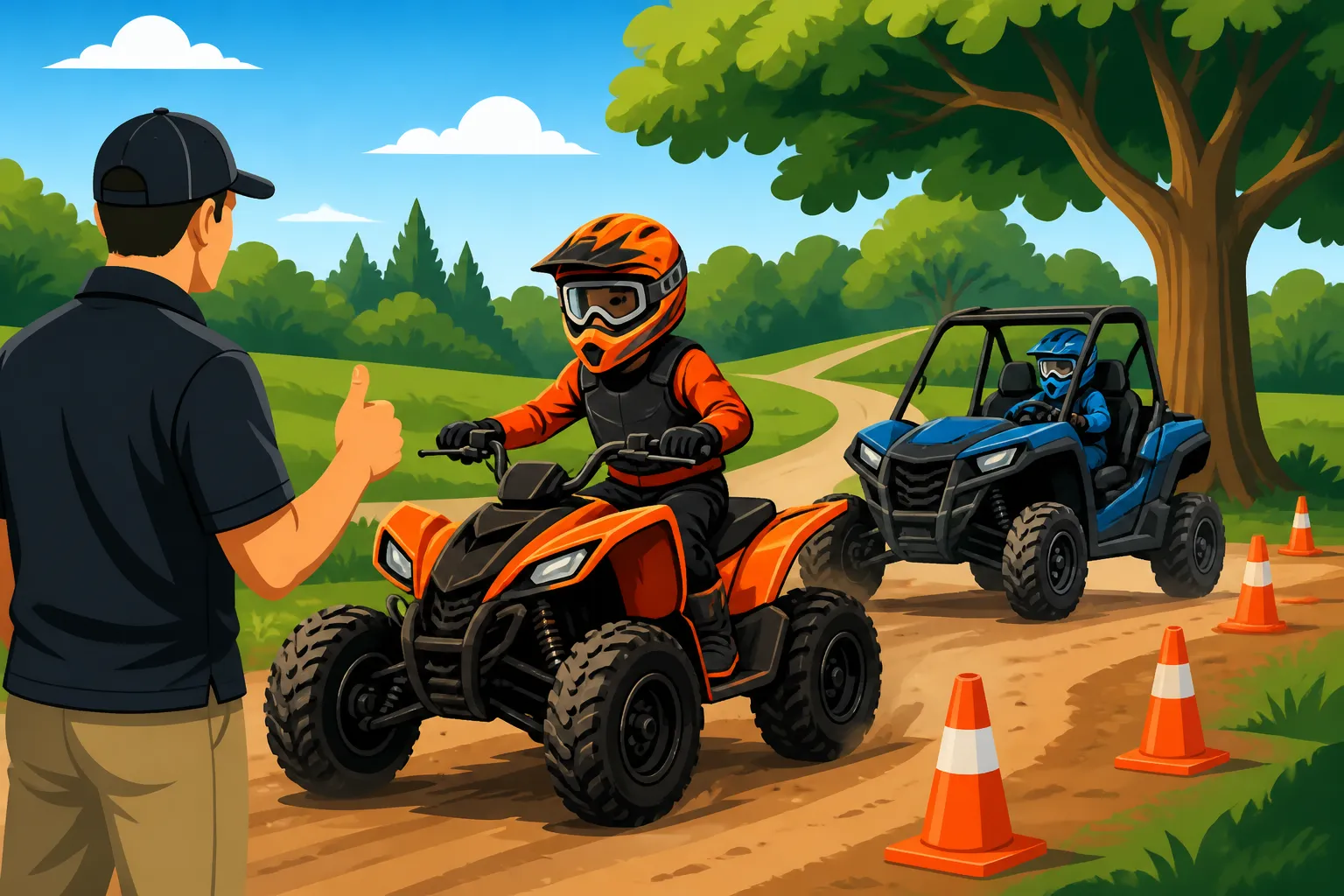
A well-planned youth course should make expectations clear before a child starts riding. It should include instruction suited to the participants’ age and experience, time to practice in a controlled area, and a way for the instructor to supervise the group. The organizer should be able to explain how students are divided and what happens if a child is uncomfortable or cannot keep up.
The exact lesson may vary, but a useful introductory session often addresses machine controls, starting and stopping, body position, turning, braking, spacing, and recognizing hazards. For trail riding, students may also need to understand how to yield, avoid riding beyond their ability, and respond to changing surface conditions. Ask what the course covers instead of assuming that every “youth day” teaches these skills.
Look for a sensible progression from explanation to practice. A child should have time to understand a skill, try it at a controlled pace, and get feedback before moving on. A large mixed group with little individual attention may be less useful for a beginner than a smaller session, even if the event is advertised as a course. Ask about instructor-to-student supervision in practical terms: who watches the riders while they practice, and how are students kept within the designated area?
A course completion card or certificate can be helpful for keeping a record, but ask what it represents. It may be the park’s own participation record rather than a credential recognized by another park, land manager, or agency. Keep the organizer’s written description and completion information if you may need to show what the child attended later.
After the class, ask the instructor what the child handled well and what needs more practice. A course is not a guarantee that a young rider is ready for difficult trails or longer rides. Use the instructor’s observations alongside your own judgment, and choose routes that fit the rider’s current ability. For related rules about young riders outside a private-park setting, see [Alabama Rules for Young Riders].
If the park has no formal course, you can still ask whether it has a beginner practice area, a family orientation, or an approved instructor coming for a future event. Do not treat a quiet trail or open field as a training space unless the park allows it. Riding off the designated route can create safety problems and may violate park rules. A short conversation with staff can help you find an appropriate place to practice without assuming that every open area is available.
Finally, keep the scope of a private-park course clear. It may help a child learn machine handling and park etiquette, but it is not a permit for public land, a substitute for permission to ride on private property, or automatic proof that another facility will accept the child. If your plans include riding on public land or visiting another park, check that location’s separate access and safety rules. A course is most useful when families know exactly what it teaches and what it does not cover.
Disclaimer
This article is for general informational purposes only and does not constitute professional advice. Laws, prices and regulations vary by location and change over time. Consult a qualified professional for guidance on your specific situation.