Purple Paint on a Fence Post
A purple mark on a fence post can be easy to mistake for a trail marker, property marker, or old paint. In Alabama, it may instead give notice that land is off-limits. For ATV and UTV riders, understanding that signal helps prevent an accidental trespass, especially where trails, timber roads, and private boundaries meet.
What purple paint means in Alabama
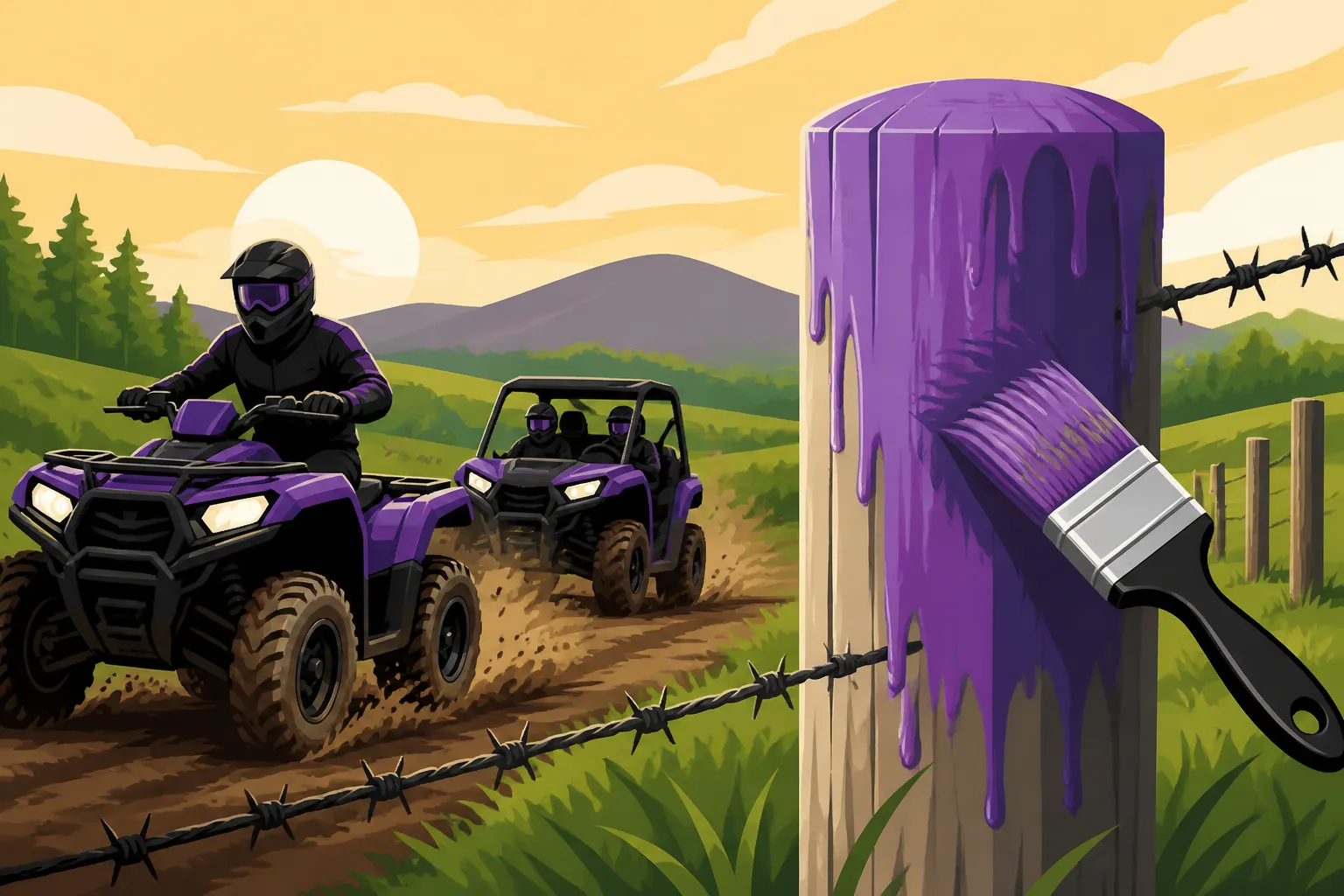
Alabama recognizes purple paint on trees or posts as a way to give notice against trespass. A purple mark is not a trail blaze or an invitation to continue. If you see it while riding, treat it as a boundary warning and do not enter the land beyond it unless you have permission or another clear legal basis to be there.
The state’s requirements describe marks that are visible and placed in a particular way, including their size, height, and spacing. Those details help identify paint used as formal notice. But riders should not try to decide at the edge of a trail that a mark “doesn’t count” because it looks small, faded, or irregular. A casual inspection may not tell you where the property line lies, what the owner intended, or whether other notice applies. The safer response is to stop and stay on the side of the boundary you know you may use.
Purple paint does not create ownership by itself. It is a way to communicate that land is posted; it does not tell you who owns the land, grant permission to cross, or map the exact boundary with survey-level precision. A fence can help show where access changes, but fences do not always sit precisely on a property line. If you need to know whether a route is open, check a reliable land or trail map and ask the landowner or managing agency.
| What you see | Practical meaning for a rider |
|---|---|
| Purple paint on a post or tree | Treat it as notice to stay out unless you have permission or confirmed legal access. |
| A trail that continues past purple marks | The trail’s appearance does not establish a right to use the land beyond the marks. |
| Purple marks near a public road | Stay on the road or other confirmed public route; do not assume the shoulder or adjoining track is public. |
| A faded, isolated, or unclear mark | Do not use uncertainty as permission to ride through. Stop and verify access. |
| A posted boundary near a managed riding area | Follow the park or land manager’s current map, signs, and instructions. |
For a broader explanation of how posted property affects riders, see Alabama Posted Land Rules for Riders and Alabama Trespass Law for Riders. Those rules apply whether you ride an ATV, UTV, dirt bike, or another off-road machine. The paint is a warning about land access, not a special rule for one type of vehicle.
How to respond when you see purple paint
The safest response is simple: stop before crossing the marked boundary, turn around if necessary, and confirm that your route is authorized. Do not ride farther in to look for a better trail, a gate, or a place to turn around. If the route is narrow, reverse or turn around on ground you are allowed to use rather than cutting across the posted property.
A practical approach:
- Stop before the mark or boundary. Avoid crossing the fence, passing a posted tree, or continuing down a track that appears to enter the marked land.
- Check your map and your location. A phone map can help, but it may not show private boundaries or current access restrictions. Do not treat a trail line on an app as proof of permission.
- Ask the person or agency responsible for the land. If the route may cross private property, get permission from the landowner. If it is part of a managed riding area, contact the park or land manager.
- Use a confirmed route instead. Return to a designated trail, public route, or property where you have permission.
- Tell your group. Make sure riders behind you know the route is closed to them too. A lead rider’s decision to turn around does not help if the rest of the group continues.
If you realize you have crossed onto posted land by mistake, stop rather than riding deeper into it. Return by the route you used if that is safe and does not require crossing another boundary. Do not damage a fence, move a marker, or open a gate without authorization. If you cannot tell how to leave without causing further trouble, contact the landowner or an appropriate local authority.
Permission should be clear, not assumed from a previous visit, a neighbor’s access, or the fact that another rider is already on the property. If an owner grants access, ask what area is included, which routes are allowed, and whether permission applies to the whole group. Written permission can help avoid confusion on private land. See Written Permission From an Alabama Landowner for more on what to clarify.
The same care applies to timber roads, utility corridors, and hunting land. A road may look established and still be private, restricted, or open only for a particular purpose or season. Before riding, check the land manager’s rules and confirm the route rather than relying on tire tracks or a gate that happens to be open. For context on these specific situations, see Alabama Rules for Riding a Timber Road and Alabama Riding a Power Line Cut.
What purple paint does not tell you
Purple paint is an access warning, but it does not answer every question about a route. It does not prove that every nearby road is private, that every tract beyond the mark has the same owner, or that a public route has been closed. It also does not make an otherwise unlawful ATV or UTV road trip legal. Property access and vehicle-use rules are separate issues.
For example, a rider may have permission to cross private land but still need to follow applicable rules about where an off-road machine may be operated. Conversely, a trail may be open within a park or public riding area, while a connecting track across neighboring private land is not. Check both the land-access rules and the machine-use rules before riding.
A route near a road needs particular care. Purple paint on a fence or tree does not automatically prohibit travel on a public road, but it is a strong reason not to turn onto an adjoining track or cross onto the property. Road shoulders, ditches, and access lanes can have different ownership or restrictions. Do not assume that a visible track running beside a road is part of the public right-of-way. Alabama’s rules on road riding are a separate subject; Alabama ATV Road Rules Explained can help you distinguish road access from private-property access.
Paint can also be ambiguous in the field. It may be old, partly hidden by vegetation, or mixed with other markings. A color alone may not let you identify the property line or confirm that a route is open. Even if the paint seems inconsistent with the state’s formal marking requirements, that is not a sound basis for riding onto the land. Seek confirmation rather than testing the boundary.
The same principle matters on hunting land and wildlife management areas. A hunting lease does not automatically give every rider permission to use every tract, and rules can differ by property and season. Access may depend on permits, designated routes, landowner terms, or other posted instructions. Review Does a Hunting Lease Let You Ride a Quad? and Alabama WMA Riding Rules before assuming that a hunting connection or public-land permit covers the route you want to ride.
Plan for boundaries before the ride
Boundary problems are easier to prevent before the group unloads than to sort out on a narrow trail. If a planned route crosses several parcels, identify which sections are public, which are privately owned, and where permission is required. Do not rely on a single map source if the route depends on an unclear boundary. Contact the land manager or property owner and ask specifically about the route, dates, and machines in your group.
Before setting out, make a simple plan:
- Use an authorized trail map. Prefer current information from the riding area or managing agency over a route shared without access details.
- Mark known boundaries and turnarounds. Agree on what the group will do if a trail ends at a fence, posted sign, purple mark, or closed gate.
- Confirm group permission. Ask whether permission covers every rider and passenger, not just the person who contacted the owner.
- Carry a way to contact the group. Riders separated by distance may not see a boundary warning at the same time.
- Have an alternate route. A detour is better than crossing land without permission.
Registration, a permit, or an out-of-state decal does not grant permission to use private land. Those documents serve different purposes and may relate to a machine, a particular public area, or another access requirement. Visiting riders should check both Alabama’s vehicle and riding rules and the property rules for each place they plan to enter. What Visiting Riders Need to Ride Legally in Alabama explains why visitor status does not remove the need to follow local access restrictions.
If you are unsure whether a marked route crosses private property, pause the ride and verify before continuing. A purple mark is not a challenge to find another way through; it is a signal to respect the boundary. When permission is unclear, choose a route you can confirm is open.
Disclaimer
This article is for general informational purposes only and does not constitute professional advice. Laws, prices and regulations vary by location and change over time. Consult a qualified professional for guidance on your specific situation.