No State Course Requirement
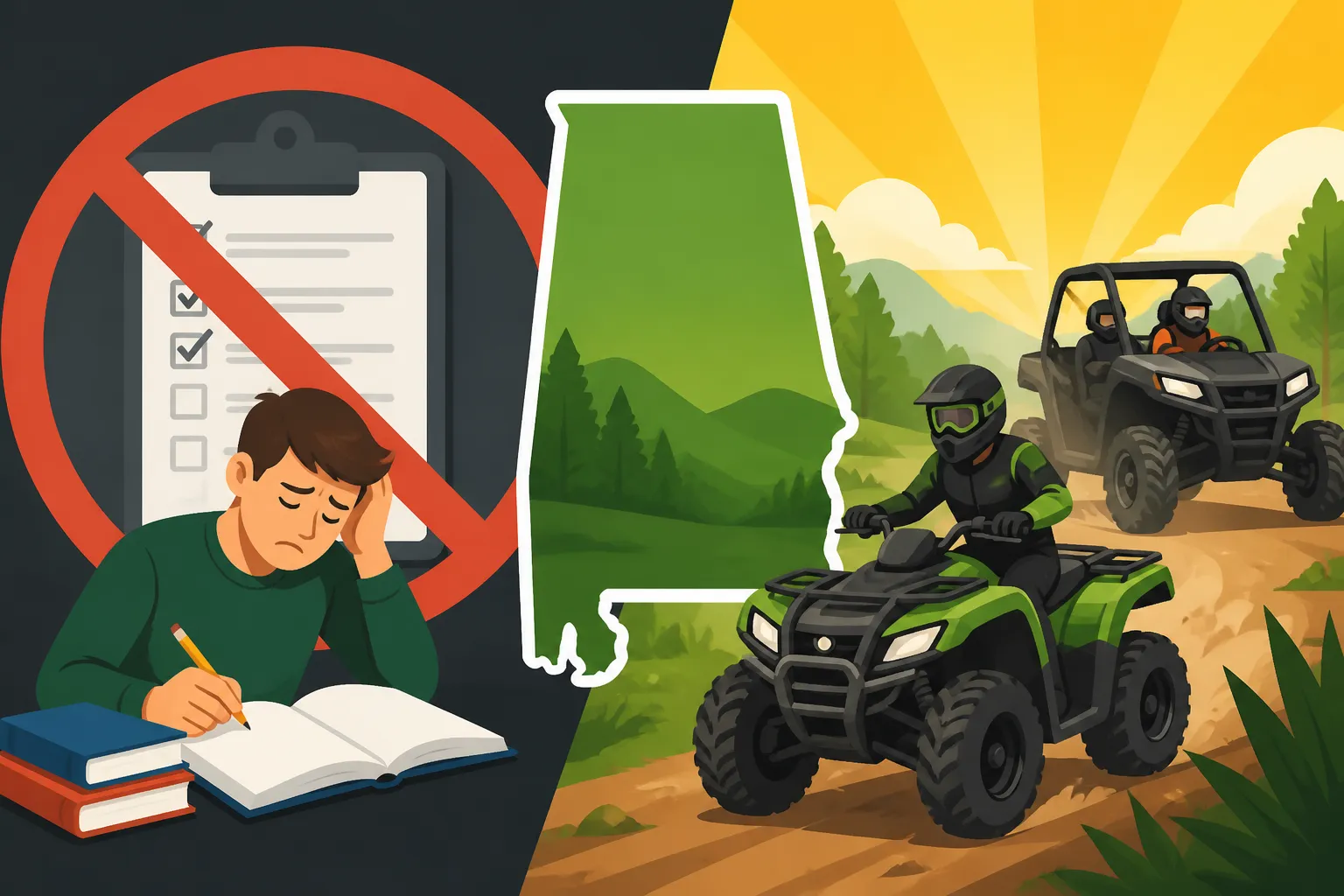
Alabama does not require every ATV or UTV rider to complete a state safety course before riding. That does not mean every trail, park, or landowner has the same rules. Here’s how to tell the difference between statewide requirements and site-specific conditions, and when a course can still be a smart choice.
What Alabama’s lack of a state course requirement means
Alabama has no general statewide requirement that ATV and UTV riders complete a safety course before riding. For ordinary off-road use, you do not need to show a state course-completion card simply because you operate an ATV or UTV in Alabama.
That is a limited answer to one question: whether the state requires a course as a general condition of riding. It does not guarantee access to every riding area, settle age or supervision questions, or make a machine legal to use on a road. Other rules can apply based on where you ride, who is operating the machine, and what the land manager or property owner requires.
Keep these terms separate:
- Safety course: Training that teaches riding skills, risk management, and safe operation.
- Permit or license: Permission or authorization that may be required for access to a specific type of land.
- Registration: An administrative record for a machine where registration applies. Alabama registration is voluntary in the general state system, but a registration record does not replace a land-access permit or a park’s entry requirements.
- Road-use compliance: Separate legal requirements for using a machine on a public road. A safety course does not make an ATV or UTV street legal.
These distinctions matter because riders sometimes hear “no state course required” and assume they can arrive anywhere, on any machine, without checking conditions. A course card is not a universal trail pass, and the absence of a statewide course mandate is not a promise that every riding location is open to every rider.
If you’re sorting out statewide registration from land access, start with Alabama Registration Is Voluntary and Alabama Public Use Designated Areas. For a broader look at how Alabama treats different off-road machines, see Alabama’s ATV and ROV Legal Definitions.
Where a separate course or other condition may matter
A state-level rule and a site-level rule can differ. A private riding park, event organizer, landowner, or public-land manager may set conditions for entry or use. Those conditions can concern age, adult supervision, helmets, passenger limits, machine type, permits, waivers, or other safety measures. Check the rules for the specific place before you travel.
A location might require a parent or guardian to sign for a minor, restrict young riders to certain machines or trails, or apply different rules to riders based on age. It might also offer or require instruction for a particular activity. Do not assume that a state-level answer overrides a park’s posted requirements or a landowner’s conditions.
| Question | What the state-level course answer tells you | What to check separately |
|---|---|---|
| Do I need a course just to ride an ATV or UTV in Alabama? | There is no general statewide course requirement. | The rules for the park, land, event, or route you plan to use. |
| Does a course provide access to public land? | No. A course is not an access permit. | Required licenses, permits, open dates, and area-specific rules. |
| Can a child ride because no course is required? | The course answer does not settle age or supervision rules. | State age rules and any stricter site requirements. |
| Does a course let me ride on a road? | No. Training does not make a machine road legal. | Road laws, local rules, and whether the machine meets applicable requirements. |
| Does a course card replace a park waiver? | No. They serve different purposes. | The park’s entry, waiver, and safety requirements. |
Public land deserves particular care. A safety course does not grant access to a Wildlife Management Area or a national forest route. Access rules, permits, and open routes can vary by area and by season. Review Alabama WMA Riding Rules for Quads before planning a ride on a Wildlife Management Area, and see Alabama National Forest Riding Permits when considering federal forest land. For general orientation, What Visiting Riders Need to Ride Legally in Alabama can help you identify questions to resolve before a trip.
Private property is different, but it is not automatically unrestricted. You need permission to ride land you do not own, and the owner can set conditions for access. A hunting lease, timber road, or informal invitation should not be treated as blanket permission to ride anywhere on the property. Ask what areas are open, what dates apply, and whether riders must meet particular safety or equipment requirements.
Parks and organized events may have their own admission policies. Some rules apply to every rider; others may be specific to minors, passengers, or particular machine types. Review the written rules before paying, loading the machines, or signing a waiver. If the park’s website or posted information is unclear, contact the operator and ask for the current requirements in writing.
When a course is still a good idea
A course can be useful even when it is not legally required. New riders may not know how much braking distance a machine needs, how weight shifts on a slope, or how quickly a familiar-looking trail can become difficult after rain. A structured course gives riders a chance to learn before those mistakes happen at speed or on uneven ground.
Training can be particularly valuable for:
- First-time riders, who are still learning controls, turning, braking, and how to judge terrain.
- Young riders, who may need practice matching speed and machine size to their ability.
- Adults moving from a quad to a side-by-side, since the controls, handling, passenger responsibilities, and rollover risks differ.
- Riders returning after a long break, who may remember the basics but have lost confidence or changed machines.
- Groups riding together, where a shared understanding of trail communication, spacing, and breakdown procedures can help prevent confusion.
A useful course should cover more than how to start and steer a machine. Look for instruction on protective gear, pre-ride checks, braking, hills, uneven ground, carrying passengers where the machine is designed to do so, and what to do after a breakdown or crash. Training should also stress riding within the operator’s abilities and following the machine manufacturer’s instructions.
A course is not a substitute for supervision or sensible machine selection. A young rider can complete training and still be placed on a machine that is too large or powerful for their size and experience. Parents and guardians should consider the rider’s maturity, reach, strength, ability to control the machine, and the terrain where it will be used. Review [Alabama Rules for Young Riders] and Alabama ATV Age Rules for questions that are separate from course completion.
Protective gear remains important whether or not anyone asks to see a course card. Use a properly fitted helmet and other protective equipment suited to the activity. Check the owner’s manual for passenger limits and operating instructions. Before every ride, inspect the machine, confirm that controls and tires are in usable condition, and make sure the rider understands how to stop and what to do if something goes wrong.
How to check requirements before riding
Treat course requirements as one item on a broader pre-ride checklist. The right answer depends on the particular land and activity, so confirm the details with the organization responsible for access rather than relying on a general statement about Alabama law.
- Identify the riding location. Find out whether it is a private park, private property, a Wildlife Management Area, national forest land, or another public area. Rules for one type of land do not automatically apply to another.
- Ask whether a course is required or recommended. If the location has a requirement, ask which riders it covers, what proof is accepted, and whether the requirement differs for minors or certain activities.
- Check permits and access dates. Ask whether you need a permit, license, reservation, or other authorization. Confirm which routes or areas are open on the day you plan to ride. A course certificate does not replace these permissions.
- Confirm age, supervision, and passenger rules. Ask about minimum ages, adult supervision, and whether the machine may carry a passenger. Check both the state rules and the location’s own conditions.
- Read the machine and gear requirements. Verify that your ATV or UTV is allowed at the site and review any rules on helmets, safety equipment, noise, width, or other machine limits.
- Keep proof available. If a course, permit, waiver, or registration record is relevant to your trip, keep the required documentation accessible. Do not assume a phone screenshot is accepted if the organization specifies another form of proof.
If you are visiting from another state, do not assume your home-state course card, permit, or registration is automatically accepted in every Alabama riding area. Ask the land manager or park what documents it accepts and whether visitors need an Alabama-specific permit. Reciprocity questions are usually about access credentials and machine paperwork, not about whether a course is generally mandatory statewide.
For a Wildlife Management Area trip, check the area’s own instructions rather than relying only on a general permit overview. How to Get an Alabama WMA Permit can help with the permit question, while Alabama WMA Rules Vary by Area is a reminder to verify the rules for the tract you intend to use. For a private park, confirm entry conditions directly with the operator, especially when children or a large group are involved.
The practical answer is straightforward: Alabama does not impose a general statewide ATV or UTV safety-course requirement, but a course can still be worthwhile, and individual riding locations can set their own conditions. Check the rules for your destination, make sure each rider and machine is suitable for the planned route, and treat training as preparation—not as a substitute for permission, permits, or safe judgment.
Disclaimer
This article is for general informational purposes only and does not constitute professional advice. Laws, prices and regulations vary by location and change over time. Consult a qualified professional for guidance on your specific situation.