Alabama Riding a Power Line Cut
There's a specific kind of frustration that bubbles up when you're an ATV or UTV rider in Alabama, especially when you see those wide-open clearings stretching across the landscape – the power line cuts. They look like an invitation, don't they? A perfect, ready-made trail just begging for some throttle. But the reality is often far more complicated, leaving many riders confused about where they can legally and safely enjoy their machines. This guide is here to untangle the myths from the facts, helping you understand the legalities, dangers, and best practices for navigating Alabama's power line cuts.
Understanding Power Line Cuts in Alabama
When you're out exploring the vast beauty of Alabama, whether it's the rolling hills of north Alabama or the dense forests of the central part of the state, you've undoubtedly seen them: those long, often seemingly endless corridors of cleared land that slice through the landscape. These aren't just random clearings; they serve a vital purpose, but their appearance can be incredibly deceptive for anyone looking for a place to ride.
What Exactly is a Power Line Cut?
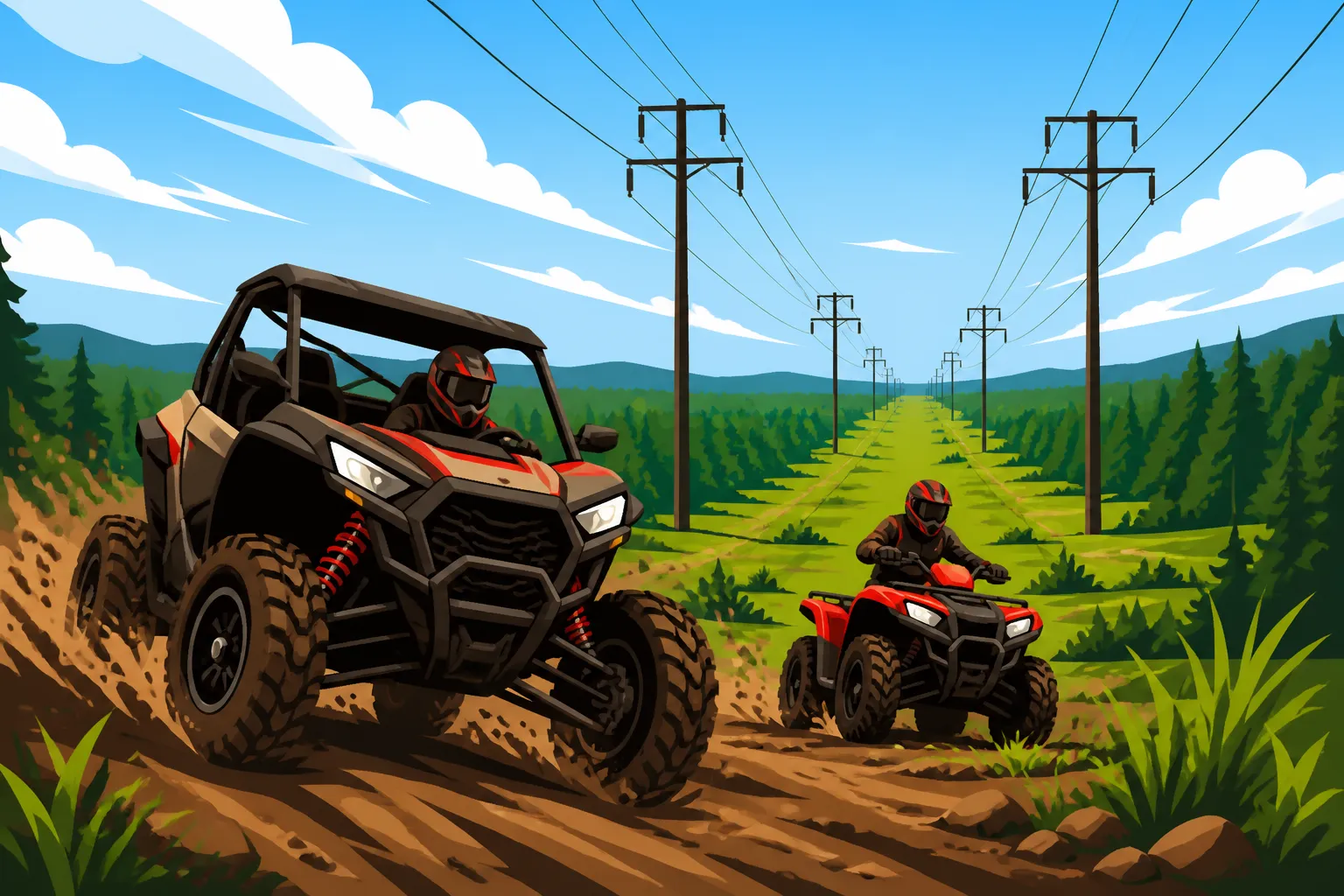
Let's start with the basics. A "power line cut," or often just a "power line right-of-way," refers to the strip of land that has been cleared directly beneath high-voltage electrical transmission lines. These aren't your typical neighborhood power poles, but massive structures carrying electricity over long distances. The reason for these cleared strips is purely functional and incredibly important for public safety and reliable electrical service.
Utility companies, like Alabama Power or the Tennessee Valley Authority (TVA), need these areas clear for a few key reasons. First, it's a safety zone. Trees and other vegetation growing too close to high-voltage lines pose a significant fire hazard and can cause power outages, especially during storms. Second, it's an access corridor for maintenance. When equipment needs repair or lines need to be inspected, crews need a clear path to reach the infrastructure quickly and safely. You'll often find these cuts varying in surface – sometimes it's relatively smooth gravel, other times it's just dirt and grass, and frequently, it can be extremely rough with exposed rock, stumps, or deep erosion washes, especially in our heavy Alabama rains.
These cleared strips are essentially private property, or at the very least, managed under an easement. An easement grants the utility company the right to use a specific portion of land for a particular purpose (like running power lines), even if the land's ownership remains with a private individual or entity. This distinction is absolutely crucial for riders, because an easement for power lines does not automatically grant public access for recreation.
Why They Attract Off-Road Riders
It's easy to see why power line cuts hold such an appeal for ATV and UTV enthusiasts. Imagine you're driving down a winding county road, and suddenly, a wide, open path appears, stretching far into the distance. It looks like an unofficial highway, a direct route through what would otherwise be dense, impassable woods. For riders, this offers the allure of unrestricted space, a place to open up the throttle and explore.
These cuts often present a variety of terrains, from challenging mud holes to rocky sections and steep climbs, making them seem like a natural fit for the capabilities of an off-road machine. There's a perceived sense of freedom – no trail markers, no crowds, just you and your machine. The accessibility is also a draw; many power line cuts intersect or run parallel to public roads, making them seem easy to hop onto.
However, this perceived freedom is where many riders get into trouble. The very features that make power line cuts attractive for riding – their openness, varied terrain, and often secluded nature – are also what make them legally problematic and inherently dangerous without proper authorization. What looks like an open invitation is almost always a private utility corridor.
The Legal Landscape of Riding Power Line Cuts
This is where the rubber meets the road, or more accurately, where your tires might hit private property without permission. The legalities surrounding power line cuts are perhaps the most misunderstood aspect for many off-road riders in Alabama, and it's essential to get this straight to avoid a heap of trouble.
Private Property vs. Public Access
Here's the plain truth: a utility easement for a power line cut does not mean it's public land or open for recreational riding. This is the biggest misconception, and it's one that leads to countless trespassing issues for riders. Think of it this way: if your neighbor grants the power company an easement to put a utility pole in their backyard, that doesn't mean you can hold a picnic under it just because the power company has access.
Most power line cuts in Alabama exist under one of two scenarios: they are either on private land where a utility company has purchased or been granted an easement, or the utility company itself owns the land outright. In both cases, these areas are typically considered private property. The utility company has the right to access and maintain their equipment, clear vegetation, and ensure safety, but this right does not extend to the general public for recreational purposes. You might see a beautiful stretch of land that looks like a perfect trail, but if you don't have explicit permission, you are almost certainly trespassing. It's crucial to understand [Alabama Trespass Law for Riders] before you ever consider riding off designated trails.
Just like with any other private property, landowners who host these easements can mark their boundaries. You might encounter "No Trespassing" signs, or increasingly common in Alabama, purple paint on trees or fence posts. [Posted Land and Purple Paint in Alabama] are clear indicators that the land is private and access is restricted. Ignoring these signs is not only disrespectful but also illegal.
Official Statements and Policies from Utility Companies
Utility companies in Alabama are very clear on this subject: they generally prohibit recreational riding on their rights-of-way. This isn't just to be difficult; it's rooted in serious concerns about safety, liability, and property damage. Companies like Alabama Power or the TVA invest heavily in these corridors to ensure reliable power, and unauthorized activities directly interfere with that.
Their reasons are manifold:
- Safety Hazards: Power lines carry immense voltage. There's always a risk of fallen lines, damaged equipment, or even contact with buried infrastructure. Utility workers need a clear, predictable environment to perform their jobs safely. Your presence, especially on an ATV or UTV, introduces an unpredictable element into a high-risk zone.
- Liability: If you get injured on their property, even if you were trespassing, it can become a legal headache for the utility company or the underlying landowner. They want to avoid that.
- Damage to Infrastructure: Heavy machines can cause ruts, damage access roads, and even expose or damage buried cables or gas lines. This can lead to costly repairs and even dangerous situations.
- Environmental Impact: Unauthorized riding can accelerate erosion, especially on Alabama's distinct red clay, which leads to maintenance headaches for the utility company.
So, while that power line cut might look like an awesome place to ride, understand that the entities responsible for its upkeep actively discourage and often prohibit such use. If you're caught, you could face significant [Alabama Trespass Penalties for Riders], which might include fines or even the impoundment of your machine.
Exceptions: When is it Legal?
Now, before you get too discouraged, there are a few very specific scenarios where riding on or adjacent to a power line cut might be legal. These are, however, genuine exceptions and not the general rule.
The primary way you can legally ride a power line cut is if you have explicit, written permission from both the underlying landowner and the utility company that holds the easement. This is a tall order, and frankly, it's pretty rare. Utility companies are hesitant to grant such permission due to the safety and liability concerns mentioned above. A private landowner might give you permission to ride on their land, but that permission usually doesn't extend to the utility's easement unless specifically negotiated and approved by the utility itself. Without that dual permission, you're still risking a trespass charge.
Another, more common, exception is if a power line cut happens to be located within the boundaries of a legally designated and managed OHV park or trail system. For instance, a park like [Stony Lonesome OHV Park in Alabama] or [Minooka Park Riding in Alabama] might have trails that cross or run along parts of a power line easement. In these cases, the park management has already worked out agreements with the utility company and the landowner, integrating the area into their official trail system. When you ride these specific sections within a park, you're riding legally because it's part of a managed and permitted area. But stepping off these designated park trails onto an unapproved section of a power line cut would still be considered trespassing. Always check the park's official maps and rules. When looking for places to ride, always prioritize [Alabama ATV Trails: Where to Ride] that are officially designated and open to the public.
Risks and Dangers of Riding Power Line Cuts
Beyond the legal headaches, riding on unauthorized power line cuts carries a host of serious physical and environmental dangers that every rider needs to be aware of. It's not just about getting a ticket; it's about your safety and the health of the land.
Safety Hazards for Riders
Let's be frank: power line cuts are not designed or maintained for recreational riding. This means they are often riddled with hazards that can quickly turn an exciting ride into a nightmare. You might encounter:
- Ungraded Terrain: While they look flat from a distance, many cuts have hidden obstacles. We're talking deep, unexpected ruts from maintenance vehicles, erosion washes that appear after heavy rains, large rocks unearthed during clearing, or stumps that are just begging to snag a tire or suspension component. Imagine hitting one of these at speed – it's a recipe for a serious crash.
- High Voltage Lines: This is the most obvious and gravest danger. Even without direct contact, power lines carry immense voltage that can arc. Fallen lines, though rare, are catastrophic. There might also be ground-level hazards from transformers or other electrical equipment that isn't always clearly marked or easily visible from your riding position. The simple presence of high-voltage lines overhead should be enough to make anyone think twice about riding underneath.
- Utility Equipment: These corridors are working environments. You might encounter utility poles, guy wires, grounding wires, or even open trenches for buried lines. Maintenance crews regularly use these paths, and encountering a large utility truck or heavy machinery around a blind curve is a major collision risk.
- Lack of Emergency Access: Should you or a riding buddy have an accident in a remote section of a power line cut, getting emergency services to your location can be incredibly difficult and time-consuming. These areas are often not mapped for public access, and reaching you might involve significant delays. Always remember that reporting an incident properly, even if it's on private land, is important, so understanding [Alabama Accident Reporting for an ATV Crash] is good practice.
Environmental Impact and Damage
As off-road riders, we all share a responsibility to protect the lands we enjoy. Unauthorized riding on power line cuts can cause significant and often irreversible environmental damage, which further fuels utility companies' reasons for prohibiting access.
- Erosion: Alabama's red clay is beautiful but notoriously susceptible to erosion, especially when disturbed. ATVs and UTVs churning up the soil, particularly on inclines or during wet conditions, can create deep ruts. These ruts channel rainwater, leading to accelerated erosion, gullying, and sediment runoff into streams and rivers. Utility companies often struggle to manage erosion on these cuts, and unauthorized riding only exacerbates the problem.
- Damage to Vegetation: While these areas are "cleared," utility companies often manage specific types of low-growing vegetation that don't interfere with the lines but help stabilize the soil. Unauthorized riding can damage these plants, exposing more bare soil to erosion.
- Spread of Invasive Species: Vehicles can inadvertently transport seeds of invasive plants from one area to another, disrupting local ecosystems along the power line corridor.
The cumulative effect of unauthorized riding can create maintenance nightmares for the utility companies, further cementing their stance against public access. It's not just about a few riders; it's about the potential for widespread, long-term damage that impacts their ability to maintain the power grid.
Legal Repercussions and Penalties
If the physical dangers and environmental concerns aren't enough to deter you, consider the very real legal consequences of riding on unauthorized power line cuts in Alabama. These aren't minor infractions.
- Trespassing Charges: The most common consequence is a trespassing charge. In Alabama, trespassing can range from a violation to a misdemeanor, depending on the specifics, such as whether it's first or second degree. Penalties can include significant fines, court costs, and a criminal record.
- Machine Impoundment: Law enforcement has the authority to impound your ATV or UTV if you are caught trespassing, especially if you're repeat offender or if other laws are being violated (like reckless riding or [Alabama Impaired Riding Rules]). Getting your machine back from impound can be a lengthy, expensive, and frustrating process. Understanding [When Police Impound a Quad After a Stop] is important for any rider.
- Liability for Damage: If your machine causes any damage to the utility company's property, equipment, or the underlying landowner's property (e.g., knocking over a sign, damaging a fence, creating severe ruts), you could be held financially liable for the repairs. This could easily run into thousands of dollars.
- Confrontation: While not a legal penalty, unauthorized riding increases the risk of confrontation with landowners or utility workers. This can escalate quickly and lead to unpleasant and potentially dangerous situations.
The bottom line is that the risk-to-reward ratio for riding an unauthorized power line cut is incredibly poor. The thrill of a few minutes of perceived freedom is simply not worth the potential for injury, environmental harm, or severe legal and financial repercussions.
Responsible Riding Alternatives and Best Practices
Given the legal complexities and significant dangers associated with riding power line cuts, the most responsible approach is to seek out legal, designated riding areas. This protects you, your machine, and the land.
Seeking Permitted Riding Areas
Alabama is fortunate to have a growing number of fantastic, legal off-road riding opportunities. Instead of risking a trespass charge or worse, put your energy into exploring these fantastic options.
- Designated OHV Parks: These are your best bet. Parks like [Stony Lonesome OHV Park in Alabama] in Cullman County or [Minooka Park Riding in Alabama] in Jemison offer hundreds of acres of varied terrain, from challenging rock crawls to scenic woods trails. These parks have designated routes, clear rules, and often on-site staff, ensuring a safer and more enjoyable experience. They've already done the hard work of securing land access and managing the trails responsibly. Many parks also offer camping and other amenities, making for a full weekend adventure.
- Wildlife Management Areas (WMAs) and National Forests: Some areas within Alabama's WMAs and National Forests allow ATV and UTV riding, but it's crucial to understand that these are usually restricted to designated routes only. You cannot just ride anywhere. These rules are in place to protect wildlife, natural resources, and other forest users. Always check the specific regulations for the WMA or National Forest you plan to visit. You'll often need specific permits in addition to hunting or fishing licenses. Read up on [Alabama WMA Riding Rules] and [Alabama National Forest Riding Permits] before you ever load up your machine. Remember, just because it's public land doesn't mean it's open for unrestricted off-road riding.
By choosing these legal venues, you're not only protecting yourself from legal trouble but also contributing to the sustainability of off-road riding by supporting responsible land use.
Obtaining Permission for Private Land
If you absolutely have your heart set on riding a particular piece of private land – perhaps it's family property, or a friend owns a large tract – the proper way to go about it is to obtain explicit, written permission from the landowner. This is non-negotiable.
- Start with the Landowner: Your first step is always to contact the person who owns the land. Explain what you want to do, and discuss their concerns. If they grant permission, ask for it in writing. This protects both you and them. A simple signed letter stating you have permission to ride your ATV/UTV on their property on specific dates is a huge safeguard. Having [Landowner Permission Forms] makes this process smoother and more professional.
- Address Power Line Cuts Separately: If the private land includes a power line cut, you and the landowner would then need to contact the utility company. As mentioned before, utility companies are often very hesitant to grant recreational access to their easements due to liability. If they do, they'll likely have specific stipulations. Do not assume that landowner permission automatically covers the utility easement unless the utility company has also explicitly granted permission.
A respectful approach and clear communication go a long way. Many landowners are open to responsible recreation if they trust you and know you'll respect their property and follow their rules.
Gear and Machine Considerations for Rough Terrain
Even if you do get permission to ride a power line cut, or if you encounter similarly rough terrain in a designated park, you need to ensure your machine and your gear are up to the challenge. Power line cuts are often not maintained like dedicated trails, meaning they can be brutal on equipment.
- Tires: Good tires are paramount. For the varied conditions you might find on a power line cut – from mud to rocks and hard-packed dirt – you'll want something aggressive and durable. Brands like SuperATV offer a range of tires, such as their Intimidator or Assassinator models, which are specifically designed to tackle deep mud and rocky conditions, common elements in these rough, untamed corridors. You need something that can grip through the clay and withstand punctures.
- Protection: Skid plates are not an option; they're a necessity. Exposed rocks and stumps can wreak havoc on your undercarriage, engine, and drivetrain. Robust A-arm guards are also a wise investment. Consider heavy-duty bumpers. [Skid Plates for Talladega Rock] can save you from a costly repair bill.
- Recovery Gear: A winch is invaluable. Even on relatively flat ground, Alabama's notorious red clay can become incredibly slick and grabby after rain, leaving you stuck. A good winch, like those found at SuperATV, mounted on your machine, can be a lifesaver. Carry recovery straps, a shovel, and a basic tool kit. Learning how to properly use a winch is important; check out tips for [Winches for Steep Clay Climbs].
- Safety Gear: Always wear a helmet, eye protection, sturdy boots, gloves, and long sleeves/pants. While Alabama doesn't have a universal helmet law for ATVs on private land, it's just plain smart. [Choosing a Helmet When Alabama Does Not Require One] still means making a safe choice for your head. The terrain on power line cuts is unpredictable, and accidents can happen quickly.
Remember, the right equipment isn't just about performance; it's about safety and protecting your investment. SuperATV's focus on durability and performance is exactly what you need for these demanding conditions.
Distinguishing Power Line Cuts from Other Access Points
It's easy to look at any cleared path and assume it's fair game for an ATV or UTV. However, recognizing the subtle differences between a power line cut and other types of corridors, such as logging roads or general rights-of-way, is vital for staying on the right side of the law.
How Power Line Cuts Differ from Logging Roads
While both logging roads and power line cuts are cleared paths through wooded areas, their purpose, ownership, and accessibility differ significantly. Understanding these distinctions can prevent you from inadvertently trespassing.
- Purpose: Logging roads are created specifically for timber operations – to access, cut, and transport trees. They are part of a forest management plan. Power line cuts, on the other hand, exist solely for the installation, maintenance, and safety of electrical transmission lines.
- Ownership and Access: Logging roads are almost universally on private timber company land or private family holdings. Access to these roads is almost always restricted unless you have explicit permission from the timber company or landowner, or if you hold a hunting lease that grants specific road access. While some old logging roads might be adopted into a public trail system, this is an exception. Power line cuts are either on land owned by the utility or on private land with a utility easement. Again, public recreational access is generally prohibited. Learning the nuances of [Alabama Riding a Timber Road] is important for any rider.
- Maintenance: Logging roads are maintained (or not maintained) by the timber company, often focused on keeping them passable for heavy logging trucks. Power line cuts are maintained by the utility for vegetation management and equipment access, which means clearing for lines, not necessarily for smooth recreational passage.
The key takeaway is that both are typically private, but for different reasons and with different managing entities. Never assume either is public.
Navigating Easements and Rights-of-Way
The terms "easement" and "right-of-way" are often used interchangeably, but there are important distinctions when it comes to ATV and UTV access. These legal concepts define who can use land and for what purpose.
- Utility Easements: As discussed, a utility easement grants a utility company the right to use a specific strip of land for their infrastructure (power lines, pipelines, etc.), even if the land is privately owned. Crucially, this easement does not automatically grant public recreational access. The rights granted are very specific to the utility's operations. The underlying landowner still owns the land and can restrict other uses, including ATV riding, if it doesn't interfere with the utility's rights.
- Public Rights-of-Way: This typically refers to land dedicated for public travel, such as a road, highway, or sometimes a public trail. If you're on a public road, you're on a public right-of-way. However, the right-of-way of a public road ends, and an adjacent private property (which might contain a power line cut) begins. The "shoulder" of a road doesn't suddenly become an open trail. Understanding [Alabama Riding a Right-of-Way] is complex, as it often boils down to very specific property lines and legal definitions.
The critical distinction is the scope of the right-of-way or easement. A right-of-way for public travel is what you generally need for legal ATV use (if the specific road rules allow it). A utility easement is not a public right-of-way for recreation. Don't confuse the two, as doing so can lead directly to trespassing issues.
When in Doubt: Ask the Authorities
If there's one piece of advice that will keep you out of trouble, it's this: when you're unsure about the legality of riding a specific power line cut, always, always ask. Making assumptions can lead to serious consequences.
Contacting Utility Companies for Clarity
If you're eyeing a particular power line cut and genuinely want to know if there's any possibility of riding it legally, the first step is to contact the utility company responsible for those lines. Companies like Alabama Power or the TVA will have departments that handle land and right-of-way inquiries.
- Be Specific: When you call, be prepared with specific location information – cross streets, GPS coordinates, or even pole numbers if you can find them. The more precise you are, the better they can answer your question.
- Be Prepared for "No": As we've discussed, utility companies generally prohibit recreational riding on their easements due to safety and liability. So, be prepared for them to say "no." Don't argue; simply accept their decision.
- Understand Their Stance: This contact isn't necessarily about getting permission (though you can ask), but primarily about clarifying their policy for that specific location. They can tell you if it's their easement, and what their rules are. This information is invaluable and can save you a lot of grief.
Remember, these companies are managing critical infrastructure, and their primary concern is reliability and safety. Your recreational riding is almost certainly not within their operational scope.
Consulting Local Law Enforcement
Before venturing onto any questionable terrain, a quick, polite call to your local Sheriff's office or city police department can be a huge help. They are the ones who enforce trespass laws, and they're usually happy to provide guidance on local regulations.
- Know Your Location: Again, precision is key. Tell them exactly where you're thinking of riding – county road numbers, nearest town, specific landmarks.
- Ask About Trespass Laws: Directly ask about the legality of riding ATVs/UTVs on power line cuts in that specific area and what the local regulations are.
- Respect Their Advice: Law enforcement officers have a good understanding of local property lines and common trespassing hotspots. Their advice can save you from a ticket, a fine, or even having your machine impounded. It's always better to get information beforehand than to deal with the consequences afterward. A quick call to [Calling an Alabama Sheriff Before You Ride] can prevent a lot of headaches.
By proactively seeking information from utility companies and local law enforcement, you demonstrate responsible rider behavior and ensure that your off-road adventures in Alabama remain legal, safe, and enjoyable. There are plenty of fantastic, legal places to ride in Alabama without risking a confrontation or a citation.
Disclaimer
This article is for general informational purposes only and does not constitute professional advice. Laws, prices and regulations vary by location and change over time. Consult a qualified professional for guidance on your specific situation.