Alabama Online Safety Courses
An online ATV safety course can be a useful starting point, especially for a new rider or a parent helping a child prepare. But finishing a course does not automatically provide permission to ride everywhere in Alabama. Here’s how to understand the state’s course requirements, choose useful training, and check what still applies at your riding area.
Does Alabama require an online ATV safety course?
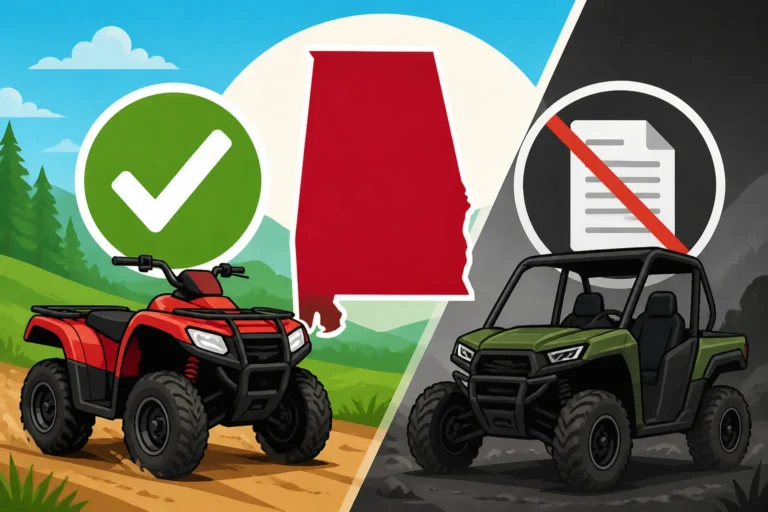
Alabama does not have a general state requirement that ATV riders complete a safety course before riding. An online course is usually voluntary training, not a statewide license or permit. The distinction matters: a completion certificate may show that you studied safe riding practices, but it does not by itself authorize you to ride on public land, a private trail, or a road.
For a closer look at the state requirement, see Alabama Has No Mandatory ATV Safety Course. Even when state law does not require a course, an individual park, event organizer, landowner, or other riding area may set its own conditions. Check the rules for the place you plan to ride rather than assuming that a course certificate—or the lack of one—settles the question.
| Question | Practical answer |
|---|---|
| Must every Alabama ATV rider take an online course? | No general statewide course requirement applies. |
| Does a certificate count as permission to ride? | No. It is training evidence, not a land-use permit or access authorization. |
| Can a park or event require training? | It may set its own participation rules. Confirm directly before traveling. |
| Does the course replace a WMA permit or other required permission? | No. Check the area’s current access and permit rules separately. |
| Does the course make an ATV street legal? | No. Training does not change the machine’s legal status or road-use rules. |
A course may still be worthwhile even when it is optional. Riders can use it to review controls, protective gear, terrain hazards, and passenger safety before heading out. A parent can also use the material to start a practical conversation about where a young rider may go, how the machine should be operated, and when to stop.
Keep the purpose in perspective. Online safety training can help build knowledge, but it cannot guarantee that a rider will make safe choices on a real trail. It also cannot replace reading the machine’s owner’s manual, learning its controls, and practicing in a suitable area under supervision.
What an online course can teach
Online courses vary in their format and depth. Some use short lessons and quizzes; others provide a longer sequence of topics and a completion record. Before enrolling, check what the course actually covers and whether it includes any hands-on component. A certificate alone is not a reliable measure of how much practical skill a rider has gained.
Topics worth looking for
A useful course should cover more than basic acceleration and braking. Look for clear instruction on:
- Controls and starting procedures: How to operate the machine’s controls, check that the rider can reach them comfortably, and follow the manufacturer’s starting and shutdown procedures.
- Protective equipment: The role of a properly fitted helmet, eye protection, gloves, boots, and suitable clothing. A course should not imply that gear makes reckless riding safe.
- Rider position and control: How body position affects balance and handling, and why riders should avoid abrupt inputs or carrying more passengers than the machine is designed for.
- Terrain and hazards: How slopes, loose ground, water, ruts, blind corners, and changing trail conditions can affect control.
- Pre-ride checks: Basic checks for visible damage, tires, brakes, lights where fitted, fluids, and other items identified in the owner’s manual.
- Passengers and cargo: Why the machine’s design and instructions matter, and how extra weight can affect handling.
- Emergency response: How to stop a ride, get help, and respond sensibly if a rider is injured or a machine becomes disabled.
The course should present safe practices as decisions a rider needs to make, not as a promise that a machine is safe in every situation. For example, learning about water crossings does not mean every crossing is appropriate. A rider should be ready to turn around when depth, current, footing, or visibility is uncertain.
Online instruction versus hands-on practice
Online training is convenient, but it cannot give a learner the same feedback as supervised practice. A video can explain braking or shifting; it cannot confirm that a rider can perform those actions smoothly on a particular machine. Nor can it replicate the changing grip and visibility of a real trail.
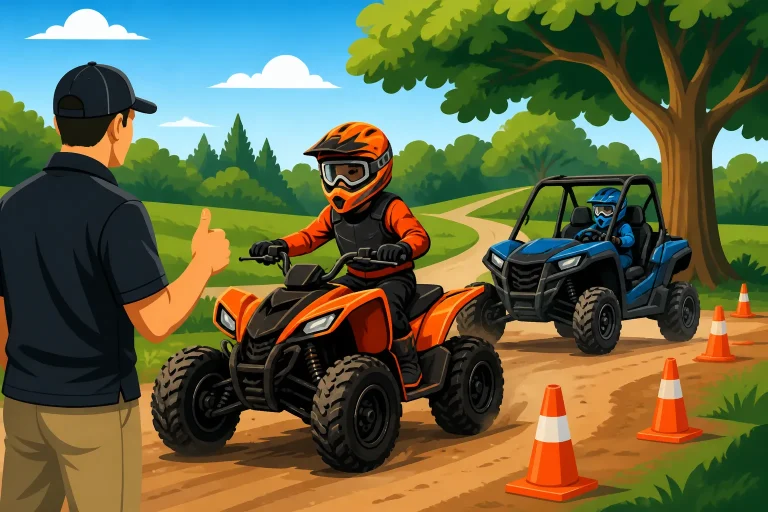
A sensible approach is to use an online course as preparation, then practice in a controlled location where riding is allowed. Start with the machine’s manual and a clear explanation of its controls. Keep early practice slow and uncomplicated, and have an experienced adult supervise a young or inexperienced rider. Do not use a public road, an unfamiliar trail, or someone else’s land as a practice area without confirming that riding is allowed there.
When comparing courses, consider these questions:
| Check | Why it matters |
|---|---|
| Is the course specifically about ATV or off-highway vehicle safety? | General outdoor or hunting material may not teach machine operation. |
| Does it identify who created the lessons? | A named, qualified training organization is easier to evaluate than an unexplained certificate. |
| Does it explain the limits of online learning? | Riders still need machine-specific instruction and practical experience. |
| Is the completion record clearly described? | You should know whether it documents a course, a test, or a practical assessment. |
| Does your park or event accept it, if training is required? | Acceptance is set by the organization requiring training, not by the certificate’s appearance. |
| Is the content suitable for the rider’s age and experience? | A course aimed at adults may not work well as a child’s first instruction. |
Do not treat a search result or a certificate graphic as proof that a course is officially recognized in Alabama. If a park, event, or organization says a course is required, ask which courses it accepts and whether online-only training meets its rule. If no organization requires one, choose based on the quality and relevance of the instruction rather than a claim that completion grants statewide riding privileges.
Choosing a course for a child or new rider
For a beginner, the best course is one the rider can understand and apply. A child may need an adult to explain unfamiliar terms, pause lessons, and connect the material to the actual machine. An adult beginner may benefit from the same approach: learn the machine’s limits before riding with a group or on difficult terrain.
Start by matching the machine to the rider, not by treating a course as permission to use a larger or more powerful vehicle. The rider should be able to reach and operate the controls as intended. Follow the manufacturer’s age and operating guidance, and keep the rider away from conditions beyond their ability.
For Alabama-specific questions about minors, review [Alabama Rules for Young Riders]. A private park may also set its own minimum ages, supervision requirements, or rules for youth riders. Those policies can differ from one location to another, so check them before making a trip. [Alabama Private Park Minimum Ages] provides more context on why a park’s own age policy may matter even when state law does not require a general ATV safety course.
A practical learning plan can look like this:
- Read the owner’s manual together. Identify the controls, warnings, passenger limits, and maintenance checks for the exact machine.
- Take a relevant online course. Pause to discuss any topic the rider does not understand, especially gear, terrain, and stopping.
- Practice in an allowed, low-risk area. Start with basic control and stopping before moving to more demanding conditions.
- Supervise actively. Stay close enough to intervene and set clear boundaries for speed, distance, and where the rider may go.
- Reassess as conditions change. A rider who manages a flat practice area may not be ready for mud, steep ground, traffic, or a long group ride.
A parent or supervising adult should not rely on a child’s certificate as evidence of readiness. Readiness depends on the rider’s judgment, physical ability, machine fit, and demonstrated control. A child who is tired, upset, distracted, or unsure should not be pressured to continue.
Courses also have limits when riders use a side-by-side. A UTV has different controls and handling characteristics from a quad, and its occupants may have different protective-equipment needs. Choose training that addresses the type of machine being used, then follow that machine’s manual and the rules of the riding area. A course about ATVs should not be assumed to cover every issue specific to a side-by-side.
What a safety course does not replace
The most common misunderstanding is that training and permission are interchangeable. They are not. Before riding, work through three separate questions: Is the machine allowed in that location? Does the rider need a permit or permission? Are there operating rules that apply to this ride?
Land access and permits
Access rules depend on where you intend to ride. Private parks set admission and operating rules. A landowner or hunting club controls access to its property. Public areas may have designated routes, seasons, permits, or other conditions. A safety course does not override any of those limits.
If you plan to ride a Wildlife Management Area, check the relevant area’s current requirements before you go. The rules can depend on the area and the type of access. Start with Alabama WMA Riding Rules for Quads and confirm the details for the specific tract. A course certificate should not be treated as a substitute for required authorization or as a guarantee that every road or trail is open to machines.
For federal forest land, do not assume that a general forest map shows routes open to ATVs. Check the current route information and rules for the specific forest area. Alabama National Forest Riding Permits can help clarify the separate question of access and permits. If a route’s status is unclear, contact the managing office before unloading the machine.
Private riding areas can have their own waiver, equipment, age, and conduct rules. Read the posted rules and any waiver carefully. A waiver is not a safety course, and completing a course does not excuse a rider from park requirements. For more on that distinction, see Alabama Private Park Waiver Forms.
Road use and local rules
Completing an online course does not make an ATV or UTV street legal. Road access is a separate legal question involving the machine, the road, and applicable state or local rules. Do not ride on a public road just because a course discussed road crossings or safe traffic behavior.
For the broader issue, see Can You Drive an ATV on the Road in Alabama?. If a route involves a county road, town street, or highway crossing, check the rules that apply to that specific place. A course can teach riders to watch for traffic, but it cannot create a legal right to use the road.
Gear, permits, and proof
A course certificate may be useful to keep with your riding records, particularly if a park or event asks for training documentation. Keep it in a place you can access, but do not assume an officer, land manager, or park employee will accept it in place of another required document.
Before leaving, confirm what you need for the ride itself:
- Permission to use the land or route.
- Any permit, license, or check-in required for the area.
- The park’s admission, waiver, age, passenger, and equipment rules.
- The machine’s owner’s manual and any required safety equipment.
- A plan for communication, emergencies, and changing weather or trail conditions.
If requirements are unclear, contact the land manager or park rather than relying on an online course provider’s general description of Alabama rules. A provider may explain safe riding practices, but it may not know the current access policy for a particular tract or private park.
The useful role of an online safety course is straightforward: it helps riders prepare and gives them a structure for learning. Treat it as one part of responsible riding, alongside hands-on practice, appropriate protective gear, the machine’s instructions, and permission to ride the chosen route. That approach avoids the two main errors: skipping helpful instruction because it is not mandatory, and assuming a certificate grants rights it does not provide.
Disclaimer
This article is for general informational purposes only and does not constitute professional advice. Laws, prices and regulations vary by location and change over time. Consult a qualified professional for guidance on your specific situation.