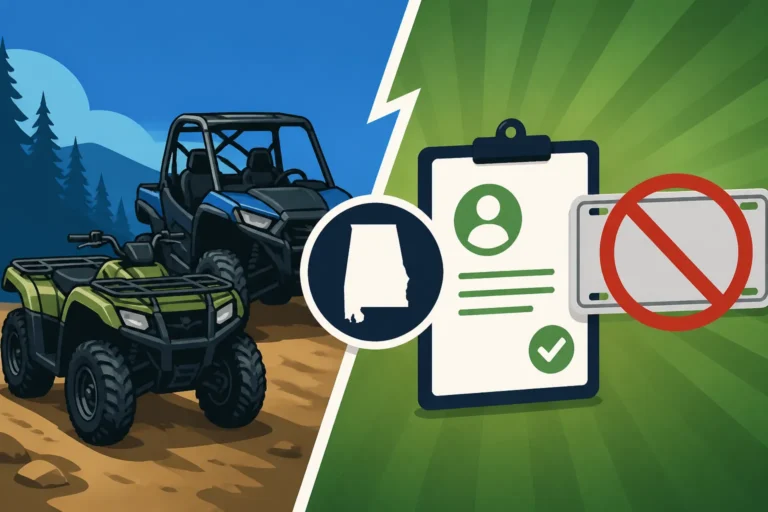
Why Pre-2026 Owners Do Nothing
It's easy to feel a little lost and overwhelmed when new laws come into play, especially when they involve something you already own, like your trusty ATV or side-by-side. Many folks in Alabama are scratching their heads about the state's new titling requirements for off-road vehicles, wondering if they need to rush out and get a title for their beloved quad that's been in the family for years. The good news for many is that the new law has a specific starting point, meaning if your machine is older than a certain model year, you likely don't need to do a thing about titling. This guide is here to clear up that confusion and explain precisely why pre-2026 ATV and UTV owners in Alabama don't need to worry about the new titling mandates.
Understanding Alabama's New Titling Law for ATVs and UTVs
Alabama has a rich history of off-road culture, from riding the trails at Stony Lonesome OHV Park to using a side-by-side on a family farm. For years, one thing has been consistent: off-road vehicles like ATVs and UTVs didn't have titles like cars or trucks. Ownership was typically proven with a bill of sale or a manufacturer's statement of origin (MSO). However, that's all changing with a new law that brings titling into the picture, but it's crucial to understand who it actually applies to.
The January 2026 Cutoff: What It Means for New Purchases
The new law, officially known as [Alabama's 2024 Titling Law], dictates that ATVs and UTVs model year 2026 and newer will be required to have a title. This means that if you walk into a dealership or buy privately starting January 1, 2026, and the machine you're looking at is a 2026 model or newer, it will need a title. This is a significant shift, creating a clear dividing line based on the machine's model year. For example, a brand-new 2026 Yamaha Wolverine purchased in February 2026 will absolutely need a title, and the dealer will likely handle the application for you, much like they would for a car or truck. Conversely, a 2025 Honda Foreman bought just a month earlier, even if new, would fall under the old rules.
This cutoff is designed to phase in the titling system rather than retroactively apply it to every off-road vehicle already out there. The state isn't trying to create a massive administrative burden by forcing everyone to title older machines. Instead, it's setting a forward-looking standard. This new process will involve applying for a title through your county licensing official, similar to how you would for a car. You'll need specific documentation, which is why understanding the details of [Alabama ATV Title Requirements for 2026] is so important for future buyers.
Why Older Machines Are Exempt from Titling
Here's the key takeaway for many Alabama off-road enthusiasts: if your ATV or UTV has a model year older than 2026, it is generally exempt from this new titling requirement. This means your 2020 Polaris RZR, your 2015 Kawasaki Brute Force, or that trusty 2008 Honda Rancher you've had for years will not need an Alabama title. The law specifically targets [A Model Year 2026 Machine] and anything manufactured beyond that point.
The reasoning behind this exemption is practical. Imagine the nightmare of trying to track down original MSOs or bills of sale for every single ATV and UTV sold in Alabama over the last few decades. Many machines have changed hands multiple times, and original paperwork can be lost or simply never existed in a formal, titled sense. By drawing the line at model year 2026, the state avoids this monumental task and focuses on creating a clear, trackable ownership record for future machines. So, if you're riding a [A Model Year 2015 Machine], you can breathe easy; the titling requirement simply doesn't apply to your ride. Your existing proof of ownership, like a bill of sale, continues to be sufficient for demonstrating who the machine belongs to.
Distinguishing Between Titling and Registration in Alabama
It's easy to conflate "titling" and "registration," especially when they both involve official paperwork and fees. However, in Alabama, they are distinct processes managed by different state agencies, and understanding this separation is vital for off-road vehicle owners. The new law introduces titling, but it doesn't fundamentally change the state's long-standing registration system for ATVs and UTVs. [Alabama Splits Titling and Registration Between Agencies], adding another layer of distinction.
Alabama's Voluntary ATV Registration Through ALEA
Alabama has had a system for off-road vehicle registration for quite some time, managed by the Alabama Law Enforcement Agency (ALEA). This registration is entirely voluntary, meaning you are not legally required to register your ATV or UTV unless you intend to ride it on public lands where registration is mandated. You might choose to register for various reasons, such as peace of mind, or to ensure you're compliant when visiting certain riding areas.
When you register your machine through ALEA, you receive a registration decal and card. This registration typically runs for [Three Years Instead of One], a convenient feature that saves you the hassle of annual renewals. There are also two tiers of registration: "public use" and "private use." The public use registration generally allows you to ride on designated public lands, while private use is for machines used exclusively on private property. Most people opt for private use if they don't plan on visiting state-managed trails or parks that require public registration. The important thing to remember is that this registration process, including fees and requirements, remains unchanged for all ATVs and UTVs, regardless of their model year. Even if you have a pre-2026 machine, you can still register it voluntarily through ALEA if you choose. For more details on the process, you can look into [Alabama's Voluntary ATV Registration Through ALEA].
The New Titling Process and How It Differs
Starting with model year 2026, the new titling process will be mandatory for eligible machines. Unlike registration, which is voluntary and managed by ALEA, titling will be handled by your county's licensing official, much like vehicle titles. The state's system for managing these titles is called [Alabama's ALVIN System and Off-Road Titles]. When you acquire a model year 2026 or newer ATV or UTV, you'll apply for a certificate of title through your local county office. This title serves as the official, government-issued proof of ownership, detailing the owner's name and any lienholders, which is a major benefit for financing and theft recovery.
The key difference for pre-2026 owners is that this new titling process simply does not apply to you. Your existing machines, being older than model year 2026, will not enter the ALVIN titling system. You won't be able to apply for a title for them, nor will you be required to. Your older machine will continue to exist outside this new titling framework, relying on your traditional proof of ownership. This distinction is vital for understanding [Why Pre-2026 Owners Do Nothing] regarding the new titling mandates. The goal of titling is to create a more robust ownership record for new machines moving forward, not to retroactively apply formal titles to every legacy off-road vehicle in the state.
Practical Implications for Pre-2026 ATV and UTV Owners
So, if you're a proud owner of a pre-2026 ATV or UTV in Alabama, what does "do nothing" actually mean in your daily life and in scenarios like selling or insuring your machine? It means you continue operating under the rules that have been in place for years, focusing on diligent record-keeping rather than awaiting a new government document.
Continuing to Rely on Your Bill of Sale and Other Proof of Ownership
For older machines that don't qualify for an Alabama title, your primary proof of ownership remains what it always has been: a solid paper trail. The most important document is a well-crafted [Alabama Bill of Sale Requirements]. This document should clearly identify the machine by its Vehicle Identification Number (VIN) or serial number, the buyer's and seller's information, the date of sale, and the purchase price. Think of it as your machine's birth certificate and ownership history all rolled into one. Without a title, this document is paramount, especially if you ever need to prove the machine is yours.
Beyond the bill of sale, other documents can bolster your claim of ownership. This might include the original manufacturer's statement of origin (MSO) if you still have it from the initial purchase, previous registration cards, or even comprehensive insurance policies that list your machine's serial number. If you're involved in a private sale, either buying or selling, it's always a good idea to use a detailed bill of sale. Resources like LawDepot offer templates that can help you create a legally sound document, ensuring all the necessary information is included. This practice helps to solidify your [Proving You Own an Untitled Machine], providing undeniable evidence in a world where formal titles are becoming the norm for newer machines. Even if you bought your quad at a farm sale years ago, any scrap of paper or record linking you to that machine is valuable.
When You Might Still Need Ownership Records for Insurance or Sale
Even though your pre-2026 machine won't have a state-issued title, robust ownership records are still incredibly important for several real-world situations. Let's say, heaven forbid, your machine is stolen. Without a title, law enforcement will rely heavily on your detailed bill of sale and serial number to help track and recover it. Having clear proof, potentially drafted with the help of a service like LawDepot, can make a huge difference in [Theft Recovery Without a Title]. Similarly, if you file an insurance claim, whether for theft, damage, or an accident, your insurance provider will ask for proof of ownership. They're not going to pay out on a machine that you can't definitively prove belongs to you. This might involve submitting your bill of sale, previous registration, or even photographs that clearly show your machine and its serial number. [Why Your Policy Should Name the Serial Number] is a detail often overlooked but critical for claims.
When it comes time to sell your pre-2026 ATV or UTV, a clear and comprehensive bill of sale is essential for the buyer. They will need it to prove their ownership, and a buyer is much more likely to trust a seller who can provide a professional, complete record of the transaction. A well-documented sale protects both parties. Without a formal title, your bill of sale is the cornerstone of the transaction, acting as the legal transfer of ownership. It's not just about proving you own it; it's about proving you have the right to sell it, and then providing the new owner with the proof they need.
Common Questions and Misconceptions for Legacy Owners
The introduction of any new law inevitably leads to questions and misunderstandings, especially when it creates a two-tiered system for machines. Pre-2026 ATV and UTV owners often have specific concerns about how the new titling law impacts their existing machines and their riding habits. Let's tackle some of those common questions.
Can I Voluntarily Title My Older Machine?
This is perhaps the most common question pre-2026 owners have, and unfortunately, the answer is generally no. The Alabama titling law for ATVs and UTVs is very specific: it applies only to machines of model year 2026 and newer. There is no provision in the current legislation for voluntarily titling older machines. The system, as designed, isn't set up to accept title applications for, say, a 2018 Can-Am Defender or a 2012 Suzuki KingQuad.
The reason for this strict cutoff, as mentioned before, is largely practical. Creating a retroactive titling system would be incredibly complex and resource-intensive, requiring owners to produce original documentation that may no longer exist, or to go through a potentially lengthy and expensive process to prove ownership of a machine that has never legally required a title. So, if you're thinking about proactively titling your older machine for peace of mind or future resale, the state's current system won't allow it. You'll need to continue to rely on your traditional proof of ownership, such as a bill of sale. For a deeper dive into why older machines are exempt, refer to [Why Older Alabama ATVs Cannot Be Titled].
What About Registration? Does That Change for Me?
Another major concern for many is whether the new titling law will somehow alter the existing voluntary registration system. The good news is that for pre-2026 owners, your registration status and options remain completely unchanged. Alabama's ATV and UTV registration, managed by ALEA, is still voluntary for all machines, regardless of model year. You can still choose to register your pre-2026 ATV or UTV for public or private use, and this process will continue to run for [Alabama Registrations Run Three Years].
The titling and registration processes are distinct. Titling establishes legal ownership with the state for newer machines, while registration provides a decal and a record for specific uses (like riding on public land) for any eligible machine. If you've been riding on private land and haven't registered your machine, you can continue to do so without penalty, just as before. If you plan to ride on designated public trails, you will still need to obtain a voluntary ALEA registration, but this isn't tied to the new titling law. Think of it this way: your pre-2026 machine exists outside the new title system, but it still exists within the voluntary registration system if you choose to participate. Information like [Alabama Public Use ATV Registration Explained] or [Alabama Private Use ATV Registration Explained] remains relevant for all owners.
Here's a quick comparison of how the new titling law impacts pre-2026 versus post-2026 machines:
| Feature | Pre-2026 Model Year ATVs/UTVs | Post-2026 Model Year ATVs/UTVs |
|---|---|---|
| Titling Requirement | No (Exempt) | Yes (Mandatory starting Jan 2026) |
| Proof of Ownership | Bill of Sale, MSO, Past Registrat. | State-issued Certificate of Title |
| Agency for Ownership | Private Records | County Licensing Official (ALVIN) |
| Voluntary Registration | Yes (through ALEA) | Yes (through ALEA) |
| Registration Term | Three Years | Three Years |
| Purpose of Titling | N/A | Legal Ownership, Lien Recording, Theft Prevention |
| Impact on Existing Machines | No Change to Ownership Records | New Machines Require Formal Process |
In summary, for those of you with a trusted off-road companion that's been around for a few years, the message is clear: when it comes to the new titling law in Alabama, you really don't have to do anything. Keep your existing paperwork in order, understand the voluntary registration system, and continue to enjoy the beautiful trails and lands Alabama has to offer.
Disclaimer
This article is for general informational purposes only and does not constitute professional advice. Laws, prices and regulations vary by location and change over time. Consult a qualified professional for guidance on your specific situation.