What the Seller’s Name and Address Prove
It’s easy to get swept up in the excitement of bringing home a new-to-you ATV or side-by-side, whether it's for tearing up the trails or getting serious work done on the farm. But amidst the thrill, many folks overlook a truly crucial detail: securing and verifying the seller's complete and accurate name and address. Trust me, skipping this step can turn your dream machine into a headache, leading to frustrating registration delays, questions about legitimate ownership, and even significant financial risks. This guide is here to walk you through exactly why the seller's name and address are absolutely vital for any off-road vehicle transaction in Alabama, protecting both you as the buyer and ensuring a smooth process.
Why Seller Information is Crucial for Proving Ownership
When you purchase an ATV or UTV in Alabama, even if it's a casual private sale, you're not just buying a machine; you're acquiring its history and, critically, the right to claim it as yours. The seller's information isn't just a formality; it's the anchor that connects you to that history, creating an unbroken chain of custody that proves you are the rightful owner. Without this clear line, you could find yourself in a really sticky situation, especially if the machine's past isn't as clean as you thought.
Establishing a Clear Chain of Custody
Think of the seller's name and address as the foundational link in your machine's ownership story. When you buy an ATV, that information, recorded on a bill of sale, explicitly states who transferred ownership to you and when. This creates a traceable paper trail. Without it, how do you definitively prove that you legally acquired the machine? Imagine a scenario where you buy a quad from someone you met in a parking lot. They seem nice, you hand over the cash, and they sign a quick receipt with just a first name. A few months later, a law enforcement officer pulls you over, runs the serial number, and finds it flagged as stolen. Your "receipt" with a vague name won't do much good to prove you bought it legitimately. You'd be in a terrible bind, potentially losing the machine and your money, all because that initial link in the chain was weak or broken. [Proving You Own an Untitled Machine] becomes incredibly difficult without solid seller details.
The Importance for Future Titling
While Alabama's titling law for ATVs and UTVs officially kicks off with model year 2026, making it not immediately applicable to older machines, the principle of clear ownership remains paramount. For those model year 2026 machines and newer, a proper title will be issued, and establishing clear ownership from the previous owner (or dealer) will be an absolute requirement. This means the seller's identity will be recorded and verified as part of the titling process. Even for machines that currently cannot be titled in Alabama because they are older, the future could always bring changes. Having robust seller information on your bill of sale today sets you up for success if and when titling becomes more widespread or retroactive. It also shows a clear path of ownership, which is something Alabama's new [How the ALVIN Titling System Handles an ATV] will surely demand.
Safeguarding Against Theft and Fraud
Perhaps one of the most sobering reasons to meticulously record and verify seller information is to protect yourself from inadvertently purchasing a stolen vehicle or falling victim to fraud. A legitimate seller will have no issue providing their full name and address and allowing you to verify their identity against a driver's license or other official document. This simple act of due diligence can save you immense heartache and financial loss. If you suspect something is off, or if the seller is cagey about providing their details, it should be a huge red flag. Your bill of sale, complete with the seller's specific identifying information, is your primary defense if the machine's legitimacy ever comes into question. It allows law enforcement to trace the transaction and helps you avoid being implicated in a crime. This is also why performing [Alabama Stolen Machine Checks] is so crucial, but even that requires a verifiable seller if issues arise.
The Role of Seller Details in Alabama's Registration Process
Even though Alabama's ATV and UTV registration is currently voluntary, it's a process that still requires a foundational level of proof of ownership. The state's agencies, particularly the Alabama Law Enforcement Agency (ALEA), need accurate information to maintain their records and ensure that the machines being registered are indeed owned by the person applying. Without proper seller details, your registration application can hit a wall, preventing you from legally utilizing your machine in ways you might intend, such as riding in designated public areas.
Meeting Alabama Registration Paperwork Requirements
When you go to register your ATV or UTV with ALEA, you'll find that the application form itself asks for information about the previous owner. This isn't just a suggestion; it's a requirement to process your application. Your bill of sale, which includes the seller's full name and address, serves as the primary document to satisfy this requirement. It confirms the transaction and who you acquired the machine from. If you show up to register without this vital information, or if the details are vague or incomplete, you're setting yourself up for an immediate rejection or, at the very least, significant delays. ALEA needs to establish a clear point of origin for your ownership claim. For a complete understanding of what's needed, it’s worth reviewing [Alabama Registration Paperwork Explained].
Ensuring Accuracy for Official Records
The state maintains records of registered off-road vehicles, and these records are only as good as the information submitted. When you provide the seller's name and address, you're contributing to an accurate database that helps track ownership changes over time. This accuracy can be crucial for various reasons beyond just your personal registration. For instance, if a machine is involved in an accident or a legal dispute, having precise ownership records helps authorities navigate the situation efficiently. An incorrect or fabricated address for the seller can create a ripple effect of problems. Imagine you provide a partial or incorrect address for the seller, and your registration documents are mailed out to a non-existent or wrong address. You won't receive your decal, and your legitimate claim to having a registered machine could be jeopardized, leading to more frustration and wasted time.
Facilitating Smooth Transfers of Ownership
Think ahead to when you might decide to sell your registered ATV or UTV. When that day comes, you will become the "seller," and the next buyer will need your accurate information to register the machine in their name. A seamless transfer starts with a clean record from your own purchase. If your initial acquisition lacked proper seller information, it complicates your ability to provide a robust chain of ownership to your buyer. This can deter potential buyers or even cause them to question the legitimacy of your machine, potentially impacting its resale value. Having a thoroughly documented initial purchase helps ensure that your eventual sale and the subsequent [Alabama Registration Transfer After a Sale] go as smoothly as possible, validating the integrity of your ownership history.
Protecting Yourself: Verifying Seller Identity and Information
Buying an ATV or UTV from a private seller requires you to be your own detective. Unlike a dealership where many safeguards are in place, a private sale puts the burden of due diligence squarely on your shoulders. Protecting yourself means not just getting the seller's name and address, but actively verifying that information to ensure it's legitimate and accurate. This proactive approach is your best defense against potential scams, stolen property, or future disputes.
The Bill of Sale: More Than Just a Receipt
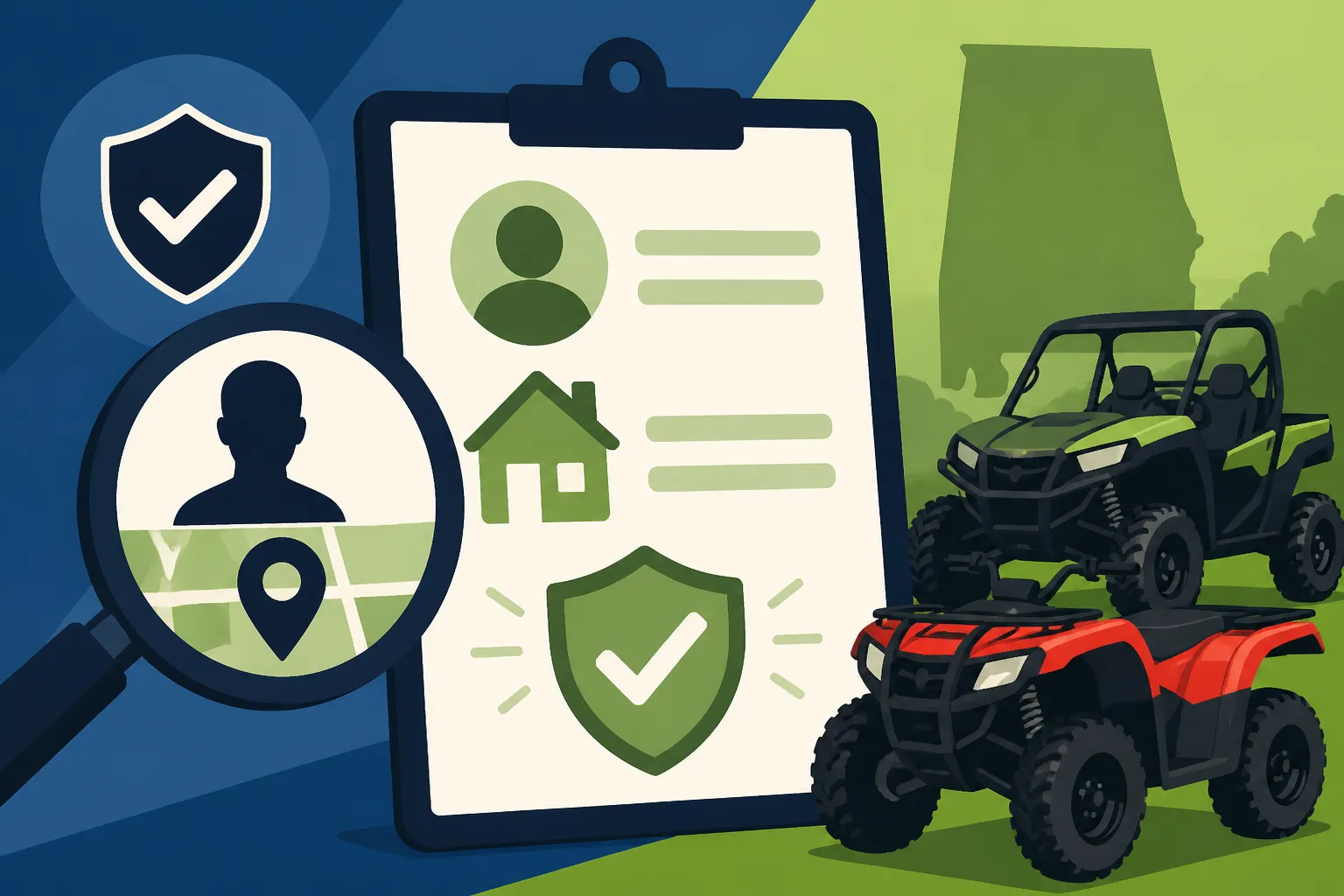
The bill of sale is arguably the single most important document in a private off-road vehicle transaction. It's not just a casual receipt; it's a legal document that formally transfers ownership and outlines the terms of the sale. For it to be truly effective, it must include comprehensive details about both the buyer and the seller, as well as the machine itself. This includes:
- Full legal names of both buyer and seller: No nicknames or abbreviations.
- Complete residential addresses for both parties: PO boxes are generally not sufficient for official records.
- Contact information: Phone numbers and email addresses.
- Date of sale: Crucial for establishing the timeline of ownership.
- Detailed machine description: Make, model, year, and most importantly, the Vehicle Identification Number (VIN) or serial number.
- Purchase price: Clearly stated.
- Signatures of both buyer and seller: In some cases, notarization might offer an extra layer of security, though not always required by law.
Using a reputable template, such as those available from LawDepot, can ensure you don't miss any critical fields. A well-crafted bill of sale is your proof of purchase and the foundation of your ownership claim. Remember, [Alabama Bill of Sale Requirements] specifically state the importance of including the serial number.
In-Person Verification and Due Diligence
Never, ever buy an ATV or UTV from someone who refuses to meet you in person or who won't provide identification. When you meet the seller, ask to see their government-issued photo ID, such as a driver's license. Compare the name and address on their ID to the information they've provided on the bill of sale. If there are discrepancies, ask for an explanation. If their story doesn't add up, or they become defensive, consider it a major red flag.
Meeting in a public place, like a bank parking lot or even at a county office, can add an extra layer of safety for both parties. Take your time during this process; don't feel rushed. Your goal is to confirm that the person selling you the machine is, in fact, who they say they are and that they appear to be the legitimate owner. For instance, if you're using a LawDepot template for your bill of sale, have it ready and politely ask the seller to fill in their details while you observe and compare.
When to Be Wary: Red Flags and Cautionary Tales
While most private sellers are honest, it's essential to be vigilant. Certain behaviors or situations should trigger caution:
- Vague or evasive answers about the machine's history: If the seller can't tell you where they got it, how long they've had it, or details about its maintenance, be suspicious.
- Reluctance to provide a proper bill of sale: Any seller who insists on a "handshake deal" or a bare-bones receipt without essential details is a risk.
- Pushing for a cash-only deal with no paperwork: While cash transactions are common, refusing any documentation is a problem.
- Meeting in an obscure, isolated location: This can be a safety concern and a tactic to avoid scrutiny.
- The price is "too good to be true": Unusually low prices can often indicate a problem, like a stolen machine or a significant undisclosed issue.
If you encounter any of these red flags, it's always better to walk away. The potential savings aren't worth the risk of buying a stolen machine, a lemon, or getting entangled in legal trouble. A comprehensive LawDepot bill of sale can alleviate many of these concerns by requiring full disclosure.
| Feature | With Verified Seller Information | Without Verified Seller Information |
|---|---|---|
| Proof of Ownership | Strong, verifiable chain of custody, easy to prove legitimate ownership. | Weak, difficult to prove legitimate ownership, vulnerable to challenges. |
| Registration | Smooth process, application likely accepted, official records updated accurately. | Roadblocks, delays, potential rejection, inability to register for public use. |
| Theft Protection | Strong defense against buying stolen goods, aids law enforcement in recovery efforts. | High risk of buying stolen goods, machine confiscation without compensation. |
| Future Sale | Easier resale, provides confidence to future buyers, higher perceived value. | Difficult resale, raises buyer suspicion, potential reduction in market value. |
| Dispute Resolution | Clear legal standing to pursue recourse for fraud or misrepresentation. | Little to no legal recourse, difficulty in identifying or locating responsible party. |
| Insurance Claims | Easier to process, clear proof of insurable interest. | Potential issues with claim validity, proving you own the machine for payout. |
| Peace of Mind | High confidence in your purchase, no lingering doubts about legitimacy. | Constant worry, uncertainty about the machine's true history or legal status. |
What Happens When Seller Information is Missing or Incorrect
The consequences of neglecting to secure accurate and complete seller information can range from minor annoyances to significant financial and legal headaches. It's not just about what might happen; it's about what will happen when you try to engage with official processes or if an unforeseen issue arises. Your investment in an ATV or UTV deserves to be protected with proper documentation from day one.
Registration Roadblocks and Delays
Let's say you've bought your machine, are excited to hit a local riding park like Stony Lonesome OHV Park, and dutifully fill out your ALEA registration application. If the seller information section is blank, incomplete, or contains details that can't be verified, your application will almost certainly be rejected. This means no registration decal, no legal access to designated public riding areas, and a lot of wasted time and frustration. You'll then be scrambling to track down a seller who might be unwilling or unable to provide the necessary information, or you might find yourself in the position of needing to prove [Alabama Registration Without a Bill of Sale], which is a much harder battle. These [Alabama Registration Processing Time] delays can easily extend for weeks or months, keeping you off the trails.
Challenges in Proving Legitimate Ownership
Beyond registration, having incomplete or false seller information leaves you incredibly vulnerable if your ownership is ever questioned. Imagine your machine is involved in an accident, or tragically, it's stolen from your property. When you file an insurance claim, your insurer will require proof of ownership. If all you have is a vague bill of sale, or worse, nothing at all, your claim could be denied or significantly delayed. Similarly, if law enforcement recovers your stolen machine, but you can't definitively prove it's yours due to inadequate purchase records, getting it back can be a nightmare. You might even lose your machine entirely. For example, [Insuring a Machine With No Title] is already a challenge, and lacking clear seller information only compounds it.
Legal Repercussions and Financial Losses
The worst-case scenarios, though less common, are significant. If you unwittingly purchase a stolen machine, and it's later identified by law enforcement, it will be confiscated, and you will likely lose your financial investment with little to no recourse. You could also face questioning or even charges yourself, depending on the circumstances, even if you were an innocent buyer. Without proper seller information, tracking down the original thief or fraudulent seller becomes nearly impossible.
Even in less extreme situations, like if the seller misrepresented the condition of the machine (e.g., claiming it had a new engine when it didn't), trying to pursue legal recourse is an uphill battle without accurate contact details for the seller. Your ability to recover any losses, whether through small claims court or other legal avenues, is severely hampered if you can't identify and locate the responsible party. This is where a clear and comprehensive LawDepot bill of sale, filled out completely and accurately, truly acts as a shield, protecting your investment and your rights. The absence of such documentation could leave you facing [Alabama Penalties for a Missing Title] or simply out of luck and out of pocket.
Disclaimer
This article is for general informational purposes only and does not constitute professional advice. Laws, prices and regulations vary by location and change over time. Consult a qualified professional for guidance on your specific situation.