Alabama Trail Volunteer Days
Finding an Alabama ATV or UTV trail volunteer day can be harder than finding a place to ride: events may be announced locally, postponed after rain, or limited to people who have checked in with the land manager. This guide explains how to find legitimate workdays, choose a useful task, prepare safely, and avoid damaging trails while trying to help.
What Alabama trail volunteer days involve
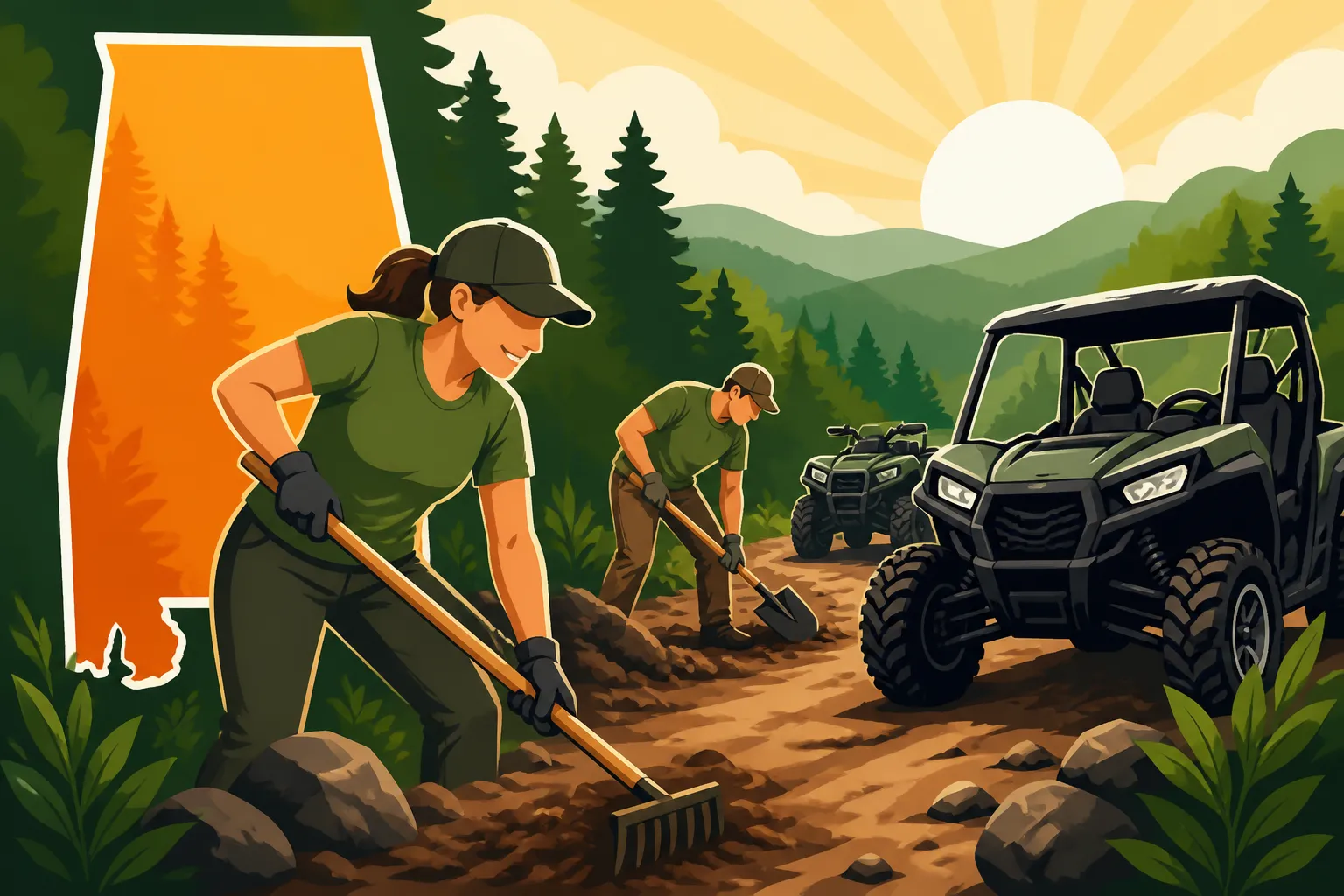
Trail work is not just picking up litter. A volunteer day might focus on clearing branches, improving drainage, repairing signs, documenting damage, or helping a riding area prepare for a busy season. The right task depends on the site, its rules, recent weather, and the skills of the people who organize the work.
Common volunteer tasks
Litter cleanup is often the most accessible assignment. It may involve walking a trailhead, parking area, or designated route with bags and gloves. Ask organizers how to handle sharp objects, fuel containers, or other potentially hazardous waste; do not pick up anything you cannot handle safely.
Brush and downed-limb removal can help keep a route passable, but it should be done only under direction. A limb that looks easy to move may be hung up, under tension, or blocking a drainage feature for a reason. Never bring or operate a chainsaw unless the organizer has approved it and you have the appropriate training and protective equipment.
Drainage and erosion work can make a particularly meaningful difference on Alabama’s red clay. Volunteers may help clear a water bar, direct runoff away from a trail, or stabilize a worn section. The goal is not to make a muddy route rideable at any cost. Work should follow the land manager’s plan so that water does not simply cut a new channel or carry sediment downhill. For more on why soil conditions matter, see [Treading Lightly on Erodible Alabama Clay].
Sign and route checks may involve recording a missing marker, damaged post, blocked gate, or confusing junction. Take notes and photos from a safe location, then report them through the organizer’s process. A volunteer should not move a sign, open a gate, or mark a new route without permission.
| Volunteer task | What it may involve | A useful question to ask first |
|---|---|---|
| Litter pickup | Collecting ordinary trash in an approved area | How should sharp or hazardous items be reported? |
| Brush clearing | Removing small debris under supervision | What may I move, and what must stay in place? |
| Drainage work | Clearing or improving water-control features | Which tools and methods has the land manager approved? |
| Sign checks | Reporting damaged or unclear markers | Where should photos and location details be sent? |
| Trail observation | Noting washouts, hazards, or closures | Which routes are open to volunteers that day? |
Where to look for organized workdays
Start with the riding area or land manager, rather than arranging a work party on your own. A private park, county recreation area, public-land unit, and trail club may each have different procedures for volunteer access. Contact the site directly and ask whether it has an approved workday, who is coordinating it, what tasks are needed, and whether advance registration is required.
In north Alabama, riders may be familiar with places such as Stony Lonesome OHV Park and Minooka Park. Their existence does not mean that either site has a volunteer day scheduled or accepts unannounced work crews. Confirm directly with the park before making plans. The same principle applies to routes and recreation areas near Talladega or in the Bankhead region: public access does not automatically authorize trail maintenance.
Local clubs can also be a useful starting point because they may know which land managers welcome volunteer help. Check [Alabama ATV Clubs Worth Joining] for ways to connect with riding groups, then ask whether a club is coordinating an authorized project. A club’s informal ride or cleanup idea is not a substitute for permission from the person responsible for the property.
How to find and confirm an opportunity
A volunteer day is most useful when it solves a real maintenance need and fits the land manager’s plan. A little preparation can prevent the frustrating experience of towing to a trailhead only to discover that the event was postponed, the work area is closed, or volunteers need to check in somewhere else.
Contact the organizer before you travel
When you reach out, ask concise, practical questions. Find out where to meet, what time to arrive, whether the work is on foot or involves riding, what tools are supplied, and what clothing or protective equipment is required. Also ask whether minors can participate, whether a waiver is involved, and how weather-related changes will be communicated.
Do not assume that a trail open for recreational riding is also open for volunteer work. A route may be closed for restoration, hunting-season access, construction, or another management reason. If you are unsure which routes are currently available, review [Alabama Trail Closures After a Storm] and confirm conditions with the site before setting out.
Ask whether the organizer wants volunteers to bring machines. In some projects, an ATV or UTV may be useful for transporting approved supplies; in others, it may be unnecessary or prohibited. Never ride into a closed section to “check it out,” even if the machine would make the work easier. For route-planning context, [Alabama Trail Conditions Before You Tow] can help you think through what to confirm before a trip.
Use maps as a planning aid, not permission
A mapping app can help you understand the general area, plan the drive, and save a route for reference. Some riders use onX Offroad to review mapped riding areas and prepare for trips. Treat any digital map as a planning aid, not proof that a route is open, legally accessible, or approved for volunteer work. Boundaries and trail status can change, and private property may be close to public routes.
If you use onX Offroad or another mapping tool, compare what you see with the organizer’s instructions and posted information at the site. Save the correct meeting point, but follow the designated check-in process rather than navigating straight to a work area. Keep your phone charged, and do not rely on cellular service being available in a remote area.
Share your location notes carefully. A photo of a washout or damaged sign can help a coordinator, but posting precise access details publicly may create problems if the route is private or closed. Send observations to the person responsible for the project, and let that person decide whether the information should be shared more widely.
Prepare for the workday and protect yourself
Volunteer work can be physical, muddy, and exposed to changing weather. The safest approach is to learn what the day involves before packing, and to be honest about your experience and physical limits. You can still contribute if you are not comfortable using tools or walking a long distance; organizers may have observation, check-in, or cleanup tasks that fit better.
Bring practical clothing and supplies
Wear sturdy closed-toe footwear with traction, long pants, and gloves suited to the task. Alabama weather can feel hot and humid, while shaded trail sections may still be wet or slippery. Bring drinking water, sun protection, and any personal medication you may need. Ask the organizer whether eye protection, hearing protection, high-visibility clothing, or other equipment is required.
Do not assume the work crew will provide every item. Before leaving home, confirm what tools are supplied and whether volunteers should bring hand tools. If you bring a tool, keep it secured during transport and use it only after the coordinator approves it. For a day that includes riding, check the park’s rules for helmets, passengers, sound, and permitted machines rather than assuming ordinary trail habits apply during a work event.
A machine can create more problems than it solves if it is too wide for a narrow route, too heavy for soft ground, or not approved for the task. Ask what vehicle access is allowed and whether the work area has a designated staging point. If you are joining a crew with several riders, review [Alabama Group Ride Planning] and agree on how the group will stay together and communicate.
Follow the crew leader’s directions
At check-in, listen to the safety briefing even if you have volunteered elsewhere. The site may have specific instructions about gates, wildlife, tools, weather, first aid, or areas to avoid. Make sure you know who is leading the crew and how to contact that person if you become separated or notice a hazard.
Stay with your assigned task and within the work area. Do not cut a new bypass around mud, widen a trail to make it easier, or alter a berm or drainage feature because it seems convenient. An improvised fix can redirect water, damage vegetation, or encourage riders to use a route that the manager is trying to protect. Follow posted closures and the organizer’s boundaries.
Good trail manners matter during volunteer work just as they do during a ride. Yield where appropriate, keep equipment and materials out of the travel path, and avoid blocking access for other authorized users. [Alabama Trail Etiquette Locals Expect] offers useful context for sharing riding areas respectfully.
Make your help useful beyond one event
A single workday can improve a small section of trail, but lasting maintenance depends on accurate reporting, respectful use, and returning only when invited. Volunteers help most when they support the site’s priorities instead of making changes based on personal preference.
Report problems without taking unauthorized action
If you spot a dangerous washout, fallen tree, damaged sign, or blocked route, record the location as clearly as you can and notify the coordinator. A photo can be helpful, but take it from a safe position and do not step into unstable ground to get a better angle. If the issue presents an immediate danger, tell the organizer promptly rather than waiting until the end of the day.
Do not post a route around a closure or share instructions for bypassing a gate. Closures can protect riders, allow repairs, or prevent additional environmental damage. A well-intended social media post can send more traffic into a fragile area before managers have a chance to address it.
Likewise, do not assume that trail work gives you permission to ride a route later. The event’s access conditions may apply only to the workday, and a volunteer assignment does not replace a park pass, permit, waiver, or landowner’s permission. Before your next ride, check the site’s current rules and the route’s status.
Keep showing up in ways that fit
If the workday goes well, ask how the organizer prefers to communicate future needs. Some crews need people who can help with cleanup; others may benefit from experience in first aid, mapping, equipment operation, or event support. Do not overstate your qualifications. It is better to say you are new to trail work and ask for a suitable task than to take responsibility for equipment you have not been trained to use.
You can also help between events by riding responsibly, reporting damage through the right channel, and encouraging other riders to respect closures. [Alabama Trail Closures After a Storm] is a useful reminder that wet conditions can make routine riding especially hard on vulnerable surfaces. When a trail is closed or visibly saturated, waiting for it to recover may protect the route better than attempting a quick repair after more traffic passes through.
If you want to understand what a volunteer crew is trying to improve, learn about route difficulty and site expectations before you go. [Alabama Trail Difficulty Ratings] can help you match your riding plans to your ability, while [Alabama Trail Etiquette Locals Expect] reinforces the habits that keep shared areas welcoming. The best volunteer contribution is not always a dramatic repair. Sometimes it is careful observation, following instructions, and leaving a trail in better shape than you found it.
Disclaimer
This article is for general informational purposes only and does not constitute professional advice. Laws, prices and regulations vary by location and change over time. Consult a qualified professional for guidance on your specific situation.