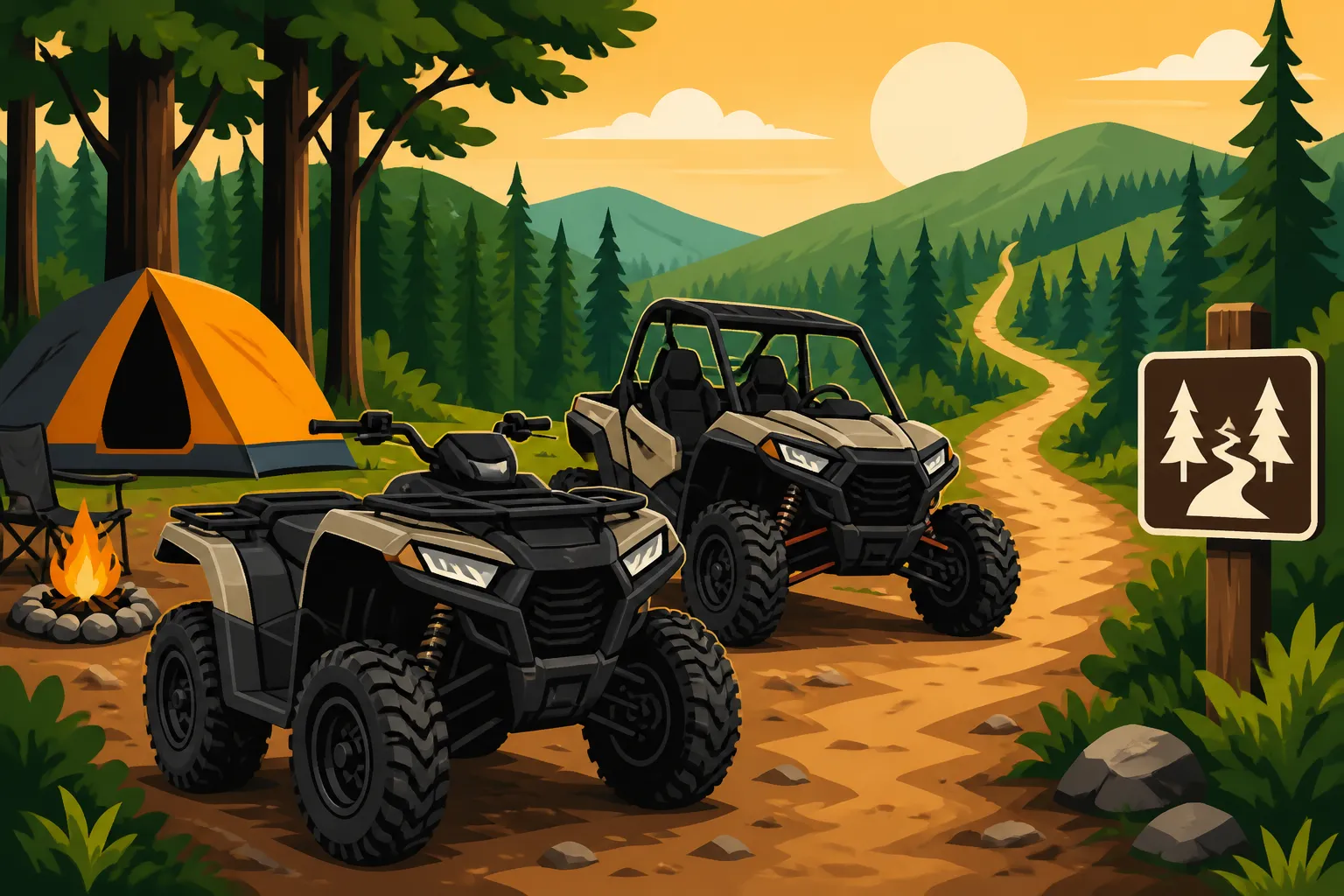
Alabama Campgrounds Next to a Trailhead
Finding a campground beside an Alabama ATV trail can save you a long tow each morning, but “near the trail” does not always mean you can ride directly from your campsite. This guide explains where to start looking, how to compare camping and trail access, and what to confirm before you pack the side-by-side.
Alabama campgrounds with trail access
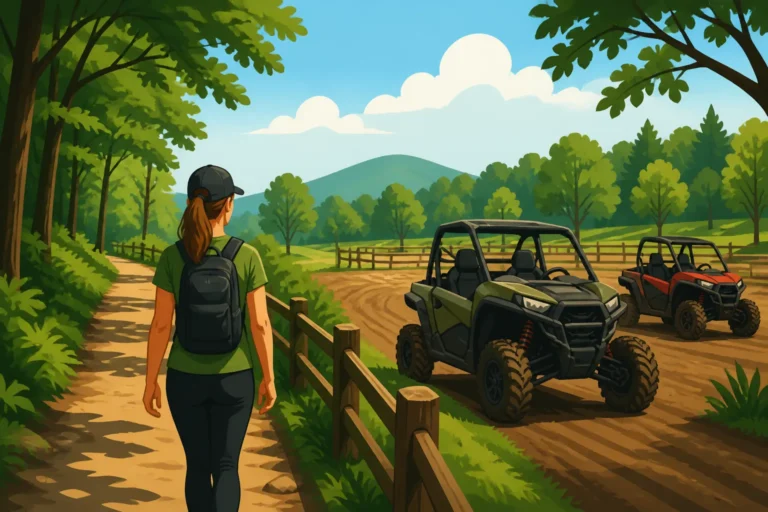
The easiest setup is usually camping inside or immediately beside a riding area. You can unload once, keep the trailer parked, and spend less time coordinating vehicles between a campground and a trailhead. But facilities, riding access, and park rules are separate questions: a campground can be close to trails without allowing campers to ride between the two.
Before booking, ask whether your campsite is inside the riding property, whether machines can travel from the campsite to the trail system, and whether you need to register or check in separately for riding. It’s also worth asking where trailers can be parked and whether the campground has any machine-specific restrictions.
Stony Lonesome OHV Park in Bremen
Stony Lonesome OHV Park is a useful place to investigate if your priority is combining camping with organized off-highway riding. It is in Bremen, in Cullman County, and is known for a sizable trail network. The park has offered camping options, including full-hookup sites, but the available facilities and reservation details are the kind of information to confirm directly before making the drive.
When you call or check the park’s current information, be precise about what you need. “Do you have camping?” may not get you the answer you need if you’re bringing a large trailer, want hookups, or need a site for a group. Ask whether the site accommodates your trailer and tow vehicle, whether the campground is accessible to your machine, and whether riding access is included or handled separately.
Also ask about the terrain and trail difficulty. A group with novice riders or young children may be happier planning shorter loops and taking breaks than setting out to cover as much ground as possible. For more on the park itself, see [Stony Lonesome OHV Park in Alabama]. If you’re comparing how much trail time you can realistically fit into a visit, [Riding 150 Miles Inside One Park] can help you think beyond a map’s mileage total.
Minooka Park and nearby camping
Minooka Park in Chilton County is another Alabama riding destination to consider, especially if you’re planning around the Jemison area. Don’t assume, though, that every place to stay nearby is connected to the riding property. A campground may be a short drive away, but you could still need to tow your machine to the park each day.
That distinction matters when you’re traveling with children, sharing a campsite with friends, or hoping to avoid repeated loading and unloading. If you find lodging or a campground near Minooka, ask for the actual driving route to the riding entrance, not just the distance between two map pins. A close-looking route can involve roads that are unsuitable for an ATV or UTV, and proximity does not create permission to ride on public roads or across private land.
A practical planning approach is to identify the riding area first, then compare nearby places to sleep by road access, trailer space, and the amenities your group really needs. [Minooka Park Riding in Alabama] is a helpful starting point for understanding the park. For the broader local picture, [Alabama Riding in Chilton County] can help you explore the area around your planned ride.
Nearby campgrounds are not automatically trail-connected
A campground can be “next to” a trailhead in several different ways. It might sit within an OHV park, border public land, be a short drive away, or simply appear close on a map. Those arrangements have very different implications for unloading, access, and whether your machine can legally travel from your campsite to the trail.
Use a map to screen possible campsites, then confirm the details with the campground and riding-area operator. onX Offroad can help you study routes and terrain while you plan, but a mapped line should not be treated as proof that a road or trail is open to your machine. Check the land manager’s rules and any local restrictions before relying on a route.
If camping inside the riding area is unavailable, ask whether the nearest campground has a safe, practical place to park a trailer. Also check whether the route from camp to the riding area is one your tow vehicle can handle. A few extra minutes of driving may be much easier than arriving at a narrow or poorly suited entrance with a loaded trailer.
How to choose a campground for an ATV trip
The best campground is not necessarily the one closest to a trailhead. It’s the one that fits your group, your machine, your trailer, and your preferred style of camping without creating avoidable problems once you arrive.
Start with the basics: Can you get in and out with your full setup? Is there room to turn around? Can you park the ATV or UTV securely? Are there quiet hours or other rules that affect your plans? A campsite that looks ideal for a tent-and-car trip may be awkward for a long trailer and a side-by-side.
Compare camping setups before booking
Use the table below as a shortlist tool. It describes common setups rather than promising that a particular facility has a specific amenity. Confirm availability and rules with the campground or riding-area operator.
| Camping setup | Why it can work well | What to confirm |
|---|---|---|
| Camping within an OHV park | Less daily towing and easier access to riding | Whether riding is allowed from the campsite and how check-in works |
| Campground near a riding area | More choice of places to stay and amenities | Driving distance, trailer parking, and whether roads are suitable for your tow vehicle |
| Public campground near forest riding | A quieter base for exploring permitted routes | Which roads are open to your machine and whether riding is allowed on the route |
| Private campground or cabin | Convenient for groups who want more comfort | Machine storage, parking, access rules, and travel time to the trailhead |
| Primitive camping | A simpler option for riders who are prepared to be self-sufficient | Site access, water availability, waste rules, and fire restrictions |
A phone call can clarify details that a booking page doesn’t spell out. Explain the size of your trailer, the number of machines, and whether you need electric and water hookups. If you’re traveling with several households, ask whether the campground can place sites together or if your group needs to book separately.
If you’re planning a longer stay, consider what happens on a non-riding day. A campground beside a trail may be perfect for a focused weekend, but families often appreciate nearby food, fuel, walking options, or a place to buy supplies. For a wider comparison of places to stay, see [Alabama Campgrounds Next to a Trailhead] alongside [Alabama Parks With Full Hookup Sites].
Check access rules before treating a map as permission
Alabama riding access can depend on who manages the land and what specific roads or routes are open. A campground’s proximity to a national forest, wildlife management area, timber road, or private trail system does not mean you can ride there freely. A route visible in a mapping app may be closed, limited to another vehicle type, or located on land where you do not have permission to ride.
Use onX Offroad or another mapping tool as part of your research, not as the final word. Look for route details, boundaries, and possible connections, then verify what is open with the relevant land manager or riding-area office. For federal land, [Alabama National Forest Riding Permits] and [Which Forest Roads in Alabama Are Open to ATVs] are useful topics to review before you plan a route.
If your camping plan depends on riding from your site to the trail, ask the operator to describe the approved connection. Is it a designated route? Does it require crossing a public road? Is it available to ATVs and UTVs, or only certain vehicles? Getting a clear answer before arrival is much easier than discovering that your campsite and trailhead are close but disconnected.
Planning the trip around Alabama conditions
A campground that works beautifully in one season can be less convenient in another. Heat, rain, clay, hunting activity, and park schedules can all affect how much riding your group can comfortably do. Build flexibility into the plan instead of assuming every trail day will go exactly as expected.
If you’re hauling from Birmingham, Huntsville, Montgomery, or farther away, the last hour of the trip can be tiring. Choose a campsite with a straightforward entrance and enough room to unload safely. If the route to camp includes narrow roads or steep grades, check those details before towing a large trailer.
Allow for weather and changing trail conditions
Alabama’s red clay can become slick after rain, and wet ground can make some routes difficult or vulnerable to damage. Even if the campground remains accessible, a trail may be muddy, closed, or less suitable for a new rider after heavy rain. Confirm conditions before leaving home and again before unloading.
Bring equipment that matches the trip rather than packing for every possible emergency. A basic tool kit, recovery strap, tire repair supplies, gloves, and drinking water can make a long day less stressful. If your group is riding in wooded or hilly areas, keep a paper map or offline navigation option available in case phone service is weak. [Alabama Trail Closures After Rain] and [Alabama Trail Conditions Before You Tow] offer useful planning context.
Heat deserves equal attention. A humid day on the trail can wear riders down faster than expected, particularly children and anyone new to riding. Plan shade and water breaks, and don’t make the first loop of the trip your longest one. For seasonal considerations, see [Alabama Riding Season Considerations].
Make a campsite checklist for machines and people
A little preparation can prevent the frustrating arrival-day scramble of searching for a place to park, discovering you’re short on supplies, or realizing the campsite setup doesn’t suit your group. Keep one checklist for the campsite and another for the machine.
For the campsite, confirm your reservation details, arrival procedure, trailer parking, hookups, restroom access, quiet hours, and rules for fires or generators. Ask whether you need to bring drinking water or supplies for waste disposal. If you’re staying at a private campground, make sure you understand its policies for pets, guests, and machine use.
For the riding day, plan a route that matches your least experienced rider, bring protective gear, and agree on a meeting point if the group gets separated. Store keys, phones, and essential documents somewhere secure while riding. onX Offroad can help you organize route ideas in advance, but save the details you need for offline use where available and verify access rules before following a route.
A simple booking and arrival plan
A good trip plan doesn’t need to be complicated. It just needs to answer the questions that could otherwise turn into surprises at the gate or campground.
- Choose the riding area first. Decide whether Stony Lonesome, Minooka, or another destination fits your group and machines.
- Find camping options near that specific area. Separate campsites inside the riding property from nearby campgrounds that require daily towing.
- Confirm access directly. Ask whether riding from camp is permitted, which routes connect to the trails, and whether additional check-in is needed.
- Check trailer and machine logistics. Share your trailer size, number of machines, and hookup needs when you contact the campground.
- Review land and route rules. Confirm that each route is open to your vehicle type and that you have permission to use it.
- Recheck conditions before departure. Weather, closures, and campground arrangements can affect the trip, so verify the details close to your travel date.
When you arrive, take a few minutes to locate the campground office or check-in point, identify the approved route to the riding area, and review any posted rules. If the route or access instructions differ from what you were told, stop and ask before riding. A small delay is far better than accidentally entering a closed area or crossing land without permission.
For more ideas on how to build a trip around trail access and camping, explore [Alabama OHV Camping With Trail Access]. If you’re choosing between destinations farther apart, [Alabama North and South Riding Compared] can help you think through the broader travel plan.
Disclaimer
This article is for general informational purposes only and does not constitute professional advice. Laws, prices and regulations vary by location and change over time. Consult a qualified professional for guidance on your specific situation.