Alabama WMA Rules Vary by Area
Alabama wildlife management areas do not operate under one simple, statewide riding rule. Access can depend on the tract, the route, the season, and the permit required that day. Before loading your ATV or UTV, use the area’s current map and rules to confirm that your machine and planned ride are allowed—not just that the WMA is open.
Why WMA rules can differ from one area to another
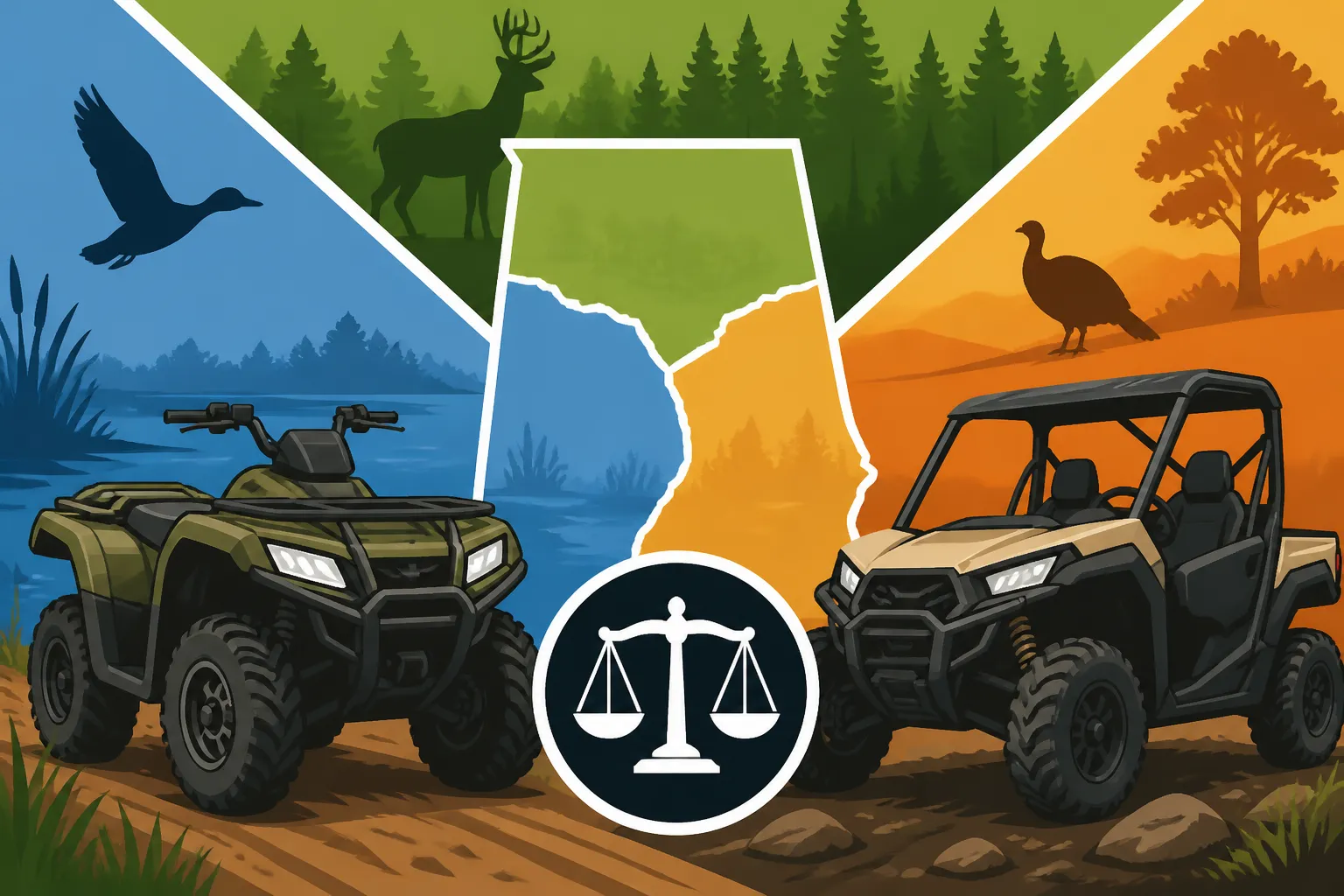
A wildlife management area, or WMA, is managed for wildlife and public recreation under rules that can change by location and season. A rule that applies on one tract may not apply on another, even if both are in Alabama and managed by the same state agency. Access may also be restricted within a single WMA: one road might be open to certain vehicles while nearby land, trails, or roads are closed.
That is why a general statement such as “ATVs are allowed on WMAs” is not enough to plan a ride. It can leave out the conditions that matter most, including:
- Which roads or routes are open to motorized use
- Whether the route is open to ATVs, UTVs, or both
- Whether riding is limited to particular dates, seasons, or activities
- Which license or permit is required for the area
- Whether riders must check in or out
- Whether temporary closures or signs change access
The area’s official map and current rules are the practical starting point. Treat them as part of your ride plan, not as optional background reading. For an overview of how rules and access can differ across WMAs, see Alabama WMA Rules Vary by Area and [Alabama WMA Riding Rules for Quads].
A WMA is not automatically an ATV riding area
A WMA may be open to the public for some purposes without being open for unrestricted off-road riding. “Public access” does not mean that every road, trail, field, or timber track is available to every vehicle. The area can have distinct rules for hunting, wildlife viewing, foot travel, and motorized travel.
Likewise, an existing road on a map does not necessarily mean it is open to ATVs. It could be closed to vehicles, reserved for a particular use, or open only during a specified period. A route may also be open for travel but subject to limits on where you can leave it. Staying on a marked or designated route matters; a shortcut across a field or around a gate can take you outside the permission the rules provide.
The key question is not simply, “Is this WMA open?” Ask instead: “Is this specific route open to my type of machine, on this date, under the permit I have?”
Rules can change with the season and the activity
Wildlife management priorities shift through the year. Hunting seasons, habitat work, construction, fire restrictions, and other management needs can affect access. A road available for a ride at one time may be restricted later, and a general map may not show every temporary change.
Hunting access and machine access are related but not interchangeable. A hunting license or area permit does not automatically make every road rideable. Conversely, having permission to travel on an open route does not necessarily give you permission to hunt or enter a restricted area. If your ride is connected to hunting, review Alabama Hunting Season and Trail Access as well as the rules for the particular WMA.
What to check before taking a machine onto a WMA
Use the latest official information available for the area and the date you plan to visit. The Alabama Department of Conservation and Natural Resources’ Wildlife and Freshwater Fisheries Division provides WMA information, but riders should still confirm the details for the tract they intend to enter. Area-specific instructions may be published with a map, permit, posted notice, or other official update.
The following table shows what to verify. It is not a substitute for the rules of an individual area; it is a checklist for reading them carefully.
| What to verify | Why it matters | What to look for |
|---|---|---|
| Exact WMA and tract | Rules can differ between areas and even between sections of an area | The official area name, boundary, and tract details |
| Open route | A road or trail may be closed to motorized travel | Route markings, legends, closures, and posted signs |
| Machine type | Rules may distinguish between vehicle types or uses | Any wording about ATVs, UTVs, off-highway vehicles, or motor vehicles |
| Dates and season | Access may be limited to certain periods or change during hunting seasons | Effective dates, seasonal schedules, and temporary notices |
| Permit or license | Different permissions may apply to different kinds of access | Required WMA license, area permit, daily permit, or other authorization |
| Check-in instructions | Some areas may require a specific check-in or permit procedure | App, kiosk, paper permit, or other listed method |
| Route limits | Permission to use one road does not necessarily allow travel off it | “Open roads,” designated routes, gate restrictions, and boundary notes |
| Current field signs | Temporary changes may not be reflected in an older copy of a map | Signs, barricades, closed gates, and posted notices at the site |
If the map or permit uses a term you do not understand, do not assume it grants broad access. Look for definitions or contact the area office or biologist before you ride. Alabama Area Biologists and Their Maps explains why area-specific maps and local guidance can be useful.
Check the date on the map and rules
A map can be accurate for the purpose it was made for and still not answer whether a route is open today. Check its issue date, effective period, and any accompanying notices. If you have an older paper map from a previous trip, do not rely on it as the only source.
Look for a separate season schedule or current notice, especially if your trip falls during a hunting season or another period when access may be limited. If online information and a sign at the entrance appear to conflict, pause and confirm the current rule with the appropriate area contact. Do not treat an old screenshot, social-media post, or another rider’s recollection as permission.
When you print a map, keep it readable and protected from rain and mud. A clear map sleeve from an outdoor retailer or Amazon can help keep the route information usable on the trail. A printed copy is also useful if your phone loses reception or its battery runs low.
Permits, licenses, and registration are different things
Riders often use the word “permit” to describe several kinds of paperwork. On a WMA, it is important to identify what each document authorizes. A permit or license related to WMA access is not necessarily a vehicle registration, and neither should be assumed to replace the other.
A WMA license or area permit may relate to entering or using a particular management area under its rules. A daily permit, where required, may have its own instructions for the date and area. Vehicle registration concerns the machine and its registration category. Proof of ownership, insurance, or a riding-park waiver are separate matters again. Carrying one document does not automatically satisfy the others.
For details on the kinds of WMA permissions that may apply, see What a Wildlife Management Area Permit Covers, Alabama WMA Area Permits, and [Alabama WMA Daily Permits]. If you are unsure what you need for a specific trip, How to Get an Alabama WMA Permit can help you work through the permit process. For a focused packing list, see Which Permits to Carry on an Alabama WMA.
A permit does not create an open route
A common mistake is to treat a valid permit as permission to ride anywhere within the WMA. The permit may allow a type of access, but the area rules still determine where and when you can travel. If the route is closed, outside the designated area, or restricted to another use, the permit does not make it open.
The reverse is also important: finding a route that appears open does not necessarily mean you have completed any required permit or check-in steps. Read both the access instructions and route rules. The permissions work together; one does not cancel the other.
Residents and visitors should check the same area rules
A machine’s home state does not tell you which routes are open on an Alabama WMA. Riders visiting from another state should check Alabama’s current requirements for the area and the type of access they plan to use. Do not assume that an out-of-state registration, permit, or hunting credential automatically satisfies every Alabama WMA requirement.
For more on the limits of permits across public and private land, see Alabama Public Land Rules Compared to Private. If you are bringing a machine from another state, Alabama Rules for an Out-of-State Machine may also help separate rules for the machine from rules for WMA access.
How to read area maps, signs, and route restrictions
Start with the map’s legend, not just the lines. Different line styles, colors, symbols, and labels can indicate different types of roads or access. A thin line may show a road but not state that it is open to motorized vehicles. A route label may apply only to a particular user or season. Make sure you know what each symbol means before you plan a loop.
Then check the boundaries. It is easy to follow a road that crosses between a WMA and adjoining land, especially where the boundary is not obvious from the trail. Permission to use a route within the WMA does not establish permission to continue onto neighboring private property or another restricted area. Turn back where the official boundary or closure requires it.
“Open roads” is a limitation, not a suggestion
If the rules confine machines to open or designated roads, stay on those roads. Do not ride around a gate, create a new route, or cross a field because the ground looks passable. A closed gate can indicate a legal restriction, a temporary closure, or a safety and management concern. It is not an invitation to find a way around.
An open road also may not permit every activity. The WMA could allow travel along a road while restricting side trips, stopping in sensitive areas, or traveling during particular periods. Follow the full rule rather than relying on one phrase in isolation. For more on this specific restriction, see Machines Confined to Open Roads.
Read signs when you arrive
Signs at an entrance, junction, gate, or closed route can provide important information that was not part of the map you reviewed. Pay attention to dates, vehicle restrictions, route closures, and instructions about permits or check-in. If a sign clearly closes a route, do not use it merely because an older map shows the road.
Signs also help you confirm that you are on the intended route. If you reach a junction and cannot tell whether your planned route continues, stop in a safe place and check the map rather than guessing. A wrong turn can take you beyond the permitted route or into a different landowner’s property.
Keep an offline copy of relevant route information on your phone, but do not rely on the phone alone. A compact power bank from Amazon can help keep a device charged during a long day, though it does not solve a no-signal problem. A printed map in a protective sleeve is a useful backup. If you buy trail gear through Amazon, check that the item suits your machine and can be secured safely; loose accessories can become distractions or hazards while riding.
A practical process for planning an Alabama WMA ride
A short check before departure can prevent a long drive to a closed route or a problem once you arrive. Use this sequence for the specific WMA you intend to visit.
- Identify the exact area. Confirm the official WMA name and the tract or section you plan to enter. Similar names or adjacent areas can make it easy to consult the wrong map.
- Find current official rules. Use the area’s current map, permit information, and notices. Check effective dates and look for temporary closures.
- Confirm that your machine is covered. Look for the wording that applies to your vehicle type. If the rule is unclear about an ATV or UTV, ask before traveling.
- Trace the route. Mark the roads or routes that are specifically open to motorized use. Check whether the route crosses an area boundary or reaches a closed gate.
- Check season-specific limits. Review hunting-season and area-use notices for your planned date. A route or activity may have a time restriction that does not apply year-round.
- Complete required permit steps. Obtain the correct license or permit and follow any check-in or check-out instructions. Keep any required confirmation available while you are there.
- Confirm at the entrance. Read posted signs and compare them with your plan. If a sign, gate, or barricade changes access, follow the on-site restriction and seek clarification before proceeding.
- Stay on the authorized route. Do not improvise a detour onto an unmarked road, closed route, or adjoining property. Turn around if you cannot confirm that the route remains open.
If you are going with a group, make sure every rider understands the route and permit conditions. It is not enough for only the trip leader to know where the group is allowed to go. Share the map, closure details, and meeting point before you lose cell service. A waterproof document pouch from Amazon can be useful for carrying a printed map and permit paperwork together, but keep original or required documents protected according to the permit instructions.
When information is unclear
If the map, permit, and signs do not give a clear answer, contact the relevant WMA office or area biologist before riding. Provide the exact area name, planned date, machine type, and route you want to use. A focused question is more useful than asking generally whether “ATVs are allowed.”
For example, ask whether a specific road is open to your type of machine on the planned date, whether you need a daily permit, and whether there are seasonal restrictions. Write down the answer and the date you received it. If you still cannot confirm access, choose a route or riding area with clear, current authorization rather than testing the boundary in the field.
Do not rely on another rider’s experience as a substitute for current instructions. They may have visited a different tract, ridden under a different season’s rules, or used a permit that does not apply to your trip. Official area information and signs are the safer basis for a decision.
Common mistakes that can spoil a WMA ride
The most avoidable problems usually come from assuming that a general permission applies everywhere. These are the assumptions to leave behind:
- “The WMA is open, so the whole area is open to machines.” Access may be limited to named routes, dates, or activities.
- “I have a permit, so I can ride wherever I can fit.” A permit does not override road closures or route restrictions.
- “The map shows a road, so it must be open.” A map may show infrastructure without granting motorized access.
- “The gate is open, so the road is open.” An open gate is not always a statement of permission. Follow official rules and posted signs.
- “The route was open on my last visit.” Rules and conditions can change between trips.
- “A hunting license covers every kind of WMA access.” Different activities may have separate requirements.
- “The state permit covers private land nearby.” WMA access does not grant permission to cross neighboring private property.
- “A registration document is my WMA permit.” Vehicle paperwork and area-access paperwork serve different purposes.
Before you unload, pause for a final check: the right area, the right date, the right permit, and a route that is explicitly allowed for your machine. If any one of those is uncertain, resolve it before riding. That small amount of planning is easier than dealing with a closed route, a missed permit step, or an access problem miles from the trailhead.
For the broader process of checking permissions before a trip, see Three Things You Need Before Riding a WMA. If you want to understand the daily-permit steps in particular, Alabama WMA Daily Permit Steps offers related guidance.
Disclaimer
This article is for general informational purposes only and does not constitute professional advice. Laws, prices and regulations vary by location and change over time. Consult a qualified professional for guidance on your specific situation.