Firearms Carried on a Machine
Navigating the wilds and byways of Alabama on your ATV or UTV is a fantastic experience, whether you're heading to a deer stand, checking fence lines, or simply enjoying the trails. However, a common question that comes up, especially for those who cherish their Second Amendment rights, is how to legally and safely carry firearms on these machines. It's a topic that can feel a bit like a tangled briar patch, with state laws, land-specific regulations, and common-sense safety all playing a part. This guide is here to untangle that, offering clarity on Alabama's rules for carrying firearms on your off-road vehicle, ensuring you stay legal and secure on your adventures.
The General Rules of Carrying Firearms in Alabama
Before we even talk about ATVs and UTVs, it's crucial to understand the foundational firearm laws in Alabama that apply to everyone, everywhere in the state. An ATV or UTV is not some magical bubble where different rules apply; it's simply another mode of transport within the existing legal framework. This means that whether you're in your truck, walking through a park, or riding your side-by-side, the core tenets of Alabama firearm law remain constant. The key is knowing how those general laws specifically interact with the unique environment of off-road riding.
One of the biggest areas of confusion often revolves around how Alabama defines and regulates the carrying of firearms. The state has laws governing both open carry and concealed carry, and understanding the distinction is paramount. For many, the open spaces and natural environment of ATV riding might suggest a more relaxed approach, but it’s still important to adhere to the letter of the law. Your machine simply puts you in a different context, not a different legal jurisdiction, when it comes to your rights and responsibilities as a firearm owner.
Open Carry vs. Concealed Carry on an ATV
Let's break down the difference between open and concealed carry, especially when you're out riding your ATV or UTV. Open carry, generally speaking, means carrying a firearm in a manner that is visible to the public. For long guns like rifles or shotguns, this often means they're secured in a scabbard or on a gun rack, clearly visible on the machine. This is a common sight in rural Alabama, particularly during hunting season, as folks head out to their deer camps or timberland. As long as you are not prohibited from possessing a firearm, Alabama law generally allows for open carry of rifles and shotguns.
When it comes to handguns, Alabama law also allows for open carry without a permit for anyone legally able to possess a firearm. This means a handgun openly carried on your person, or even resting visibly on the seat next to you in a UTV, generally falls under open carry. However, visibility is the key. If the handgun is tucked away, even slightly out of sight, it might inadvertently transition into a concealed carry situation, which then brings permit requirements into play. It's easy for an item to shift while riding over rough terrain, so what starts as open carry might become concealed without intent.
Concealed carry, on the other hand, means carrying a firearm in a way that is not readily observable by others. This could be a handgun in a holster under a jacket, in a backpack, or even tucked into a storage compartment on your ATV or UTV. For concealed carry of a handgun, Alabama requires a Concealed Carry Deadly Weapon Permit (CCDWP), often just called a concealed carry permit or pistol permit. Without this permit, carrying a handgun concealed can lead to legal trouble, even if you're on your own private property. While rifles and shotguns can be openly carried without a permit, if you were to somehow conceal a rifle (which is pretty hard to do on an ATV!), it would still fall under the general open carry provisions for long guns, assuming it's not done with the intent to commit a crime.
| Feature | Open Carry (Handgun) | Concealed Carry (Handgun) | Open Carry (Long Gun) |
|---|---|---|---|
| Visibility | Readily observable by an ordinary observer | Not readily observable | Readily observable, typically in a scabbard/rack |
| Permit Required | No (for legal firearm owners) | Yes (Concealed Carry Deadly Weapon Permit) | No (for legal firearm owners) |
| Typical Location | Belt holster, seat, dashboard (visible) | Inside clothing, backpack, closed compartment | Scabbard, gun rack on ATV/UTV |
| ATV Context | Handgun visible on person or machine | Handgun hidden on person or in storage | Rifle/shotgun mounted visibly on vehicle |
| Intent | General carry, no specific criminal intent assumed | General carry, no specific criminal intent assumed | General carry, often for hunting/utility |
Permitting and Exemptions for Off-Road Vehicles
As mentioned, the need for a permit generally hinges on whether you're carrying a handgun concealed. In Alabama, obtaining a Concealed Carry Deadly Weapon Permit (CCDWP) is a straightforward process handled by your local Sheriff's office. This permit allows you to carry a handgun concealed, whether it's on your person, in your vehicle, or yes, even on your ATV or UTV. Without this permit, you should only carry a handgun openly or transport it unloaded and secured, for example, in a locked case or trunk, separate from ammunition.
There are no specific exemptions for ATVs or UTVs within Alabama's firearm statutes that would negate the need for a permit if you choose to carry a handgun concealed. Some states have "vehicle carry" exceptions, but Alabama's law generally treats all conveyances, including off-road vehicles, under the same concealed carry regulations. This means if you want the flexibility to have a handgun tucked away in your UTV's glove box or a concealed holster while riding, that permit is essential. Ignorance of the law is never a valid defense, especially when dealing with firearms.
However, it's worth noting the exemptions for possession of a handgun by a person not required to have a permit. These typically involve carrying on your own property, on property where you have permission, or carrying to or from a gunsmith, range, or hunting trip. So, if you're riding exclusively on your own land, or land where you have explicit permission from the landowner, the concealed carry permit might not be legally required for that specific location. But the moment you venture onto public roads, designated trails, or property where you don't have direct permission, the general permit rules for concealed carry snap back into full effect. It's always safest to have the permit if you intend to carry concealed anywhere beyond your strictly private domain. This is also important to consider for situations like [Alabama Rules for Riding to a Deer Stand] or general [Alabama Hunting License Requirements].
Carrying Firearms on Public Lands and Designated Riding Areas
While Alabama's general firearm laws apply across the board, specific land management agencies often have their own regulations that can further restrict or define how firearms may be carried. This is particularly true for public lands that are managed for conservation, recreation, or hunting. You can't just assume that because it's legal somewhere else, it's legal here. These areas typically have clearly posted rules, and it’s your responsibility to know them before you head out. Riding your ATV or UTV on these lands means agreeing to abide by their specific mandates, which often include rules about firearms.
The type of public land makes a big difference. A state-managed Wildlife Management Area, for example, will have different rules than a federal National Forest, and both will be distinct from a private, commercial OHV park. It's not just about whether you can carry, but also how you can carry, and when certain activities, like target shooting, are permitted. These regulations are usually in place to ensure public safety, protect wildlife, and minimize conflict between different user groups. Always check with the governing authority of the specific public land you plan to visit, because their rules supersede general state law when it comes to activities within their boundaries.
Rules for WMAs and National Forests
When you're riding your ATV or UTV on Alabama Wildlife Management Areas (WMAs), you're subject to specific rules enforced by the Alabama Department of Conservation and Natural Resources (ADCNR). These rules are often outlined in annual hunting and fishing regulation booklets and are typically posted at WMA entrances. Generally, firearms are allowed on WMAs, particularly during established hunting seasons, but their use is highly regulated. For example, loaded firearms are often restricted to certain modes of transport or circumstances. You might be able to carry a loaded shotgun in a gun rack during bird season, but not a loaded rifle while scouting outside of deer season. Always review the specific WMA regulations for the area you're visiting, as they can vary. Information on [Alabama WMA Riding Rules] and [Alabama WMA Permits for Riders] will shed more light on these specific requirements.
National Forests, such as the Bankhead, Talladega, Tuskegee, and Conecuh National Forests, are federal lands managed by the U.S. Forest Service. Here, federal regulations generally align with state laws regarding firearms, meaning if it's legal under Alabama law, it's usually legal in the National Forest. Open carry of long guns and handguns is typically permitted, and concealed carry of handguns requires an Alabama CCDWP. However, there are significant restrictions on discharging firearms. Target shooting might be permitted in designated areas only, and discharging a firearm randomly in the forest is almost always prohibited, except in self-defense or during legal hunting seasons. Camping and riding through with an openly carried rifle, for example, is generally fine, but you can't just set up a target and start shooting wherever you please. You should always check the specific rules for [Alabama National Forest Riding Permits] and any area-specific guidelines for the forest you plan to visit.
Private OHV Parks and Their Policies
Private Off-Highway Vehicle (OHV) parks, like Stony Lonesome OHV Park or Minooka Park, operate under their own sets of rules and regulations. While they must adhere to state and local laws, they often impose additional restrictions to ensure the safety of their patrons and the integrity of their property. When it comes to firearms, many private parks have very strict policies. It's not uncommon for a private park to prohibit the carrying of loaded firearms on trails, or even to ban firearms altogether from the riding areas, especially if alcohol is consumed on the premises or if the park caters heavily to families with young children.
Before you load up your ATV, strap on your gear, and head to a private park with a firearm, you absolutely must check their specific rules. This usually means visiting their website, checking their FAQ section, or even giving them a call directly. Many parks require you to sign a waiver upon entry, and these waivers often include acknowledgements of their firearm policies. Disregarding these rules could result in being asked to leave the park, or even a ban from future visits, regardless of whether your carry method is legal under state law. These private entities have the right to set their own policies on their land. For more general information, check out [Alabama Private Park Waivers and Rules].
Practical Considerations for Carrying on an ATV or UTV
Carrying a firearm on an ATV or UTV isn't just about legality; it's also about practicality and safety. The unique dynamics of off-road riding — the bumps, jostles, mud, and water – present challenges that you wouldn't typically encounter in a car or truck. A firearm that's not properly secured can become a safety hazard, a damaged piece of equipment, or even lost on the trail. Thinking through these practical aspects before you ride can save you a lot of headache, and potentially a lot more.
You're dealing with sensitive equipment in a sometimes harsh environment. Your machine will be rattling, bouncing, and exposed to the elements. This means a flimsy attachment or an open case won't cut it. Furthermore, you want to ensure your firearm is accessible when needed, but also secure enough that it won't interfere with your riding or pose an accidental discharge risk. It's a balance between security, protection, and readiness that every responsible rider must consider.
Secure Storage and Safety for Firearms
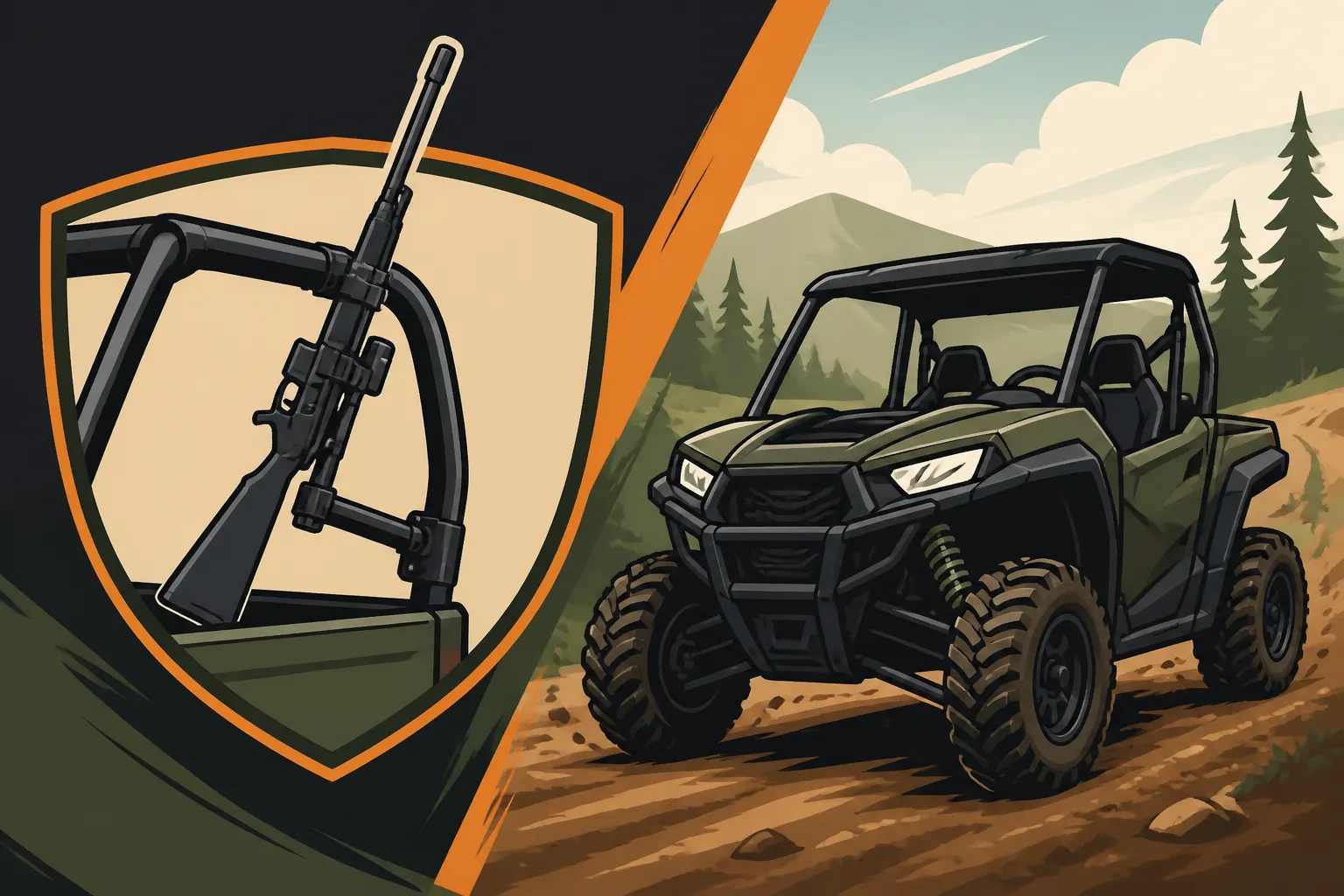
The first and foremost practical consideration is secure storage. For long guns like rifles and shotguns, a robust scabbard or gun rack is highly recommended. These are designed to hold the firearm firmly in place, protecting it from impacts and keeping it from bouncing around. Look for models that are specifically designed for ATVs and UTVs and can be mounted securely to your machine's racks or roll cage. Many companies, including SuperATV, offer a variety of gun racks and scabbards that can withstand the rigors of off-road use, keeping your rifle safe and sound as you traverse uneven terrain.
When choosing a scabbard, consider its material and closure. Hard cases offer maximum protection from mud, dust, and water, which is a huge plus in Alabama's varied climate. Soft cases might be lighter, but they offer less protection from impacts and the elements. Regardless of the type, ensure the firearm is unloaded when stored in transit, especially if it’s a long journey or you're riding with others. This simple step significantly reduces the risk of accidental discharge. Trigger locks or cable locks can add another layer of safety, especially if you're taking breaks or leaving the machine unattended, even for a short time.
For handguns, if you're carrying concealed with a permit, a quality holster that secures the firearm to your person is ideal. For storage on the machine, consider lockable compartments or specific handgun mounts designed for UTV dashboards or consoles. The goal is to keep the handgun secure, protected from the elements, and in a position where it won't be dislodged by bumps or vibrations. Never simply place a handgun loosely in a storage bin where it could bounce around, get damaged, or become dangerously positioned.
Avoiding Accidental Discharge or Loss
The rough-and-tumble nature of ATV and UTV riding increases the risk of accidental discharge if a firearm isn't handled and stored correctly. A bump could jar a poorly secured firearm, or a loose item could snag a trigger. This is why the advice to carry unloaded when in transit is so critical. Only load the firearm when you are at your destination and are ready to use it for its intended purpose, whether that's hunting or target shooting. This is especially vital when negotiating steep inclines, deep ruts, or crossing water, where unexpected movements are common.
Loss of a firearm on the trail is another significant concern. Imagine hitting a deep mud hole, and your rifle, not properly secured, bounces out into the murky water. Or perhaps a sudden jolt dislodges a handgun from a makeshift storage spot. Not only is losing a firearm a serious safety issue, but it's also a considerable financial loss and could potentially fall into the wrong hands. Using reliable, purpose-built retention systems, like quality gun racks and cases, is the best defense against this. Regularly check the mounting hardware of your firearm accessories to ensure they remain tight and secure, as vibrations can loosen bolts over time.
It's also prudent to consider how you might interact with law enforcement while carrying a firearm on your ATV or UTV. If you're stopped by a game warden or sheriff's deputy, always inform the officer that you have a firearm and where it is located, in a calm and respectful manner. Keep your hands visible and follow all instructions. This transparency can de-escalate potential tensions and ensure a smoother interaction, regardless of whether you are openly or concealed carrying. Knowing the nuances of [Alabama DUI Law and Off-Road Machines] could also be relevant in such an interaction.
Common Scenarios and Misconceptions
There are many reasons why an Alabama ATV or UTV rider might carry a firearm, and with those reasons come specific considerations and sometimes, common misunderstandings about the rules. Whether you're a seasoned hunter, a landowner tending your property, or someone who believes in carrying for personal protection, understanding the law and best practices for your specific situation is key. It's easy to assume how things "should be," but the law often has very specific definitions and requirements that need to be followed.
One of the biggest areas where misconceptions arise is regarding the interplay between hunting regulations and general firearm carry laws. Just because you're on a hunting trip doesn't mean all other firearm laws are suspended. Similarly, using your ATV or UTV for game retrieval has its own set of rules that often dictate how firearms must be handled. By addressing these common scenarios, we can clear up some of the confusion and ensure you're prepared for whatever your off-road adventures entail.
Hunting and Game Retrieval
For many Alabama ATV and UTV owners, hunting is a primary reason for carrying a firearm on their machine. During legal hunting seasons, carrying a firearm that is legal for the game being pursued is generally permitted on your ATV or UTV, especially on private land or designated public hunting areas. However, there are crucial distinctions. Often, it's illegal to have a loaded firearm, especially a rifle or shotgun, in or on a motorized vehicle while hunting, except under specific circumstances such as certain mobility-impaired hunter permits, or if you are legally engaged in varmint control. The firearm might need to be unloaded and cased while actively driving the ATV to your hunting spot. Always consult the current Alabama Hunting & Fishing Digest for the specific regulations that apply to the game you are hunting and the area you are in. This includes rules around [Alabama Rules for Riding a Deer Stand] or [Alabama Rules for Riding a Timber Road].
Game retrieval is another scenario where firearms are commonly present. After a successful hunt, using your UTV to retrieve game is often allowed, and your firearm might still be with you. However, the same rules about loaded firearms in a vehicle often apply even during retrieval. For instance, if you're driving your side-by-side through the woods to pick up a harvested deer, your rifle should ideally be unloaded and secured in a scabbard. The goal is to avoid any appearance or actual violation of "hunting from a motorized vehicle" laws, which are strictly enforced. Review specific rules on [Alabama Game Retrieval by Machine] to ensure compliance, as violating these can lead to fines and loss of hunting privileges.
Self-Defense While Off-Road
The right to self-defense is fundamental, and Alabama law generally supports an individual's right to protect themselves and others from serious harm. This right doesn't disappear just because you're off-road on an ATV or UTV. If you possess an Alabama Concealed Carry Deadly Weapon Permit, you can carry a handgun concealed for self-defense while riding, just as you would in any other lawful place. If you do not have a permit, you may still openly carry a handgun for self-defense, provided you are not otherwise prohibited from possessing a firearm.
However, carrying for self-defense on an off-road vehicle brings its own set of practical considerations. The environment itself can be remote, and help may be far away. Ensuring your firearm is secured yet accessible is a key balance. Training for defensive scenarios in an off-road context is also different than in an urban environment. You're dealing with uneven ground, potentially limited cover, and the dynamic nature of being on a moving machine. While the legal right to self-defense remains, the tactical application of it in an off-road setting requires careful thought and preparation.
It's also important to remember that carrying a firearm for self-defense does not grant you license to engage in any unlawful activity. All other laws, such as those prohibiting illegal trespassing or impaired riding, still apply. If you find yourself in a situation where you need to use a firearm defensively, the same legal standards for justified use of force will apply as if you were anywhere else in Alabama. This means understanding when force is legally justified and being prepared to articulate why you felt your life or the life of another was in danger. Always err on the side of caution and responsibility, ensuring your actions are within legal boundaries. For more information about where you can ride legally, consider topics like [Alabama Public Use Versus Private Use] or [Alabama ATV Trails: Where to Ride].
Disclaimer
This article is for general informational purposes only and does not constitute professional advice. Laws, prices and regulations vary by location and change over time. Consult a qualified professional for guidance on your specific situation.