Why Alabama Issues an Ownership Record, Not a Plate
It can be incredibly confusing when you're used to vehicles having a license plate, only to find that your shiny new (or new-to-you) ATV or UTV in Alabama doesn't come with one. Many riders wonder why they don't get a traditional metal plate, especially when they register their machine. This guide will walk you through exactly why Alabama issues an ownership record – like a registration decal or, soon, a title – instead of a full-blown license plate for your off-road machine, clearing up common misconceptions and explaining what this means for you.
Understanding the "Why": ATVs and UTVs Are Not Road Vehicles in Alabama
The fundamental reason your off-road vehicle doesn't receive a traditional license plate in Alabama boils down to its legal classification. In the eyes of the state, ATVs and UTVs are generally not considered highway vehicles designed for public road use. License plates are typically reserved for vehicles that meet federal motor vehicle safety standards (FMVSS) and are intended for travel on public roads and highways. Your quad or side-by-side, while powerful and capable, is built for the trails, the fields, and private property, not the asphalt.
The Federal Standard Barrier to Road Use
Alabama's laws, like many states, align with federal guidelines regarding what constitutes a street-legal vehicle. To qualify for a traditional license plate and operate on public roads, a vehicle must meet the Federal Motor Vehicle Safety Standard 500 (FMVSS 500). This standard outlines a comprehensive list of safety requirements, including specific lighting, mirrors, braking systems, and passenger restraints. Most standard ATVs and UTVs simply do not meet these rigorous requirements. They lack the necessary safety features and certifications that would allow them to be registered and licensed for highway travel. This is why you won't see a standard factory-produced quad with a metal plate on the back, even if it has headlights and taillights. [Alabama's Federal Standard Barrier to Road Use] goes into more detail about this crucial distinction.
Highway vs. Off-Highway Definitions
The state makes a very clear distinction between vehicles intended for highway use and those intended for off-highway use. A car, a truck, or a motorcycle is designed and manufactured to meet highway standards, hence the need for a license plate to track its legal operation on public roads. An ATV or UTV, by its very definition within Alabama's statutes, is primarily an off-highway vehicle. Its design, speed capabilities, tire type (non-highway tires are often explicitly mentioned), and intended use place it firmly in the off-road category. Because it's not meant for public roads, the system of road vehicle identification, including license plates, simply doesn't apply. This also informs why the registration process, as we'll discuss, is voluntary for many uses.
The Evolution of Alabama's Off-Road Vehicle Records: Registration vs. Titling
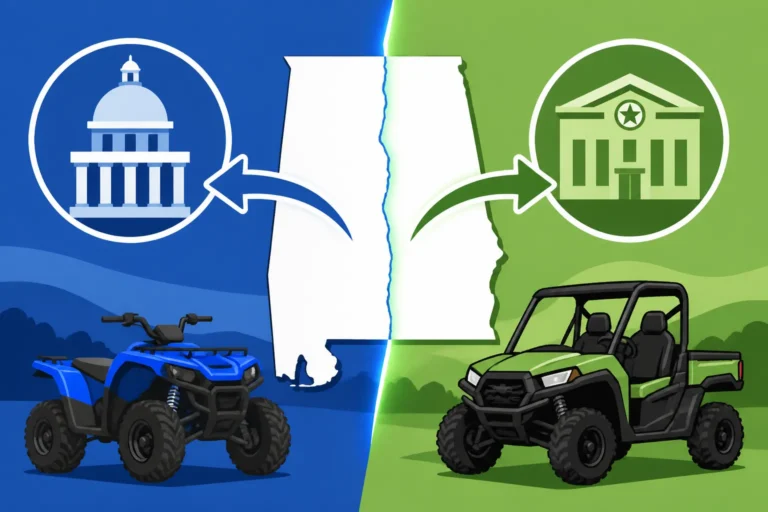
For a long time, the primary official record for an ATV or UTV in Alabama was its voluntary registration. However, a significant change in the law means that for newer machines, a title will also become a key "ownership record." It's important to understand both systems and how they differ from the traditional car-and-plate scenario. [Alabama Splits Titling and Registration Between Agencies] highlights how these two processes are managed by different state bodies.
Voluntary Registration Through ALEA
Until very recently, and still for many existing machines, the closest thing to an official state record for your ATV or UTV was its registration through the Alabama Law Enforcement Agency (ALEA). This process has always been voluntary for machines used exclusively on private property, but it becomes mandatory if you plan to ride on any designated public lands or trails. When you register, you don't get a metal plate. Instead, you receive a registration certificate and a decal that you affix to your machine. This decal, usually a brightly colored sticker, signifies that your machine is legally registered for public use, or simply recorded by the state if you choose private use registration. [Alabama's Voluntary ATV Registration Through ALEA] explains the nuances of this system. It acts as a temporary permission slip to operate, not a permanent identifier for road use.
The Advent of Titling for Newer Machines (Model Year 2026 and Later)
A big change is coming that introduces a more robust form of ownership record for ATVs and UTVs. Starting with model year 2026, all new ATVs and UTVs sold in Alabama, or brought into the state, will be subject to a mandatory titling process. This title, issued by the county probate judge, is a formal document proving legal ownership, much like a car title. It’s a paper record that details the vehicle identification number (VIN), the owner's name, and any liens on the machine. This is a significant shift because while registration proves your machine is allowed to be operated in certain areas, the title proves you own it. [Alabama ATV Titling Starts With Model Year 2026] dives into the specifics of this new law. Despite this new title, these machines still won't receive a traditional license plate, as their fundamental classification as off-highway vehicles remains unchanged.
Why Titles and Registrations Are Different from a Plate
Think of it this way: a license plate is typically tied to the right to operate on public roads and serves as a visible identifier for law enforcement on those roads. An ATV or UTV registration decal, on the other hand, is about permission to access specific off-road areas or simply a state record of existence. The new title, starting in 2026, is purely an ownership record, protecting your investment and making sales and financing easier. None of these functions require a traditional license plate because none of them grant general permission for highway use. The state is essentially creating systems to track and manage off-road vehicles within their designated use parameters, without crossing them into the realm of road-legal vehicles. This is an important distinction when considering things like theft recovery or proving ownership in a dispute; a title will offer a much stronger legal standing than just a registration decal ever did.
What Your "Ownership Record" Actually Looks Like and What It Proves
Since you won't get a metal plate, understanding what official documents you do receive and what purpose they serve is crucial. These documents are your proof of legal standing regarding your off-road machine in Alabama.
The Registration Decal and Certificate
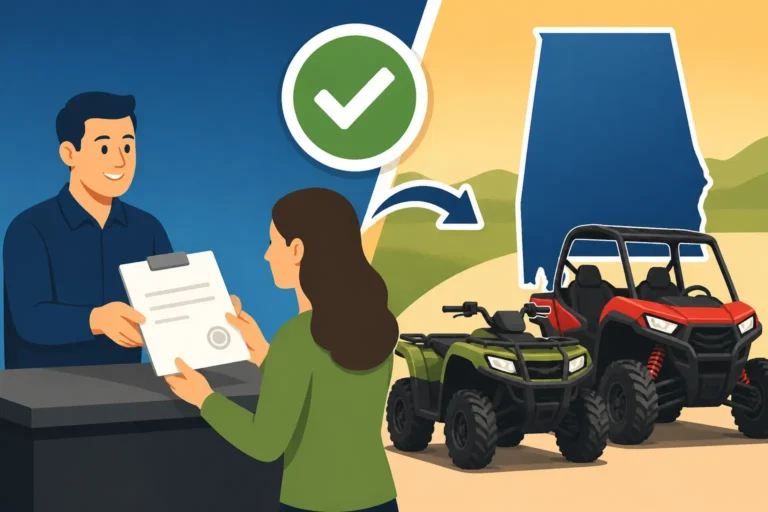
When you register your ATV or UTV through ALEA, you'll receive two main items: a registration certificate and a decal. The certificate is a piece of paper, often similar in size to a vehicle registration for a car, which lists your name, address, the machine's VIN, make, model, and the registration expiration date. You should keep this certificate in a safe place, and often carry a copy or the original with you when you ride, especially on public lands, as proof of valid registration. The decal is a small, adhesive sticker that you attach to a visible part of your ATV or UTV, typically near the front or side, as directed by ALEA. This decal acts as a quick visual confirmation for park rangers or law enforcement that your machine is registered. It's not a license plate; it's a permit sticker, verifying your adherence to state regulations for off-road use. [Alabama Registration Paperwork Explained] clarifies all the details of these documents.
The New Off-Road Title Document
For model year 2026 and newer machines, the new title will be a much more formal document, akin to a car title. It will be a distinct piece of paper, likely with security features to prevent fraud, issued by the county probate judge's office. This title will clearly state the owner's name, the machine's VIN, its make and model, and potentially any lienholders (if you financed the purchase). The title is the ultimate proof of legal ownership. If you ever sell your machine, transfer it to a family member, or need to prove ownership for insurance purposes or in legal disputes, this title will be the authoritative document. Even for those who buy an older machine without a title, knowing how to prove ownership is vital, and resources like LawDepot can assist in creating robust bills of sale or affidavits to establish a paper trail, especially if you're trying to prove you own an untitled machine.
Proving Ownership for Untitled Machines (Pre-2026)
For the vast majority of ATVs and UTVs currently operating in Alabama – those that are model year 2025 or older – there will be no state-issued title. This situation can lead to headaches, especially when buying or selling privately, or dealing with theft. For these machines, proving ownership relies on a combination of documents. A comprehensive bill of sale, especially one including the machine's VIN and signed by both buyer and seller, is paramount. Other evidence can include original purchase receipts, old registration certificates (even if expired), insurance records, or even sworn affidavits. It's a patchwork approach compared to the clear-cut nature of a title. When dealing with private sales of older machines, using a service like LawDepot to generate a legally sound bill of sale can provide an extra layer of protection and clarity, helping you establish a strong paper trail even without an official title. [Proving You Own an Untitled Machine] offers additional strategies.
| Document Type | Issued By | Purpose | Visible Identifier | Applies To |
|---|---|---|---|---|
| Registration Decal | ALEA | Permission to operate (public/private use) | Sticker on machine | All ATVs/UTVs, voluntary for private, mandatory for public land |
| Registration Cert. | ALEA | Proof of current registration (paper) | None | All ATVs/UTVs, voluntary for private, mandatory for public land |
| Title (New Law) | County Probate Judge | Legal proof of ownership (paper) | None | Model Year 2026 and newer ATVs/UTVs (mandatory) |
| Bill of Sale | Private Seller/Dealer | Proof of transaction/transfer of ownership | None | All ATVs/UTVs (crucial for older/untitled machines) |
Public Use vs. Private Use: Tiers of Registration
Alabama's approach to ATV/UTV registration acknowledges that not all off-road machines are used in the same way. This distinction between "public use" and "private use" further explains why a traditional plate isn't issued and why the registration is primarily an internal state record, rather than a public road identifier. [Alabama Public Use Versus Private Use] gives a broader overview of these categories.
When Public Use Registration is Required
If you plan to ride your ATV or UTV on any designated public lands, trails, or areas managed by the state or federal government within Alabama, then you absolutely must have a public use registration. This includes popular OHV parks, state forests, and Wildlife Management Areas (WMAs) where ATV riding is permitted. The public use registration fee is generally higher than the private use option because it implies a broader scope of access and potential impact on public resources. The decal you receive will typically be marked to distinguish it as a public use registration. Without it, you could face fines or other penalties for riding illegally on public property. [Alabama Public Use ATV Registration Explained] details the requirements and benefits.
The Voluntary Nature of Private Use Registration
For many Alabama riders, their ATVs and UTVs are strictly for their own property, hunting leases, or private land where they have explicit permission. In these scenarios, the state does not require you to register your machine. However, many owners still choose to get a "private use" registration. While it doesn't grant you access to public trails, it does record your machine with ALEA. This can be beneficial for several reasons, such as creating a state-recognized record of your machine (helpful in theft situations or proving ownership, though not as definitive as a title), and simply adhering to a "best practice" even if not legally mandated. The private use registration typically carries a lower fee, reflecting its more limited scope of intended use. [Alabama Private Use ATV Registration Explained] provides more context.
The Role of Decals in Each Tier
In both public and private use scenarios, you'll receive a decal. These decals are designed to be readily visible on your machine. They serve as an immediate visual cue for authorities – whether a park ranger at a public OHV park or a sheriff's deputy investigating a theft – that your machine has been recognized by the state system. The specific color or coding of the decal often indicates whether it's for public or private use. This system works well for managing off-road vehicle activity without the need for the metal plates associated with on-road vehicles. It’s a pragmatic solution tailored to the unique regulatory environment of off-road vehicle use in Alabama.
The Practical Implications of Not Having a Plate
While the lack of a traditional license plate makes sense from a legal and classification standpoint, it does have some practical implications for ATV and UTV owners in Alabama. These can range from how you identify your machine to how law enforcement interacts with off-road vehicles.
Identification for Law Enforcement and Theft Recovery
Without a universally recognized license plate, the primary identifier for your ATV or UTV becomes its Vehicle Identification Number (VIN) and the registration decal. In the unfortunate event of theft, reporting the VIN to law enforcement is absolutely critical. While the ALEA registration system does record your VIN, a physical license plate is often easier for a casual observer to spot and report. This is why it’s so important for owners to know their VIN, keep clear records, and, for newer machines, hold onto that title. For older, untitled machines, having robust records like a detailed bill of sale (perhaps one you crafted using a template from a resource like LawDepot) and photographs of your machine with its VIN clearly visible can be invaluable for recovery. [Theft Recovery Without a Title] highlights the challenges and strategies.
Limited Road Access and Rules
The absence of a license plate is a constant reminder that ATVs and UTVs are, by and large, not permitted on Alabama's public roads. While there might be very specific, limited exceptions (such as crossing a road, or certain county ordinances allowing golf carts, which are not ATVs), these are narrow and strictly defined. Attempting to ride your non-plated ATV or UTV on a paved public road, or even many unpaved county roads, can lead to citations, fines, and even impoundment. The law is very clear: if it doesn't have a plate and doesn't meet street-legal vehicle standards, it generally doesn't belong on the road. [Are ATVs Street Legal in Alabama?] is an important read for every rider.
Insurance and Lending Considerations
Insurance companies and lenders understand that ATVs and UTVs do not carry traditional license plates. When insuring your machine, the VIN is the primary identifier used for your policy. For lenders financing a purchase, especially before the 2026 titling law, they often relied on the bill of sale and the machine's VIN. The new titling law will certainly simplify things for lenders, as a title provides clear proof of ownership and the ability to record a lien. However, even with a title, insurance remains crucial. Comprehensive coverage can protect your investment against theft or damage, whether on your property or out on the trails. Always ensure your insurance policy accurately records your machine's VIN. [Insuring an Untitled Machine in Alabama] delves into coverage for vehicles without a traditional title.
Future Changes: When a Plate Might Come Into Play (for some machines)
While the general rule is "no plate for ATVs and UTVs," it's worth noting that there are specific types of vehicles that do get plates in Alabama, and some off-road-like machines can become street-legal under very particular circumstances. It’s important not to confuse these exceptions with your standard quad or side-by-side.
Low-Speed Vehicles (LSVs) and Their Plates
Alabama law does allow for the registration and plating of Low-Speed Vehicles (LSVs). These are distinct from ATVs and UTVs. An LSV is typically defined as a four-wheeled vehicle with a top speed greater than 20 miles per hour but not greater than 25 miles per hour, and it must meet specific federal safety standards (FMVSS 500) that include headlights, taillights, stop lights, turn signals, reflective devices, mirrors, a parking brake, a windshield, and seatbelts. Because they meet these standards, LSVs can be registered and receive a traditional license plate, allowing them to operate on roads where the posted speed limit is 35 mph or less. However, it's crucial to understand that your typical ATV or UTV, even with aftermarket modifications, usually cannot be legally converted into an LSV and plated. [Alabama Low-Speed Vehicle Rules] clarifies this distinction.
The Unlikely Scenario for ATVs/UTVs to Get Plates
The reality is that for a standard ATV or UTV, the likelihood of ever receiving a traditional license plate in Alabama is extremely low. The core definitions and federal safety standards that differentiate these machines from road-legal vehicles are deeply embedded in the law. While state laws can change, a fundamental shift that would allow non-FMVSS compliant off-road vehicles to be plated for general public road use would be a monumental legislative undertaking, fundamentally altering their classification. It's far more probable that any future changes would focus on refining the titling process or expanding designated off-road riding opportunities, rather than making these machines road-legal with plates. For the foreseeable future, your off-road machine will rely on its VIN, registration decal, and (for newer models) its title as its primary official records.
Disclaimer
This article is for general informational purposes only and does not constitute professional advice. Laws, prices and regulations vary by location and change over time. Consult a qualified professional for guidance on your specific situation.