When Two Official Pages Define an ATV Differently
If you have ever tried to cross-reference Alabama government websites before registering your trail rig or buying a used side-by-side, you have likely run into a frustrating wall of double-talk. One official state portal classifies your vehicle by strict weight limits and tire types, while another agency’s portal uses entirely different physical dimensions to define the exact same machine. This administrative disconnect leaves everyday owners confused about whether their vehicle requires registration, how it should be titled, or if it can legally cross a rural county road. This guide breaks down why these official definitions clash, explains the exact statutory numbers that govern off-road vehicles in Alabama, and provides actionable steps to keep your paperwork legal.
The Frustration of Conflicting State Definitions in Alabama
How the Department of Revenue and Law Enforcement Diverge
Few things irritate off-road enthusiasts quite like taking a clean title or bill of sale down to the county probate office, only to be told that the system does not recognize your machine the same way the state trooper on the highway does. In Alabama, administrative authority over off-road vehicles is split between tax-collecting bodies and law enforcement agencies. The Alabama Department of Revenue focuses heavily on tax classifications, vehicle identification numbers, and titling frameworks managed through state databases. They care about financial transactions, dealer certificates, and whether a machine meets taxable criteria.
On the flip side, the Alabama Law Enforcement Agency, along with county sheriffs and wildlife conservation officers, views these machines through the lens of public safety, trail access, and highway traffic codes. When law enforcement reads the criminal or traffic code, they look at operational capabilities, seat configurations, and safety restraints. Because these agencies operate under different legislative chapters written years apart, their public-facing websites often publish definitions that seem directly at odds with one another. A machine that ALEA considers a recreational off-highway vehicle might be flagged by a county tax clerk as a generic all-terrain vehicle, creating endless head-scratching when you try to complete basic Alabama Registration Paperwork Explained procedures.
This split means that a rider can follow every instruction on a portal managed by Montgomery tax officials, only to discover that the local conservation deputy enforcing rules in a state forest or Wildlife Management Area uses a completely different checklist. The gap between tax law and traffic enforcement is where everyday owners get stuck in bureaucratic limbo.
Why Machine Dimensions Create Bureaucratic Confusion
The root cause of this online definition war usually boils down to numbers on a scale and lines on a tape measure. When the Alabama Legislature originally drafted statutes to cover off-road recreational equipment, four-wheelers were small, lightweight, and engineered almost exclusively with single-rider saddles. As side-by-side technology exploded, manufacturers began building machines with automotive-style bucket seats, multi-passenger rows, long-travel suspensions, and heavy-duty roll cages.
Legislators scrambled to update the codes by inserting new statutory categories like Recreational Off-Highway Vehicles alongside traditional All-Terrain Vehicles. However, older web pages, static PDF guides, and legacy county portal entries were never fully purged. One official page might tell you that any off-road machine weighing under a certain threshold is an ATV, while another page on a sister department’s site asserts that if it has a steering wheel instead of handlebars, it becomes an ROV regardless of its dry weight.
When you bring a modern, wide-body side-by-side to a licensing clerk, these overlapping physical definitions create immediate gridlock. If the clerk inputs your vehicle’s serial number into an automated database, the computer might pull up an old classification rule that forces your machine into a category it no longer fits. Understanding Alabama’s ATV and ROV Legal Definitions requires looking past what a glossy state brochure says and digging directly into the actual statutory language passed by lawmakers.
The Practical Impact on Daily Riders and Hunters
For the average Alabamian hauling a quad to a deer camp in Marengo County or staging a side-by-side for a weekend at a park, these conflicting definitions are not just academic theories. They cause real-world headaches, delayed rides, and unexpected fines. If your local county clerk registers your machine under the wrong statutory tier because of a confusing state webpage, you could end up paying improper fees or carrying documentation that fails an inspection on public ground.
Consider a hunter trying to haul game across a designated timber trail. If the state forestry or wildlife division considers their rig a full-sized utility vehicle based on width rules listed on their site, but the county registration paper lists it as a standard light quad, the owner risks receiving a citation for operating an unapproved vehicle on restricted trails. Furthermore, if you plan to sell your machine to a private buyer, conflicting paperwork can instantly kill the deal. A cautious buyer looking at your state paper might see a category that does not match the physical machine sitting on your trailer.
To safeguard yourself against these administrative mix-ups during a private sale, it is always wise to draft clean, detailed documentation. Utilizing legal template platforms like LawDepot allows both buyers and sellers to construct a precise bill of sale that lists the vehicle’s explicit physical traits, engine displacement, and explicit serial number, ensuring that no matter how state clerks interpret the category, your proof of purchase remains legally sound.
Deciphering Statutory Boundaries for ATVs and ROVs
Alabama ATV Width and Weight Limits
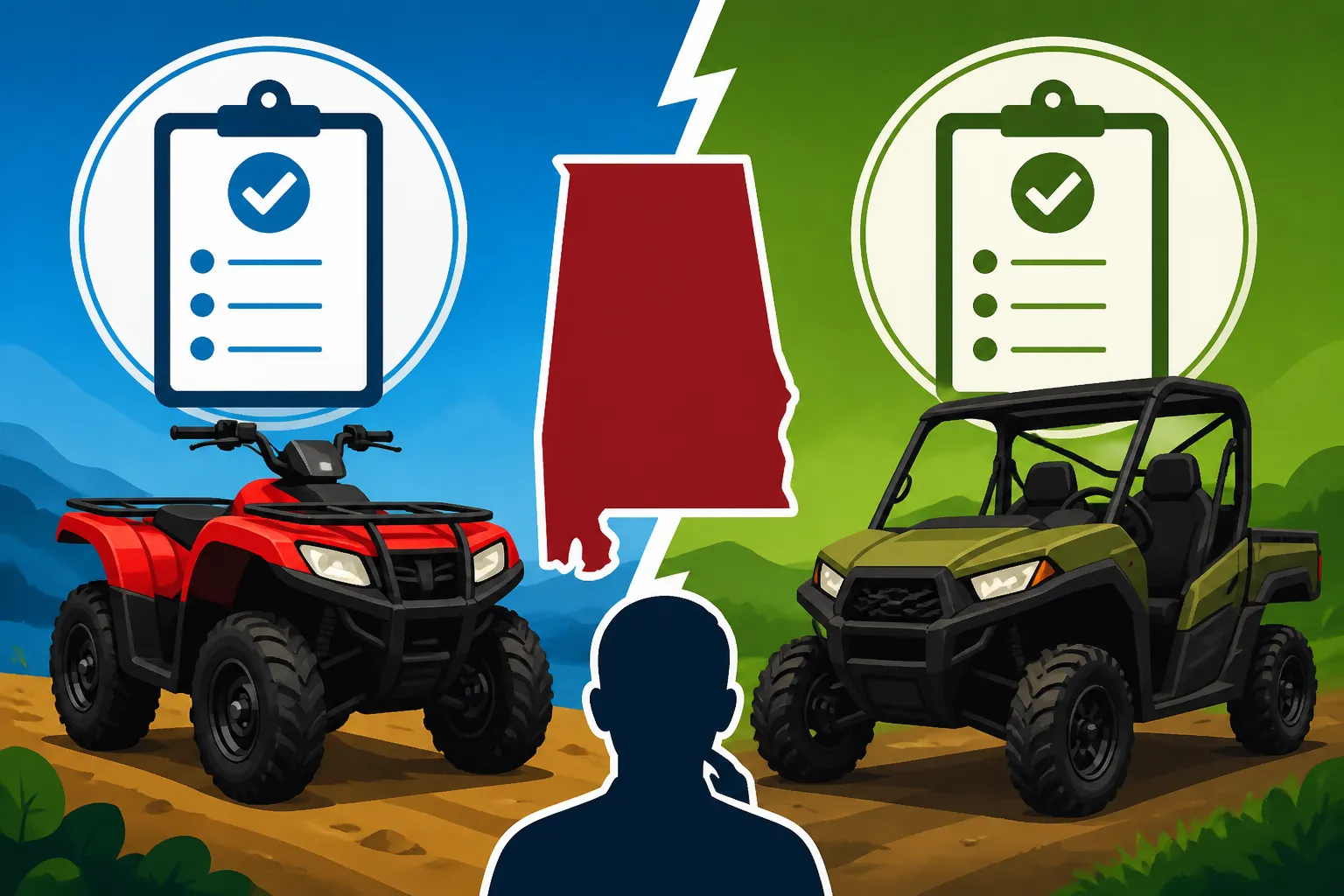
To understand where your machine legally fits, you have to look closely at the precise structural boundaries written into Alabama code. A standard All-Terrain Vehicle is defined very specifically by its dimensional footprint, steering setup, and seating design. Under state law, a classic ATV is an off-highway vehicle designed primarily for off-road travel that travels on three or more low-pressure tires. It must feature a straddle seat for the operator and be steered using handlebars rather than a conventional steering wheel.
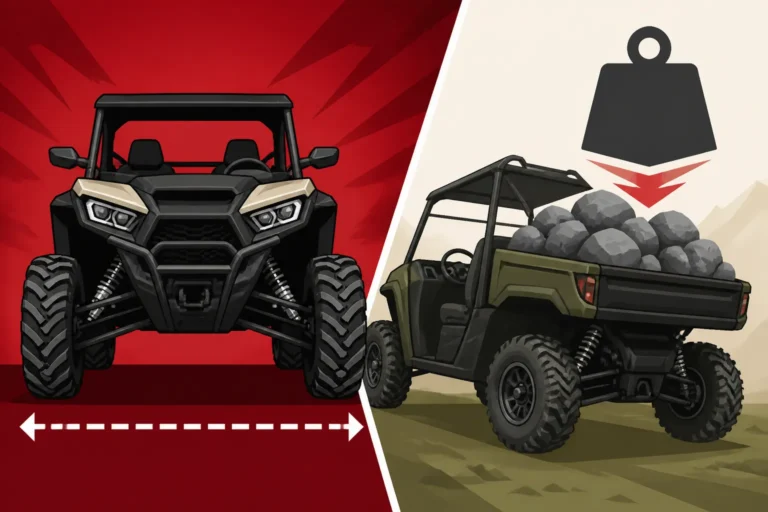
Beyond how you sit on it and steer it, physical size is the ultimate legal dividing line. To qualify under Alabama ATV Width and Weight Limits, the machine must have a total overall width of 60 inches or less. Furthermore, its unladen dry weight must not exceed a specific statutory cap, which is typically set at 1,500 pounds. If a quad exceeds 60 inches in width or pushes past that dry weight ceiling, it exits the legal definition of a standard ATV, even if it still features a straddle seat and handlebars.
STATUTORY BOUNDARY CHECK
TRADITIONAL ATV RECREATIONAL OFF-HIGHWAY
– Handlebar Steering – Steering Wheel
– Straddle Seating – Bucket / Bench Seating
– Width: 60 Inches Max – Width: 80 Inches Max
- Weight: 1,500 lbs Max – Weight: 3,500 lbs Max
These strict dimensional caps exist to separate lightweight personal quads from larger commercial or industrial off-road equipment. If you own an aftermarket modified quad with wide-offset wheels, extended A-arms, or heavy skid plates, you need to be careful. While aftermarket parts might make your machine perform better on red clay or deep mud, pushing your machine past that 60-inch total width mark can technically shift how the state views your vehicle during official filings.
Alabama ROV Width and Weight Limits
As utility and sport side-by-sides evolved into larger, faster machines, state lawmakers had to create a secondary statutory box to catch them. This category is officially known as a Recreational Off-Highway Vehicle, commonly abbreviated as an ROV or UTV. Unlike standard quads, an ROV is defined as a machine motorized for off-highway use that utilizes a non-straddle seating system, meaning you sit inside bucket or bench seats using automotive-style seat belts or harness systems.
The physical dimensions for this category are significantly larger to accommodate multi-passenger cabs and heavy roll-cage structures. Under Alabama ROV Width and Weight Limits, an ROV can feature an overall width up to 80 inches. This wider allowance accommodates modern wide-stance sport side-by-sides built for high-speed desert or trail performance. Additionally, the maximum dry weight threshold for an ROV is capped far higher than a quad, allowing machines up to 3,500 pounds dry weight to remain within the recreational off-road framework.
These higher allowances give side-by-side owners broad coverage under the law, but they also draw a sharp line between recreational vehicles and road-bound motor vehicles or heavy machinery. If a side-by-side exceeds 80 inches in width or 3,500 pounds in dry weight, it can no longer be classified as an ROV, which locks it out of standard off-road vehicle registration procedures altogether.
Navigating Alabama’s Conflicting ROV Weight Figures
The primary reason riders find conflicting information online stems directly from historical updates to state statutes. When ROVs were first formally introduced into Alabama law, the dry weight limit was set significantly lower to mirror smaller, early-generation utility vehicles. Over time, as four-seat models and heavy-duty turbocharged side-by-sides dominated the market, the legislature raised the dry weight ceiling to accommodate these massive factory builds.
However, state agency websites do not always update their online databases or downloadable PDF manuals at the same pace. It is very common to find a PDF guide on an older state web page listing an outdated 2,000-pound or 2,500-pound weight cap, while a newer page references the expanded 3,500-pound cap. This mismatch leads to widespread confusion when owners search for Alabama’s Conflicting ROV Weight Figures trying to determine if their four-seat factory machine is legal.
When facing these contradictory figures, the rule of thumb is that the highest enacted statutory weight ceiling in the current Alabama Code takes legal precedence over any legacy summaries published on web pages. If a county clerk flags your multi-passenger UTV as being “too heavy” based on an outdated internal printout or an old state website page, politely ask them to verify the current statute governing Recreational Off-Highway Vehicles in their official portal software.
Registration Tiers and County Agency Discrepancies
Public Use Versus Private Use Tiers
Once you figure out whether your machine is an ATV or an ROV, you face another decision that frequently trips up owners during county registration: selecting the correct usage tier. Alabama operates a dual-tier system for off-road vehicle registrations, splitting applications between private farm or property use and public land access. Choosing the wrong tier can either waste your money or leave you vulnerable to law enforcement fines when trail riding.
The private use tier is designed specifically for owners who operate their machines exclusively on private property, family farms, enclosed hunting camps, or timber tracts. Under the Public Use Versus Private Use Tiers structure, private land operators pay a minimal administrative fee to obtain an official state record of ownership without needing full public trail clearance. Conversely, if you plan to unload your machine at public riding areas, state-managed trails, or designated public lands, you are required to register your vehicle under the public use tier, which carries a slightly different fee structure and provides an official decal that must be visibly displayed on the frame.
REGISTRATION TIER DECISION MATRIX
CRITERIA PRIVATE USE TIER PUBLIC USE TIER
——————– ———————- ———————
Primary Location Private Farm / Camp State Parks / WMAs
Decal Display Optional / Paper Record Mandatory Frame Decal
Fee Structure Lower Base Rate Standard Public Rate
Trail Legal No (Private Only) Yes (Public Off-Road)
The issue arises when state web pages fail to clearly explain the functional differences between these two tiers. Many owners erroneously select the cheaper private tier at the county office, assuming it covers them anywhere in the state, only to get cited by a park ranger at a public off-road park for lacking a valid public land decal.
County Processing Between Eighteen and Twenty-Three
Another source of confusion for Alabama riders is the sheer variance in how individual counties handle off-road paperwork. Alabama has 67 counties, and while state statutes set the overarching laws, the actual intake of applications is handled at the local level by county probate judges, license commissioners, or revenue directors. This decentralized setup means that the customer experience can change drastically depending on whether you are standing at a counter in Baldwin County, Jefferson County, or Pike County.
Staff training levels vary widely across local offices. In smaller rural counties where farming quads are part of daily life, clerks are often intimately familiar with off-road filings and can clear a transaction in minutes. In larger urban counties, clerks may handle hundreds of standard automobile transfers every day but rarely process an off-road decal or specialized title application. As a result, clerks in urban centers are much more likely to rely strictly on strict, outdated web pages that present conflicting weight and width figures.
When navigating county processing between various offices, it pays to call ahead. Asking specific questions regarding what paperwork that exact office expects to see will save you multiple trips across town. If a clerk seems confused by your machine’s dimensions or tier status, having printed copies of current state definitions can help bridge the gap.
Documenting Ownership When Definitions Shift
When state definitions are in flux or interpreted loosely by local clerks, having ironclad proof of ownership is your strongest shield. When you walk up to a county counter, the clerk is far less likely to argue about minor weight variations or model definitions if your bill of sale and title paperwork are meticulously structured and free of errors.
If you are buying a machine from a private party who lacks a clear title—which is very common for older quads—you must ensure the bill of sale leaves zero room for interpretation. The document should explicitly list:
* The full legal names and physical addresses of both buyer and seller
* The exact model year, make, and trim level
* The complete, unedited Vehicle Identification Number (VIN) stamped on the frame
* The engine size in cubic centimeters (cc)
* The physical seat configuration (straddle vs. bucket)
Using a standardized contract tool like LawDepot ensures that every required legal element is accounted for before money changes hands. Having a clean, professionally formatted bill of sale prevents county clerks from rejecting your filing due to missing structural details, giving you a smooth path toward securing your official registration record.
How Conflicting Definitions Impact Titles and Sales
The Transition to Titling Modern Off-Road Vehicles
For decades, Alabama was widely known as a non-titling state for off-road machinery. Quads and side-by-sides were bought, sold, and traded on simple paper bills of sale or hand-written receipts written on notebook paper. However, as off-road machines grew increasingly expensive, with high-end side-by-sides commanding prices equivalent to modern pickup trucks, the need for formal title records became undeniable. State lawmakers passed updated titling frameworks to protect buyers, curb rampant off-road vehicle theft, and streamline financial liens.
This shift created a distinct split based on machine model years. Newer models fall under modern titling mandates, integrated directly into the state’s automated ALVIN system, while older machines remain permanently exempt from titling requirements. This transition period is precisely where many state website pages fail to align. One state web page might broadly state that “ATVs in Alabama do not receive titles,” referring to older legacy machines, while a newer portal details mandatory titling protocols for late-model side-by-sides.
If you own or are looking to purchase a modern machine, you must understand where it falls on this timeline. Assuming that a modern, high-value UTV does not require a title simply because an old government web page says off-road vehicles are non-titled will lead to major headaches when you try to finance, insure, or resell the vehicle down the road.
Private Sale vs Dealer Purchase Paperwork
The paperwork process differs significantly depending on whether you purchase your rig from a licensed powersports dealership or a private seller sitting on a farm in rural Alabama. When you buy from an established dealer, their finance office typically handles the initial legwork. They file the required manufacturer statement of origin, collect applicable sales taxes, and transmit title applications directly to Montgomery through state portal networks.
In a private sale, however, the burden of proof falls entirely on the shoulders of the buyer and seller. If you are buying a used quad from a private individual, you will not have a dealer package to hand to the clerk. If the machine falls into a category where the state website lists contradictory definition guidelines, the county clerk will scrutinize your private paperwork with extra care.
To prevent your application from being kicked back, you must ensure that every piece of paper matches perfectly. The VIN on the bill of sale must match the frame stamp down to the last digit, and the model description should align with standard industry terms. If the seller presents an old registration card, verify that the names, addresses, and physical vehicle descriptions align flawlessly with the bill of sale you prepare prior to closing the transaction.
Resolving Missing Paperwork and Bill of Sale Issues
It is a scenario every off-road enthusiast in Alabama knows all too well: you find a fantastic deal on a well-maintained quad, but the seller admits they lost the original paperwork years ago. Because off-road vehicles frequently change hands among family members, hunting buddies, and neighbors, paper trails often disappear entirely over time.
Navigating Alabama Machines With No Paperwork requires patience and strategic documentation. You cannot simply walk into a probate office with a verbal story and expect a registration decal. You must rebuild the chain of ownership using written affidavits, bill of sale records, and physical VIN checks to prove the machine is not reported stolen in state or national databases.
PAPERWORK RECOVERY CHECKLIST
STEP 1: Run physical VIN check against state theft databases.
STEP 2: Obtain a formal, notarized Bill of Sale from seller.
STEP 3: Draft an Affidavit of Ownership detailing machine history.
STEP 4: Present documentation to county clerk for manual review.
When seller paperwork is missing, drafting a clear, legally binding transfer document is non-negotiable. Utilizing LawDepot allows you to quickly generate a tailored bill of sale and liability release that documents the transaction in full legal detail. Taking this extra step protects you if a clerk raises questions about the vehicle’s background or if statutory definitions complicate your attempt to register the machine for trail use.
Comparison of Off-Road Vehicle Designations in Alabama
ATV vs ROV vs Golf Cart Regulatory Matrix
To help you navigate the confusing overlaps across various state websites, the following matrix contrasts how Alabama law categorizes different types of light off-road and utility equipment. Understanding these structural boundaries will help you identify exactly which rules apply to your machine before you pay fees or apply for decals.
| Vehicle Category | Steering Mechanism | Seating Arrangement | Max Overall Width | Max Dry Weight | Mandatory Titling Status |
|---|---|---|---|---|---|
| Traditional ATV | Handlebars | Straddle Seat | 60 Inches | 1,500 Pounds | Depends on Model Year |
| Recreational Off-Highway (ROV) | Steering Wheel | Bucket / Bench Seats | 80 Inches | 3,500 Pounds | Depends on Model Year |
| Golf Cart | Steering Wheel | Bench Seat | Excluded from Chap. | Excluded from Chap. | Permanently Exempt |
| Utility Farm Machine | Variable | Variable | Variable | Exempt (Ag Use) | Exempt (Ag Exclusions) |
As shown in the table, golf carts and dedicated agricultural machinery operate under completely different statutory rules. A golf cart is explicitly excluded from standard off-road vehicle definitions under Alabama law, meaning you cannot register a standard golf cart as an ATV or ROV no matter how many modifications you make to its suspension or tires.
Equipment Exclusions That Catch Owners Off Guard
Beyond golf carts, state statutes explicitly exclude several other types of equipment that owners frequently mistake for registered off-road vehicles. Understanding these statutory exclusions is critical if you want to avoid buying a machine that cannot be legally registered under off-road recreational codes.
For example, riding lawnmowers, compact utility tractors, dirt bikes, and home-built dune buggies do not fit the legal definition of an ATV or ROV. Dirt bikes, while designed for off-road travel, travel on two wheels rather than low-pressure tires and are governed under separate motorcycle provisions. Likewise, dune buggies and custom rock crawlers often fail the dry weight or width limits, pushing them into a grey area where they cannot be registered as recreational off-highway vehicles nor licensed for highway driving without meeting full federal motor vehicle safety standards.
EXCLUDED EQUIPMENT TYPES
[ X ] Standard Golf Carts (Excluded by Specific Statute)
[ X ] Dirt Bikes / Off-Road (Two Wheels; Separate Motorcycle Code)
[ X ] Lawn Tractors / Mowers (Maintenance Equipment Exclusion)
[ X ] Full-Size Buggies/Trucks (Exceeds Width/Weight Ceilings)
Another major trap involves agricultural equipment. While farmers enjoy specific tax exemptions and road-crossing privileges when using quads for farm operations, using an unregistered farm quad for weekend recreational riding on public land will result in a ticket. The exemption follows the use of the machine, not just its physical design.
Preparing Your Paperwork Before Visiting the County Clerk
When you are ready to register your machine or clear up a title confusion, going to the county courthouse fully prepared is the best way to guarantee success. Never head to the counter relying on verbal explanations or memory alone. Having your documentation organized in a clear, professional folder prevents unnecessary delays and keeps the clerk focused on processing your file.
Before stepping up to the counter, ensure you have compiled the following itemized package:
1. The Physical Machine Details: A clear photograph or rubbing of the frame-stamped Vehicle Identification Number (VIN), along with photos showing the seating layout and overall tire footprint.
2. Proof of Ownership: The manufacturer’s certificate of origin, a valid title signed over by the previous owner, or a structured, legally binding bill of sale.
3. Identification and Residency: Your valid Alabama driver’s license or state-issued identification card proving residency in the county where you are applying.
4. Form of Payment: Verify accepted local payment methods beforehand, as some rural probate offices charge extra fees for credit card processing or require cash for exact decal amounts.
If you hit a roadblock where the clerk pulls up an outdated state website that contradicts your vehicle’s physical specs, stay calm. Politely review the dimensional breakdown with them, point out the specific steering and seating traits of your rig, and offer to present your detailed bill of sale. If you need to generate professional, legally sound transfer documents before your county visit, legal software services like LawDepot can assist you in generating custom bill of sale forms that align perfectly with state standards.
By taking the time to understand how Alabama’s conflicting web definitions developed, learning the true statutory width and weight caps, and showing up at the county counter with complete, professional paperwork, you can bypass the online confusion and enjoy your time out on the trails.
Disclaimer
This article is for general informational purposes only and does not constitute professional advice. Laws, prices and regulations vary by location and change over time. Consult a qualified professional for guidance on your specific situation.