Alabama Machines With No Paperwork
Oh, the headache of owning an ATV or UTV in Alabama that doesn't have a neat stack of paperwork! It's a surprisingly common situation, especially with older machines or those bought in private sales where things might have been a bit… informal. You're left scratching your head, wondering if you can even ride it legally, let alone sell it down the road. This guide is here to walk you through the nuances of what Alabama considers proof of ownership when formal titles might be missing, and how to navigate the registration process when your machine falls into that "no paperwork" category.
Understanding Alabama's Off-Road Vehicle Paperwork System
Alabama's approach to ATV and UTV ownership records has, until recently, been a bit of a patchwork, particularly compared to how we title cars or trucks. This has led to a lot of confusion, especially when you're trying to do the right thing and ensure your machine is properly documented. It's a situation many of us have faced, whether buying from a seasoned hunter who "just knows" who owns what, or from an online marketplace where the seller's record-keeping wasn't exactly top-notch.
The Divide: Titling Versus Registration
Here in Alabama, the system for off-road vehicles like ATVs and UTVs has historically split ownership record-keeping between two different state agencies. For years, the Department of Revenue (DOR) handled vehicle titles, but ATVs and UTVs were often exempt. Meanwhile, the Alabama Law Enforcement Agency (ALEA) has been responsible for the voluntary registration of these machines, which is more about public use and tracking for safety than proving legal ownership in the way a title does. This dual system can be incredibly confusing, and it's a major reason why many machines don't have a clear "paper trail" as you'd expect with a car.
This distinction is crucial, especially as new laws come into play. A registration from ALEA, while important for riding on designated public lands, isn't the same as a title. A title is the definitive legal document proving who owns a machine. Without a title, proving ownership for insurance claims, sales, or even just peace of mind can be challenging. It's like having a handshake deal for a piece of land but no deed – it feels right, but proving it to a third party is a whole different ballgame. You can find more details on how these agencies split tasks in [Alabama Splits Titling and Registration Between Agencies].
Why Paperwork Matters: Beyond Just Legality
You might think, "Well, if it's just for my own land, who cares about paperwork?" But the truth is, a lack of proper ownership documents can lead to a host of problems far beyond just legal compliance. Imagine your beloved quad gets stolen. Without a clear title or strong proof of ownership, reporting it to law enforcement and having any hope of recovery can become a bureaucratic nightmare. Even if you have insurance, proving insurable interest – that you actually own the machine – can be difficult without the right documentation.
Then there's the resale value. When it comes time to upgrade or simply sell a machine you no longer use, buyers are increasingly savvy. They want to see a clear chain of ownership. A machine with no paperwork is often perceived as a higher risk, potentially leading to a significantly lower selling price or making it much harder to find a buyer at all. It might even raise suspicions about how the machine was acquired in the first place. Good paperwork, even if it's not a formal title, builds trust and protects your investment.
The Model Year Conundrum: When Titling Kicks In
Here's where things get really specific for Alabama. Starting in January 2026, a new law mandates titling for off-road vehicles model year 2026 and newer. This means if you buy a brand-new side-by-side that's a 2026 model, it will have a title. However, the law also includes a crucial exemption: machines that are ten model years old or older are exempt from this new titling requirement. So, a 2015 model year quad, even in 2026, would fall under the "older machine" category and would not need a title.
This leaves a specific window of machines – those model years 2016-2025 – that won't ever be titled under this new law. They are too new to be exempt as "ten model years old or older" but too old to be "2026 model year and newer." This is a key point of frustration for many owners. For these specific model years, and indeed for any machine without a title, you'll rely heavily on alternative forms of ownership proof. It's why understanding these workarounds is more important than ever. You can learn more about this specific detail in [Why the Model Year Decides If You Title It].
Navigating Ownership Proof for Untitled Machines in Alabama
So, you've got a quad or a UTV, and it doesn't have a title. What do you do? The good news is that Alabama's ALEA, the agency that handles voluntary registrations, understands this reality. They don't require a title to register your machine. Instead, they accept other forms of documentation to establish ownership. This is where your diligent record-keeping and understanding of what constitutes valid proof becomes absolutely vital.
The Essential Bill of Sale
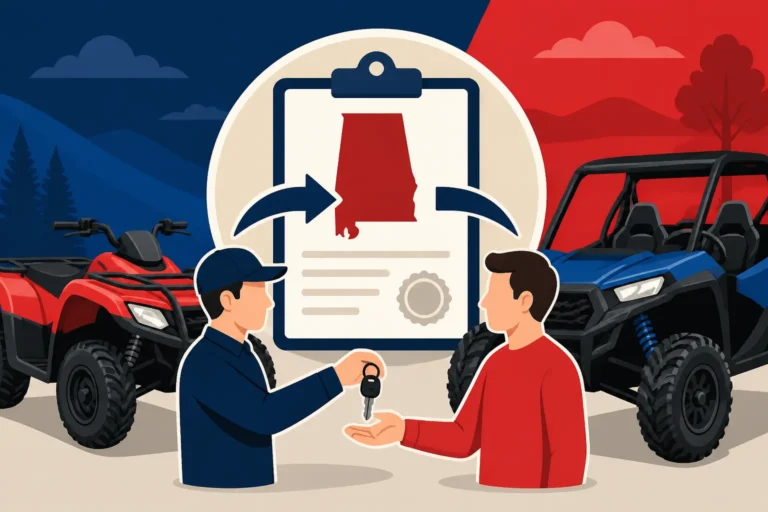
For machines that don't have a title, a strong bill of sale is often your best friend. This isn't just a scribble on a napkin; it needs to be a detailed document that clearly establishes the transfer of ownership. A good bill of sale should include:
- Seller's Information: Full legal name, address, and contact information.
- Buyer's Information: Your full legal name, address, and contact information.
- Machine Description: Year, make, model, color, and most importantly, the Vehicle Identification Number (VIN) or serial number. This is absolutely critical for identification.
- Purchase Price: The amount you paid for the machine.
- Date of Sale: When the transaction took place.
- Signatures: Both the buyer and seller should sign and date the document. It's a good idea to have it notarized if possible, as this adds an extra layer of legitimacy.
Think of it as the closest thing you have to a title. Without a bill of sale that includes the serial number, proving you actually bought that specific machine can be nearly impossible. If you’re ever in doubt about creating one, resources like LawDepot offer customizable bill of sale templates that can guide you through the process, ensuring you hit all the key points. This helps create a professional and legally sound document even for a private sale. More details on this are available in [Alabama Bill of Sale Requirements].
Sworn Affidavits and Ownership Statements
What if you bought your machine years ago, or inherited it, and a formal bill of sale isn't available? This is where sworn affidavits or ownership statements can come into play. These are formal declarations made under oath, often notarized, stating that you are indeed the rightful owner of the machine. An affidavit might be necessary if:
- You inherited the ATV/UTV after a family member passed away, and there's no original bill of sale.
- The machine was gifted to you, and no formal transaction record exists.
- The original bill of sale was lost, and the seller is no longer reachable.
In such cases, you might draft an affidavit explaining the circumstances of how you came into possession of the machine, explicitly stating the VIN/serial number, and affirming your ownership. Having it notarized is crucial for its legal weight. If you're looking for guidance on drafting such a document, legal template sites like LawDepot can provide forms for affidavits or general ownership declarations, which can be adapted to your specific situation. While not as strong as a title, a well-executed affidavit can be a powerful piece of evidence when combined with other forms of proof.
Photographic and Serial Number Evidence
Never underestimate the power of thorough documentation of the machine itself. Before you even think about needing paperwork, make it a habit to:
- Photograph the entire machine: Take pictures from all angles, showing its condition.
- Take clear photos of the serial number/VIN: This is usually stamped on the frame in a visible location. Make sure it's legible in the photo.
- Document any unique features: Scratches, modifications, or distinctive marks can help identify your machine.
These photos, especially those showing the serial number, can corroborate your claim of ownership when presented alongside a bill of sale or affidavit. For example, if your bill of sale lists a specific VIN, and you have a photo of that VIN stamped on your machine, it's a very strong connection. This kind of physical evidence is often what an insurance company or law enforcement will look for if there's ever a question of theft or damage. It's a simple step that provides immense peace of mind. Check out [Recording Serial Numbers at Home] for more tips on this.
Here’s a quick overview of common ownership proofs and their strength:
| Document Type | Description | Strength for Proving Ownership (Without a Title) |
|---|---|---|
| Bill of Sale | Detailed record of transaction, seller/buyer info, machine details, serial number, price, signatures. | High (Especially if notarized) |
| Sworn Affidavit | Formal, notarized statement explaining how you acquired the machine and affirming ownership. | Medium (Stronger with corroborating evidence) |
| Manufacturer's Cert. of Origin (MCO) | Original document from manufacturer for new machines, proving first ownership. | High (If you are the original owner) |
| Photos of Machine/VIN | Clear pictures showing the machine and its serial number. | Medium (Stronger when paired with other documents) |
| Registration (Previous) | If previously registered by you or a prior owner, can show a history of possession. | Low to Medium (Doesn't prove legal ownership itself) |
How to Get Alabama Registration for a Machine Without a Title
Even without a title, you can absolutely register your ATV or UTV in Alabama through ALEA. This is crucial if you plan to ride on designated public lands. The process is designed to be accessible for machines that don't fit the traditional titling model, recognizing the common scenario of private sales and older equipment. It might feel like a bit of a hurdle, especially if you're used to simply presenting a title for vehicle registration, but it's entirely manageable with the right approach.
Gathering Your Proof of Ownership
When you head to your county licensing official to register, you'll need to present documentation that satisfies ALEA that you are indeed the rightful owner. This is where all those documents we just discussed come into play. Your goal is to provide a clear, undeniable link between you and the specific machine.
Typically, the most accepted forms of proof will be:
- A strong bill of sale: This is usually the primary document. Ensure it meets all the criteria mentioned above, especially the inclusion of the serial number.
- Manufacturer's Certificate of Origin (MCO): If you purchased the machine new and it never had a title, the MCO is the original ownership document. This acts like a birth certificate for the machine.
- Sworn Affidavit of Ownership: If an MCO or sufficient bill of sale isn't available, a notarized affidavit explaining your ownership history can be submitted. You might need to provide supporting evidence with it, such as photos of the machine.
It's always a good idea to call your local county licensing office beforehand to confirm what specific documents they prefer or require, as practices can sometimes vary slightly from county to county. They might even have specific forms they want you to fill out if you're using an affidavit route. Don't be shy about asking; they deal with these kinds of situations regularly.
Completing the Registration Application
Once you have your proof of ownership squared away, the next step is to fill out the Alabama Off-Road Vehicle Registration Application. This form will ask for details about you and your machine, including:
- Your personal information: Name, address, driver's license number.
- Machine details: Make, model, year, engine size, fuel type, color, and, critically, the serial number/VIN.
- Use type: You'll choose between "public use" (for riding on designated public trails) or "private use" (for riding exclusively on private land). The fee differs for these. Many people opt for the public use registration for the flexibility it offers.
Make sure every piece of information is accurate and matches your supporting documents. Inconsistencies can cause delays. Remember, ALEA registrations run for three years, so you're getting a good stretch of validity for your effort. You can learn more about this in [Alabama Registrations Run Three Years].
Dealing with Missing or Illegible Serial Numbers
This is arguably the toughest challenge when dealing with a machine with "no paperwork." If the serial number is missing, defaced, or illegible, it creates a significant hurdle for proving ownership and registering the machine. The serial number is the unique identifier, the fingerprint of your ATV or UTV. Without it, it's incredibly difficult for any agency to verify its identity or ensure it's not a stolen machine.
If you find yourself in this situation, here's what you might need to do:
- Thorough Inspection: Double-check every common location for the VIN/serial number. Sometimes it's in an obscure spot, under mud, or painted over. Check the frame, engine block, and any data plates.
- Contact Manufacturer: If you can identify the make and approximate year, sometimes the manufacturer can provide information based on other identifying features, though this is rare for older machines.
- Police Verification: In some cases, if the serial number is completely missing or questionable, the county official might direct you to contact local law enforcement. They may be able to run checks or conduct a physical inspection to determine if the machine has been reported stolen or if a secondary number can be found. Without a legible serial number, it's very hard for ALEA to issue a registration, as it's a crucial piece of information for their records and for theft prevention.
This particular scenario highlights the importance of checking for a clear, legible serial number before you ever purchase a machine, especially in a private sale. It's a red flag that can indicate significant future problems.
Protecting Your Investment and Future-Proofing Ownership
Getting your machine registered, even without a title, is a huge step. But the journey doesn't end there. Thinking ahead about insurance, resale, and even the future of titling laws in Alabama can help you further protect your investment and avoid headaches down the road. It’s all about being a proactive and informed owner in a state with evolving regulations.
Insuring an Untitled Machine
Many owners wonder if they can even get insurance for an ATV or UTV that doesn't have a title. The good news is, yes, you generally can! Insurance companies are primarily concerned with covering your asset against theft, damage, and liability. While a title certainly simplifies things, they understand that many off-road vehicles operate without one.
When seeking insurance for an untitled machine, be prepared to provide:
- Proof of ownership: This will be your strong bill of sale, MCO, or notarized affidavit, along with supporting photos of the machine and its serial number.
- Machine details: Year, make, model, VIN/serial number, and any aftermarket accessories.
- Intended use: Private property, public trails, or farm use.
It's crucial to be completely transparent with your insurance provider about the lack of a title. They may have specific underwriting requirements or forms they need you to complete to ensure coverage is valid. Don't assume anything; ask clear questions about what documentation they need to consider your ownership legitimate for coverage purposes. Having proper insurance is non-negotiable, especially for covering potential liabilities when riding. You can learn more about this in [Insuring an Untitled Machine in Alabama].
Selling a Machine Without a Title
Eventually, you might want to sell your ATV or UTV. When your machine doesn't have a title, managing the sale process requires a bit more transparency and effort on your part to reassure potential buyers. Remember, a buyer will likely be in the same boat you were: needing to prove ownership without a formal title.
Here are some tips for selling an untitled machine:
- Be upfront: Clearly state in your listing that the machine does not have a title, but you have a clear bill of sale and registration.
- Provide all documentation: Have your original bill of sale (from when you bought it), your current ALEA registration, and any affidavits or MCOs ready to show. Make sure to provide the buyer with a new, detailed bill of sale with the serial number and your signature, and have them sign it too. You can use templates from LawDepot for a professional bill of sale.
- Explain the Alabama titling laws: Inform the buyer about the 2026 titling changes and why their particular model year won't have a title, easing their concerns.
- Be prepared for questions: Buyers will likely want to know the history of the machine and why it lacks a title. Honesty builds trust.
Selling a machine without a title is very common for older models and won't necessarily deter a serious buyer if you can provide solid proof of ownership and a clear explanation.
Preparing for 2026 Titling (If Applicable)
As we approach 2026, many owners are looking at their machines and wondering how the new titling law will affect them. If you currently own a machine that is a 2026 model year or newer, or plan to purchase one, it will require a title. If you are one of the many owners with a machine from model years 2016-2025, you're likely in that "never titled" category.
For those with older machines, meaning ten model years old or older by January 2026, you also won't need a title. This means for a 2015 model, you’ll continue to rely on your existing proofs of ownership. The key takeaway here is to understand which category your specific machine falls into based on its model year. This clarity will guide whether you need to prepare for a title application (for 2026+ models) or continue relying on a robust bill of sale and registration (for older models). Keeping good records now will make any future processes, whether it's registration, sale, or insurance, much smoother. Find out more about this important cutoff in [Alabama ATV Titling Starts With Model Year 2026].
Disclaimer
This article is for general informational purposes only and does not constitute professional advice. Laws, prices and regulations vary by location and change over time. Consult a qualified professional for guidance on your specific situation.