Arriving Before the Gate Opens
Arriving before an Alabama ATV or UTV park opens can make a riding day smoother, especially when you need to unload, check permits or get a group organized. But an early arrival does not mean you can enter the property or start riding. Confirm the park’s current hours and check-in rules, then use the extra time to prepare without blocking access.
What Arriving Early Does and Does Not Allow
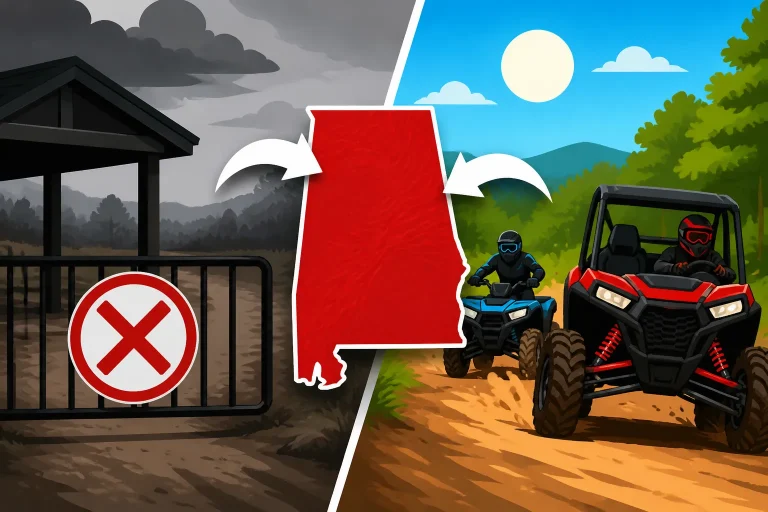
“Arriving before the gate opens” can mean pulling into a public road or designated waiting area before admission begins. It does not automatically mean you may pass a closed gate, enter a trail, unload inside the property or use a campsite. The park’s posted rules and staff instructions control access.
That distinction matters because parks do not all handle early arrivals in the same way. One may have a place to wait outside the entrance; another may ask visitors to remain off the property until opening. A campground or reservation confirmation also does not necessarily authorize riding before the riding area opens. Check what your reservation covers and when access begins.
Before setting out, verify the information directly with the park. Look for current operating hours, closures, admission procedures, reservation instructions and any special event notices. If the website is unclear or unavailable, contact the park rather than relying on an old search result or a social media post. Start with Alabama Park Reservation Systems and Alabama Trail Conditions Before You Tow, then confirm any details that could affect your arrival that day.
Give yourself a realistic buffer, not an extremely early arrival. If check-in begins at opening, arriving shortly before that time may be enough to park safely, gather paperwork and get your group ready. Reaching the entrance well before staff or gates are available can leave you waiting on a narrow shoulder, create congestion for other visitors or put your trailer in a place where it obstructs traffic.
Use this simple rule: if the park has not clearly said that early staging is allowed, treat the entrance as closed until its published opening time or staff gives you instructions. Do not tailgate another visitor through a gate or assume that an open gate means the trails are open. A gate may be open for staff, deliveries or another authorized purpose.
| Before you leave | What to confirm | Why it matters |
|---|---|---|
| Operating hours | Gate, admission and riding hours | These may not start at the same time |
| Early arrival | Where visitors may wait before opening | Keeps trailers off unsafe shoulders and access roads |
| Reservation | What the booking includes and when it starts | A campsite booking may not include early trail access |
| Admission | Payment method and check-in process | Avoids delays at the entrance |
| Paperwork | Waivers, permits and proof of payment | Some requirements may need to be completed before riding |
| Conditions | Trail closures, weather and maintenance notices | A park may change access after rain or other conditions |
Hours can change with seasons, maintenance, weather, staffing or special events. Treat a map listing, old review or previous visit as a starting point, not a guarantee. If arriving early is important because you are traveling a long distance, ask the park specifically whether you may wait in a designated area and when you can begin unloading.
Use the Waiting Time to Get Ready
If the park allows visitors to wait nearby, use that time to prepare rather than trying to rush through everything at the gate. A little organization helps the check-in process and reduces the chance that someone in the group is still searching for a waiver, helmet or phone signal when staff are ready to admit visitors.
Keep the relevant items together in one place. Depending on the park’s process, you may need a reservation confirmation, payment information, identification, a signed waiver or proof of a permit. Requirements differ by location, so do not assume that a document accepted at one park will satisfy another park’s rules. Check Alabama Private Park Waivers and Rules before the trip, particularly when minors are riding or a group is arriving in separate vehicles.
For paper documents, a simple waterproof pouch can protect printed confirmations from rain, mud and spills. A basic pouch from a local store or Amazon can work; the important thing is that the papers stay dry and easy to reach. Keep digital copies on a phone as a backup, but do not rely on them alone if your battery is low or reception is unreliable. A screenshot stored on the device may be more useful than a confirmation that requires a live connection to open.
Use the pre-opening wait to check the equipment and load, too:
- Confirm that the trailer is secure and that the machine is tied down correctly before moving it into any area where unloading is permitted.
- Check that helmets and other protective gear are ready for each rider. Review [Alabama Park Rules for Helmets] for the kinds of park-specific requirements to ask about.
- Make sure passengers, children and pets are supervised while the group waits. Parks may have their own rules for minors, passengers and animals; confirm those before arrival.
- Put water, medication, keys and any essential safety supplies where they can be reached without unloading the entire trailer.
- Assign one person to handle check-in while another keeps the group and machines organized, if the park permits that arrangement.
Do not unload on a public road or shoulder just because you have reached the entrance early. A shoulder may be narrow, soft or unsafe for a trailer, and it can obstruct other visitors, local traffic or emergency vehicles. If there is no clear waiting area, find a safe legal place off the road and return closer to opening.
Avoid warming up or test-driving a machine near homes, businesses or the entrance. Noise, exhaust and unnecessary movement can disturb neighbors and create risk around people arriving on foot. Follow posted speed limits and staff direction once you are admitted. If the park has not opened, keep the machines secured and wait.
A final check of the group is useful before approaching the entrance: everyone knows who is checking in, where the vehicles will park, which waiver applies, and what to do if a rider or vehicle is delayed. For youth riders, check Alabama Park Rules for Minors and confirm that the responsible adult has completed any required paperwork. These details are easier to resolve before the gate line forms.
Permits, Reciprocity and the Difference Between Parks and Public Land
A common source of confusion is treating every riding area as if it uses the same permit or entry system. A private OHV park generally has its own admission process, waiver and operating rules. Public land can involve separate access requirements. A permit or registration that applies in one setting does not automatically grant permission to ride somewhere else.
For example, a private park’s admission receipt is not a substitute for a permit required on a public tract. Likewise, a permit for a public area does not necessarily cover entry to a private park. Confirm the rules for the actual property you plan to ride, not merely the rules for Alabama or for a different park you visited previously.
If your destination is a Wildlife Management Area, check the requirements for that specific area and the dates you plan to visit. Access rules can vary by tract, season and permitted activity. Start with Alabama WMA Rules Vary by Area and Which Permits to Carry on an Alabama WMA. Confirm whether you need a license, area permit, daily permit or another form of authorization, and whether the permit must be displayed, carried or completed before entering.
Do not assume that a hunting license alone gives you permission to ride an ATV or UTV on every Wildlife Management Area. The permit requirements and the activities allowed are separate questions. A tract might allow access only on specified roads or during certain periods, or may close some routes for management or safety. Review the current area information and contact the appropriate office if the map or instructions are unclear.
The same caution applies to National Forest land. A road shown on a general map is not necessarily open to off-highway vehicles, and a gate may mark a seasonal or permanent restriction. Check Alabama National Forest Riding Permits and Which Forest Roads in Alabama Are Open to ATVs before making a route plan. Follow the official route information and posted signs, even if a road appears passable.
Visitors arriving from another state should confirm what Alabama requires rather than assuming their home-state decal or registration settles every issue. Rules can differ by land manager and riding destination. Alabama Rules for an Out-of-State Machine is a useful starting point, but it is still important to check the rules of the specific park or public area. Reciprocity is not a universal permission to ride wherever you arrive.
If the trip includes more than one property, make a short checklist for each stop. Record the location, opening time, required permit or admission, check-in instructions and any access limitations. This prevents a valid permit for one destination from being mistaken for authorization at the next one.
A Low-Stress Arrival Plan
A smooth arrival begins before the tow vehicle leaves home. Check the destination’s current information, save the address and contact details, and confirm whether there is a safe place to wait if you reach the area ahead of schedule. If the entrance is on a busy or narrow road, consider arriving closer to opening rather than creating a queue where there is no room for one.
The night before, put documents and confirmations together and make sure every rider understands the plan. Tell the group what time you intend to reach the area, where to meet if vehicles become separated, and who will handle check-in. If one vehicle is delayed, the rest of the group should not enter or begin riding in a way that leaves a minor or other rider without their responsible adult.
On arrival, follow the signs and do not block the entrance. If staff are not present, wait where the park has authorized visitors to wait. If you are unsure whether you may enter, call or follow posted directions rather than interpreting an open gate or an empty parking area as permission. Be especially cautious about unloading: do it only in a place and at a time the park allows.
Once admitted, complete the park’s check-in process before riding. Pay the required admission, submit waivers and ask about that day’s closures, designated riding areas and any special restrictions. Alabama Park Fees and What They Cover can help you understand why admission and other charges may be separate, but confirm current fees and what they include with the park itself.
A useful arrival checklist is:
- Confirm the park is open and operating on the day you plan to visit.
- Ask whether early waiting or staging is allowed and where.
- Verify reservation, admission and payment instructions.
- Prepare any required waiver or permit for each rider.
- Check helmet, passenger and minor rules for the destination.
- Review trail closures and weather-related notices.
- Keep the entrance and public road clear while waiting.
- Do not unload, pass a closed gate or ride before authorization.
- Ask staff about routes and restrictions before heading onto the trails.
If plans change during the drive, do not assume that reaching the gate resolves the problem. A delayed opening, weather closure or event restriction may affect access. Contact the park and ask whether to wait, return later or use a different destination. For public land, verify the applicable permit and route information before continuing to another tract.
Arriving a little early can be helpful when the park allows it: you have time to organize paperwork, prepare the group and respond to questions without rushing. The key is to treat the opening time as the beginning of authorized access, not as a suggestion. Confirm current instructions, wait only where permitted, and keep park rules and public-land permits separate.
Disclaimer
This article is for general informational purposes only and does not constitute professional advice. Laws, prices and regulations vary by location and change over time. Consult a qualified professional for guidance on your specific situation.