Group Limits on a Busy Weekend
A busy riding weekend can turn a simple group trip into a logistics problem: a park may limit event size, campsites may hold fewer people than expected, and public-land rules may apply to each rider separately. The safest approach is to confirm the venue’s current group policy before you travel, then check permits, vehicle eligibility, and supervision requirements for everyone in your party.
What a group limit can mean
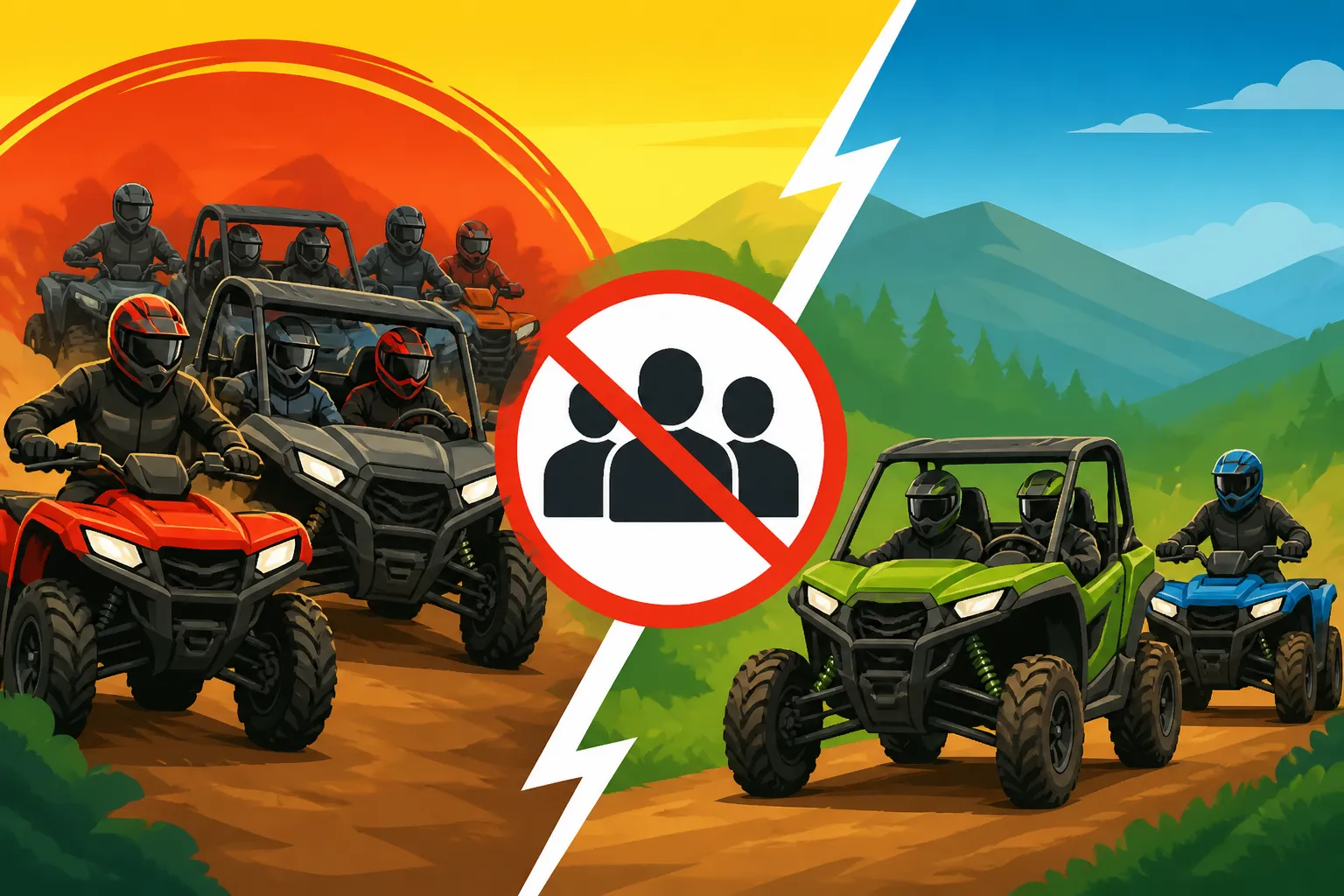
“Group limit” is not always one fixed number. A riding area may set limits for organized events, trail groups, campsite occupancy, parking, or the number of machines allowed to enter together. Those limits can be different, even at the same venue.
For example, a park might allow a large gathering on its grounds but require riders to split into smaller trail groups. A campground may have a separate occupancy limit for each site. An event held at a public riding area may need advance approval even when individual riders do not normally reserve a place.
| Type of limit | What it usually controls | What to ask |
|---|---|---|
| Event or group reservation | The number of participants the venue will accept for a planned gathering | Does the park approve the group size in advance? |
| Trail group size | How many machines may ride together on a trail | Must the group split into smaller riding units? |
| Campsite occupancy | The number of people, machines, or vehicles assigned to a site | How many riders and trailers fit under the site rules? |
| Parking capacity | The number of tow vehicles and trailers that can be accommodated | Is there enough parking for the full group? |
| Public-land permit rules | What each rider or machine must have to enter or use a specific area | Does each person need a permit, or does one permit cover the group? |
| Youth supervision | How minors must be accompanied or supervised | What adult-to-youth arrangement does the venue require? |
Do not assume that “group” means only the riders who leave the staging area together. A venue may count everyone arriving under one reservation, including passengers, children, non-riding guests, and people staying at a campsite. It may also count tow vehicles and trailers when deciding whether a group fits.
Ask whether the venue’s cap is a maximum number of people, machines, households, or reservations. Those are not interchangeable. A group of ten people might include six machines, while a smaller group could bring more machines and trailers. The park needs to know the details that affect its capacity.
A policy may also distinguish between an informal gathering and an organized ride. A few friends arriving together may be handled as ordinary day visitors. A club ride, charity event, guided outing, or group reserving multiple campsites may need advance coordination. When in doubt, describe the plan plainly rather than relying on the word “group” alone.
How to check a park’s policy before a busy weekend
Start with the exact riding area, not just a general search for ATV parks in Alabama. Rules can differ between private parks, county recreation areas, and public land, and a venue’s policy can change with operating conditions. A park’s regular admission process does not necessarily answer questions about group reservations or event approval.
Use the venue’s official contact information to confirm the policy for your chosen dates. If the website has a reservation system, check whether it can accommodate the whole party and whether a reservation is required. For broader planning, Alabama Park Reservation Systems can help you identify the kinds of reservation details to check, while Alabama Private Park Waiver Forms is relevant when everyone needs to complete venue paperwork.
When contacting the park, have the following information ready:
- The date and expected arrival time.
- The number of riders, passengers, and non-riding guests.
- The number and type of machines, including ATVs and side-by-sides.
- The number of tow vehicles, trailers, and planned campsites.
- Whether any riders are minors and how they will be supervised.
- Whether the trip is a casual outing, club ride, event, or guided activity.
- Whether anyone in the group needs to arrive later or leave early.
Ask for the limit that applies to each part of your visit. In particular, confirm whether the venue requires the group to register together, split into smaller trail groups, or use a designated staging area. Ask whether everyone must arrive together and whether the reservation holder must be present at check-in. If a rule is communicated by phone, write down the date, the name or role of the person who answered, and the details given. That record can help clear up misunderstandings at arrival.
A busy weekend can mean slower check-in and more pressure on parking, trails, and staff. A park may enforce ordinary rules more carefully when it is crowded, or it may limit new arrivals once capacity is reached. A reservation or a past visit is not a guarantee that every part of the group will be admitted if the venue’s current conditions do not allow it. Confirm whether your booking covers everyone in your party and what happens if the group arrives in separate vehicles.
Do not plan around a number posted in an old discussion, event flyer, or social media comment without confirming it. The post may refer to a different date, a special event, a specific campsite, or a former policy. If a park says it cannot take the whole party, ask whether there is a lawful and practical alternative, such as a separate arrival time or a different date. Do not split the group across reservations if that would bypass a stated event or capacity limit.
A useful planning rule is to keep the head count flexible until the venue confirms the booking. Collect names and machine details early, but do not promise that late additions can join. If the group changes, update the park before arrival. A few extra machines can affect parking and trail flow even when the number of people seems modest.
Permits and rules when the ride is on public land
A private park’s group policy is only part of the planning. Public land can have its own access requirements, and a private park reservation does not substitute for a public-land permit. Likewise, having an Alabama registration or an out-of-state registration does not automatically authorize riding in every public area.
For Wildlife Management Areas, requirements can vary by area and activity. Some permit processes may be individual, while an area may also have conditions that affect groups, dates, routes, or permitted uses. Check the current rules for the specific tract and the purpose of the visit before treating one person’s permit as coverage for the entire party. Alabama WMA Rules Vary by Area and Alabama Permits for a Group Trip are useful starting points for identifying which questions to resolve.
National Forest access also requires careful route checking. A forest boundary does not mean every road or track is open to ATVs or UTVs. The allowed routes, vehicle types, and seasonal restrictions depend on the applicable maps and rules. Check Alabama National Forest Riding Permits and the current route information before choosing a meetup point or planning a group loop.
Out-of-state riders should confirm what their home-state credentials do and do not cover in Alabama. Reciprocity is not a blanket permission to use every Alabama riding area. A visiting rider may still need to meet the destination’s permit, registration, proof-of-ownership, or entry requirements. The conditions can depend on where the group rides, not just where the machines are registered. Alabama Visitors From Out of State can help with the broader questions, but the land manager or park is the final place to confirm venue-specific entry rules.
Before the trip, give every participant the same list of requirements. Do not assume the lead rider’s paperwork covers passengers or other machines. Ask whether each rider needs a separate permit, whether a pass must be displayed or carried, and whether the group must check in or out. Keep permits and confirmations accessible to the people who may be asked for them. If the area uses a map or posted rules at a kiosk, read those on arrival as well; local directions can explain restrictions that are easy to miss during online planning.
A group is responsible for riding only where its machines are allowed. Keep the party together at junctions, but do not let that become an excuse to leave designated routes or enter closed areas. If a trail is unsuitable for one machine, turn around or divide the outing only in a way the area permits. A larger group also needs a clear lead and sweep rider so nobody is left behind or takes an unplanned route.
A practical plan for keeping a large group manageable
Once the venue confirms the cap, organize the trip around the actual rules rather than trying to fit everyone into one riding line. If a park requests smaller trail groups, choose the groups before arrival. Put riders together by experience, machine capability, and pace, and make sure each group knows its route and return plan.
A simple trip plan can cover the details that matter most:
- Name one coordinator. This person handles the reservation, communicates changes, and knows the park’s instructions.
- Choose a lead and a sweep for each riding unit. The lead watches navigation and trail conditions; the sweep helps ensure no one is separated behind the group.
- Share the venue rules ahead of time. Include check-in steps, required paperwork, permitted routes, quiet hours if camping, and any helmet or passenger rules.
- Set a meeting point. Use a place the venue allows, not a road shoulder or entrance that could block other visitors.
- Plan for staggered arrival only with approval. A late arrival may have to check in separately or may not be admitted if capacity is full.
- Keep contact details available. Cell service may be limited, so agree on a fallback meeting place and a time to regroup.
- Have a weather and closure plan. Ask how the venue communicates closures, delays, or changes to access.
If children are riding, check both the venue’s policy and the machine’s intended passenger capacity. A park’s group limit does not establish that a child is allowed on a particular machine or that a passenger arrangement is safe. Confirm supervision rules before the trip; Alabama Park Rules for Minors may help identify the questions to ask.
Campsites require their own head count. A group that meets the riding-area limit may still exceed a campsite’s occupancy or vehicle allowance. Confirm whether the site assignment covers the people and machines you plan to bring, and whether extra tents, trailers, or guests need separate arrangements. Avoid assuming that nearby sites can be combined or that an empty site will still be available when you arrive.
If the group is an organized event rather than a casual outing, explain that when you make contact. A venue may have event approval requirements or conditions that do not apply to a family or friend group. Do not collect money, advertise a ride, or invite a larger public group on the assumption that ordinary admission rules automatically cover an organized event. Ask the park or land manager what approval is needed before promoting it.
The same principle applies if your plan includes a WMA or forest route before or after a private park visit. Treat each destination as a separate stop with its own access rules. Confirm whether the group can legally travel between locations on the route you intend to use, and do not assume that a trail connection shown on an informal map is open to motorized vehicles.
If the venue cannot accommodate the full party, respect that decision. Options may include choosing another date, reducing the group, selecting a location with confirmed capacity, or dividing the outing into separate trips if the venue allows it. Arriving anyway and hoping staff will make an exception can leave some riders without access and create a problem for other visitors.
For a smooth weekend, the key is to confirm three things separately: how many people and machines the venue will accept, what each rider needs to enter, and how the party must be organized once inside. That small amount of coordination is usually easier than resolving a capacity or permit issue at the gate.
Disclaimer
This article is for general informational purposes only and does not constitute professional advice. Laws, prices and regulations vary by location and change over time. Consult a qualified professional for guidance on your specific situation.