Alabama Proof of Ownership on the Trail
A question about ownership can come up at a trailhead, on public land, or after a stop—and an ATV or UTV may not have a title to show. In Alabama, the right documents depend partly on the machine’s age and where you ride. Here’s what to carry, what each record proves, and how to avoid confusing registration with ownership.
What counts as proof of ownership in Alabama
The best document depends on how you acquired the machine and whether Alabama requires it to be titled. A title is strong evidence of ownership when the machine has one, but not every ATV or UTV has an Alabama title. Alabama’s newer titling rules apply to certain model years; older machines can fall outside the titling requirement. For the details, see Alabama Proof of Ownership Without a Title and Alabama ATV Titling Starts With Model Year 2026.
If your machine is titled, carry a copy or another accessible record showing the owner’s name and the machine’s identifying information. Whether a copy is accepted for a particular official purpose can depend on the situation, so keep the original title secure and check the relevant agency or riding area’s requirements. Don’t leave the original in a machine that could be stolen or damaged.
If the machine does not have a title, gather the records that show how ownership passed to you. These may include a bill of sale, a purchaser’s certificate, or paperwork from a dealer, estate, or family transfer. The documents are more useful when they identify the machine by its serial number and clearly name the buyer and seller. A receipt that says only “ATV” may be difficult to connect to the machine you’re riding.
| Record | What it can help show | What it does not automatically prove |
|---|---|---|
| Title | The named owner and the titled machine | Permission to ride on a particular trail or property |
| Bill of sale | A sale between the named buyer and seller | That the seller had good ownership or authority to sell |
| Purchaser’s certificate or dealer paperwork | Details of a purchase and the machine | That every later transfer has been recorded |
| Registration record | That a machine was registered under a particular program or use tier | Ownership by itself, or permission for every riding area |
| Serial number and photos | Which physical machine the paperwork refers to | A legal chain of ownership on their own |
| WMA or park permit | That a rider obtained a required access credential | Ownership of the ATV or UTV |
A registration record is useful to have, but it is not a substitute for a title or purchase record. Alabama registration is generally voluntary, and its purpose and use tier matter. Read Alabama Registration Is Voluntary alongside Alabama Registration Paperwork Explained to understand what a registration record says and what it doesn’t.
The simplest practical approach is to carry a small document set that connects the machine to you: the title if it has one, or the best available purchase or transfer papers if it doesn’t, plus registration and any location-specific permits. Keep the papers together, and make sure the machine’s serial number is legible and matches the documents.
What to carry when you ride
You may not need to carry every ownership document on every ride, but having the right records available can save time if a question arises. Requirements can differ among private parks, public land managers, and other riding locations. A park may also set its own admission, waiver, or check-in rules. Confirm those rules before traveling rather than assuming that a document accepted at one location will satisfy another.
A useful riding folder—paper, digital, or both—can include:
- Proof of purchase or transfer. Carry the bill of sale, dealer paperwork, or other record that shows how the machine came to you. If the machine passed through several owners, keep the available records that connect the chain of transfers.
- Title, if the machine has one. Keep the original protected and secure. If you carry a copy, verify that the place you’re visiting accepts it for its purposes.
- Registration documents, if registered. Bring the registration card or record and any required decal information. Registration can help identify the machine, but it does not turn into an ownership document just because it contains your name.
- Access permits or credentials. For a Wildlife Management Area, private park, or other managed property, carry whatever access credential the specific area requires. Ownership papers and access permits answer different questions.
- A record of the serial number. Keep a photo of the number and a separate written copy. Confirm that it matches the number shown on your paperwork.
- Contact information. Make it possible to reach the registered owner or seller if the machine is borrowed, jointly owned, or still recorded in another person’s name.
For digital records, store readable photos or scans somewhere you can access without cell service. A phone-only plan is less dependable if the battery dies, the trail has no signal, or the screen is damaged. A waterproof document pouch or a copy kept with your vehicle’s travel paperwork can provide a backup. If you buy a pouch through a retailer such as Amazon, choose one that closes securely and keeps papers dry; don’t treat the pouch as a replacement for protecting the original title at home.
Before setting out, compare the serial number on the machine with the number on the bill of sale or other ownership record. If the number is obscured, damaged, or doesn’t match, don’t wait for a roadside question to investigate it. Alabama Serial Numbers on the Application explains why the serial matters in paperwork, and Recording Serial Numbers at Home covers a simple way to keep a record for your files.
Ownership documents are not riding permits
A rider can own a machine and still lack permission to ride it in a particular place. The reverse is also true: a permit or registration may show that an access step was completed without proving that the person named on the paperwork owns the vehicle.
Alabama’s rules can depend on whether you’re riding on private property, a designated public area, or a managed tract with its own access conditions. A registration tier does not grant general access to land. Before riding, check both the land manager’s rules and the machine’s registration status. Alabama Public Use Versus Private Use explains why those categories should not be treated as interchangeable.
Wildlife Management Areas are a good example of why separate records matter. A rider may need an applicable permit or other credential for a particular area, while still needing ownership paperwork for the machine itself. Requirements can vary by area and activity, so check the specific tract’s instructions before you go. See Alabama WMA Permits for Riders and Alabama WMA Rules Vary by Area for the access side of the question.
Private riding parks may also ask for items beyond proof of ownership, such as a signed waiver or evidence that riders meet the park’s rules. Those requirements are set by the facility and may change. Review its current instructions before the trip; having a title or bill of sale does not override a park’s admission conditions.
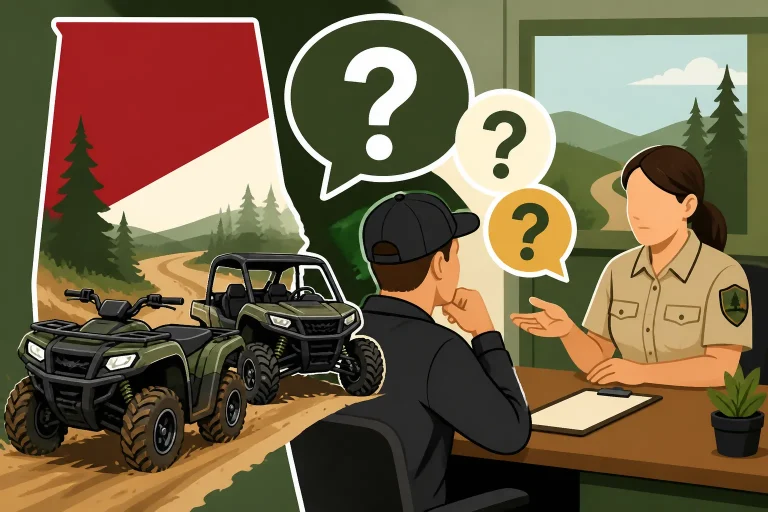
If a law enforcement officer or land manager asks about the machine, stay calm and provide the documents you have. A registration card, title, or bill of sale may help identify the vehicle and explain who owns it, but don’t assume that one document answers every question. If you’re unsure why a particular record is being requested, ask respectfully what information is needed and follow the applicable process.
Special cases: borrowed, recently bought, or out-of-state machines
Some ownership questions are harder because the rider is not the person named on the paperwork or the machine has recently changed hands. Plan for those situations before leaving home.
Borrowed machines: Carry the owner’s contact information and written permission to use the ATV or UTV. The permission note should identify the machine and the dates or general period of use. It is not a title and does not establish your ownership, but it can clarify why you have the machine. Ask the owner to provide a copy of the purchase or title record if the riding location’s rules call for it.
Recently purchased machines: Keep the bill of sale and any dealer or transfer paperwork with you until the ownership records are fully sorted out. Check that the seller’s name, buyer’s name, date, and serial number are clear. If the seller cannot show a title where one should exist, or the serial number has been altered or is unreadable, pause before riding or completing the deal. Buying From a Private Seller in Alabama and Alabama Stolen Machine Checks can help you think through those checks before a purchase.
Machines with two owners: Make sure the paperwork reflects the ownership arrangement as accurately as possible. If one co-owner is riding without the other, carry contact information and any permission that could clarify the arrangement. If names on the title or other record don’t match the rider, that does not by itself settle every ownership question; keep the supporting transfer records available.
Out-of-state machines: Do not assume that another state’s registration decal or paperwork automatically satisfies Alabama requirements or a particular Alabama property’s access rules. Bring the machine’s home-state ownership or registration documents, then confirm the riding location’s rules before you travel. Alabama Rules for an Out-of-State Machine addresses the separate question of which riding rules apply to visitors.
Inherited or family-transferred machines: Gather documents that show the transfer, even if there was no conventional sale. If the machine has no title, the route to documenting ownership may depend on its age and history. Keep a written account of the transfer and any supporting records, and check the applicable county or agency process before relying on a family understanding alone.
A quick check before leaving home
Use this short review to catch common problems before reaching the trail:
- Is the title or best available ownership record easy to access?
- Does the serial number on the machine match the paperwork?
- Do the buyer and seller or prior and current owners make sense from the records?
- Is the machine registered, and are you clear about what that registration does and does not establish?
- Does the destination require a separate permit, waiver, or check-in?
- Can you access your records if your phone has no service?
- If the machine belongs to someone else, can you show permission to use it?
If a document is missing, identify what is missing before riding and contact the relevant agency, seller, land manager, or park. Avoid making a replacement document yourself or altering a serial number. When ownership is disputed or the records conflict, pause and resolve the issue before taking the machine onto a trail.
The practical takeaway is straightforward: carry records that connect you to the machine, keep the serial number consistent across those records, and treat ownership proof, registration, and riding permission as separate things. That preparation won’t guarantee that every location accepts the same paperwork, but it makes an ownership question easier to answer and helps prevent a permit from being mistaken for proof of ownership.
Disclaimer
This article is for general informational purposes only and does not constitute professional advice. Laws, prices and regulations vary by location and change over time. Consult a qualified professional for guidance on your specific situation.