Alabama Visitors From Mississippi
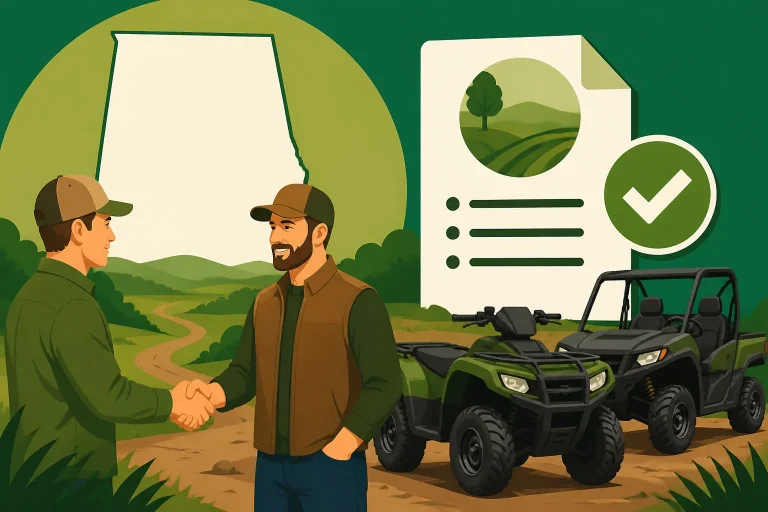
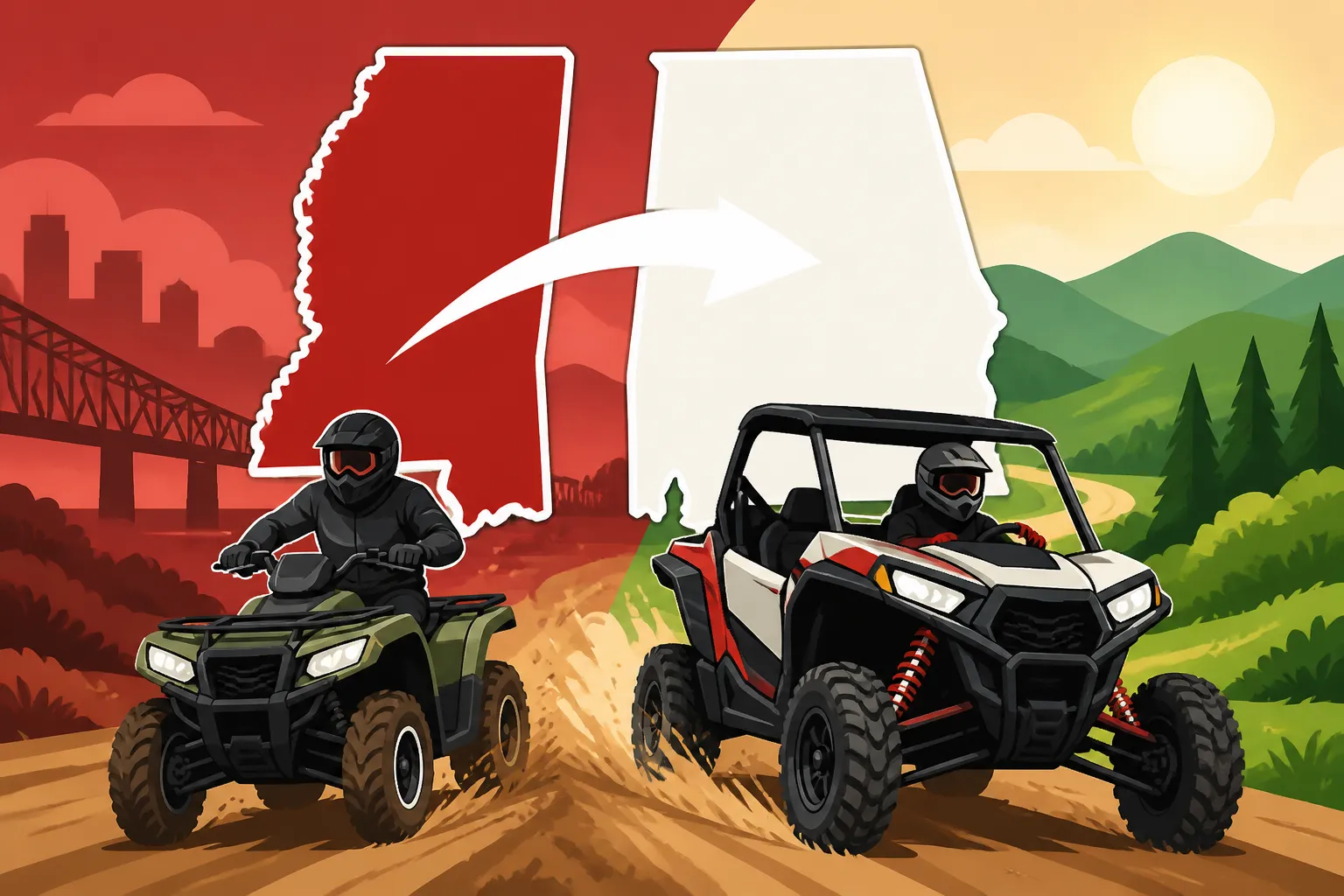
Visitors from Mississippi can ride an ATV or UTV in Alabama, but crossing the state line does not automatically bring permission to use every trail or public land area. The important distinction is between machine paperwork, land-access permits and rules for where you may ride. Check each destination’s requirements before loading up, especially if your trip includes a wildlife management area or forest road.
What “reciprocity” means for an Alabama ride
There is no single pass that makes a Mississippi rider eligible to ride everywhere in Alabama. Reciprocity depends on what you are trying to do: travel to a private riding park, use a wildlife management area, ride a designated route on public land or cross a road. Requirements can come from different land managers, and a document that serves one purpose may not serve another.
Keep these three questions separate:
- Is the machine properly documented? Keep any registration, ownership record or other paperwork you have for the ATV or UTV. It can help identify the machine and show your connection to it, but it does not by itself authorize access to land.
- Are you allowed to use the land? The owner or managing agency sets access conditions. A permit, check-in, pass or written permission may be required, depending on the location and activity.
- Is the route open to your type of machine? Public land may have designated routes and restrictions. Permission to enter an area does not necessarily mean every road or trail is open to ATVs or side-by-sides.
That distinction matters because people often use “registration” and “permit” as if they mean the same thing. They do not. Registration or ownership paperwork concerns the machine; an access permit concerns your right to use a particular area. And neither automatically makes an off-road machine street legal.
Alabama’s ATV and ROV registration system is voluntary, but that does not make every public riding area open without other conditions. Nor should a Mississippi registration, decal or license be treated as a substitute for Alabama land-access requirements. For an overview of what visiting riders should check, see What Visiting Riders Need to Ride Legally in Alabama.
| Riding destination | What to check before leaving Mississippi | What paperwork does not guarantee |
|---|---|---|
| Private off-road park | Current admission process, required waiver, machine and rider rules, and whether advance arrangements are needed | A state registration does not replace the park’s admission or safety rules |
| Wildlife management area | Requirements for that area, allowed roads or routes, permits, open dates and check-in instructions | A Mississippi hunting license or machine document does not automatically authorize riding |
| National forest | Current motor-vehicle map, routes open to the machine and any location-specific riding requirements | Being on a forest road does not mean the road is open to ATVs |
| Private land | Permission from the owner and any additional lease or company conditions | A hunting lease or access to nearby land does not necessarily include permission to ride |
| Public road | Whether the road or crossing is legally available to the machine and what rules apply | A plate, decal or street-legal kit does not automatically make an ATV road legal in Alabama |
The safest approach is to confirm the destination’s rules directly with its manager. If your trip includes more than one property or agency, check each one separately rather than assuming a permit or permission carries across boundaries.
Wildlife management areas and public land
Wildlife management areas can be a source of confusion because access rules may depend on the specific area, season and activity. Riding a machine for access, hunting, retrieving game or recreation may not all be treated the same way. A valid permission for one purpose should not be assumed to cover another.
Before riding a WMA, identify the exact tract and check its current rules. Look for whether ATVs or UTVs are allowed at all, which routes are open, whether riding is restricted to particular dates or seasons, and whether you must obtain a permit or complete a check-in. Also check if rules differ for riders who are hunting and those who are not. Alabama’s WMA permits for riders and WMA rules that vary by area are useful starting points, but the current instructions for the specific tract should settle the details.
A Mississippi hunting license should not be treated as an Alabama WMA riding permit. Reciprocity for hunting privileges, where applicable, is not the same as permission to operate an off-road machine on a particular tract. Likewise, having an Alabama hunting license or WMA document does not necessarily mean every road on the property is open to your machine.
Depending on the area, you may encounter area permits, daily permits, posted rules, check-in procedures or restrictions tied to hunting seasons. These are not interchangeable. An area permit may cover a particular tract or set of conditions, while a daily permit may need to be obtained for an individual visit. Confirm which process applies rather than relying on an old permit, a screenshot from a previous trip or someone else’s directions. The details in Alabama WMA area permits and Alabama WMA daily permits can help you understand the distinction.
On national forest land, an open forest road is not automatically an ATV trail. Routes can be limited by vehicle type, width, seasonal closures or other land-management decisions. Use the current official motor-vehicle map for the forest or district you plan to visit, and check for notices about closures before you tow. A general road map or a trail app may show a road without showing whether it is legally open to your machine. See Which Forest Roads in Alabama Are Open to ATVs and Alabama National Forest riding permits for more on what to verify.
Where a permit is required, follow the instructions for carrying or displaying it. If the process involves checking in or out, complete both steps. Keep a copy of the area map or permit details accessible, especially if your phone loses service. A permit is most useful when you can show that it applies to the place, date and activity in question.
Private land also requires care. Permission to hunt, camp or fish does not automatically include permission to ride a quad or side-by-side. A timber company, landowner or hunting club may set conditions that are stricter than general state rules. Confirm the permitted routes, dates, machine types and any limits on passengers or group size. If permission is given verbally, ask whether written permission is available and carry it with you.
Private parks, waivers and machine paperwork
A private off-road park sets its own admission and operating rules. Those rules can differ from one facility to another, so do not assume that a park in Alabama accepts the same documents, age arrangements or safety equipment as a riding area in Mississippi. Before driving to a park, confirm that it is operating and that its current rules fit your machine and group.
Ask the park directly about:
- Whether ATVs, UTVs or both are allowed on the trails you want to use.
- Any restrictions on machine size, width, passenger capacity or noise.
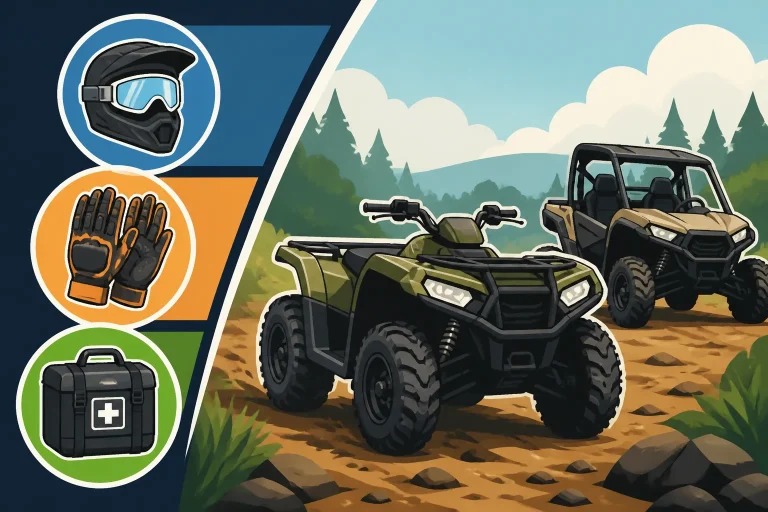
- Required helmets, eye protection or other equipment.
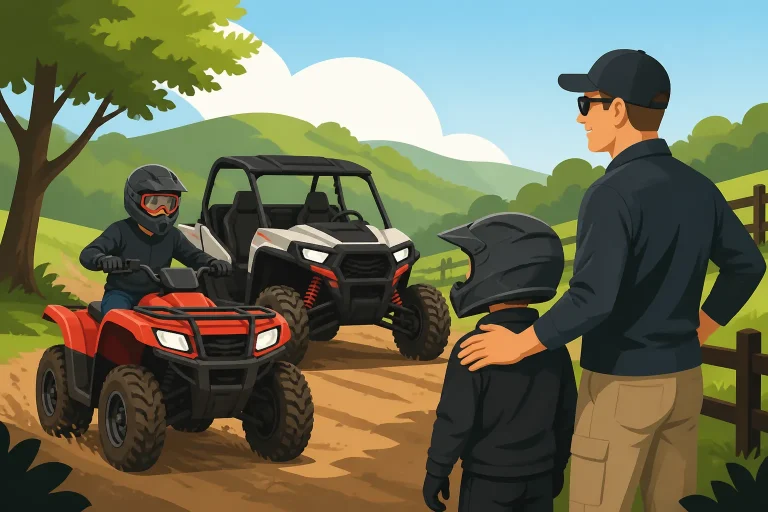
- Minimum ages for riders and passengers, and what a minor’s parent or guardian must do.
- Whether a waiver is required and whether it must be signed by every rider.
- Admission, reservation and check-in procedures.
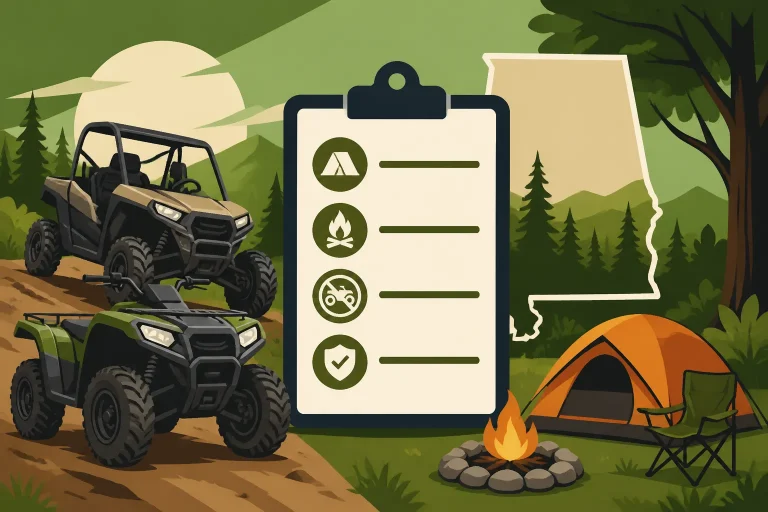
- Rules for pets, alcohol, camping, fires and quiet hours if you plan to stay overnight.
The park’s waiver is not a state registration, and a state document does not replace the waiver. Each serves a different function. A rider may need to satisfy the park’s admission conditions even when the machine is properly documented. Read the rules before signing, particularly if a minor is part of the group. For a closer look at common facility requirements, see Alabama private park waivers and rules.
Bring the machine documents you have, such as registration or proof of ownership, but ask the park whether it requires any specific document. Do not assume that a Mississippi plate or sticker is required for a private trail, or that it gives you permission to ride there. Similarly, Alabama’s voluntary registration program should not be confused with a park pass or a land permit. Alabama registration is voluntary explains the difference between the state registration process and other riding requirements.
If you borrowed or recently bought the machine, sort out ownership paperwork before the trip. A bill of sale, receipt or other record may help explain who owns it, but the park or an officer may have its own requirements for a particular situation. Keep paperwork protected from water and mud, and store a clear copy separately from the original if that is practical.
A Mississippi registration is not a universal permission slip for Alabama. If you are unsure whether it is relevant to the place you plan to ride, ask the park or land manager rather than relying on the appearance of a decal. The same caution applies to proof of insurance: a policy may help cover certain losses, but it does not establish that a trail is open or that a rider has permission to enter.
Roads, crossings and riding limits
An ATV or UTV’s registration status does not determine by itself whether it can be driven on an Alabama road. Off-road trails and public roads are governed by different rules. A road that leads to a trailhead may be public, private or part of a managed property, and the rules can differ at each point.
Do not assume that a machine becomes road legal because it has lights, mirrors, a horn, a windshield or a street-legal conversion kit. Alabama law sets requirements for vehicles that may be operated on public roads, and an ordinary off-road machine may not meet the applicable standard. A road-use rule in Mississippi does not automatically carry over to Alabama. For the broader state-specific explanation, see Alabama ATV road rules explained and Alabama’s federal standard barrier to road use.
Crossing a road can also be different from riding along it. A trail may meet a road at a point where crossing is controlled or prohibited. Before crossing, check for signs, barriers and local rules, and use only a crossing that is allowed. Do not treat a brief road connection, a public right-of-way or a nearby trail as permission to travel along the road. Alabama rules for crossing a highway covers that specific issue.
Local rules can add another layer. A town or county may regulate riding in places that are not covered by a private park’s rules. If your route passes through a municipality or subdivision, check for local ordinances rather than assuming the countywide rule applies everywhere. The destination’s land manager may also impose restrictions that are stricter than the general rules. See Alabama local ordinances on ATV riding before planning a route through a town.
A practical way to avoid an accidental road violation is to plan the route from the trailer to the riding area in advance. Confirm where you may unload, whether a connecting route is legal for your vehicle, and whether the trailhead has parking for your trailer. Do not count on being able to ride on a public street from a campground, gas station or parking area to the trail.
At the riding site, obey posted signs and barriers even if a map or older directions show a route. Closures can change, and a route that was open during a previous visit may not be open now. If a route is unclear, stop and ask the responsible office or park staff instead of guessing. Do not follow another rider onto a road or closed trail just because their machine appears to be permitted.
A before-you-go checklist for Mississippi riders
A short call or message to the right office can prevent a long drive to a closed or unsuitable riding area. Start with the land manager, not a general search result or an old social media post. If you plan to visit multiple properties, make a separate check for each one.
- Name the exact destination. Record the park, WMA, forest district or private property you intend to use. A broad location name may cover several parcels with different rules.
- Confirm that riding is allowed. Ask whether your type of machine is permitted and whether the intended activity is allowed. A destination open to hikers, hunters or vehicles in general may still restrict off-road machines.
- Ask what permits or passes apply. Clarify whether a permit is needed, who must obtain it, what dates it covers and how it must be carried or displayed. Ask whether hunting-related documents are separate from riding access.
- Check the route, not just the property. Get the current map or route information and verify which trails and roads are open to your machine. Ask about temporary closures, seasonal limits and road crossings.
- Confirm the park or property’s own rules. For a private park, check waivers, rider ages, passenger limits, helmets, reservations and other operating conditions. For private land, get permission from the owner or authorized manager.
- Bring machine and rider paperwork. Carry the ownership or registration documents you already have, along with any required permits, identification or park confirmation. Keep them accessible and protected.
- Check practical details. Confirm hours, entry procedures, trailer parking, fuel availability and whether you need a reservation. If the phone signal may be unreliable, save the map and directions for offline use or bring a paper copy.
- Recheck before departure. Weather, maintenance, hunting activity and land-management decisions can affect access. A quick check shortly before the trip is more reliable than assuming conditions have not changed.
When you contact an office, ask specific questions. “Can I ride there?” may not produce a useful answer if the person does not know your machine type or intended route. Instead, say whether you have an ATV or side-by-side, identify the area and ask which routes are open, what documents you need and whether a permit or check-in is required. For a WMA, ask whether requirements differ if you are riding for recreation rather than hunting. For a private park, ask what each rider and passenger must bring.
Also have a backup destination. If the area is closed, the route is unsuitable for your machine or the required permit cannot be obtained, do not improvise by riding on a nearby road or onto land that looks accessible. Choose another approved riding area or postpone the ride.
Frequently Asked Questions
Does a Mississippi registration let me ride anywhere in Alabama?
No. Machine paperwork and land-access permission are different. A Mississippi registration does not by itself authorize entry to a park, WMA, forest route or private property. Check the rules for the exact destination.
Do Mississippi riders need an Alabama permit?
It depends on where and how you plan to ride. Some destinations may have their own permit or check-in requirements. Confirm the rules with the park or land manager, especially for a WMA or public land area.
Can I ride my ATV on an Alabama road if it is registered in Mississippi?
Do not assume so. Registration in another state does not automatically make an off-road machine legal for road use in Alabama. Check Alabama’s road rules and local requirements before using any public road.
Does a hunting license give me permission to ride a WMA?
Not necessarily. Hunting privileges and machine access are separate questions. Check the specific WMA’s rules for riding, routes, permits and dates, whether or not you plan to hunt.
What should I carry on the ride?
Carry any permits or passes required for the destination, along with the machine paperwork you have and the park or area’s rules. Keep a map or route information available, especially where phone service may be limited.
Disclaimer
This article is for general informational purposes only and does not constitute professional advice. Laws, prices and regulations vary by location and change over time. Consult a qualified professional for guidance on your specific situation.