Alabama Visitors From Georgia
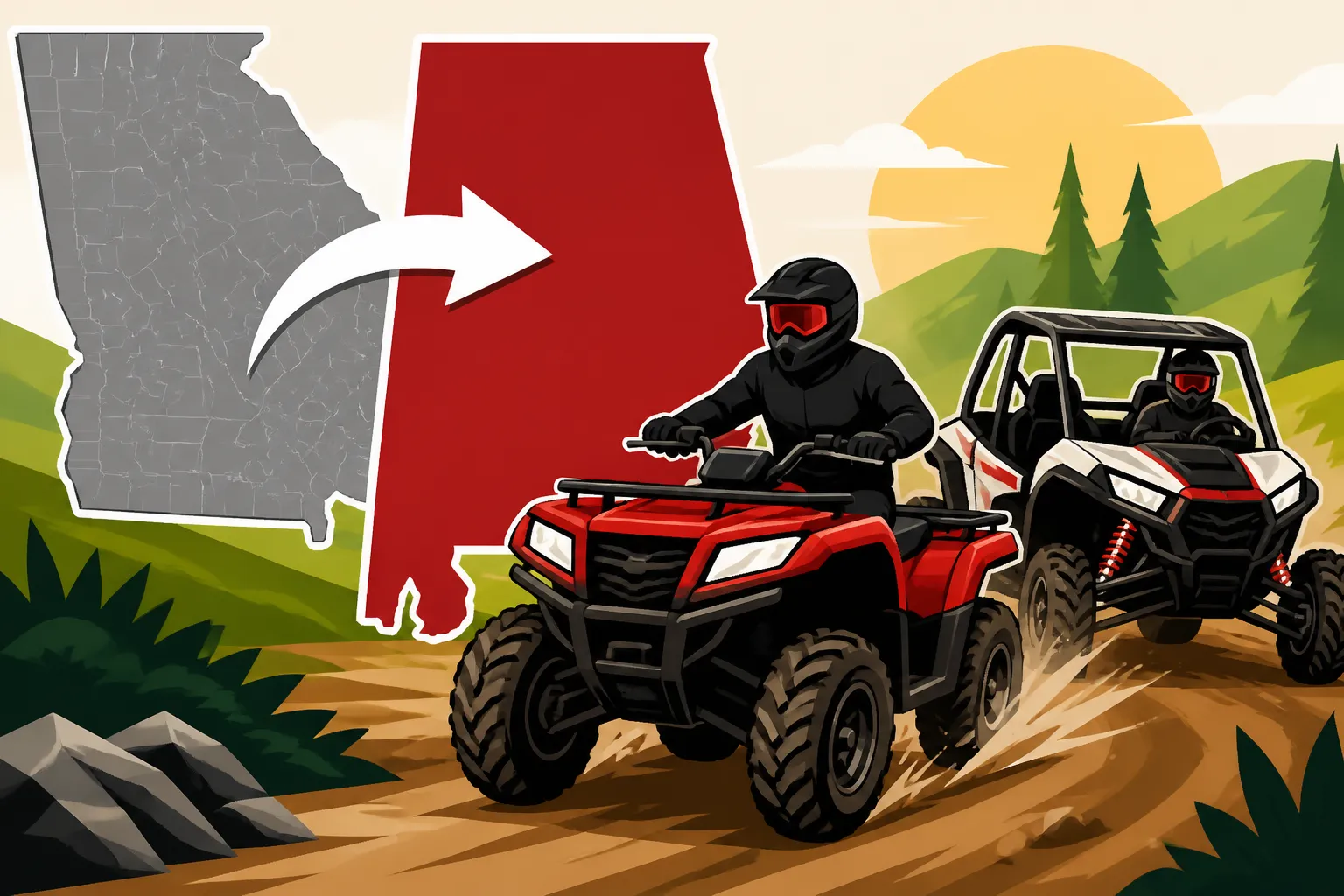
Georgia riders planning an Alabama trip often have the machine and route sorted out, but not the permissions. The key is that a Georgia document, decal, or hunting credential does not automatically cover every Alabama riding area. Match your paperwork to the place you will ride, then check its current rules before loading the trailer.
Start with the place you plan to ride
There is no single permit that makes every ATV or UTV ride in Alabama legal. The required permission depends first on who manages the land: a private riding park, a wildlife management area, national forest land, or private property. A credential that works for one destination may have no effect at another.
For a Georgia visitor, it helps to separate four questions:
- May this machine ride on this property or trail?
- Does the land manager require a permit, pass, waiver, or other paperwork?
- Does the machine need to meet local equipment or size rules?
- Are you allowed to use roads to reach the riding area?
Those questions are related, but they are not interchangeable. A registration or proof-of-ownership document does not by itself give you permission to ride on public land. A park waiver does not make a machine street legal. And being allowed to ride on a trail does not necessarily mean you can ride the public road that leads to its entrance.
Alabama’s off-road vehicle registration framework is generally voluntary, but that is not a blanket exemption from land-access rules. Some destinations set their own requirements, and public lands can have route, seasonal, or permit restrictions. The useful starting point is What Visiting Riders Need to Ride Legally in Alabama, followed by the current rules for the specific place you have chosen.
Before leaving Georgia, write down the destination’s official name and the managing agency or park operator. “Riding in the national forest” or “going to a WMA” is too broad to establish what is open. A particular tract, road, or trail may have its own access conditions, while another nearby area may not allow recreational riding at all.
| Where you plan to ride | What to verify before you go | What a Georgia document does not establish |
|---|---|---|
| Private riding park | Admission process, waiver, age and passenger rules, machine limits, and operating schedule | That you have met the park’s entry requirements |
| Wildlife management area | Whether riding is permitted, which routes are open, and whether an area permit or other credential applies | That a Georgia hunting or recreation credential authorizes riding |
| National forest | Which roads or trails are open to your machine, seasonal restrictions, and any site-specific permit rules | That every forest road is an ATV route |
| Private property | Landowner permission and any conditions attached to it | Permission to cross neighboring land or use a public road |
| Public road | State and local road-use rules for that road and vehicle | That an off-road decal or park pass makes the machine road legal |
Treat this table as a planning checklist, not a substitute for the current rules posted by the land manager. If you are unsure which category applies, contact the office or operator responsible for the site.
Private parks, WMAs, and national forests have different rules
The most common source of confusion is treating “public land” as one category. Alabama’s public riding opportunities do not share one universal entry rule. A private park can set its own entry conditions; a WMA is managed under area-specific rules; and national forest routes follow federal land-management rules. Check the destination itself rather than assuming that a permit or registration carries across.
Private riding parks
A private park’s entry requirements come from the park operator. Depending on the facility, you may need to pay for admission, sign a waiver, show identification, comply with age or passenger limits, or meet machine requirements. Parks can also close trails, limit access after rain, change operating hours, or restrict certain vehicle types.
Ask the park directly whether an out-of-state rider needs any paperwork beyond the standard admission process. If the park asks for proof of ownership, insurance, or a particular registration document, clarify what it accepts before arrival. Do not assume that a Georgia document will satisfy a requirement unless the park confirms it.
Review the waiver and operating rules before you sign. A waiver is an agreement with the park; it is not a state registration or a permit to ride elsewhere. For more on park-specific requirements, see Alabama Private Park Waivers and Rules.
Wildlife management areas
A WMA is not automatically an OHV recreation area. Whether riding is allowed, where a machine may travel, and what credentials are needed depend on the area and its current rules. Some areas may limit vehicle use to certain roads or uses; some may have seasonal access limits; and a route shown on a general map may not be open to recreational ATVs.
Do not assume that a Georgia hunting license, Georgia WMA credential, or out-of-state registration authorizes riding on an Alabama WMA. A hunting credential and permission to ride are separate questions. Before setting out, check the rules for the exact Alabama area, confirm whether recreational riding is allowed, and ask what permits apply to a nonresident who is riding rather than hunting.
The Alabama WMA guidance is area-specific, so review Alabama WMA Rules Vary by Area and Alabama WMA Permits for Riders. If you plan to hunt as well as ride, check hunting requirements separately. Having a hunting license does not, by itself, settle the rules for operating an ATV or UTV on the property.
National forest land
National forest land is not a network of unrestricted trails. Routes can be open to some vehicle types and closed to others, and access can change because of maintenance, weather, resource protection, or seasonal management. A road visible on a phone map may not be an authorized OHV route.
Check the current motor-vehicle map and guidance for the specific forest area. Confirm that the route is open to your vehicle class and that your machine fits any posted restrictions. If a permit, pass, or other condition applies to the place you intend to use, the responsible forest office can explain what is required. Start with Alabama National Forest Riding Permits and confirm the current route information with the appropriate Forest Service office.
Private property
On private property, get permission from the landowner or the person who has authority to grant it. Do not treat a hunting lease, camp access, or invitation to use one tract as permission to ride neighboring land, cross a gate, or use a road outside that property. Ask about boundaries and permitted routes, especially if the planned ride follows timber roads, utility corridors, or trails that connect separate parcels.
Whatever the destination, permission for one place does not travel with the machine. It is tied to the land and the terms set by the owner or manager.
Does a Georgia permit or registration carry over?
The practical answer is: do not count on it without confirmation from the Alabama land manager. Alabama and Georgia may classify, document, or regulate off-road machines differently, and a credential issued for one state or purpose is not automatically an Alabama access permit.
Alabama registration is generally voluntary for off-road machines, but that does not mean every site must accept a Georgia registration or decal as proof of eligibility. Nor does it mean that a Georgia credential replaces a park’s admission process, a WMA’s area-specific requirements, or a forest’s route rules. For the state registration distinction, see Alabama Registration Is Voluntary. For issues involving a machine from another state, see Alabama Rules for an Out-of-State Machine.
It is useful to separate these terms:
- Registration is an administrative record for a vehicle. It does not automatically authorize access to a particular trail.
- A land-access permit or pass is permission associated with a specific area, activity, or managing agency.
- A park admission or waiver applies to that private facility and its conditions.
- Proof of ownership helps show who owns the machine, but is not a riding permit.
- Road legality is a separate matter from riding off-road or entering a park.
If a Georgia registration document or decal is current, keep it with your trip paperwork. It may help identify the machine or satisfy a site’s request, but do not assume that it settles Alabama’s requirements. If the machine has no state registration, that fact alone also does not establish whether a particular Alabama trail is open to it.
A call or email to the site can prevent a wasted trip. Describe the machine accurately: ATV or side-by-side, make and model if known, whether it has a passenger seat, and whether it is registered in Georgia. Then ask whether that document is accepted for the specific activity and location. Avoid asking only, “Is my registration good in Alabama?” The more useful question is, “What must a Georgia visitor bring to ride this machine on these specific routes?”
Road use is a separate question
An off-road permit, park pass, or registration document should not be treated as permission to ride on a public street or highway. Alabama road-use rules and local ordinances apply separately. The fact that a vehicle can travel between a staging area and a trail does not mean the connecting public road is open to it.
If your route includes a road, verify the rules for that road and the machine before riding. Check local restrictions as well as state requirements. A route that crosses a road may be governed differently from riding along it. See Alabama Public Use Designated Areas for the distinction between designated areas and ordinary public roads, and Alabama Rules for an Out-of-State Machine for questions specific to visitors.
Do not rely on a street-legal kit, a Georgia document, or a verbal assumption from another rider as proof that a route is legal. Confirm the route with the responsible authority before the trip.
What to bring and what to confirm before leaving Georgia
Carry enough information to identify the machine, establish your permission to be at the site, and follow its rules. Not every destination will ask for the same documents, so confirm its requirements rather than bringing paperwork as a substitute for checking.
Useful items can include:
- Any registration or ownership document you have for the machine
- A bill of sale, title, or other ownership record, if available
- The park pass, permit, reservation confirmation, or waiver instructions required by the destination
- A driver’s license or other identification if requested by the site
- Current maps or route information from the land manager
- Contact details for the park office, managing agency, or landowner
- Proof of insurance if the destination requires it or you want it for your own protection
A missing title does not necessarily answer whether you can ride, but it can create a problem if someone questions who owns the machine. Keep the best ownership records available and ask the destination what it expects. For additional guidance, see [Alabama Proof of Ownership on the Trail].
Before loading up, confirm these details directly with the destination:
- Is my vehicle type allowed? Ask about ATVs, UTVs, side-by-sides, and any vehicle-width or weight limits that matter to your machine.
- Is the specific route open? Confirm the route name or entrance, not just the general area.
- What paperwork must I show? Ask whether nonresident registration, proof of ownership, insurance, a waiver, or another document is required.
- Do I need a permit or reservation? Ask who issues it, whether it applies to each rider or vehicle, and whether it must be obtained before arrival.
- Are there age, passenger, helmet, or equipment rules? Park policies and land-management rules may differ.
- Are there seasonal or weather closures? A trail can be unavailable even if it is normally open.
- Can I ride on the access road? Confirm this separately from trail access.
- Where should I park and unload? A legal riding route does not guarantee that every nearby pull-off or staging area is suitable.
If you will ride in more than one place, repeat this check for each destination. A pass or permission at a private park does not usually answer what is required on a WMA or forest road, and an area permit does not automatically grant access to private property.
Navigation deserves a little extra planning, especially in rural areas where cell service can be unreliable. Download official maps before travel and keep a backup copy available offline. A paper map can help if a phone battery dies or the signal drops; one can be purchased locally or through Amazon, but use the land manager’s current map for route restrictions. A commercial trail app can be useful for navigation, but it should not replace an official map or posted closure.
A practical trip plan for Georgia riders
A good plan starts with the riding area, not with a search for a general “Alabama ATV permit.” Once you know where you are going, use the land manager’s current rules and contact the operator if a key point remains unclear. Keep a record of the answer, especially if you are relying on a specific interpretation of a Georgia document or permit.
Use this sequence:
- Choose the exact destination. Identify the park, WMA tract, forest area, or private property rather than planning around a broad region.
- Find the manager’s current rules. Use the official site or contact information for the entity responsible for the land.
- Check that riding is allowed. Confirm machine type, route access, and any seasonal closure.
- Ask what applies to a Georgia visitor. Be specific about the machine and the activity. If riding and hunting, ask about each separately.
- Arrange required permits or park admission. Do not assume a permit can be obtained at the gate; ask about timing and payment procedures.
- Check road connections. Verify any public-road segment separately and plan a legal route to the staging area.
- Prepare machine and paperwork. Carry documents that the site requests, along with ownership records and the contact details you may need.
- Recheck before departure. Weather, maintenance, fire risk, hunting seasons, or management decisions may affect access.
This plan is particularly useful when one trip includes multiple kinds of land. For example, a private park’s waiver and entry rules apply to that park; a nearby WMA or national forest has a separate manager and separate access conditions. Do not assume you can ride from one property to another just because trails appear connected on a map.
If a rule is unclear, ask the site to confirm it in writing when practical. A short email stating the exact machine and route can be easier to refer to later than a vague recollection of a phone conversation. Still, follow signs and closures on arrival: a previous answer cannot override a new closure or a posted restriction.
Finally, plan for the possibility that access is denied or a route is closed. Have a second legal destination in mind, but check its requirements in advance too. That is safer than assuming that a nearby forest road or public tract is an acceptable substitute.
Frequently Asked Questions
Does a Georgia ATV registration let me ride anywhere in Alabama?
No. A Georgia document does not automatically provide access to every Alabama park or public-land route. Check the requirements for the particular destination and ask whether it accepts your document.
Does an Alabama permit automatically cover a Georgia visitor?
Not necessarily. The permit may be specific to an area, activity, or vehicle. Confirm that it applies to nonresidents and to the route you intend to ride.
Can I ride an Alabama WMA just because I have a hunting license?
Do not assume so. Hunting permissions and authority to ride are separate questions, and WMA rules vary by area. Verify whether riding is allowed and what credentials apply to your activity.
Does a park pass make my ATV street legal?
No. Park admission and off-road access do not establish that a machine may use a public road. Check state and local road-use rules separately.
Disclaimer
This article is for general informational purposes only and does not constitute professional advice. Laws, prices and regulations vary by location and change over time. Consult a qualified professional for guidance on your specific situation.