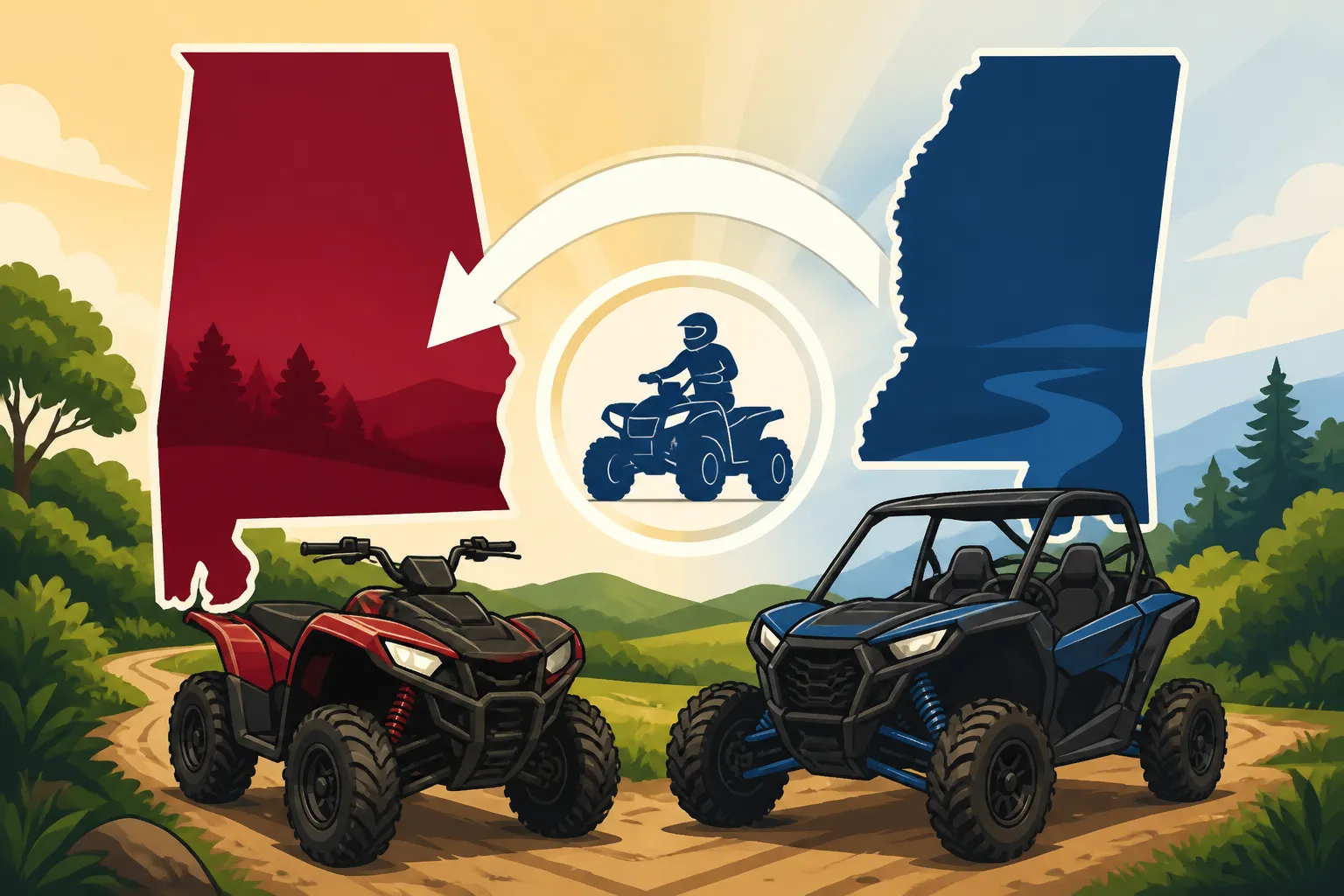
Alabama Rules for a Visiting Mississippi Rider
Coming from Mississippi to ride your ATV or UTV in Alabama can feel like stepping into a whole new set of rules, and trust me, you're not alone in feeling a bit overwhelmed. You might assume your Mississippi registration or even your "street legal" conversion will automatically transfer, only to find yourself scratching your head at the nuances of Alabama's off-road vehicle laws. This guide is specifically for you, the visiting Mississippi rider, to help you navigate Alabama's unique requirements, understand where you can legally ride, and ensure your adventure here is smooth, safe, and free from unexpected hassles.
Understanding Alabama's Core Philosophy on Off-Road Vehicles
Alabama has a specific way of looking at ATVs and UTVs, which can be quite different from how things are handled just across the border in Mississippi. It's not about whether your machine is cool or capable – and let's be honest, many of you have some seriously decked-out rigs with gear from places like SuperATV – it's about how the state classifies and regulates these vehicles for various uses. This foundational understanding is key to avoiding any missteps during your visit.
Alabama's Two Tiers of Registration: Public vs. Private Use
One of the first things an Alabama resident learns about owning an ATV or UTV here is the concept of voluntary registration, which is split into two tiers: "Public Use" and "Private Use." While your Mississippi registration proves ownership, these Alabama tiers dictate where you can legally operate your machine within the state, particularly on public lands.
The "Public Use" registration tier is designed for those who plan to ride on state-managed trails, designated public areas, or any other land that isn't exclusively private property. This tier carries a slightly higher fee but provides the necessary authorization for adventure beyond your own backyard or a friend's farm. It’s important to understand that even with this public use registration, there are still strict rules about where you can ride – it’s not a free pass to hit any dirt road you please. For a visitor, this distinction is crucial because if you intend to explore Alabama's beautiful state parks or specific public trail systems, you'll need to know if your Mississippi registration is sufficient or if a temporary Alabama registration is advised. Think of it as purchasing a specific permit for your activity, much like some fishing or hunting licenses operate across state lines. [Alabama Public Use Versus Private Use] outlines these nuances in detail.
On the other hand, the "Private Use" registration tier is for machines operated exclusively on private property, meaning land owned by you, a family member, or a friend who has given you express permission. This tier has a lower associated fee, reflecting the limited scope of use. For many Mississippi riders coming to Alabama, their primary goal might be to visit a family farm or a hunting camp, which falls under private property. In such cases, your Mississippi registration typically suffices as proof of ownership, and you might not need to worry about the Alabama private use registration unless you intend to live here or keep your machine here permanently. The state's system recognizes that you own your machine, but it wants to track machines that might interact with public infrastructure or lands. For a clearer picture of what this means for residents, you can look into [Alabama Public Use ATV Registration Explained] and [Alabama Private Use ATV Registration Explained].
The New Titling Law: A Game Changer for Future Machines
Alabama recently introduced a new titling law for off-road vehicles, a significant change that has created a lot of discussion among local riders. As of a certain model year, ATVs and UTVs in Alabama are now required to have a title, much like cars or trucks. This is a big shift, as previously, only an ownership document or a bill of sale was typically used.
For you, as a visiting Mississippi rider, this new titling law typically won't directly impact your current visit with your Mississippi-titled or registered machine. Your home state's title or registration serves as your proof of ownership. However, it's vital to be aware of this change, especially if you ever consider purchasing a machine in Alabama, moving to Alabama, or even selling your current machine to an Alabama resident in the future. The new law primarily affects machines manufactured for a specific model year and beyond. So, if your machine is an older model from before this change, you generally won't encounter any immediate issues due to Alabama's new titling requirements during a temporary visit. [Alabama ATV Titling Starts With Model Year 2026] dives deep into this new regulation. For many current Alabama owners of older machines, the advice is simply to keep their existing paperwork, as explored in [Why Pre-2026 Owners Do Nothing]. This highlights that Alabama is moving towards a more structured system for tracking these vehicles, and while it's a future consideration for visitors, it's an immediate reality for new purchases by residents.
Navigating Registration and Titling as an Out-of-State Visitor
When you're loading up your rig in Mississippi, ready for an adventure in Alabama, questions about paperwork are bound to pop up. Will your current state's registration be enough? What about titles? It’s completely understandable to feel a little anxious about getting it right, especially when crossing state lines. Let’s break down what Alabama expects from you regarding these crucial documents.
Does Your Mississippi Registration Transfer?
This is a common and excellent question, and generally, the answer is good news: your current Mississippi registration and proof of ownership are typically recognized in Alabama for proving that you legally own your ATV or UTV. Alabama's off-road vehicle statutes are primarily concerned with ensuring machines are legitimately owned and operated responsibly. As long as your Mississippi registration is current and valid, it serves as that proof of ownership while you're visiting.
However, there's a nuance. While your Mississippi registration validates ownership, it doesn't automatically grant you the privileges of Alabama's voluntary Public Use registration. If you plan to ride on specific state-managed public trails or areas that explicitly require an Alabama OHV registration sticker, your Mississippi registration might not be enough on its own to enter those specific trail systems. It's always a good practice to check with the specific park, forest, or riding area you intend to visit in Alabama to understand their particular entry requirements for out-of-state machines. Some public parks might simply ask to see proof of ownership and insurance (if applicable), while others with their own permit systems might have different rules. For comprehensive advice on what visiting riders truly need, see [What Visiting Riders Need to Ride Legally in Alabama]. Remember, while your machine is registered in Mississippi, carrying that physical proof with you is paramount, along with a valid ID.
Titling Requirements for Out-of-State Machines
Alabama's recent implementation of a titling system for off-road vehicles might raise concerns for visiting riders, but for the most part, your Mississippi title or lack thereof (depending on Mississippi's own laws for your machine) won't create a barrier to your visit. The Alabama titling law applies to machines of a specific model year and newer sold within Alabama, or when a new resident moves to Alabama with a machine that falls under the new titling scope.
For the casual visitor from Mississippi, Alabama doesn't require you to obtain an Alabama title for your machine simply because you're riding here temporarily. Your Mississippi title (if your machine has one) will continue to serve as your official proof of ownership. This system is designed more for permanent residents and transactions within Alabama. If you were to sell your machine to an Alabama resident, or if you decided to move to Alabama permanently, then the state's titling requirements would come into play for your machine, depending on its model year. In those scenarios, you might need to go through a process to obtain an Alabama title. For more information on how Alabama handles titles for machines originating outside the state, refer to [Alabama Title for a Machine Bought Out of State]. It’s a good idea to keep a copy of your title or registration with you when you ride, just in case you're asked to prove ownership by law enforcement or park officials. Details on the statewide implementation of titles can be found in [Alabama Title Applications From January 2026].
The Big Question: Road Riding and Public Land Access in Alabama
For many ATV and UTV enthusiasts, especially those crossing state lines, the rules about road riding and public land access are often the most confusing and frustrating. You might have a "street legal" kit from SuperATV installed on your UTV, complete with turn signals and a horn, which might be perfectly acceptable in certain parts of Mississippi. However, bringing that same setup into Alabama doesn't necessarily grant you the same privileges. Alabama has a very specific and generally restrictive stance on where off-road vehicles can operate.
Alabama's Stance on Street Legal ATVs and UTVs
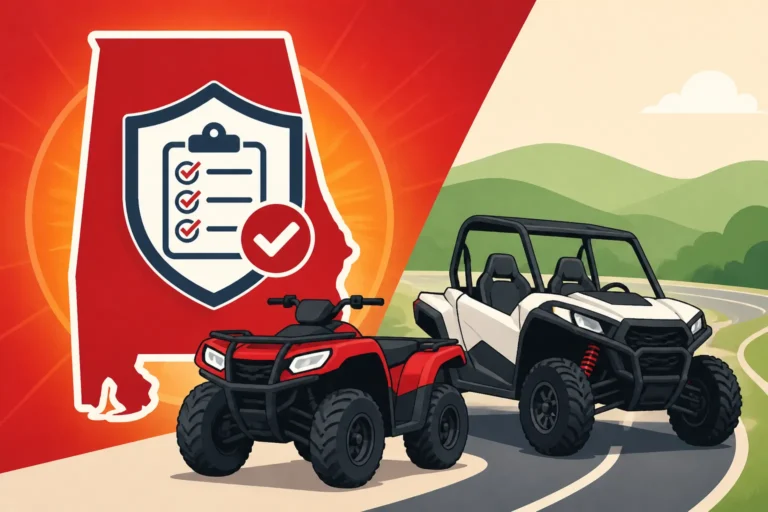
This is where many visiting riders from Mississippi can run into trouble if they're not fully informed. While you might be accustomed to certain counties or towns in Mississippi allowing properly equipped ATVs or UTVs on public roads, Alabama’s default position is that ATVs and UTVs are off-road vehicles only. This means that, with very few exceptions, you cannot legally operate your ATV or UTV on Alabama's public roads, streets, or highways, even if it has a horn, mirrors, turn signals, and a license plate from another state.
The key reason for this strict stance is rooted in federal law. Alabama's statutes defer to the Federal Motor Vehicle Safety Standards (FMVSS). For a vehicle to be considered "street legal" and capable of being registered for road use in Alabama, it typically must meet these rigorous federal standards, often classified as a Low-Speed Vehicle (LSV) or similar designation. Most factory-built ATVs and UTVs, despite their impressive capabilities and the accessories you might add (like those found at SuperATV for performance and safety), do not meet these federal highway standards. A "street legal kit" typically modifies an off-road vehicle, but it doesn't change its fundamental manufacturing compliance. So, while your machine might be perfectly legal to drive on a country road back home in Mississippi, that same action could result in a citation or even impoundment in Alabama. It's a hard truth, but an important one to understand before you hit the pavement. [Are ATVs Street Legal in Alabama?] provides a deep dive into this topic, further supported by information in [Alabama's Federal Standard Barrier to Road Use] and [Why a Street Legal Kit Will Not Make It Legal].
Accessing Alabama's Public Trails and Riding Areas
So, if road riding is largely a no-go, where can you ride your ATV or UTV in Alabama as a visitor? The good news is that Alabama offers some fantastic opportunities for off-road adventure, primarily in designated off-highway vehicle (OHV) parks, specific trails within Wildlife Management Areas (WMAs), and on designated roads within National Forests. These are the places where your machine truly belongs and where you can enjoy the thrill of riding without breaking the law.
Alabama boasts several popular OHV parks, like Stony Lonesome OHV Park in Bremen or Minooka Park in Jemison, which offer miles of trails catering to various skill levels, from easy scenic routes to challenging rock crawling sections. These parks usually have admission fees, and they will expect you to show proof of ownership (your Mississippi registration works here) and sign a waiver. For WMA riding, you'll need to acquire the appropriate permits from the Alabama Department of Conservation and Natural Resources, which often involves a WMA license in addition to any hunting or fishing licenses if you're engaging in those activities. National Forests typically restrict OHV use to specific, marked roads, often gravel or dirt, and prohibit off-trail riding. Always check the rules of the specific WMA or National Forest district you plan to visit, as regulations can vary significantly by location and even by season. [Alabama ATV Trails: Where to Ride] gives an overview of options, while [Alabama WMA Riding Rules] and [Can You Ride an ATV in Alabama's National Forests?] provide specific guidance for those areas.
Riding on Private Property and Local Ordinances
When it comes to riding on private property in Alabama, the rules are much more straightforward and generally align with what you'd expect in Mississippi. If you have explicit permission from the landowner, you are usually free to ride your ATV or UTV on their private land. This is the simplest and safest way to enjoy your machine in Alabama without worrying about state-level restrictions, especially if you're visiting family or friends with land. Always ensure you have clear, preferably written, permission from the landowner to avoid any potential trespass issues.
However, even on private property, it’s worth being mindful of local ordinances. While less common, some cities or counties might have noise restrictions or other local rules that could affect riding, particularly if the private property is located near residential areas. For instance, if you're visiting a hunting camp nestled close to a small town, a local noise ordinance might dictate riding hours, especially late at night. It's always a good idea to do a quick check with the local sheriff's office or city hall if you have concerns about specific regulations in the area you'll be visiting. Understanding [Riding Exclusively on Private Property in Alabama] is key here. Additionally, [Alabama Local Ordinances on ATV Riding] can give you a sense of how these local rules might come into play. Always be respectful of your surroundings and neighbors, whether you're a local or a visitor, to ensure off-road riding remains a welcome activity in the community.
Key Differences a Mississippi Rider Will Notice
While Alabama and Mississippi share a border and a love for the outdoors, there are distinct differences in how off-road vehicles are regulated that can catch a visiting rider off guard. Knowing these nuances can save you a lot of hassle and ensure your trip is enjoyable and compliant with Alabama law.
Helmet Laws and Age Restrictions
One area where you might notice a difference is in helmet laws. While Alabama has a mandatory helmet law for motorcycles, this law does not explicitly extend to ATVs or UTVs in all contexts. On private property, for adult riders, a helmet is generally not legally required by state law. However, this absolutely does not mean you should skip wearing one! Many private OHV parks in Alabama, as a condition of entry, will require all riders, regardless of age, to wear an approved helmet. It's a safety measure, and these parks prioritize rider well-being. Always check the specific rules of any park or trail system you plan to visit.
For younger riders, Alabama does have age restrictions on operating ATVs. Generally, a rider needs to be a certain age, often 14 or 16, to operate an ATV without direct adult supervision, and even younger riders might be restricted to certain engine sizes or require supervision. These rules are in place for safety, and parents of visiting youth riders should be keenly aware of them. Even if Mississippi's rules are different, Alabama's laws apply once you cross the state line. While the state doesn't mandate a safety course, it's always a good idea for young riders to take one, and many parks encourage it. For specific details on this, you can look into [Are Helmets Required for ATV Riders in Alabama?] and [Alabama ATV Age Rules]. Eye protection is always a wise choice, especially with Alabama's dusty red clay trails!
Equipment Checks and Enforcement
When you're out riding in Alabama, whether on private land with permission or at a designated OHV park, you might encounter law enforcement or park rangers. They have the authority to perform equipment checks and ensure riders are compliant with state and local regulations. While your Mississippi registration is important for proving ownership, they might also be looking for other things, especially if you are stopped near or on a public road, or within a public riding area.
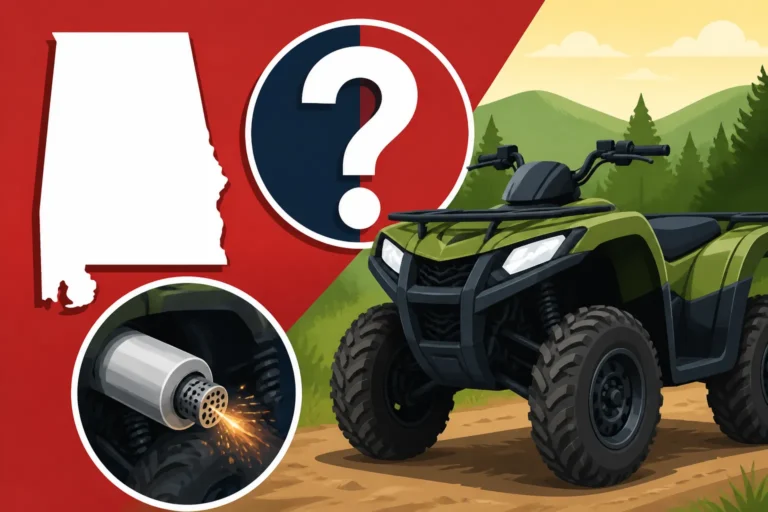
Common things an Alabama deputy or park official might look for include operational headlights and taillights if you're riding after dusk or in low visibility conditions. Many public riding areas also require a spark arrestor on your exhaust system to prevent wildfires, a standard piece of equipment on most modern ATVs and UTVs but worth checking if you've modified your exhaust. If your machine is equipped with accessories from SuperATV, such as additional lighting, winches, or protective gear, these are usually seen as positive additions that enhance safety and capability on the trails. However, these aftermarket parts don't change the underlying legal status of the machine regarding road use. Always carry your proof of ownership (your Mississippi registration), a valid driver's license (if you have one, or other ID), and be prepared to show them if requested. Understanding [Alabama Equipment Checks by Deputies] can help you be better prepared for a smooth interaction. It's always best to be polite, cooperative, and have your paperwork readily accessible.
| Feature | Mississippi Perspective (General) | Alabama Reality (for Visitors) |
|---|---|---|
| Registration | Required, usually state-level. | Your MS registration is generally recognized for ownership, but Alabama has its own voluntary tiers for public use that may be required for specific trails. |
| Titling | Required for ownership. | Alabama's new titling law (post-2026 model year) will not apply to your MS-titled machine for casual visits, but know it exists for new purchases or residency. |
| Street Legality | Some counties/cities allow "street legal" kits. | Generally no. Alabama considers ATVs/UTVs off-road only unless they meet strict federal Low-Speed Vehicle standards. Your MS street legal conversion likely won't apply here. |
| Public Land Access | Varies by state land, parks, WMAs. | Specific OHV parks, designated WMA trails (with permits), and certain National Forest roads are open. Check rules before you go for specific entry requirements. |
| Helmet Laws | May vary by age/location. | Not universally required by state law for adults on private land, but many OHV parks enforce them. Always recommended, especially for minors. |
| Proof of Ownership | Title/registration often suffices. | Always carry your MS registration or title proof. An Alabama deputy or park ranger may ask for it. |
Disclaimer
This article is for general informational purposes only and does not constitute professional advice. Laws, prices and regulations vary by location and change over time. Consult a qualified professional for guidance on your specific situation.