Alabama Parks With Full Hookup Sites
A riding weekend can unravel quickly when the campground has power but no sewer connection, or when a promised hookup site is miles from the trails. This guide explains where to start looking for full-hookup camping near Alabama ATV and UTV riding, what to confirm before booking, and how to plan around trail access, weather, and the practical needs of your RV.
What full-hookup camping means for a riding trip
Know what the site actually includes
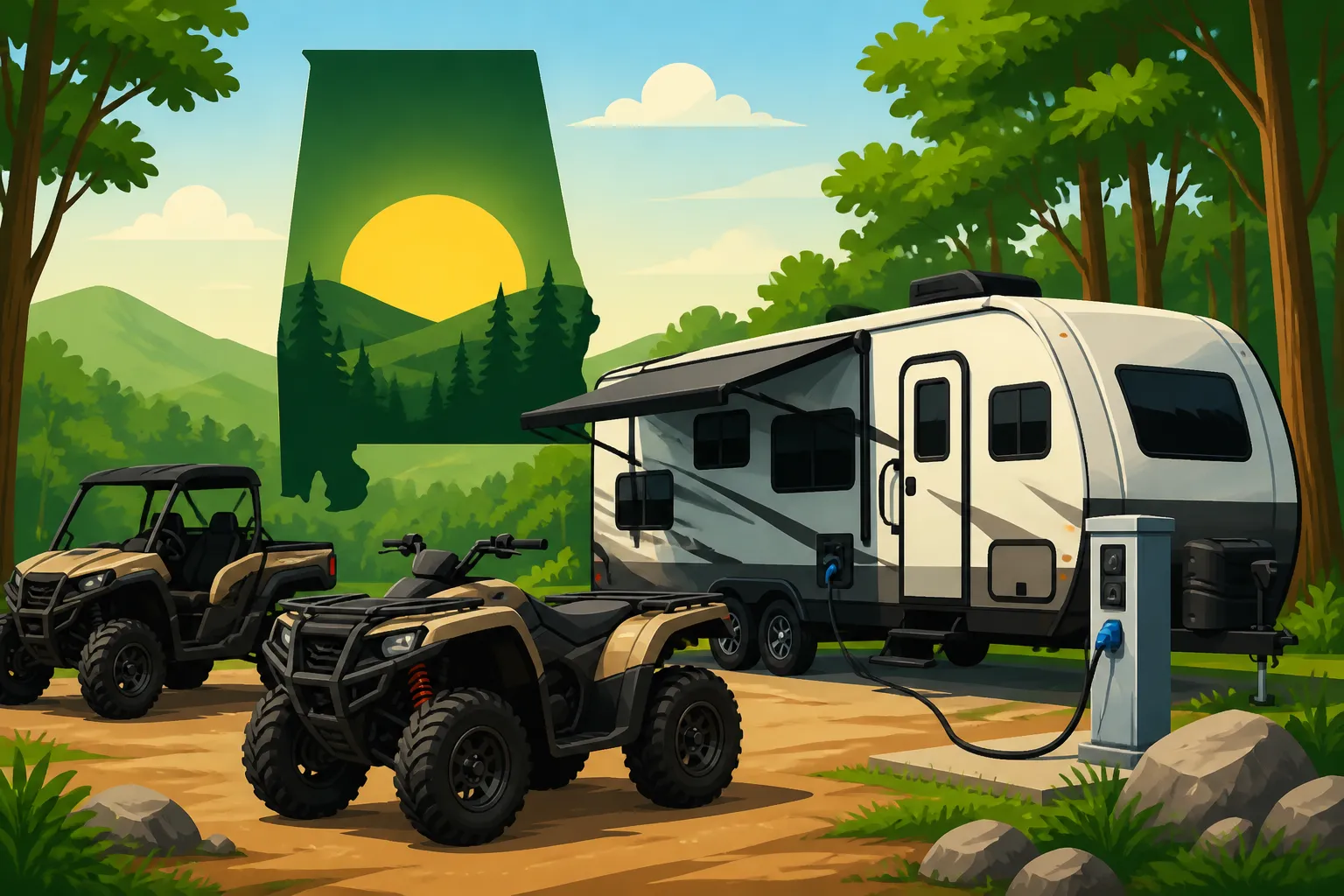
“Full hookup” generally means a campsite has connections for water, electricity, and sewer. That can make a multi-day riding trip much easier: you can keep your RV’s water system supplied, use power for everyday needs, and avoid relying on a dump station during your stay. Still, campground descriptions are not always equally detailed, so confirm the exact connections before you reserve.
Ask whether the site has the electrical service your RV requires, whether the sewer connection is at the site, and whether the water supply is available for the dates you plan to visit. If you use a larger RV, ask about site length, turning room, and whether the approach is manageable with a truck and trailer. A hookup site that technically fits your RV can still be awkward if the road is narrow or the pad is difficult to back into.
It is also worth asking what the site fee includes and what rules apply to generators, quiet hours, pets, and riding machines around the campground. Those details affect the whole group, especially when some people want an early trail start while others are still sleeping. For a broader look at campground options, see [Alabama Parks With RV Sites].
Separate the campground from the riding area
A full-hookup RV site does not automatically mean you can ride from your campsite to the trail system. Some parks place camping inside or next to the riding property; other campgrounds are simply convenient bases a drive away. Before booking, ask whether you can ride directly from the campground, whether a trailer is needed to reach the trailhead, and where you are allowed to park the machine overnight.
This distinction matters when you are traveling with a long trailer or a group of machines. A map may show the campground and riding area close together, but the route between them could involve a public road, a closed gate, or land that does not permit recreational riding. A short drive on a map can also take longer when you need to load, secure, and unload several machines.
If you are comparing accommodation styles, [Alabama Parks With Cabins] can help you think through alternatives for a group that does not want to bring an RV. Whatever you choose, treat camping access and riding access as separate questions until the park confirms how they connect.
| What to confirm | Why it matters | A useful question |
|---|---|---|
| Water, electricity, and sewer | “Full hookup” descriptions can leave details unclear | Are all three connections available at this site? |
| Electrical service | Your RV may require a particular outlet or service | What electrical connection does the site provide? |
| Site length and turning space | A long RV and trailer can be difficult to maneuver | Can this site accommodate my total setup? |
| Trail access | A campground may not be part of the riding property | Can we ride from the campground, or do we need to trailer? |
| Riding rules | Campground rules and trail rules may differ | Where can machines be parked, started, and ridden? |
| Current operations | Hours, access, and amenities can change | Is the campground open and accepting reservations for our dates? |
A leading place to investigate near the trails
Stony Lonesome OHV Park near Bremen
For riders looking for camping and off-road riding in the same trip, Stony Lonesome OHV Park near Bremen is a natural place to investigate. The park is associated with RV camping that includes full-hookup sites, so it may suit visitors who want to bring a motorhome or travel trailer rather than stay in a motel. Start with [Stony Lonesome OHV Park in Alabama] when researching the park and its riding options.
Do not assume that every site has the same setup or that a site will be available for your preferred weekend. Confirm the current campsite arrangement directly with the park, including the hookup type, site dimensions, reservation process, and whether your chosen site is close to the riding area. If your rig is large, describe its full length with the tow vehicle or trailer included.
Also ask how the park handles arrival and riding-day logistics. Find out where to check in, when gates open, whether you need to unload in a designated area, and where trailers can be left while you ride. These details sound small when you are planning at home, but they can determine whether the first morning feels relaxed or turns into a scramble.
Verify the details before you reserve
Park information can be scattered across booking pages, social posts, maps, and older listings. If two pages show different addresses or operating details, do not guess which one is right. Contact the park directly and confirm the address you should enter into your navigation app, the correct check-in location, and any instructions for arriving after hours. The guide [Checking Whether a Park Still Operates] offers a useful checklist for this kind of pre-trip verification.
Ask whether the reservation guarantees a specific site or only a site category. If you need a particular electrical connection, want to camp beside another RV, or require a site with easier access for a large trailer, say so before booking. A general promise of “RV camping” may not answer those practical questions.
It is sensible to confirm the cancellation and weather policies too. Alabama storms can affect trail conditions, and a campground may remain open even when riding is limited—or the reverse may be true. Clarify what happens if trails close, if heavy rain changes access, or if you have to alter your arrival plans. Do not rely on an old screenshot or a previous guest’s report as a substitute for current instructions.
Choose a riding area that fits your group
Match the trails to the machines and riders
A good campsite cannot make an unsuitable trail enjoyable. Before you commit to a park, check which machine types are allowed, whether the route system accommodates your ATV or side-by-side, and how trail difficulty is described. A group with young riders, first-timers, and experienced drivers may need several kinds of terrain rather than one long, challenging loop.
Ask about width restrictions, passenger rules, required gear, and whether any routes are closed to certain vehicles. Do not assume a trail listed for “OHVs” is appropriate for every machine. A full-size side-by-side, a youth quad, and a sport ATV can have very different needs, even when all are off-road machines.
When browsing digital maps, onX Offroad can help you study route layouts and orient yourself before a trip. Use it as a planning aid, not as permission to ride: a line on a map does not prove that a route is open, legal, or included in a park’s riding area. Confirm access and restrictions with the park, especially when a route appears to cross property boundaries or connect to a public road.
Check conditions, closures, and facilities
Trail conditions can change sharply after rain. Alabama’s red clay may become slick and rutted, while low-lying sections can hold water long after a storm has passed. If you are towing several hours to ride, check conditions shortly before leaving and ask which trails are open for your type of machine. [Alabama Trail Conditions Before You Tow] is a helpful companion for building that habit.
Also ask whether the park has a wash station or another place to remove mud before you load up. Washing a machine before it dries can make cleanup easier, but you should use only facilities and methods the park allows. If a wash area is not available, bring a plan for protecting your trailer and RV from mud without draining or dumping wash water where it is prohibited. See [Alabama Riding Areas With Wash Stations] when comparing riding destinations.
A closure may affect only a particular trail, or it may change the day’s entire plan. Check signs at the entrance and at trail junctions, and obey temporary barriers even when a route appears passable. For more on what wet weather can mean for a riding day, read [Alabama Trail Closures After Rain]. A little flexibility—such as having a shorter loop or a non-riding activity in mind—can save a weekend when conditions change.
Plan the RV and trailer logistics
Measure your whole setup before booking
When a campground asks about RV length, clarify whether it wants the motorhome or trailer length alone or the total length of your setup. If you tow a separate machine trailer, that may affect where you can park, turn around, and store equipment. Write down the dimensions and bring them with you when you call; estimating from memory is an easy way to book a site that feels too tight on arrival.
Ask whether the site is level, paved, gravel, or grass, and whether the route in includes tight turns, low branches, or steep grades. A site that works well for a compact travel trailer may be a poor fit for a long motorhome towing a loaded trailer. If a campground cannot answer a detail that matters to you, ask whether staff can describe the approach or recommend a site suited to your setup.
Think about where each machine will be parked overnight. Some campgrounds expect machines to stay on the trailer when not in use, while others have designated parking or additional rules. Check whether you can unload near the site and whether the campground permits riding within its boundaries. Never assume that a quiet campground lane is an approved trail.
Pack for changing weather and a muddy return
A riding trip usually brings more gear than an ordinary RV weekend. Plan for helmets, riding clothes, gloves, eye protection, spare straps, basic tools, and a way to keep wet gear separate from bedding and clean clothing. In humid conditions, muddy boots and gloves can stay damp for a long time, so pack extra layers and bags or bins for keeping the living area clean.
Protect the RV and trailer as well as the machines. Bring tie-downs suited to your equipment, wheel chocks where needed, and a small cleanup kit. If your plan includes washing machines, follow park rules about water use and runoff. A quick check of tire condition, trailer lights, and the machine’s loading arrangement before departure can prevent a frustrating roadside stop.
For navigation, consider downloading or saving information before you reach an area with weak cell service. onX Offroad may be useful for viewing a planned route offline if you have prepared the map in advance, but carry the park’s own trail map and follow posted signs. A phone battery, app, or GPS unit should not be the only source of directions on unfamiliar trails.
Build a smoother weekend around the campsite
Call ahead and prepare a simple itinerary
A quick call before booking can answer more than a long search through old listings. Confirm that the park is operating for your dates, that the campground has the hookup type you need, and that your machines meet the park’s requirements. Ask when check-in begins, what time riding ends, where to unload, and whether you need to reserve trail access separately from camping.
For a group, share the key details before everyone leaves home: the entrance address, check-in instructions, campground rules, what each rider should bring, and a backup plan if rain affects the trails. A concise group message can prevent the familiar problem of one person arriving at the wrong gate while another has no idea where the permits or waivers are handled.
Plan the first day conservatively. After a long tow, it can be tempting to unload immediately and ride until dark, but a slower arrival gives you time to set up the RV, secure the trailer, review the park map, and make sure everyone understands the rules. If the park has specific opening days or seasonal hours, confirm them directly; [Alabama Parks Closed Midweek] explains why a midweek assumption can disrupt a trip.
Respect shared trails and campground neighbors
Riding parks bring together different machines, skill levels, and plans for the day. Stay on designated routes, give other riders room, and slow down near crowded areas, trail intersections, and campsites. Do not assume that a familiar route remains open just because it was available on a previous visit. Follow signs and staff directions, and avoid creating new tracks around mud or a blocked section.
At camp, keep noise and headlights in mind. Late arrivals, generators, music, and engine warm-ups can disturb neighbors who have an early start or children trying to sleep. Check quiet-hour rules and use the designated areas for machine maintenance. A considerate campground routine makes it easier for everyone to enjoy the trip, especially on busy weekends.
If you are riding with people who have not visited the park before, establish a meeting point and a plan for separated riders. Keep the group together at trail junctions, agree on a pace, and make sure every rider knows how to get help or return to camp. [Alabama Trail Etiquette Locals Expect] provides more guidance for sharing Alabama trails responsibly. For a broader trip-planning approach, [Alabama Weekend Riding Itineraries] can help you think through how much riding to schedule each day.
Disclaimer
This article is for general informational purposes only and does not constitute professional advice. Laws, prices and regulations vary by location and change over time. Consult a qualified professional for guidance on your specific situation.