Alabama Registration Is Voluntary
Alabama riders often hear that ATV and UTV registration is voluntary, then run into a different rule at a wildlife area, forest, or private riding park. The confusion comes from treating registration, land access permits, and road legality as the same thing. This guide explains what voluntary registration does, what it does not do, and how Alabama rules can interact with requirements for visiting riders.
What voluntary registration means in Alabama
Registration is not a blanket requirement for every ATV or UTV
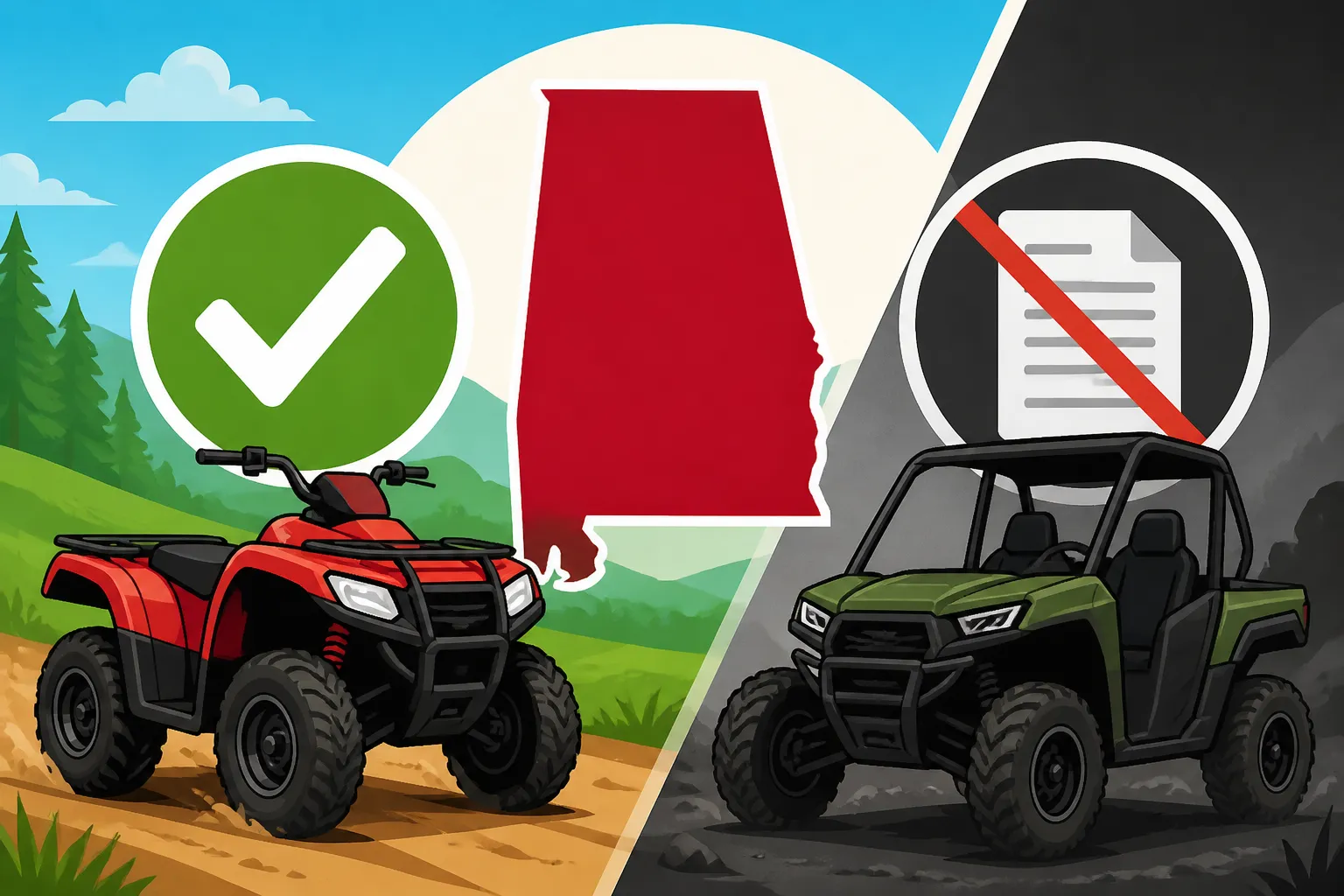
Alabama’s off-highway vehicle registration program is voluntary at the state level. That means owning an ATV or UTV does not, by itself, mean you must obtain Alabama registration before using the machine. The word “voluntary,” though, can sound broader than it is. It describes the state registration program; it does not promise that every property owner or public riding area will let an unregistered machine in.
That distinction matters when you’re planning a ride. A machine might be unregistered and still be used on property where you have permission, while a public riding area may set its own conditions for access. A private park may ask for documents, a waiver, or particular safety equipment. A wildlife management area may have rules tied to its specific tract and season. Check the requirements for the place you intend to ride instead of assuming the state-level rule answers every access question.
Registration also should not be confused with having proof that you own the machine. If you bought a used quad without paperwork, a voluntary registration may not automatically resolve an ownership dispute or replace a bill of sale. Keep any purchase documents, serial-number records, and written permission relevant to your ride. For details on the state process, see Alabama Registration Is Voluntary and Alabama Public Use Versus Private Use.
Registration does not make an off-road machine street legal
An Alabama registration record or decal is not the same thing as a license plate for ordinary road use. It does not turn a standard ATV into a street-legal vehicle, and it does not grant permission to ride along a county road, city street, or highway. Road use involves separate laws and requirements, and a machine’s design can make it ineligible for ordinary road registration even if it has safety accessories added later.
This is an easy point to miss when a machine has headlights, mirrors, a horn, or turn signals. Those items may be useful for visibility or required by a specific property, but adding equipment alone does not necessarily satisfy the legal standards for road use. Nor does an off-highway registration mean that a rider can travel between two trail areas on the shoulder or use a road as a shortcut.
If your route involves a road crossing or a road that appears open to vehicles, check the specific legal rules before riding there. Local restrictions and road classifications can matter, and an open-looking route is not automatically an authorized ATV route. For the separate road-use question, start with Can You Drive an ATV on the Road in Alabama? and Alabama Rules for Crossing a Highway.
Registration, access permits, and road rules are different
Three separate questions to answer before riding
It helps to think of a ride as three different checks rather than one paperwork question. First, ask whether Alabama requires state registration for the machine. Second, ask what the land manager or property owner requires for access. Third, ask whether the route itself is legal for an off-highway vehicle. A “yes” or “no” to one question does not settle the other two.
For example, a rider may not need state registration simply to own an ATV, but still need a permit or other authorization for a particular public area. A privately operated riding park may admit riders under its own rules, including a signed waiver and machine or passenger requirements. And if the ride includes a public road, neither a park waiver nor a land-access permit makes that road legal for ATV travel.
Here is a practical way to keep the requirements straight:
| Question | What it concerns | What to check |
|---|---|---|
| Is state registration required? | Alabama’s off-highway registration program | The state program and any specific access condition |
| May I ride on this land? | Permission from a landowner or rules set by a land manager | The property’s current rules, permits, seasons, and open routes |
| May I use this road? | Traffic and vehicle laws | Road-specific rules and whether the machine qualifies for that use |
| Does my home-state document carry over? | Recognition of an out-of-state credential | Alabama rules and the destination’s own requirements |
A permit gives only the permission it covers
A permit is not a universal riding pass. It may authorize access to a particular tract, activity, time period, or route, and the conditions may differ from one place to another. A permit for hunting-related access, for instance, should not be treated as permission to ride any trail in the area at any time. Read the terms and maps that come with the authorization, and look for closures or seasonal restrictions.
The same caution applies to park admission. Paying to enter a private OHV park does not automatically mean every machine, passenger arrangement, or behavior is allowed. Parks can set their own rules for helmets, youth riders, dogs, alcohol, camping, noise, and trail access. Check the park’s requirements before loading the trailer, especially if you are bringing a side-by-side with passengers or a young rider.
For a public-land trip, identify the exact managing agency and location before you go. “We’re riding in the forest” or “we’ll be on a WMA” is not specific enough to determine the route or permit rules. Use the official tract or area map and confirm whether motorized travel is allowed on the route you intend to use. The guides to What Registering Gets You Before Riding Public Land and [Alabama WMA Riding Rules for Quads] can help frame those checks.
How permits work on Alabama public land
Wildlife management areas need location-specific checking
Alabama wildlife management areas are not one uniform riding destination. Access conditions can depend on the specific area, the season, the activity, and the routes open to motorized vehicles. Do not assume that a hunting license, an area permit, or a daily permit automatically authorizes ATV riding wherever you choose within the tract. Confirm both the permit requirements and the vehicle-access rules for the particular WMA.
Before leaving home, locate the WMA’s current map and read the posted conditions that apply to your intended dates. Look for roads that are open to vehicles, seasonal closures, check-in or check-out steps, and restrictions connected to hunting activity. If anything is unclear, contact the responsible office or area staff rather than relying on an old map saved on your phone or advice from someone who visited a different tract.
A practical example: you and a friend plan to use a quad to reach a hunting spot on a Saturday. You need to establish that you have the required authorization for the activity, that the access route is open to motorized vehicles, and that your planned use is allowed at that time. Those are separate checks. For permit steps and area-specific considerations, see How to Get an Alabama WMA Permit and Alabama WMA Rules Vary by Area.
National forest access depends on designated routes
In Alabama’s national forests, a map showing forest land does not mean every road, trail, or open space is available to ATVs and UTVs. Motorized use is generally governed by designated routes and the applicable forest rules. Gates, signs, closures, and route designations matter; do not ride around a gate or onto an unmarked path simply because it appears to continue in the direction you want to go.
Plan the route with the correct motor-vehicle map and check for changes before the trip. A general recreation map may show campgrounds, hiking trails, or roads without clearly identifying which routes are open to your machine. If a route is closed or its designation is uncertain, choose a confirmed open route instead of treating the uncertainty as permission. Also account for weather and fire-related restrictions that may affect access.
Registration does not replace route authorization in a national forest. Nor does an out-of-state decal necessarily grant access to a route that is closed to motorized use. If you are unsure how a map applies to your planned ride, contact the forest office before hauling out. The related guides Alabama National Forest Riding Permits and Which Forest Roads in Alabama Are Open to ATVs cover the difference between having a machine credential and being allowed on a particular route.
Riding in Alabama with an out-of-state machine
Do not assume your home-state registration settles Alabama access
Visitors often bring an ATV or UTV that is registered, titled, or otherwise documented in their home state. That paperwork may help establish the machine’s identity or satisfy a requirement imposed by the home jurisdiction, but it does not automatically authorize riding on every Alabama property or route. Alabama’s voluntary registration approach is one part of the picture; the land manager’s rules and route restrictions still apply.
If you are visiting from Georgia, Tennessee, Mississippi, or Florida, check both the rules that apply to your machine at home and the Alabama requirements for the place you plan to ride. Do not assume that an out-of-state decal is either required everywhere in Alabama or accepted as a substitute for a local access permit. Ask the destination directly what documentation it expects from a nonresident, and keep the answer with your trip records.
A visitor planning a weekend at a private park should check the park’s admission and safety rules, not just the paperwork requirements at home. A visitor planning public-land riding should identify the correct agency, route map, and permit process. For state-specific visitor considerations, see What Visiting Riders Need to Ride Legally in Alabama and Alabama Rules for an Out-of-State Machine.
Reciprocity is not the same as automatic access
“Reciprocity” can imply that one state’s registration or permit is automatically recognized in another. In practice, recognition depends on the credential and the rule involved. A home-state registration may not carry the same meaning as an Alabama access permit, and a permit for one area does not necessarily work at another. Treat each document as evidence of the authority it actually grants, not as a general license to ride anywhere.
Before departure, write down the destination’s requirements and ask clear questions: Is a home-state registration accepted? Is an Alabama permit needed? Are there limits on the machine type, route, or season? Does the authorization apply to the driver, the vehicle, or both? These questions are especially useful when a website uses broad language such as “registered vehicles” without explaining how it handles nonresident machines.
It is sensible to carry readable copies of relevant documents, but keep the original source and conditions in mind. A phone screenshot may be handy when cell service is poor, yet it should not replace reading the complete rules before the ride. If you keep printed maps, permits, and emergency contacts in a waterproof document pouch, you can organize the paperwork whether you bought the pouch locally or through a marketplace such as Amazon. The useful part is the preparation, not where the storage item came from.
Private parks and private property have their own rules
A park can set conditions beyond state registration
Private OHV parks can establish entry requirements that go beyond Alabama’s voluntary registration program. They may require a waiver, specify minimum ages, limit passengers, require helmets, or restrict certain machine sizes and types. A park can also close trails because of weather, maintenance, or other conditions. These rules are about access to that property and do not change the general state registration rule.
Read the park’s current visitor information before you travel, particularly if it is your first visit. A side-by-side may be subject to width or passenger restrictions that do not apply to a small quad. A youth rider may face age, supervision, or machine-size rules. If your group includes several families, agree on the requirements before everyone arrives; discovering at the gate that a rider lacks a required waiver can derail the day.
Keep a copy of your booking or admission details, waiver instructions, and any information the park says riders should carry. A simple folder or weather-resistant sleeve can help keep paper documents readable after a dusty or wet trip. If you use a product found through Amazon for document storage, treat it as organization gear only; it does not replace the park’s own paperwork or rules. See Alabama Private Park Waivers and Rules for more on what to check.
Permission from a landowner is not permission from everyone
On private land, the owner’s permission is central, but be clear about what that permission covers. A casual “you can ride out there” may not answer whether you can cross a neighboring parcel, use a logging road, enter through a gate, or ride during a particular season. Get the boundaries and allowed routes clarified before starting, especially if the property connects to timberland, a hunting lease, or public land.
Written permission is useful when several people share access or when the arrangement may be misunderstood later. It can identify the people allowed to ride, the dates, permitted routes, and any conditions set by the owner. A text message or signed note is not a substitute for understanding the land boundaries, but it can help prevent the familiar problem of one rider believing permission extends farther than the landowner intended.
Do not treat an open gate, tire tracks, or a well-used trail as evidence that you have permission. Signs, fencing, and local trespass rules deserve attention, and property lines can be hard to see in woods or brush. When you cannot confirm who controls the land, turn around and ask rather than crossing. Registration does not grant a property right, and an area permit does not authorize travel across private parcels outside its scope.
A practical pre-ride checklist for Alabama riders
Check the machine and paperwork before loading
Start by recording the machine’s serial number and keeping it with your purchase documents. If you bought it from a private seller, retain the bill of sale and make sure the machine description is clear. This is useful even when state registration is voluntary: a readable record can help identify your ATV or UTV if it is lost, stolen, damaged, or involved in a sale. Store copies separately from the machine when practical.
Next, decide whether voluntary Alabama registration makes sense for your situation. It may be useful as an ownership or identification record and may matter for a particular access program or requirement. Do not register under an assumed category without understanding what that category means. If you have recently moved, bought the machine out of state, or plan to register more than one vehicle, check the instructions that apply to your circumstances. The guide Alabama Registration for a New Resident covers a common transition question.
Keep digital and paper copies of the documents you may need, but avoid relying on a phone alone in areas with limited reception or battery access. A small waterproof sleeve from a local shop or Amazon can keep a printed map and permit paperwork together, while a separate copy at home protects against losing the entire set on a ride. Organize documents so you can quickly distinguish ownership records from permits and park waivers.
Confirm the destination on the day of the ride
Before setting out, confirm that the property is open and that the route you plan to use remains available. A map can be outdated, and access may change because of storms, maintenance, hunting seasons, fire conditions, or a landowner’s decision. Check official notices or call the relevant office when the posted information is unclear. This short check can save a long tow and prevent an avoidable access violation.
Tell everyone in the group the actual plan: where you are staging, which routes are open, what permits are needed, and what to do if the group gets separated. For a public area, have each rider understand the boundaries and restrictions rather than assuming the person who planned the trip can explain them on the trail. For a private park, make sure every rider knows the waiver and safety requirements before reaching the entrance.
Finally, leave yourself room to change plans. If you reach a gate, sign, or boundary that conflicts with what you expected, do not push through and hope it is fine. Stop, verify the rule, and choose a route you know is authorized. Carrying a map and paperwork is helpful, but the safest decision may be to turn around and call the land manager.
Common misunderstandings about voluntary registration
“Voluntary” does not mean rules never apply
The most common misunderstanding is assuming that because Alabama registration is voluntary, no paperwork or permission can ever be required. That leap is too broad. State registration, land access, park admission, and road use are different issues, each with its own rules. An area can have access conditions even when the state does not require every ATV owner to register the machine.
Another frequent mistake is believing that a registration decal is a pass to ride on public land. A decal does not identify every route that is open, satisfy every permit requirement, or remove seasonal restrictions. It is also not a substitute for property-owner permission. Read the specific area’s rules and carry the documents that apply to the planned use.
The reverse assumption can cause problems too: some riders think that because registration is voluntary, it can never be useful. Registration may help document a machine or meet a particular access requirement. The right question is not simply “Do I have to register?” but “What does this registration do, and what does my destination require?” That distinction keeps the paperwork connected to its actual purpose.
“My other state allows it” does not answer the Alabama question
A rider’s experience at home may not match Alabama’s requirements. Your home state may use different registration categories, permit systems, or road rules. Likewise, another state’s acceptance of your credentials does not automatically bind an Alabama property owner or land manager. Check the rule for the place you are visiting instead of carrying assumptions across a state line.
It is also easy to confuse a trail organization’s membership card, a park pass, a hunting credential, a state vehicle document, and an access permit. Each can serve a different purpose. Before a trip, identify who issued each document and what area, activity, vehicle, and dates it covers. If the paperwork does not clearly answer those questions, ask the issuer or destination.
For recurring rides, save a short checklist for each destination rather than relying on memory. Include the route map, permit steps, park contact details, and any special restrictions. A document pouch—whether purchased in town or through Amazon—can keep the printed copies together, but keep the most current rules easy to retrieve. The goal is not to carry paperwork for its own sake; it is to know which permission applies to the ride you are actually taking.
Disclaimer
This article is for general informational purposes only and does not constitute professional advice. Laws, prices and regulations vary by location and change over time. Consult a qualified professional for guidance on your specific situation.