Trailering Over the Roads to Cheaha
A trailer trip to Cheaha can look simple on a map, but the final climb, limited room to turn around, and uncertainty about where an ATV or UTV may actually be ridden can complicate the day. This guide helps you plan the drive, secure your machine, check access before unloading, and avoid mistaking scenic roads or forest roads for open OHV trails.
Plan the Cheaha trip before you hitch up
Separate the scenic drive from the riding plan
Cheaha Mountain sits in the Talladega National Forest region, and the roads around the mountain are part of the appeal. Alabama Highway 281, also known as the Talladega Scenic Drive, leads through the area and toward Cheaha State Park. But a scenic route is not automatically an ATV route. A road that appears quiet or surrounded by forest may still be a public road where an off-road machine cannot be driven.
Treat the drive to Cheaha and the ride itself as two separate parts of your itinerary. Your truck and trailer can use public roads that are open to them, subject to ordinary traffic laws and posted restrictions. Your quad or side-by-side should come off the trailer only at a place where unloading and riding are permitted. Do not assume that a forest road, pull-off, trailhead, or park entrance is an authorized OHV staging area.
Before choosing a riding destination, check the rules for the exact tract or facility. If you are considering routes in the Talladega area, start with Alabama Riding Near Talladega and confirm whether the specific trail permits your machine type. A motorcycle-only route, a hiking trail, and an OHV trail can appear close together on a map while having very different access rules.
This distinction is especially useful when planning a family outing. You might spend the morning driving the scenic route and visiting Cheaha State Park, then trailer to a separate riding area for the afternoon. That can be more satisfying than arriving at a viewpoint with a machine you cannot legally unload or ride.
Confirm that your chosen trail accepts your machine
ATV and UTV access can differ even at the same riding area. A route may have limits on vehicle width, vehicle type, rider age, or permitted use. Do not rely on a broad label such as “off-road” or “forest access” to answer those questions. Check the site’s current rules and look for machine-specific guidance, especially if you are bringing a wider side-by-side.
A map can help you understand the shape of a route, but it is not a substitute for access rules. Look for an official land manager or park source that identifies the route as open to the kind of machine you plan to bring. For public land, verify which routes are designated and whether seasonal or temporary restrictions apply. Checking a Forest Map Before You Go and Which Forest Roads in Alabama Are Open to ATVs are useful starting points for understanding why route designation matters.
If you are using a navigation app such as onX Offroad, use it as a planning aid rather than your sole permission check. A mapped line may help you orient yourself, but you still need to confirm access with the responsible agency or property owner. It is particularly important to distinguish a vehicle route from a hiking trail, an unofficial track, or a road that is closed to motorized recreation.
A good pre-trip check answers four specific questions: Is the route open on your planned date? Is your machine allowed? Where may you park and unload? Are there additional permits, passes, or check-in steps? If one answer is unclear, contact the land manager or riding-area office before making the drive.
Prepare for the roads and trailer
Choose a route that works for your whole rig
The best route for a car is not always the best route for a truck towing a loaded trailer. Around Cheaha, consider the entire combination: tow vehicle, trailer length, machine weight, fuel, gear, and the room you will need to stop or turn around. Hills and curves can make a route feel more demanding when the trailer is loaded, even if the road is paved.
Use a routing tool to identify the general approach, then check road conditions and restrictions before leaving. Pay attention to steep grades, tight curves, construction, narrow shoulders, and places with few safe pull-offs. If your route includes Alabama Highway 281, plan to drive at a pace that feels controlled for your loaded rig rather than trying to keep up with faster traffic. Leave extra following distance and avoid sudden braking on downhill stretches.
Do not count on being able to reverse a trailer easily at a scenic overlook, trail entrance, or small parking area. If you are unsure whether the destination has adequate trailer parking, call ahead or choose a larger, confirmed staging location. A few minutes of checking can prevent a stressful maneuver on a narrow road with traffic behind you.
| Trip detail | What to check before departure | Why it matters |
|---|---|---|
| Route | Grades, curves, restrictions, and road conditions | A loaded trailer handles differently from a car |
| Trailer parking | Space to park, turn, and unload | A small pull-off may not fit a truck and trailer |
| Machine access | ATV or UTV eligibility for the exact route | Nearby roads and trails may have different rules |
| Weather | Heavy rain, storms, and possible closures | Wet conditions can affect both travel and trail access |
| Equipment | Tie-downs, tires, lights, and hitch connections | A secure load reduces risk during the drive |
| Backup plan | Another legal riding area or a scenic-only day | Access can change or prove unsuitable |
For a more detailed trip checklist, use Alabama Trail Conditions Before You Tow. If you are relying on onX Offroad to compare route options, check the map before departure, save the information you need, and still verify closures or restrictions through the relevant land manager.
Secure the machine for the climb and descent
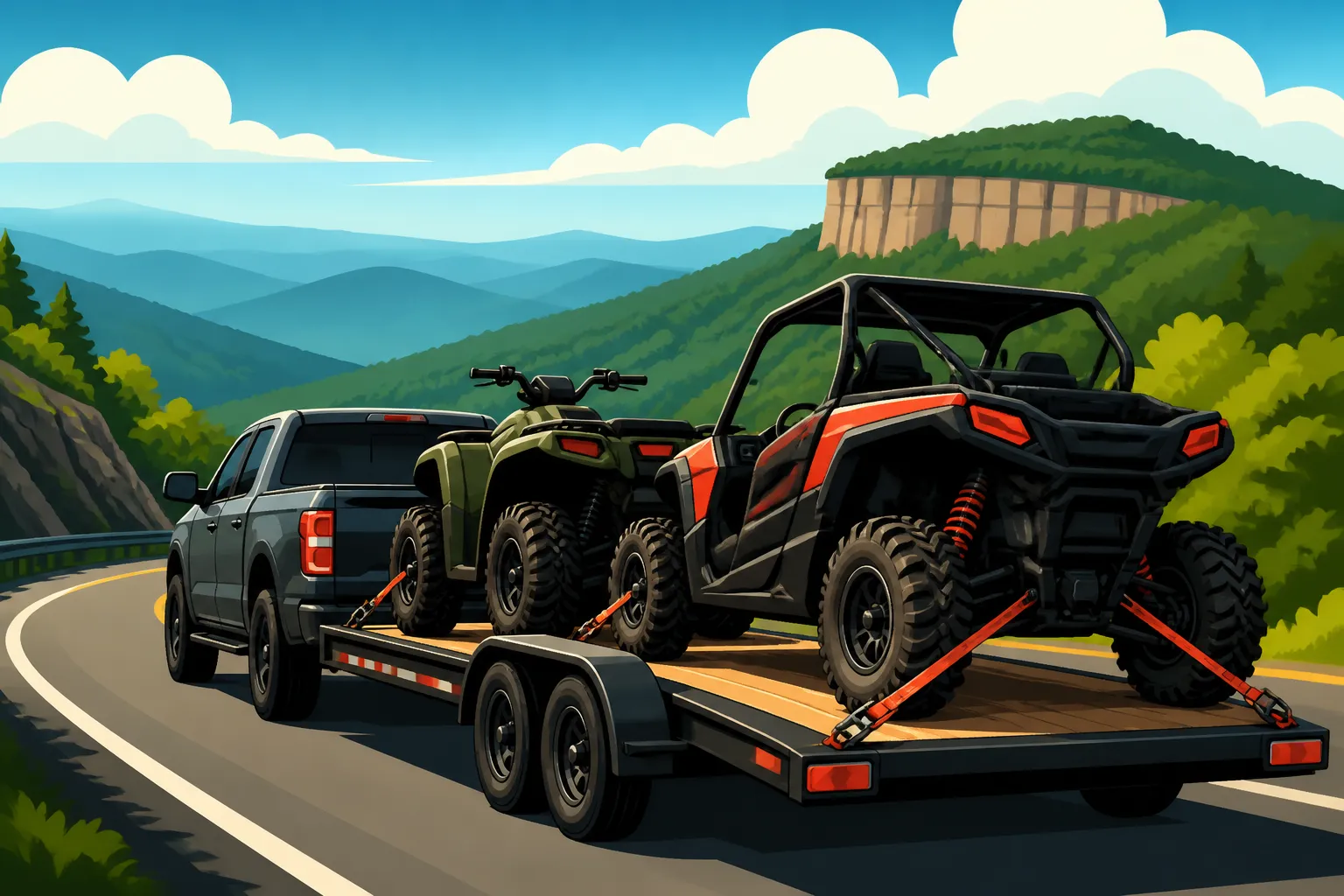
A machine that feels stable in the driveway can shift during braking, cornering, or a steep descent. Load it with the trailer on level ground whenever possible, use suitable tie-down points, and secure it according to the machine and trailer manufacturers’ instructions. Check that the tires are properly inflated and that the trailer’s lights, coupler, safety chains, and brakes are working before you start toward the mountain.
Keep heavy gear low and balanced. A cooler, tool bag, fuel container, or spare parts placed loosely in the cargo area can move during travel. Store loose items in secured compartments or tie them down separately. Make sure the machine’s parking brake is engaged if appropriate, but do not treat that as a replacement for proper tie-downs.
After driving a short distance, stop somewhere safe and inspect the load. Check for slack in straps, shifting tires, loose ramps, or anything rubbing against the machine. Recheck after a rough stretch or a major change in road conditions. If the trailer begins swaying, slow gradually and avoid abrupt steering or braking; do not try to correct a sway by accelerating sharply.
Think through unloading before you arrive. You need room to position the trailer, lower ramps securely, and move the machine without blocking traffic or another visitor’s access. If the site is crowded or the surface is uneven, it may be safer to leave the machine secured and choose another location.
Find a legal place to unload and ride
Do not treat every forest road as an OHV route
The Talladega National Forest includes many kinds of public land and routes, but public ownership alone does not mean every road or trail is open to ATVs and UTVs. Designated motorized routes, seasonal access, vehicle restrictions, and closures can all affect where you may ride. Hiking routes and scenic roads are not substitutes for signed or officially designated OHV access.
This is where trip planning can get confusing: a line on a navigation map may be a road, a trail, or a route intended for a different type of user. Confirm the route’s status with the land manager and read posted signs when you arrive. If signs conflict with an old saved track or a third-party map, follow the posted restriction and contact the responsible office for clarification.
Use Alabama Trail Closures After a Storm as a reminder to check for changes close to departure. Recent rain can affect trail conditions, and land managers may close routes to prevent damage or protect visitor safety. A route that was open on a previous trip is not necessarily open today.
If you are unsure, do not unload and “just see how far you can go.” Ask before riding. Calling the National Forest District Office Before You Ride offers a practical approach to checking access questions. For official riding-area options elsewhere in the state, compare Alabama Trails That Allow Side-by-Sides with Alabama ATV Trails: Where to Ride rather than assuming all listed trails accept all machines.
Use a fallback plan instead of forcing the day
A useful Cheaha itinerary has a backup. If the trail you hoped to ride is closed, too narrow for your UTV, or lacks suitable trailer parking, you can still enjoy the area without turning an uncertain situation into an access problem. Options might include keeping the machine on the trailer and visiting the park, taking a scenic drive, or moving to a confirmed riding area that fits your machine and schedule.
Before leaving home, identify a second legal riding location and note how much additional driving it would require. Verify its operating status, parking arrangements, machine restrictions, and any required passes. Do not assume an alternative is open just because it appears in a search or navigation app. Alabama Private Off-Road Parks can help you explore managed riding areas, while Alabama North and South Riding Compared can help frame a broader destination choice.
Keep the plan flexible if weather is unsettled. Heavy rain can make clay routes slippery, increase the chance of trail damage, or prompt closures. A ride that would be manageable for an experienced driver in dry conditions may be a poor choice for a new rider, a youth machine, or a group with mixed experience after rain.
A simple decision rule helps: if you cannot confirm the route, unloading area, and machine eligibility, do not ride there. Choosing a different activity or location is frustrating, especially after towing a long distance, but it is far better than risking a citation, damaging a trail, or getting a large trailer stuck where there is no safe way to turn around.
Make the day smoother from departure to return
Build a practical day-of checklist
The morning of the trip is not the best time to discover that a machine is too wide for the planned route or that the trailer will not fit at the parking area. Before departure, check your route, weather, trail access, and any posted operating notices. Confirm that your phone has the maps or contact details you may need, especially if you expect limited cell service in the hills.
Pack the basics for both towing and riding: tie-downs, a tire-pressure gauge, basic tools, drinking water, first-aid supplies, riding gear, and a way to secure loose cargo. Bring any required permits or proof of permission for the specific area. If you ride with a group, agree on a meeting point and a plan for what to do if someone loses signal or becomes separated.
A concise checklist can prevent small oversights:
- Confirm that the riding area is open and allows your ATV or UTV.
- Verify a legal place to park, turn around, unload, and reload.
- Check road conditions and the route for a loaded trailer.
- Inspect the trailer, hitch, tires, lights, brakes, and tie-downs.
- Save maps and contact information before leaving service coverage.
- Pack helmets and any other safety gear required by the park or route.
- Recheck access conditions before unloading.
When using onX Offroad, consider downloading or saving the relevant map information before you reach areas with weak reception. Then compare what you see on the map with posted signs and official rules at the site. Navigation can help you stay oriented, but legal access is determined by the land manager, not by whether a track appears on your screen.
Leave the area ready for the next visit
Mud and debris picked up on a ride can create a mess on the trailer and may conceal loose straps or damaged equipment. Before you head back down, make time to clean what you can safely clean, inspect the machine, and secure it again. Check that ramps are stowed, cargo is tied down, and the trailer lights work before entering the road.
Be considerate at shared parking areas. Keep loading and unloading within the space provided, avoid blocking gates or access roads, and do not leave trash or damaged straps behind. If the parking area is full, do not improvise by blocking a road or using a restricted shoulder. Find an appropriate alternative.
The ride ends when everyone and every machine is safely back at the tow vehicle, not when the engine is switched off. Take a final count of riders, check that no gear has been left behind, and confirm that the machine is secured before moving. This routine can feel overly careful when you are tired and eager to get home, but it reduces the chance of a preventable problem on the drive away.
Disclaimer
This article is for general informational purposes only and does not constitute professional advice. Laws, prices and regulations vary by location and change over time. Consult a qualified professional for guidance on your specific situation.