Who Pays for a Gate a Rider Breaks
Breaking a gate while riding your ATV or UTV can quickly turn a fun day on the trails into a stressful and expensive nightmare. Many riders don't realize the full extent of the legal and financial repercussions involved when private property is damaged, especially if you're on land without explicit permission. This guide will walk you through who is typically held responsible when a gate gets broken in Alabama, the potential costs, and crucial steps to avoid such unfortunate situations.
The Foundations of Property Damage and Rider Responsibility in Alabama
The thrill of off-road riding in Alabama, whether you're navigating a tight trail on a quad or tackling open fields in a side-by-side, often involves diverse terrain. But with that freedom comes a significant responsibility to respect private property. A broken gate isn't just an inconvenience; it's a legal incident with real consequences.
Understanding Trespass Law and Implied Permission
In Alabama, trespass is generally defined as entering or remaining on someone else's property without their permission. This concept is foundational to understanding liability for a broken gate. When you encounter a closed gate, whether it's locked, chained, or simply shut, it serves as a clear indicator: Do not enter. There is no "implied permission" to go around or through a closed gate. Many riders mistakenly believe that if a path looks inviting, or if they've ridden there before without issue, that it's open for use. This assumption is where problems begin.
A landowner's property is their domain, and a gate is an unequivocal statement of their desire to control access. Even if you see tracks from other riders, or if the gate appears old and unused, circumventing or damaging it is an act of trespass. This is especially critical on large tracts of land, such as timber company holdings or vast cattle ranches, where boundaries might not be perfectly clear but gates are intentionally placed. Thinking you can sneak through or that no one will notice is a gamble that rarely pays off, as many landowners have invested in [Posted Land and Purple Paint in Alabama] and surveillance to protect their assets.
Direct vs. Indirect Damage: Who Is Held Responsible?
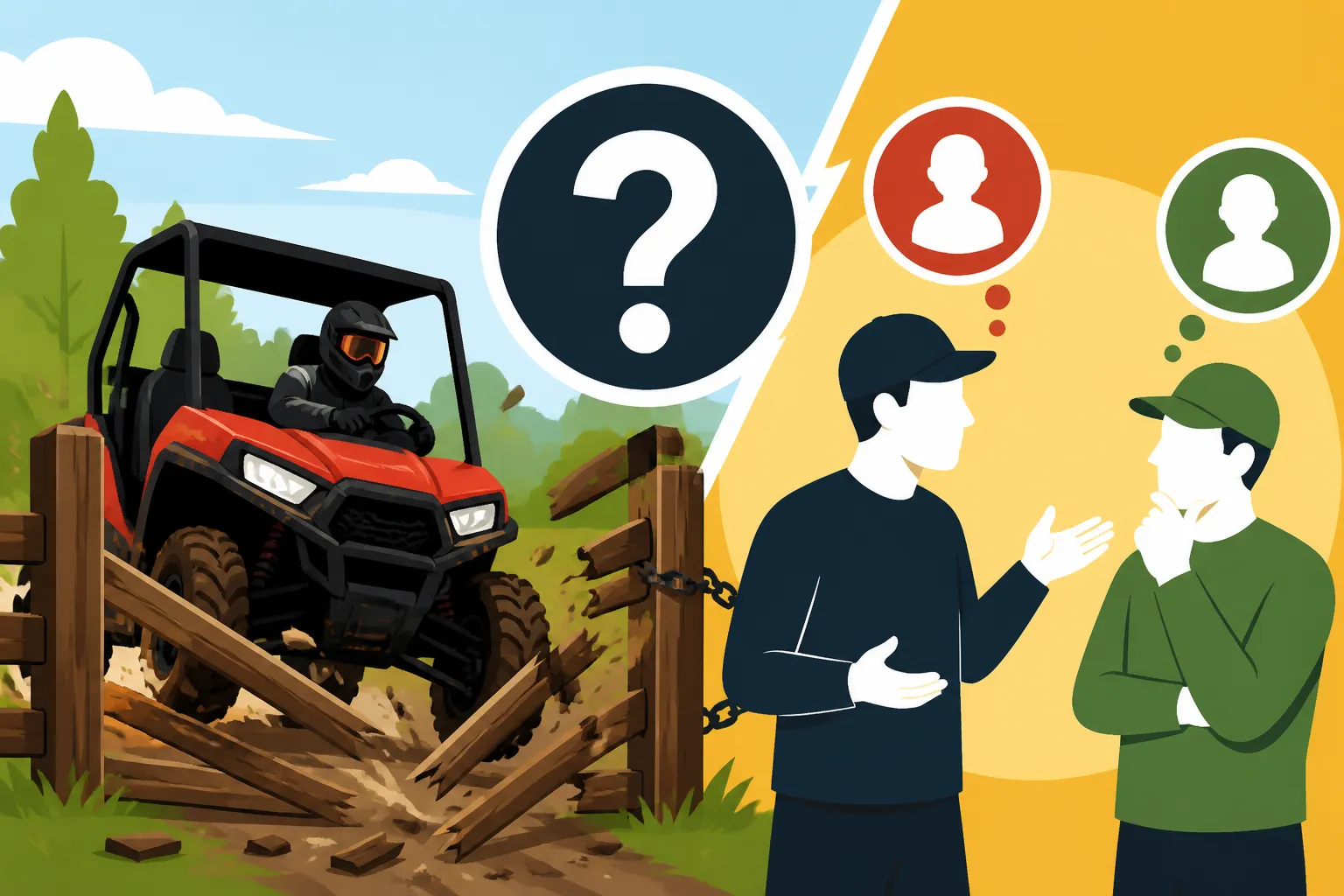
When a gate is broken, determining who is responsible primarily comes down to proving who caused the damage. If you, as the rider, directly hit a gate with your ATV or UTV, cut a lock, or force it open in a way that causes it to break, you are directly responsible. This is usually straightforward negligence or intentional damage, depending on your actions. The owner will hold you accountable for the costs associated with repairing or replacing the gate.
However, responsibility can extend beyond direct impact. Consider a scenario where you illegally enter property, leave a gate open, and livestock escapes, or valuable equipment is stolen because the property was left unsecured. In such cases, you could be held liable for not only the broken gate but also the consequential damages resulting from your actions. This could include the cost of recovering escaped animals, damages from an accident involving those animals, or the value of stolen property. This is why understanding [Alabama Trespass Penalties for Riders] is so crucial; the ramifications go far beyond just fixing a latch.
It's also worth noting that if you are riding with a group, proving individual responsibility can become complex. However, if all members of a group are trespassing, all could potentially face civil and even criminal charges, regardless of who delivered the final blow to the gate. The best defense against this is always ensuring you have [Written Permission From an Alabama Landowner] before you even approach a gate.
Financial and Legal Consequences of Damaging Private Property
The immediate aftermath of a broken gate can be daunting, extending from simple repair costs to significant legal battles. Knowing what you might face can help riders understand the gravity of respecting private property.
Repair Costs and Restitution
The cost of a broken gate can vary dramatically, from a few dollars for a simple latch repair to hundreds or even thousands for a custom-built entrance. When a gate is damaged, the landowner has the right to seek restitution for the full cost of repair or replacement. This isn't just about the material cost; it often includes the labor involved in fixing it, the cost of specialized equipment, and any associated inconveniences. For instance, a farmer might have to pay a crew to round up escaped cattle due to an open or broken gate, and that cost could be added to your bill.
In Alabama, if you are caught and identified as the person who broke the gate, the landowner can pursue civil action to recover these costs. This typically means a lawsuit in small claims court or a higher court, depending on the amount of damage. If the damage is substantial, the court may order you to pay not only the repair costs but also court fees and potentially even the landowner's legal expenses. Furthermore, if criminal charges are filed (as discussed below), a judge might include restitution as part of your sentencing. This often comes as a shock to riders who thought they were just "having fun."
Criminal Charges Beyond Civil Damages
Breaking a gate on private property in Alabama can lead to more than just a civil lawsuit for damages. Depending on the intent and the extent of the damage, you could face criminal charges such as criminal mischief, vandalism, or even theft if parts of the gate or its locking mechanism are removed. Criminal mischief in Alabama, which covers damaging property, can range from a misdemeanor to a felony, with penalties escalating based on the value of the damage.
For instance, if you damage a gate valued at a few hundred dollars, you might face a misdemeanor charge, potentially resulting in fines, probation, or even jail time. However, if the gate is a significant structure, or if your actions lead to substantial indirect damages (like causing a serious accident due to livestock on a public road), the charges could be elevated to a felony. This means a permanent criminal record, much stiffer fines, and potentially years in prison. These are serious charges that can affect your employment, your ability to own firearms, and your overall future, far outweighing the momentary thrill of riding where you shouldn't. Don't let a poor decision lead to [Alabama Penalties for Illegal Road Riding] or worse.
The Role of Insurance (or Lack Thereof)
Many ATV and UTV owners carry liability insurance, which is a smart move for protecting yourself against accidental damage or injury to others while legally riding. However, it's crucial to understand the limitations of most off-road vehicle insurance policies. Standard policies are typically designed to cover accidents that occur while riding legally on permitted property or designated trails.
| Scenario | Coverage Likely? (General) | Reason |
|---|---|---|
| Accidental Damage on Own Land | Yes | Covered under personal property or liability if others are involved. |
| Accidental Damage on Public Trail with Permit | Yes | Standard liability or comprehensive may cover this, depending on policy terms. |
| Accidental Damage on Private Land with Written Permission | Likely Yes | If permission is granted, your liability policy should apply for accidental incidents. |
| Intentional Damage/Vandalism | No | Insurance typically excludes intentional acts and criminal behavior. |
| Damage while Trespassing | No | Policies usually exclude incidents that occur during illegal activities or without permission. |
| Consequential Damage (e.g., livestock escape) while Trespassing | No | Linked to the act of trespassing, which is usually excluded. |
If you break a gate while trespassing, your insurance company will almost certainly deny any claim for damages. Insurance policies are not intended to cover illegal acts or intentional property damage. This means that if you are found liable for a broken gate while trespassing, you will be personally responsible for all repair costs, legal fees, and any fines or restitution ordered by a court. This can be a substantial financial burden, leaving you fully exposed to the costs. Even [Alabama Comprehensive Coverage for a Quad] has its limits when it comes to unlawful acts.
Preventing Damage and Protecting Your Ride (and Wallet)
The best way to deal with a broken gate is to ensure it never happens in the first place. A little foresight and respect can save you a lot of headache, heartache, and money.
Always Seek and Verify Permission
This cannot be stressed enough: Always get explicit permission before riding on private land. A simple "no trespassing" sign or a closed gate means exactly that. If you believe a piece of land might be open to riders, find the landowner and ask. Don't assume. Many landowners are friendly and might grant permission, especially if you demonstrate respect for their property. Make sure this permission is [Alabama Landowner Permission Letters] or otherwise documented, especially if you're riding with a group or repeatedly. Oral permission can be difficult to prove if a problem arises.
Before you even load up your rig, do your homework. Use mapping apps to identify property lines and landowner information. If you're unsure, or if you can't contact the owner, err on the side of caution and find another place to ride. There are many designated public areas and private parks in Alabama where riding is welcome. Organizations like the Alabama Department of Conservation and Natural Resources (ADCNR) often have information on legal riding areas. Remember, "when in doubt, turn around" is not just a polite suggestion, it's a legal safeguard.
Equipment and Rider Responsibility
While durable aftermarket parts from companies like SuperATV can significantly enhance your machine's capabilities and resilience on the trails, they don't grant you immunity from poor judgment. Investing in quality accessories like heavy-duty bumpers, rock sliders, or skid plates from a reputable brand such as SuperATV might help mitigate damage to your machine in case of an accidental bump, but it certainly won't protect you from the legal repercussions of breaking someone else's property. The responsibility for controlling your machine and respecting property lines ultimately rests with you, the rider.
This means riding within your skill level, maintaining your machine properly (ensuring brakes work, steering is responsive), and being constantly aware of your surroundings. Speeding, reckless driving, or riding under the influence significantly increase the risk of accidental damage and further complicate any legal situation. Even on public trails, riders are expected to respect infrastructure like gates, fences, and signs. Whether your machine is tricked out with SuperATV lifts or just factory stock, the principle of respecting property remains the same. Riding an ATV or UTV is a privilege, not a right, and it demands constant vigilance.
What to Do If You Accidentally Cause Damage
Even the most careful riders can have an accident. If you unintentionally cause damage to a gate or other property while riding, the absolute best course of action is to stop immediately, assess the damage, and try to contact the landowner. Do not flee the scene. Leaving the scene of an accident, especially if you've damaged property, can escalate the situation from a civil matter to a criminal one, potentially leading to hit-and-run charges in some contexts, or at least strengthening the case for intentional mischief.
If you can't locate the landowner, leave a clear note with your contact information and a brief explanation of what happened. Take photos of the damage and your machine if it was involved. When you speak to the landowner, be honest, apologize, and offer to pay for the repairs or arrange for them. While it might be an uncomfortable conversation, demonstrating integrity and a willingness to make amends can go a long way in de-escalating the situation and potentially avoiding legal action. As you would protect your investment with accessories found on the SuperATV website, landowners protect theirs. Showing respect for their property, even in an accident, is paramount.
Landowner Perspectives and Enforcement
Understanding the landowner's point of view can help riders appreciate the need for strict enforcement and prevention. For them, a broken gate is rarely an isolated incident; it's often part of a larger, ongoing struggle to protect their livelihood and privacy.
Protecting Private Property from Unauthorized Access
For many Alabama landowners, gates are more than just barriers; they are integral to the security and management of their property. A broken gate can lead to significant financial losses: escaped livestock wandering into roads or neighboring properties, damage to crops, or easier access for thieves and vandals. Farmers, timber companies, and private residents invest heavily in fences and gates to delineate boundaries, contain animals, and protect equipment. When a gate is broken, it forces the landowner to spend time, money, and effort to repair it, often disrupting their daily operations.
Beyond the financial impact, there's the invasion of privacy. Many landowners value their solitude and the peace of mind that their property is secure. Unauthorized entry and property damage can create feelings of frustration, anger, and vulnerability. They often view riders who break gates or trespass as disrespectful and a threat to their way of life. This emotional toll is part of the reason landowners are often so quick to involve law enforcement and seek full restitution.
Working with Law Enforcement
Alabama landowners who experience property damage or trespass are well within their rights to contact local law enforcement, typically the county sheriff's office. Deputies will investigate, gather evidence, and, if possible, identify the responsible parties. This evidence can include photographs of the damaged gate, tire tracks, eyewitness accounts, and increasingly, surveillance footage from trail cameras. As we touched on with [Recording Serial Numbers at Home], landowners often keep detailed records to protect their assets.
If the rider is identified, law enforcement can issue citations for trespass or property damage, or even initiate a criminal investigation if the damage is substantial or repeated. Landowners often have a strong working relationship with their local sheriff's department, especially in rural areas where off-road vehicle issues are common. They are not afraid to press charges, and they often seek to make an example of offenders to deter future trespassers. So, while you might think no one is watching, remember that landowners are often very proactive in protecting their property, and local authorities are usually on their side.
Disclaimer
This article is for general informational purposes only and does not constitute professional advice. Laws, prices and regulations vary by location and change over time. Consult a qualified professional for guidance on your specific situation.