When Police Impound a Quad After a Stop
It’s a truly awful feeling, the pit in your stomach when you realize an officer is pulling you over on your ATV or UTV, especially if you’re unsure whether you’re even supposed to be where you are. The shock can quickly turn to dread if they decide to impound your machine. This guide is here to walk you through the common reasons why your off-road vehicle might get impounded in Alabama after a stop, what steps you need to take to get it back, and how you can avoid this stressful situation in the future.
Why Your ATV or UTV Might Get Impounded in Alabama
Getting your off-road machine impounded is more than just a costly inconvenience; it means your ride, your pride, and maybe even your only way to enjoy the great outdoors is suddenly out of reach. In Alabama, there are several common scenarios that can lead to an impoundment, often stemming from misunderstandings or outright violations of the rules regarding where and how these vehicles can be operated. It’s crucial to understand these triggers so you can stay on the right side of the law.
Illegal Road Riding and Public Land Violations
One of the biggest reasons for an impoundment stems from riding your ATV or UTV on public roads or in unauthorized areas. Many riders assume that if a road is unpaved, it's fair game, or that a quick hop across a highway to get to another trail is harmless. However, Alabama has very specific [Alabama ATV Road Rules Explained] about where these machines can and cannot go. Generally speaking, ATVs and UTVs are not designed or legally permitted for public road use in Alabama. Even a county dirt road or a power line right-of-way can be off-limits if it's not a designated trail or if you don't have explicit permission. An officer might issue a citation for illegal operation and then, to prevent further violation, have the machine towed.
Consider a scenario: you’re riding with friends on what you thought was a backroad leading to a hunting camp, a route you've used for years. Suddenly, blue lights flash. An officer explains that this particular stretch is, in fact, a county road, despite its gravel surface, and your machine isn't street legal. The initial ticket for operating an unregistered or unauthorized vehicle on a public road can quickly escalate to an impoundment if the officer deems it necessary to remove the hazard or prevent you from continuing to break the law. This isn't just about a ticket; it's about the immediate removal of your vehicle from a prohibited area.
Trespassing on Private Property
Another frequent cause for impoundment is trespassing. Alabama takes private property rights seriously, and just because land looks undeveloped or unposted doesn't mean it's free to ride on. Many riders mistakenly believe that if they see existing tracks, it implies permission, or that certain timber company lands are always open. However, if a landowner or their representative calls law enforcement, and you're caught riding on their property without explicit permission, you could face not only a trespassing charge but also have your machine impounded.
Imagine this: you've found a great-looking wooded area that seems perfect for a new trail. You don't see any "No Trespassing" signs, so you venture in. What you might not realize is that the owner has purple paint markings on trees or fence posts, which in Alabama, clearly indicate private property. When the landowner spots you and calls the sheriff, you're not just looking at a fine; the deputy might order your ATV to be impounded because it was an instrument of the trespass, and it needs to be removed from the private land. This is especially true if the owner insists on it to prevent future incursions or potential liability issues.
Operating Under the Influence (OUI)
Just like driving a car, operating an ATV or UTV under the influence of alcohol or drugs is illegal in Alabama, whether you're on private land or a public trail. The laws regarding [Alabama DUI Law and Off-Road Machines] are quite broad and apply to off-road vehicles. An officer who suspects you're impaired can pull you over, conduct field sobriety tests, and if there's probable cause, arrest you for OUI. When an arrest is made, the vehicle you were operating, whether it's an ATV or UTV, will almost certainly be impounded. This isn't just about public safety; it's also about securing evidence and ensuring the vehicle isn't left abandoned or misused.
This scenario is particularly devastating: you're out camping with friends, enjoying a few beverages around the fire, and decide to take a short, seemingly harmless ride around your private property or a lease to check a trail camera. A game warden or local deputy, perhaps patrolling nearby, observes erratic operation or has reason to check on your group. If you're found to be impaired, not only will you face serious legal consequences for the OUI charge, but your machine will be taken away and stored in an impound lot until the legal process, and all associated fees, are handled. It's a stark reminder that the rules against impaired operation apply universally, regardless of the vehicle type or location.
Missing Registration or Ownership Records
While Alabama's ATV registration is generally voluntary for private use, if you're riding on public land or areas requiring registration (like some OHV parks or specific WMA tracts), lacking the proper documentation can cause issues. More critically, if there's any question about the ownership of the machine during a stop, perhaps due to a missing bill of sale or if the serial number is obscured, an officer might impound the vehicle to investigate further. This can also happen if the machine is reported stolen, or if the serial numbers don't match available records. This is where proof of ownership, even for an [Alabama Machines With No Paperwork], becomes incredibly important.
Let's say you bought an older quad at a farm auction, and you never got around to obtaining a bill of sale. You’re riding on a public trail in a county park when a park ranger stops you for a routine [Alabama Equipment Checks by Deputies]. When asked for proof of ownership, you can’t provide anything concrete beyond saying "it's mine." Without proper documentation linking you to the machine, especially if the serial number is hard to read or the machine's history is unclear, the ranger may decide to impound it until legitimate ownership can be established. This is a protective measure to ensure the machine isn't stolen and to prevent potential disputes, but it certainly complicates your day and can be quite stressful. Even voluntary registration processes like [Alabama's Voluntary ATV Registration Through ALEA] can provide a crucial paper trail in such situations.
The Immediate Aftermath: What Happens at the Scene
The moment an officer decides to impound your ATV or UTV, it can feel like everything is spinning out of control. It’s a jarring experience, but knowing what to expect can help you navigate the initial chaos and protect your rights. This isn't just about watching your machine get loaded onto a wrecker; it involves specific interactions and processes that you need to be aware of.
Understanding the Impoundment Order
When an officer makes the decision to impound your machine, they will typically inform you of the reason for the impoundment. This might be tied to an arrest (such as for OUI or resisting arrest), a severe violation (like egregious trespassing or unsafe operation), or as a protective measure (if the machine is suspected stolen or left abandoned). It’s crucial to listen carefully to why your machine is being taken. This reason will be documented and will be important later when you try to retrieve it. While it's natural to be upset, avoid arguing excessively with the officer at this stage. Your best course of action is to understand the charges, if any, and the impoundment reason.
For instance, if you're stopped for [Alabama Penalties for Illegal Road Riding] and the officer determines the machine is a public safety hazard on the roadway, they might issue you a citation and then tell you the machine must be impounded. They aren't trying to be punitive in every case, but to enforce the law and ensure the vehicle is removed from an illegal area. They will usually provide you with information about where the machine is being towed and what agency is responsible for it, such as the local sheriff's department or a specific towing company they contract with. This initial information is gold, so try to remember or write down the details they give you.
Documentation and Your Rights
During the impoundment process, the officer will likely document the condition of your ATV or UTV. They might take photos, note any visible damage, and record the VIN or serial number. It's a good idea for you to also take your own photos if it's safe and permitted by the officer. This provides a record of your machine's condition at the time of impoundment, which can be invaluable if you discover new damage later on. You have the right to ask for a copy of the impoundment report or the incident report. This document will contain vital information, including the impoundment reason, the towing company's details, and the location where your machine will be stored.
Remember, even in a stressful situation, you still have rights. You have the right to remain silent and to an attorney if you're being arrested. You also have the right to understand the process. Don't be afraid to politely ask questions about where your machine is going and what steps you need to take to get it back. The officer may not have all the answers regarding specific fees, but they should be able to tell you which agency to contact for that information. Knowing these steps will save you a lot of grief and wasted time trying to track down your machine later. For instance, if you have valuables on the machine, ask the officer if you can remove them before it's towed.
Towing and Storage Logistics
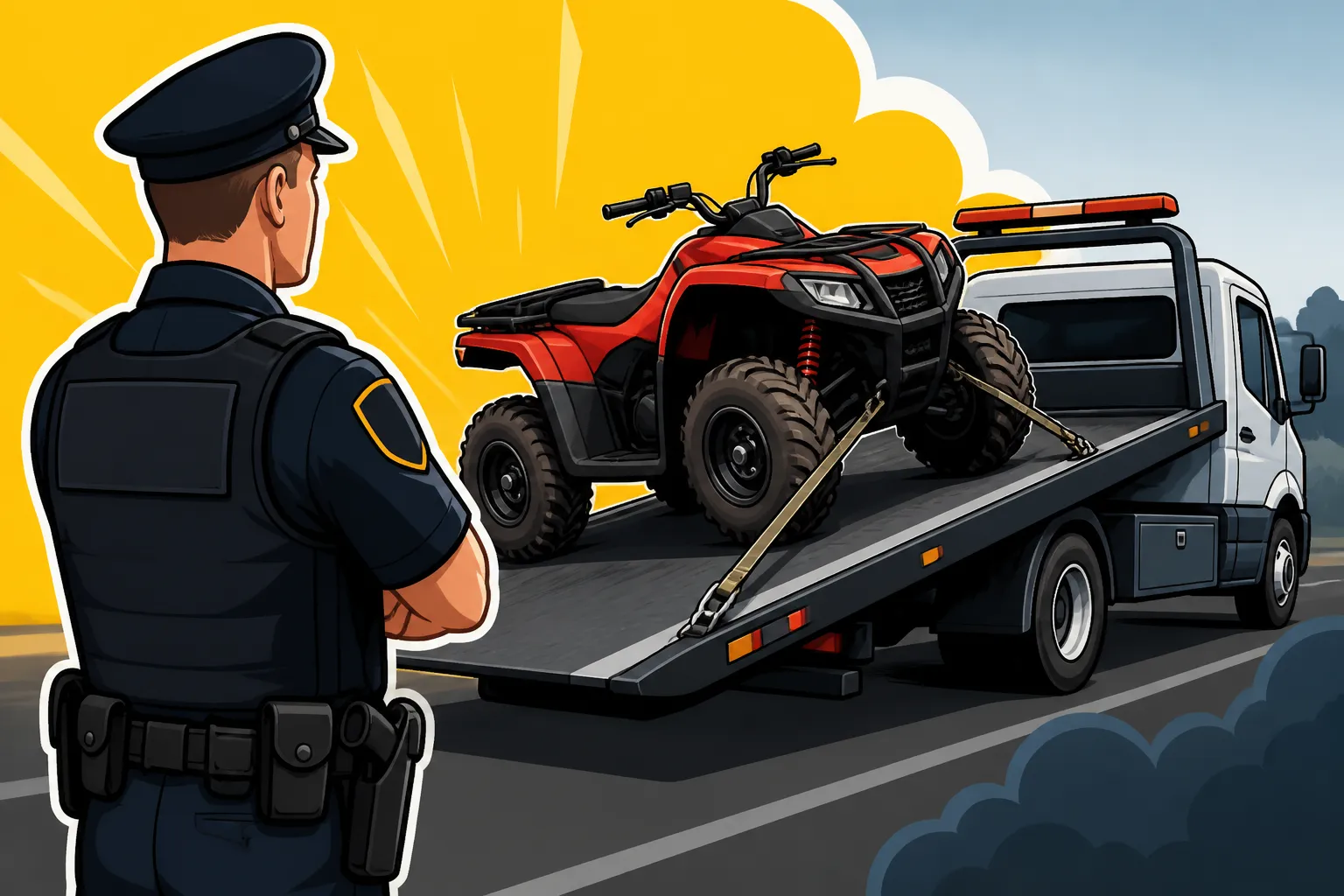
Once the decision to impound is made, a tow truck will be called. For ATVs and UTVs, this usually means a flatbed tow truck that can safely transport the machine without damaging it. The towing company is typically a private contractor working for the law enforcement agency. They will load your machine and transport it to an impound lot. These lots can be operated by the police department, the sheriff's office, or the private towing company. It’s important to understand that from this moment on, daily storage fees will begin to accrue, in addition to the initial towing charge. These fees can add up very quickly, making prompt retrieval a financial priority.
Here's a breakdown of common impoundment scenarios and what you might encounter:
| Scenario | Primary Offense | Typical Immediate Action | Key Retrieval Information Needed | Potential Additional Costs |
|---|---|---|---|---|
| Illegal Road Use | Operating an ATV/UTV on a public road | Citation, Impoundment | Case number, Tow lot info | Fines, Tow fees, Storage fees |
| Trespassing | Riding on private land without consent | Citation, Impoundment | Case number, Tow lot info | Fines, Tow fees, Storage fees |
| Operating Under Influence (OUI) | Impaired operation | Arrest, Impoundment | Case number, Tow lot info | Fines, Tow fees, Storage fees, Legal fees |
| Suspected Stolen / Ownership Doubt | Lack of proof of ownership | Investigation, Impoundment | Case number, Tow lot info | Tow fees, Storage fees, Admin fees |
| Abandoned Vehicle | Left unattended in prohibited area | Impoundment after notice period | Tow lot info, Admin fees | Tow fees, Storage fees, Admin fees |
You'll usually be given a piece of paper or told to call a specific number for the towing company and the impound lot location. Don't lose this information! It's your first step toward getting your machine back. Sometimes, depending on the severity of the offense or if there are ongoing investigations (like a stolen vehicle inquiry), there might be a "hold" on your machine, meaning it cannot be released until an officer authorizes it, even if you've paid all fees. This is rare for simple infractions but can occur in more complex situations.
Getting Your Impounded Machine Back
The good news is that getting your ATV or UTV back from impound is usually possible, but it's rarely a quick or cheap process. You'll need patience, some cash, and all your paperwork in order. This part of the journey can be frustrating, especially when you're dealing with multiple agencies and fees, but a systematic approach will help.
Navigating the Release Process
Your first step is to figure out which agency has your machine and what their specific release requirements are. This typically means calling the law enforcement agency that initiated the impoundment (e.g., the local police department or sheriff's office) or the towing company directly if they were identified at the scene. You'll need to provide the incident number or your name and the details of the stop. They will tell you where your machine is being held and what documentation you need to bring. Often, you'll need to go to the police or sheriff's office first to get an "impound release" form, which is essentially permission from law enforcement for the impound lot to let your machine go.
Be prepared for costs. There will be a towing fee, and then daily storage fees for every day your machine sits in the impound lot. These can quickly accumulate, especially on weekends or holidays when offices might be closed. Make sure you understand all the fees before you go to pick up your machine. If you're wondering about specific charges, you can ask for a detailed breakdown. Also, be aware that you might need to pay any outstanding fines related to the reason for the impoundment before they will release the machine. For instance, if you were cited for [Alabama Penalties for Illegal Road Riding], that fine usually needs to be settled.
Required Paperwork and Fees
To retrieve your ATV or UTV, you will almost always need to prove two things: who you are and that you legally own the machine. This means bringing a valid photo ID (like a driver's license or state ID) and proof of ownership. For an off-road vehicle in Alabama, proof of ownership can be a bill of sale, a previous registration from [Alabama Public Use ATV Registration Explained] or [Alabama Private Use ATV Registration Explained], or even a notarized statement of ownership if you're in a situation where traditional paperwork is missing, like [Proving Ownership of a Quad Bought at a Farm Sale]. If your machine is new enough to be subject to the new titling laws (model year 2026 and newer), then your title will be the best proof. [Alabama Title for a 2026 Side-by-Side] or similar documents are paramount.
In addition to proving ownership, you will need to pay all accrued fees. This can include the initial towing fee, daily storage fees, and any administrative fees imposed by either the towing company or the law enforcement agency. These fees must typically be paid in cash or by credit card directly to the impound lot. It's not uncommon for these costs to run into hundreds of dollars, sometimes even more if the machine has been held for an extended period. Call ahead to confirm the exact amount due and accepted payment methods. Keep all receipts!
After Release: Inspections and Repairs
Once you've completed all the paperwork and paid the fees, you'll be able to retrieve your machine. Before you leave the impound lot, thoroughly inspect your ATV or UTV for any damage. Compare its current condition with any photos you took at the scene of the impoundment. If you notice new damage that wasn't present before, document it immediately with photos and bring it to the attention of the impound lot staff. It can be challenging to prove damage occurred while in their custody, but having your own photo evidence can help.
Sometimes, after an impoundment, your machine might need a little TLC. Perhaps it was exposed to the elements, or maybe a small part got jostled during transport. If you find your machine needs some repairs or replacement parts, consider reputable suppliers. For example, if you need new ball joints, tie rods, or even a windshield after the ordeal, brands like SuperATV offer a wide range of aftermarket components that can help get your ride back in top shape. It's a silver lining to a frustrating experience, getting to upgrade a part that might have been damaged or just showing wear anyway.
Preventing Future Impoundments: Ride Smart in Alabama
Nobody wants to go through the hassle and expense of getting their ATV or UTV impounded. The best way to avoid it is to be a responsible and informed rider. This means understanding Alabama's specific laws, respecting property rights, and always being prepared with the right documentation. A little bit of knowledge and preparation can save you a lot of grief.
Know the Rules: Public vs. Private Use
Alabama has clear distinctions between where and how you can operate an ATV or UTV. The most important rule to remember is that most ATVs and UTVs are not street legal. This means no riding on public roads, highways, or streets unless specifically designated or exempted. Your machine isn't compliant with [Alabama's Federal Standard Barrier to Road Use], so don't assume any road is okay. Even a trip down a county road to get to a gas station can lead to a ticket and impoundment. Focus your riding on designated trails, private property with permission, or legally recognized OHV parks like Stony Lonesome OHV Park.
Understand the difference between [Alabama Public Use Versus Private Use]. If you're riding on your own land, the rules are much more relaxed. However, once you venture onto any public property, even a power line right-of-way that crosses private land, you fall under stricter regulations. Always verify if a trail or area is legal for ATV/UTV use before you ride. A quick call to the local sheriff's department or county commission office can often clarify local ordinances, as some areas may have [Alabama Local Ordinances on ATV Riding] that are even stricter. Ignorance of the law is not a valid defense.
Always Carry Your Documentation
One of the easiest ways to prevent issues during a stop is to have your paperwork readily available. This includes your valid photo ID and proof of ownership for your ATV or UTV. While Alabama's ATV registration through ALEA is voluntary, having an active registration and decal can certainly help establish ownership and show a degree of responsibility, especially if you're riding in an area that permits or requires it. For machines model year 2026 and newer, your title is crucial. Make sure your [Alabama Bill of Sale Requirements] are met when you purchase a machine, as this is often the most important document for older machines.
Consider storing copies of these documents in a waterproof bag on your machine, or even better, have digital copies on your phone in addition to physical ones. This way, if an officer asks for proof of ownership or registration, you can readily provide it, which can often resolve questions quickly and prevent an impoundment. Even if your machine is untitled, having a clear [Alabama Bill of Sale Requirements] and perhaps a notarized statement, if applicable, goes a long way.
Ride Responsibly and Soberly
This might seem obvious, but riding responsibly is paramount. Always operate your ATV or UTV safely, within your skill level, and according to manufacturer guidelines. Avoid reckless behavior that could draw attention from law enforcement or other concerned citizens. And under no circumstances should you ever operate your machine under the influence of alcohol or drugs. The penalties for [Alabama DUI Law and Off-Road Machines] are severe, and an OUI charge almost guarantees an impoundment, not to mention the potential for serious accidents and injuries.
If you're out with a group, encourage everyone to follow the rules and ride sober. A single impaired or reckless rider can put everyone at risk and potentially draw unwanted attention to the entire group. Staying safe and compliant isn't just about avoiding an impoundment; it's about protecting yourself, your friends, and preserving the privilege of enjoying Alabama's beautiful outdoors on your off-road machine. Remember that even if your machine has upgraded safety features from a provider like SuperATV, it doesn't change the fundamental legal requirements or the need for responsible operation.
Disclaimer
This article is for general informational purposes only and does not constitute professional advice. Laws, prices and regulations vary by location and change over time. Consult a qualified professional for guidance on your specific situation.