Why a Street Legal Kit Will Not Make It Legal
It's incredibly frustrating, isn't it? You love your ATV or UTV, you've seen those slick "street legal kits" advertised, and the idea of just hopping on and riding down the road to the gas station or a friend's house sounds amazing. But then you start digging into the actual laws in Alabama, and that dream quickly hits a wall. Many riders feel a real sense of disappointment and confusion when they realize that simply bolting on a few accessories won't actually make their machine legal for public roads. This guide is here to clear up that confusion, explaining in detail why those street legal kits, while offering useful components, don't change the fundamental legal status of your off-road vehicle in Alabama.
The Allure and Disappointment of Street Legal Kits
The market for ATVs and UTVs has exploded over the years, and with that growth comes the desire from owners to extend their machines' utility beyond the trail. For many, this means making them "street legal." You see these kits advertised everywhere, promising to add all the necessary features. It's a tempting proposition, but unfortunately, it often leads to a dead end when it comes to actual compliance with Alabama law.
What a "Street Legal Kit" Typically Includes
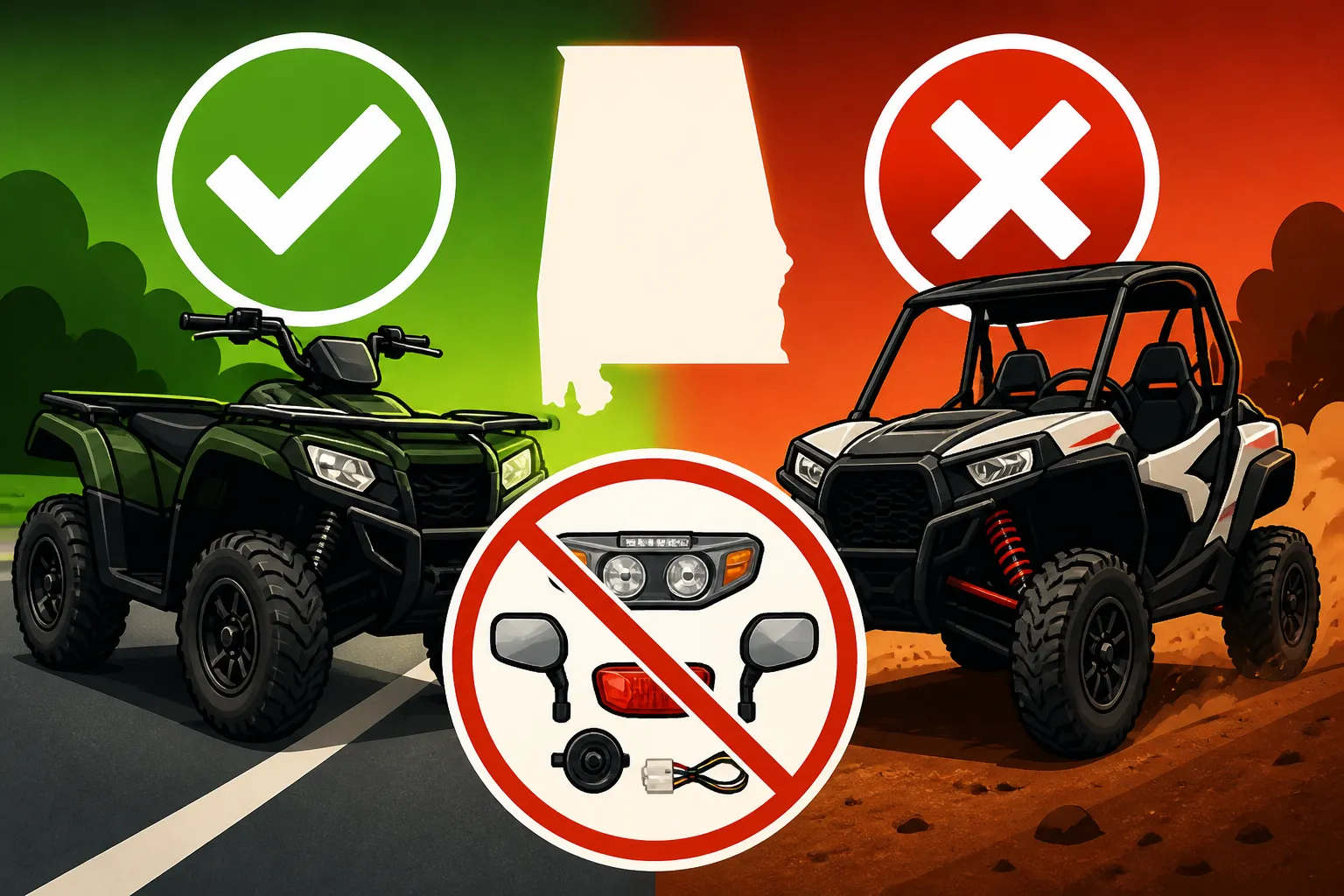
When you look at a street legal kit, whether it's from a major aftermarket provider like SuperATV or another vendor, you'll find a common set of components. These kits are designed to add features that seem to mimic what you'd find on a regular street-legal vehicle. They often include things like turn signals, usually LED lights that can be mounted on the front and rear, along with a wiring harness to connect them properly. You'll almost always get a horn, sometimes a small push-button type, for signaling. Rearview mirrors, often universal fit, are another staple, allowing you to see traffic behind you. Some kits even throw in a license plate bracket with a light, or a windshield to offer some protection from debris.
On the surface, it looks like a comprehensive package. You think, "Okay, I've got my signals, my horn, my mirrors – what else could I possibly need?" These are all features required for on-road driving, so it's a logical assumption that adding them would satisfy the legal requirements. You might even spend a weekend excitedly installing everything, proud of your upgraded machine, only to later find out your hard work doesn't quite translate to legal road access. It's an understandable trap to fall into, given how convincing these kits appear.
The Misconception About Kit Compliance
The core of the misconception lies in equating "having the parts" with "meeting the standard." Just because an ATV or UTV has turn signals, a horn, or mirrors, doesn't mean it has undergone the rigorous testing and certification required for road use. Riders often invest their time and hard-earned money into these kits with the genuine belief that they are making their machine compliant. Imagine spending several hundred dollars on a kit, plus hours in the garage, only to learn from a local deputy or county official that your efforts were largely for naught as far as street legality is concerned.
This can be incredibly frustrating. You've done your due diligence, or so you thought, by adding the obvious safety features. The problem isn't with the quality of the components themselves; a SuperATV horn will likely sound just as loud as one on a car. The issue is that the underlying legal framework in Alabama doesn't care if you've added some road-legal features; it cares if the entire vehicle was designed and manufactured to be a road-legal vehicle from the very beginning. This distinction is crucial and is where most street legal kit dreams get dashed.
Alabama's Strict Federal Standard for Road Use
The biggest hurdle for making an ATV or UTV street legal in Alabama isn't a state-specific law about turn signals or horns. It's a federal standard that dictates what can and cannot be driven on public roads. Understanding this standard is key to grasping why aftermarket kits fall short.
The Core Barrier: FMVSS Compliance
The absolute, non-negotiable barrier to making a standard ATV or UTV street legal in Alabama (and most other states) is the Federal Motor Vehicle Safety Standards, or FMVSS. These are a set of highly detailed regulations that all vehicles manufactured for use on public roads in the United States must meet. We're talking about things like crashworthiness, braking performance, headlight illumination, occupant protection (seat belts, airbags, crumple zones), emissions, and even the type of tires used. ATVs and UTVs, by their very nature and design, are specifically not manufactured to comply with these standards.
Alabama's statute, in turn, reflects this federal mandate. The state's law specifically states that for a vehicle to be operated on public roads, it must comply with Title 49, Code of Federal Regulations, Part 571, which is the umbrella for FMVSS. This is the heart of the matter: your off-road machine isn't just missing a turn signal; it's missing fundamental design elements and certifications proving it's safe for highway speeds and collisions. This means that Alabama essentially defers to the federal government's definition of a "motor vehicle" suitable for road use, and ATVs simply don't fit that bill. You can learn more about [Alabama's 49 CFR 571.500 Standard] to understand the specifics.
Why Manufacturers Don't Build ATVs for Roads
It's not an oversight by ATV and UTV manufacturers; it's a deliberate design choice based on the intended use of these machines. ATVs and UTVs are engineered for off-road environments – climbing hills, navigating rough terrain, traversing mud, and carrying heavy loads across uneven ground. Their suspension systems, frames, and engines are optimized for these conditions, not for high-speed highway travel or surviving impacts with other road vehicles. Consider the tires, for instance: knobby off-road tires provide excellent grip in dirt but wear quickly and handle poorly on asphalt, especially at speed.
Furthermore, these vehicles lack the safety features deemed essential for road vehicles. They typically don't have airbags, sophisticated crumple zones, or the robust chassis required to withstand a collision with a passenger car. The cost to redesign and re-engineer every ATV and UTV model to meet FMVSS would be astronomical, pushing their prices far beyond what most consumers would pay. It would also fundamentally change their off-road performance, making them less capable in the environments they're designed for. This is precisely [Why a Standard Quad Can Never Pass the Standard] – their purpose and construction are just too different from traditional on-road vehicles.
The Difference Between Add-Ons and Certification
This is where the rubber meets the road, so to speak. Many people think of "street legal" as a checklist of accessories. Add a horn, check. Add turn signals, check. But the reality is far more complex than just bolt-on parts.
The "Chicken and Egg" of Certification
The biggest misunderstanding revolves around the concept of certification. A vehicle is considered "street legal" because it was manufactured to meet the Federal Motor Vehicle Safety Standards (FMVSS) and was certified by the manufacturer as compliant before it ever left the factory. This certification is a fundamental part of its identity, its Vehicle Identification Number (VIN), and its classification. Think of it this way: you can put wings on a boat, but that doesn't make it an airplane. The boat wasn't designed, tested, or certified to fly.
Similarly, an aftermarket street legal kit, no matter how comprehensive or well-made (and companies like SuperATV make excellent components), cannot retroactively bestow FMVSS certification on a vehicle that was never designed for it. The process for certifying a vehicle for road use involves crash testing, emissions testing, specific lighting configurations, brake performance tests, and many other stringent requirements that are integral to the vehicle's original design. A kit just adds parts; it doesn't change the frame's integrity, the engine's emissions certification, or the overall crashworthiness of the machine. The vehicle's classification as an "off-road vehicle" remains, regardless of the accessories you install.
Implications for Registration and Titling
Because ATVs and UTVs are not manufactured to meet FMVSS, they cannot be registered as street-legal vehicles in Alabama. You might be able to get a voluntary [Alabama ATV Titling Starts With Model Year 2026] for newer machines, or you can pursue [Alabama's Voluntary ATV Registration Through ALEA] for off-road use, but neither of these pathways leads to a traditional license plate for street driving. These titles and registrations are for ownership records and off-road trail access, not for public highway use.
Alabama is very clear that [Alabama Machines That Cannot Be Plated] include most ATVs and UTVs because they do not meet the federal safety standards. Even if you've got your horn and turn signals working perfectly thanks to your new kit, the Department of Motor Vehicles or your county license plate office simply doesn't have a legal category or a process to issue a standard license plate for a vehicle that was explicitly built for off-road use. It's not a matter of the clerk being difficult; it's a matter of state law upholding federal regulations. This means that any "street legal kit" you add to your machine will not change its fundamental inability to be legally driven on Alabama's public roads.
Limited Exceptions and Practical Realities in Alabama
While the general rule is that street legal kits won't make your ATV or UTV legal for public roads, there are very specific, narrow exceptions to be aware of in Alabama. These exceptions are often confused with general street legality, but they are far from it.
Permitted Road Crossings and Agricultural Use
Alabama law does carve out extremely limited scenarios where an ATV or UTV might briefly find itself on a public road. One common example is [Crossing a Road on an ATV in Alabama]. If you're riding trails on either side of a public road, the law generally allows you to cross that road at an intersection, provided you do so safely and directly. This isn't permission to ride down the road for miles; it's strictly for traversing from one off-road area to another. You're expected to yield to all traffic and make the crossing as quickly as possible. This is a far cry from being able to commute or cruise on public streets.
Another significant exception is for bona fide agricultural use. Farmers and those involved in legitimate agricultural operations may use their ATVs or UTVs on public roads for short distances when directly engaged in farming tasks. This could include moving between fields or transporting equipment necessary for farm work. However, this is tightly defined as [Alabama Farm Use and Road Riding] and isn't a loophole for recreational riders. The machine must genuinely be used for agricultural purposes, and often only for the shortest distance practicable. You can't just slap a "Farm Use" sticker on your machine and expect to ride it anywhere you please; there must be a direct, demonstrable connection to agricultural activities. This also means understanding [Alabama Rules for Farm Machines on Roads] which still emphasize caution and specific conditions.
Local Ordinances and Their Limits
It's true that some Alabama cities and counties have enacted their own local ordinances regarding the use of certain off-road vehicles on public streets. However, these ordinances almost exclusively pertain to golf carts or purpose-built Low-Speed Vehicles (LSVs) – which are manufactured to meet a different, less stringent federal standard than regular automobiles, but a standard nonetheless. These local rules typically allow golf carts to operate on very low-speed roads, often within a certain distance of a residence or for specific community access. It's important to remember that a standard ATV or UTV is not a golf cart, and the regulations that apply to golf carts typically do not extend to your side-by-side or quad.
While you might see ads for a SuperATV kit that includes items like a horn and turn signals, implying it's for street use, the legal reality in Alabama usually means those components are for compliance in specific private parks or for the limited crossing exceptions mentioned earlier. It's always best to check [Alabama City Ordinance Lookups] for your specific area, but temper your expectations. State law, backed by federal standards, generally takes precedence over local ordinances when it comes to broad public road access. A local ordinance might allow golf carts on certain streets, but it almost never grants full street-legal status to a recreational ATV or UTV for general use. Relying solely on a street legal kit and a vague understanding of a local rule could lead to costly citations and impoundment of your machine.
Here's a quick comparison to help clarify the distinction:
| Feature/Requirement | Typical "Street Legal Kit" Components | Actual FMVSS/Alabama Road Legal Requirements |
|---|---|---|
| Turn Signals | Yes (aftermarket bolt-on) | Integrated, tested, and certified as part of original vehicle design |
| Horn | Yes (aftermarket bolt-on) | Integrated, tested, and certified |
| Mirrors | Yes (aftermarket bolt-on) | Specific field of view and mounting, certified |
| Headlights/Taillights | Often enhanced, sometimes included | Specific lumen output, beam pattern, and placement, certified |
| DOT-Approved Tires | May be included or recommended | Tire type certified for specific vehicle weight and speed |
| Windshield | May be included (aftermarket) | Laminated safety glass, crash-tested, and certified |
| Seatbelts/Restraints | Standard for UTVs, not ATVs | Specific mounting points, strength, and function, crash-tested |
| Crashworthiness | Not addressed by kit | Fundamental vehicle design, crash-tested, crumple zones |
| Emissions Standards | Not addressed by kit | Engine and exhaust system certified for on-road emissions |
| Vehicle Certification | Not addressed by kit | Manufacturer's original FMVSS certification and VIN |
| Registration/License Plate | Kit may include bracket | Requires original FMVSS certification to obtain standard plate |
Disclaimer
This article is for general informational purposes only and does not constitute professional advice. Laws, prices and regulations vary by location and change over time. Consult a qualified professional for guidance on your specific situation.