Lights, Mirrors and Belts Required
It's a common dream for many of us in Alabama: being able to hop on our ATV or UTV right from the driveway, cruise down a county road, or connect trails without having to load up a trailer. You see machines with lights, mirrors, and even seat belts, and it's easy to think, "Hey, if I just add those, I'm good to go!" But the reality of riding your off-road machine on Alabama's public roads is far more complex and often frustrating than simply bolting on a few accessories. This guide is here to untangle the confusion surrounding lights, mirrors, and belts, and explain what Alabama law really says about making your ATV or UTV street legal.
The Dream of Road Riding Versus Alabama Reality
There's a natural appeal to the idea of a street-legal ATV or UTV. Imagine being able to ride from your property directly to a nearby convenience store, or linking up different riding areas without the hassle of constantly trailering your machine. For many, it seems like a practical solution, especially if you live in a rural area with quiet county roads. The convenience factor alone makes the prospect incredibly attractive. You might invest in turn signals, a horn, and even a windshield, thinking you're well on your way to legal road use.
Why the Open Road Calls to Riders
Let's be honest, the thought of cruising a country road on your side-by-side or quad is exhilarating. It speaks to a sense of freedom and utility. Maybe you just need to run a quick errand to the hardware store a mile down the road, or perhaps you want to get to your hunting lease without trailering your rig. Connecting private property to a public trail system, or even just enjoying a leisurely ride on a scenic backroad, all contribute to this powerful draw. You might see other people doing it, or hear anecdotes from friends in other states where it's more common, and naturally assume the same applies here in the Heart of Dixie. This hope often leads riders to look into [Alabama UTV Street Legal Conversion] kits or specific accessories.
It’s completely understandable why so many people look at their machines and think, "What would it take to make this street legal?" After all, modern UTVs are incredibly capable, often featuring powerful engines, comfortable seating, and even enclosed cabs that mimic smaller cars. Adding a set of [Alabama Lighting on a Machine at Night] and mirrors seems like a small step to unlock a whole new world of riding opportunities.
The Federal Standard No One Talks About
Here’s where the dream often collides with a concrete wall of legal reality: Alabama law, specifically the off-road vehicle statute, points directly to a federal motor vehicle safety standard. This isn't just about having some lights or a mirror; it's about whether your machine was manufactured to meet a very specific federal safety standard, known as 49 CFR 571.500. This is the federal definition for a "low-speed vehicle" (LSV), and it's a huge hurdle that most aftermarket "street legal" kits simply cannot overcome.
What does this mean for you? It means that for an ATV or UTV to be considered street legal for general road use in Alabama, it must actually be a factory-built low-speed vehicle (LSV) that complies with [Alabama's 49 CFR 571.500 Standard]. These are machines that are engineered from the ground up to meet certain safety criteria, not off-road vehicles that have had accessories bolted on after the fact. The distinction is critical, and it's the reason why many riders feel frustrated when their efforts to add accessories don't result in legal road use. The state is essentially saying, "We recognize vehicles designed for low-speed road use, but your off-road machine isn't one of them, regardless of modifications." This is why [Alabama's Federal Standard Barrier to Road Use] is so important to understand.
Decoding "Lights, Mirrors, and Seat Belts" for Street Legality
When you hear about requirements for street legality, "lights, mirrors, and seat belts" are always at the top of the list. And yes, if your machine were a low-speed vehicle (LSV) built to federal standards, these components would indeed be mandatory. But the type, quality, and certification of these components are far more stringent than what most off-road machines come with, or what many aftermarket kits provide. It's not just about presence; it's about compliance.
Beyond Just "Having" Lights
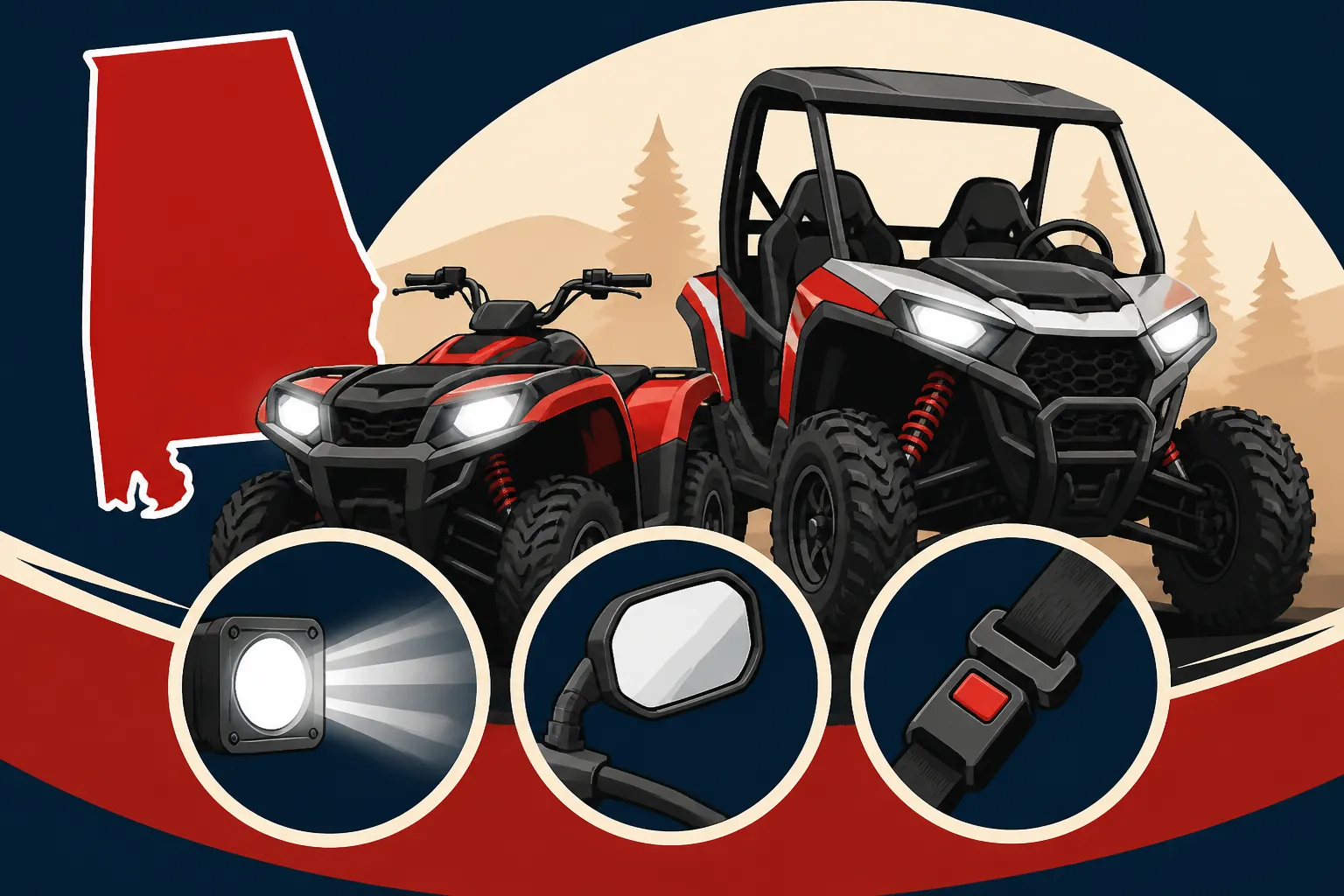
For a vehicle to be truly street legal, its lighting system must meet rigorous standards. We're talking about more than just some bright LEDs you bought online. A compliant vehicle needs:
- Headlights: These must include both high and low beams, provide a specific illumination pattern, and be Department of Transportation (D.O.T.) approved. This ensures they adequately light the road without blinding oncoming traffic. Many off-road light bars, while incredibly powerful, often don't have the precise beam pattern or D.O.T. approval required for public road use. They're fantastic for trail riding after dark, but they often fall short of legal road specifications.
- Taillights: Required for visibility from the rear, especially at night.
- Brake Lights: Clearly indicate when the vehicle is slowing or stopping. These need to be bright enough to be seen in various conditions.
- Turn Signals: Essential for indicating lane changes or turns. They need to be visible from the front and rear, and blink at a specific rate.
- Reflectors: Often overlooked, but specific red reflectors are required on the rear, and amber reflectors on the sides, to enhance visibility.
The critical takeaway here is that simply adding a light kit to your machine, even a comprehensive one, does not automatically make it compliant with D.O.T. standards. The manufacturer's original design and certification are what truly matter.
Mirrors That Actually Count
Much like lighting, the mirrors on a street-legal vehicle aren't just any mirrors. They need to provide a clear, unobstructed view of the rear and sides of the vehicle, allowing the driver to see traffic behind and beside them effectively. Typically, this means:
- Exterior Rearview Mirrors: At least one on the driver's side, and often a second on the passenger side. These mirrors must be securely mounted and provide a sufficient field of vision.
- Interior Rearview Mirror: Many LSVs also include a center rearview mirror, just like a car, to offer an additional perspective.
Small, trail-specific mirrors or those designed for low-speed maneuvering off-road often do not meet the field-of-view requirements for public roads. They might be great for spotting a rider behind you on the trail or checking a blind spot on a tight turn, but they often lack the size and positioning necessary for safe road use alongside other vehicles.
Seat Belts: More Than Just a Strap
If we're talking about a UTV that could be street legal (meaning, a factory-built LSV), then seat belts are absolutely non-negotiable. However, these aren't just any old straps. They must be:
- D.O.T. Approved: Like car seat belts, they need to be tested and certified to withstand significant force and securely restrain occupants.
- Properly Anchored: The mounting points must be structural and engineered to distribute impact forces effectively. This often means integrated into the chassis design, not simply bolted to a frame tube.
- For Every Occupant: Every designated seating position must have a functional, D.O.T.-compliant seat belt system.
Many recreational UTVs come with seat belts, and some aftermarket companies like SuperATV offer replacement or upgrade options. However, even high-quality aftermarket belts may not be sufficient to change the fundamental classification of a vehicle that wasn't originally manufactured as an LSV. The question isn't whether you have a seat belt, but whether the entire vehicle system, including the restraint, meets the federal safety standard as a coherent unit. On standard ATVs, which are designed for a single rider and typically do not have seat belts, this requirement is simply impossible to meet.
The Crucial Missing Piece: Federal Motor Vehicle Safety Standards (FMVSS)
This is the biggest hurdle, the one that often catches off-road enthusiasts by surprise. It's not about what you add to your machine; it's about what it is at its core. Alabama's off-road vehicle laws make it quite clear that for general public road use, you're looking at machines that meet specific federal manufacturing standards.
What Federal Standard 500 Means for Your Machine
Federal Motor Vehicle Safety Standard (FMVSS) 500, or 49 CFR 571.500, is the federal regulation that defines a "low-speed vehicle" (LSV). Think of it as a checklist that a vehicle's manufacturer must follow during its design and production process. This standard dictates far more than just lights, mirrors, and seat belts. For a machine to be a true LSV, and thus potentially street legal in Alabama, it must be factory-equipped with:
- A 17-digit Vehicle Identification Number (VIN) that identifies it as an LSV. This is crucial for registration and titling purposes. [What Makes a VIN Meet the Federal Standard]
- Headlamps, tail lamps, stop lamps, and turn signal lamps that meet specific D.O.T. requirements for brightness, beam pattern, and placement.
- Reflex reflectors (red on the rear, amber on the sides).
- An exterior mirror mounted on the driver's side and either an exterior mirror on the passenger's side or an interior rearview mirror.
- A parking brake.
- A windshield that meets automotive safety glazing standards.
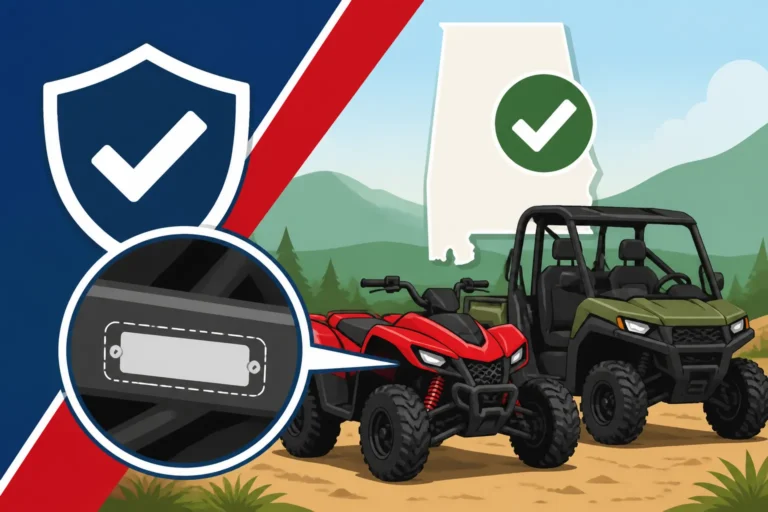
- A VIN plate identifying it as an LSV.
- A horn.
- Seat belt assemblies at every designated seating position.
- D.O.T.-approved tires.
- Can't exceed 25 mph on a paved level surface. [Why 25 mph Is the Legal Line]
If a machine rolls off the assembly line meeting all these criteria, it can be titled and registered as an LSV, and then, and only then, can it legally operate on public roads with a posted speed limit of 35 mph or less, unless a local ordinance restricts it further. This is fundamentally different from a machine designed for off-road use. [Buying a Machine Built as a Low-Speed Vehicle] is the only reliable way to get an LSV.
Why Your Standard ATV/UTV Can't Meet It
The brutal truth for most enthusiasts is that your standard ATV (All-Terrain Vehicle) or UTV (Utility Task Vehicle) is simply not manufactured to comply with FMVSS 500. [Why a Standard Quad Can Never Pass the Standard] They are built for rugged off-road performance, not for highway safety standards. Adding an aftermarket "street legal kit" with a horn, turn signals, and mirrors, while it might fulfill some visual requirements, does not magically transform your machine into an FMVSS 500-compliant LSV.
Think of it this way: you can put racing tires and a spoiler on a sedan, but that doesn't make it a Formula 1 race car. The underlying engineering, chassis, safety systems, and federal certifications are entirely different. This is why [Why a Street Legal Kit Will Not Make It Legal] for general road use. The original manufacturer's VIN and certification are paramount. Without a VIN that identifies the machine as an LSV (or another vehicle class like a motorcycle or passenger car), it cannot be titled and registered as street legal in Alabama for general road use, no matter how many D.O.T.-approved parts you bolt onto it.
Limited Road Use and Exemptions
While the path to full street legality for most ATVs and UTVs in Alabama is blocked by federal standards, there are specific, limited circumstances where these machines can legally be on public roads. It’s crucial to understand that these are exceptions to the general prohibition, not loopholes for making your machine generally street-legal.
Crossing Roads and Farm Use
Alabama law provides narrow exceptions for off-road vehicles to interact with public roads, primarily for practical necessity in rural and agricultural settings:
- Direct Crossing: You are generally permitted to cross a public road, street, or highway at approximately a 90-degree angle, provided you come to a complete stop and yield to all oncoming traffic. This is meant to allow you to get from one private property to another or to access different sections of your own land that are divided by a road. It is strictly for crossing, not for riding on the road for any distance. [Crossing a Road on an ATV in Alabama]
- Farm Use: Machines used exclusively for agricultural purposes have certain allowances. An ATV or UTV being used as bona fide farm equipment can sometimes be operated on a public road for distances of one mile or less to get from one field to another, or to access farm facilities. When operating as farm equipment, these machines should display a slow-moving vehicle emblem. This exemption is tied directly to its use in farming operations, not recreational riding. [Alabama Farm Use and Road Riding]
These exceptions highlight the state's recognition of the practical needs of landowners and farmers, but they don't grant general permission for recreational cruising on public roads. An Alabama deputy will certainly differentiate between a machine actively engaged in farm work and one simply out for a joyride down a public road.
Local Ordinances and Designated Areas
Occasionally, you might hear whispers of a town or county that allows ATVs or UTVs on its streets. While this is rare for standard off-road vehicles, it's worth noting the distinction with golf carts and true Low-Speed Vehicles (LSVs):
- Golf Cart Ordinances: Many Alabama towns and cities have passed specific ordinances allowing golf carts on certain local streets, usually with speed limits of 25 mph or less. These ordinances often come with their own requirements for lights, mirrors, and safety features for the golf carts. However, a golf cart is specifically excluded from the definition of an off-road vehicle in Alabama law and falls under a different set of rules. [Alabama Golf Cart Rules Compared to ATVs]
- Designated Public Use Areas: There are also designated public use areas, like certain OHV parks or specifically marked trails, where ATVs and UTVs are permitted. These are clearly defined spaces, and the rules of the road that apply within these areas are specific to the park or trail system, not general public roads. [Alabama Public Use Designated Areas]
For standard ATVs and UTVs, [Alabama Local Ordinances on ATV Riding] that grant general street access are exceptionally uncommon, primarily because local municipalities cannot override state laws that hinge on federal manufacturing standards. Always check with local authorities for specific rules in your area, but be prepared for the reality that general street legality for an ATV or UTV remains an elusive goal for most machines.
| Feature / Requirement | Standard ATV/UTV (Off-Road) | Low-Speed Vehicle (LSV – Street Legal) |
|---|---|---|
| Origin | Designed for off-road use | Manufactured to FMVSS 500 standards |
| VIN | Standard off-road VIN | FMVSS 500 compliant VIN |
| Headlights | Typically off-road specific | D.O.T. approved, high/low beam |
| Taillights | Yes | D.O.T. approved |
| Brake Lights | Yes | D.O.T. approved |
| Turn Signals | Often aftermarket add-on | D.O.T. approved, front & rear |
| Rearview Mirrors | Often small, off-road type | D.O.T. approved (driver's side + center or passenger) |
| Seat Belts | UTVs have off-road restraints | D.O.T. approved for all passengers |
| Windshield | Optional, non-safety glass | D.O.T. automotive safety glass |
| Tires | Off-road specific | D.O.T. approved street tires |
| Max Speed | Varies (can be 60+ mph) | 25 mph |
| General Road Use | Prohibited | Permitted on roads <= 35 mph |
So, what's the bottom line? While adding lights, mirrors, and seat belts to your ATV or UTV might seem like the logical step toward street legality, for the vast majority of machines in Alabama, it simply isn't enough. The critical factor is whether your machine was originally manufactured as a low-speed vehicle (LSV) that meets Federal Motor Vehicle Safety Standard 500. Your standard off-road quad or side-by-side, no matter how many aftermarket accessories you add, will not meet this fundamental requirement.
The dream of casually riding your ATV or UTV on public roads is a powerful one, and it's frustrating that the law makes it so difficult. Always remember that legal exceptions exist for direct crossings and bona fide farm use, but these are not avenues to general street legality. If you're hoping to ride on public roads, your safest and most legal bet is to consider a vehicle specifically designed and manufactured as a low-speed vehicle, rather than attempting to convert an off-road machine.
Disclaimer
This article is for general informational purposes only and does not constitute professional advice. Laws, prices and regulations vary by location and change over time. Consult a qualified professional for guidance on your specific situation.