Alabama Rules for a Machine With a Tag
You bought your ATV or UTV with visions of open trails, winding backroads, and maybe even a quick trip down a quiet county road to a friend's house. Then someone mentions "getting a tag" for your machine, and suddenly, you're left scratching your head, wondering what that even means in Alabama. The truth about putting a license plate on an off-road vehicle in our state is far more nuanced and, frankly, often frustrating than most people realize. This guide will cut through the confusion and explain exactly what a "tag" truly signifies for your machine in Alabama and what the rules are for those instances where it might be possible.
Understanding "A Tag" for Your Off-Road Machine in Alabama
The idea of "tagging" a vehicle usually implies getting a license plate that allows it to travel legally on public roads. For most traditional ATVs and UTVs in Alabama, this concept is where the biggest misunderstanding lies. It’s not just about a simple piece of metal; it’s about a vehicle’s fundamental design and legal classification.
The Core Truth: Why Standard ATVs Don't Get a Plate
Let's get this out of the way upfront: if you own a standard ATV (All-Terrain Vehicle) or UTV (Utility Terrain Vehicle) that was manufactured for off-road use, Alabama does not issue it a license plate, often referred to as a "tag." This is a crucial distinction that trips up many owners. When you see an ATV advertised or sold, its very definition is tied to its intended off-highway purpose.
Alabama law, like many states, has very specific [Alabama ATV & ROV Legal Definitions] that clearly delineate what constitutes an off-road vehicle. These definitions inherently separate them from vehicles designed and legal for highway travel. While you might voluntarily register your ATV or UTV with the Alabama Law Enforcement Agency (ALEA) for public land use, or acquire a title for newer models starting in 2026, neither of these processes results in a traditional, street-legal license plate. The registration you get from ALEA is more of an identification decal, not a road-use plate. Many owners assume that because Alabama now has a titling law for off-road vehicles (starting with model year 2026), that title somehow paves the way for a tag. It doesn't. The title simply establishes legal ownership, which is important for sales, financing, and recovery in case of theft, but it has no bearing on street legality.
The Federal Barrier to Street Legality
The primary reason your typical ATV or UTV cannot get a "tag" for street use in Alabama, or most places for that matter, comes down to federal regulations. These machines are simply not built to meet the rigorous safety standards set for vehicles that operate on public highways. The National Highway Traffic Safety Administration (NHTSA) establishes a comprehensive set of requirements known as Federal Motor Vehicle Safety Standards, or FMVSS.
These standards cover everything from crashworthiness to lighting, braking, tires, and occupant restraints. Your typical ATV or UTV, while incredibly fun and useful off-road, is engineered for a completely different environment. They often lack things like full automotive-grade lighting systems (headlights, taillights, turn signals, brake lights), automotive windshields, laminated safety glass, specific crash protection, crumple zones, and specific tire ratings for highway speeds. Because they don't meet [Alabama's 49 CFR 571.500 Standard], they cannot be legally operated on public roads, and therefore, cannot be issued a standard license plate. This is the fundamental [Alabama's Federal Standard Barrier to Road Use] that prevents most off-road machines from ever being considered "street legal." It's not an Alabama-specific quirk; it's a federal mandate.
When "A Tag" Is Possible: Low-Speed Vehicles (LSVs)
So, if traditional ATVs and UTVs can't get a tag, what about those small vehicles you sometimes see on city streets with plates? This is where the concept of a Low-Speed Vehicle, or LSV, comes into play. These are a different class of vehicle entirely and are the only off-road-style machines that can genuinely be "tagged" for street use in Alabama.
What Qualifies as a Low-Speed Vehicle in Alabama
A Low-Speed Vehicle (LSV) is a specific type of vehicle that is designed and manufactured to meet certain federal safety standards, albeit less stringent ones than a full automobile, and is therefore allowed to operate on public roads. In Alabama, [Alabama Low-Speed Vehicle Rules] dictate that these vehicles must be capable of speeds greater than 20 miles per hour but not greater than 25 miles per hour. This speed restriction is key. If a vehicle can go faster than 25 mph, it's typically considered a full-fledged motor vehicle and must meet all the more stringent FMVSS for cars and trucks.
To qualify as an LSV and be eligible for a tag, the vehicle must have specific safety equipment, including:
- Headlights
- Tail lights
- Stop lights
- Turn signal lamps
- Reflex reflectors
- A parking brake
- A rearview mirror (or mirrors, as required by law)
- A windshield
- A vehicle identification number (VIN)
- Seatbelts
Crucially, these vehicles are built by the manufacturer to meet these specifications from the ground up. They aren't modified golf carts or ATVs. When you're considering [Buying a Machine Built as a Low-Speed Vehicle], you'll notice it has a proper VIN and documentation certifying its compliance with LSV standards. These are the machines that can be titled and registered for street use, typically on roads with a posted speed limit of 35 mph or less. This is the only legitimate pathway to getting "a tag" on an off-road-style machine in Alabama that allows for general road use.
The Illusion of "Street Legal Kits" for ATVs
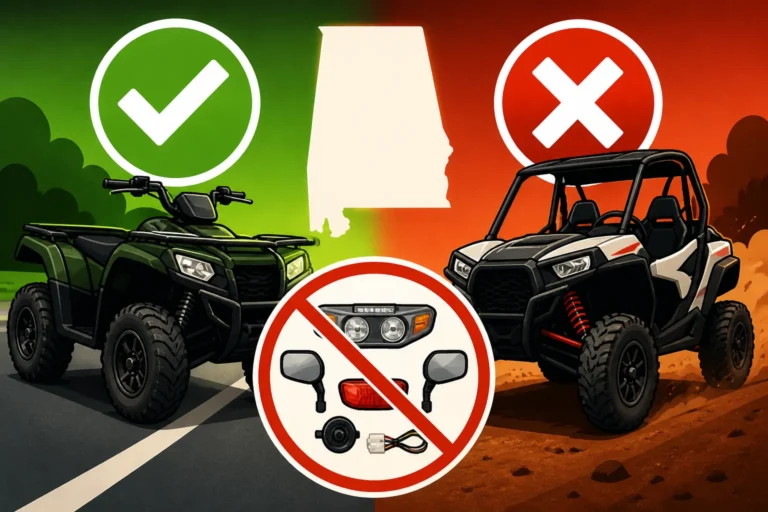
This is a common point of confusion and frustration for many ATV and UTV owners. You've probably seen advertisements for "street legal kits" that promise to convert your off-road machine into a road-worthy vehicle by adding turn signals, horns, mirrors, and maybe even a windshield. While these kits add useful safety features, and you can find fantastic aftermarket accessories from companies like SuperATV to enhance your machine's performance and safety for off-road adventures, these add-ons alone don't change the fundamental classification of your ATV or UTV in the eyes of Alabama law for highway use.
The problem isn't just about having the right accessories; it's about the entire vehicle being manufactured to meet FMVSS standards. A kit, no matter how comprehensive, cannot retrofit a vehicle to meet the federal crashworthiness, emissions, and other foundational safety standards that a true street-legal vehicle must possess. Simply put, adding a turn signal kit to your Polaris RZR or Can-Am Maverick doesn't magically make it an FMVSS-compliant vehicle, nor does it allow it to be issued a street-legal tag. [Why a Street Legal Kit Will Not Make It Legal] is a harsh reality for many who spend good money on these conversions only to find they're still not allowed on public roads for general travel. You'll still be subject to the same penalties as any other off-road vehicle if you try to use it on a highway without a legitimate LSV designation.
| Feature Comparison | Standard ATV/UTV (Off-Road) | Low-Speed Vehicle (LSV) |
|---|---|---|
| Intended Use | Off-road recreation, utility | Limited public road use |
| Manufacturing Standards | Off-road vehicle standards | Federal Motor Vehicle Safety Standards (FMVSS) for LSVs |
| License Plate (Tag) | No (not issued for street use) | Yes (if FMVSS compliant) |
| Typical Max Speed | Varies, often 60+ mph | Limited to 20-25 mph |
| Required Road Equipment | Lacks many FMVSS items | Headlights, taillights, turn signals, brake lights, windshield, seatbelts, VIN, mirrors |
| Roads Permitted On | Very limited, specific exemptions only | Roads with speed limits 35 mph or less |
| Legal Classification | Off-road vehicle | Street-legal vehicle, specific class |
Limited Road Use Exceptions for Off-Road Machines (Without a Tag)
Even though your ATV or UTV won't get a street-legal tag, Alabama does recognize some very specific, narrow circumstances where these machines might briefly interact with public roads without being considered illegal. It's vital to understand these are exceptions, not permissions for general road riding.
Farm Use and Crossing Roads
One of the most commonly misunderstood exceptions involves agricultural use. In Alabama, a person engaged in legitimate farming or agricultural activities may operate an ATV or UTV on a public road or highway for the purpose of crossing it or traveling a short distance along it to access agricultural property. This is strictly defined as [Alabama Farm Use and Road Riding]. For example, if your land is split by a county road, you might be able to ride your utility side-by-side a short distance along the road's shoulder to get from one field to another, or to cross the road.
However, this exception is not a blanket license to commute to town on your quad for groceries or take it for a joyride down the highway. The machine must be primarily used for farm purposes, and the road use must be directly related to moving between parts of a farm or accessing fields. An Alabama deputy isn't likely to accept "I'm just going to get a sweet tea for the farmhands" as a valid agricultural purpose for driving your quad down a busy highway. It's about legitimate, direct farm operations, and even then, safety and common sense should always prevail. You should still consider adding visibility enhancements like flags or reflective tape, even if not strictly required, when utilizing these brief road excursions.
Local Ordinances and Designated Areas
Occasionally, you might hear whispers or read about a small town or county that has passed its own ordinance allowing limited ATV or UTV use on specific public roads. While these are rare for true ATVs and UTVs (they usually apply to golf carts), it's not impossible. The key here is "local" and "specific." These ordinances are highly localized and typically apply only within the jurisdiction of that particular city or county, and often only to certain types of roads or for specific events.
If you believe a local ordinance might apply in your area, you absolutely must do your homework. Do not rely on hearsay or what a friend "heard." You would need to contact the city hall or county commission office directly to inquire about any specific local laws regarding [Alabama City Ordinance Lookups]. Ask to see the actual written ordinance. Even if such an ordinance exists, it almost certainly won't exempt your machine from federal safety standards, meaning you still won't be able to get a standard license plate. Instead, these ordinances might grant permission for things like parade use, or very limited travel on specific, low-speed residential streets within city limits, often with additional local requirements like speed limits or specific safety equipment. Assuming you're covered without verifying can lead to serious legal trouble and expensive fines.
Penalties for Illegal Road Riding
Given the clear distinctions between off-road vehicles and street-legal machines, it’s not surprising that there are consequences for riding your ATV or UTV illegally on public roads in Alabama. Ignoring the rules, whether out of ignorance or intent, can lead to a range of [Alabama Penalties for Illegal Road Riding]. These can include significant fines, court costs, and potentially having your machine impounded.
Beyond the immediate legal repercussions, there are severe safety implications. ATVs and UTVs are not designed for road speeds or the dynamics of interacting with cars, trucks, and other highway vehicles. Their suspension, tires, and braking systems are optimized for uneven terrain, not asphalt. A collision between an off-road machine and a passenger vehicle on a highway can have catastrophic consequences for the ATV/UTV operator, who has far less protection. Always prioritize safety and legal compliance. If you're questioning [Can You Drive an ATV on the Road in Alabama?], the general answer for your typical off-road machine is almost always "no," with only the narrowest of exceptions.
Disclaimer
This article is for general informational purposes only and does not constitute professional advice. Laws, prices and regulations vary by location and change over time. Consult a qualified professional for guidance on your specific situation.