Gates on a Bankhead Woods Road
There’s nothing quite like planning a fantastic day out exploring the vast beauty of Alabama’s Bankhead National Forest on your ATV or UTV. But then you hit it: a gate. Suddenly, that sense of freedom can quickly turn into confusion, frustration, and worry about whether you’re breaking the rules or if you’ve somehow taken a wrong turn. This guide is here to clear up the mystery of those gates you encounter on Bankhead Woods roads, helping you understand access, know what to expect, and ride confidently and responsibly.
Understanding Access in Bankhead National Forest
When you're out exploring the vast expanse of the Bankhead National Forest, it’s easy to feel like you have unlimited access to every trail and road. The truth, however, is a bit more nuanced. The U.S. Forest Service manages these lands for multiple uses, including timber production, wildlife habitat, water quality, and recreation. This balance means that not all roads are open to all vehicles, and access can change. Many riders feel a pang of disappointment when they see a closed gate, but understanding the "why" behind it can help shift that frustration into a more informed approach to riding.
The Purpose of Forest Roads and Access Restrictions
Forest roads aren't just there for fun and recreation; they serve critical functions for the U.S. Forest Service and other entities. These roads are often built and maintained to facilitate timber harvesting, allow access for firefighting crews, enable wildlife management activities, and provide administrative access for forest personnel. Because of these varied uses, the Forest Service has to make decisions about which roads can remain open to public vehicle traffic and which need to be restricted.
These restrictions aren't arbitrary; they’re put in place for specific reasons. Sometimes, a road might be closed seasonally to protect fragile resources, such as during wet periods when ATV and UTV use could cause significant erosion. Other times, closures might coincide with sensitive wildlife breeding seasons or active logging operations where heavy equipment poses a safety hazard. Understanding these purposes helps to put those gates into perspective – they are management tools, not just barriers.
The tension often arises between the public’s desire for broad access and the Forest Service’s mandate to protect natural resources and ensure public safety. It’s a delicate balancing act. When you see a gate, it’s a clear signal that the Forest Service has weighed these factors and determined that access needs to be limited at that specific point. Respecting these decisions is crucial for maintaining good relationships with land managers and ensuring continued access where it is permitted.
General Rules for ATV and UTV Riding in National Forests
It's a common misconception that national forests are a wild frontier where any off-road vehicle can go anywhere. In reality, riding your ATV or UTV in the Bankhead National Forest comes with a specific set of rules that are important to follow. These aren't just suggestions; they are regulations designed to protect the environment, ensure safety, and manage the forest sustainably. It’s vital to remember that a national forest is not the same as a private off-road park with open trails.
The most fundamental rule is that all motorized vehicles, including ATVs and UTVs, are restricted to designated roads and trails. This means you can't just venture off into the woods wherever you see an enticing path or decide to forge your own new route. The Forest Service uses a system of Motor Vehicle Use Maps (MVUMs) to clearly delineate where motorized travel is permitted. These maps are your absolute best friend for staying legal and safe. You'll often hear discussions about [Can You Ride an ATV in Alabama's National Forests?], and the answer always comes back to these designated routes.
Ignoring these rules can lead to serious consequences. Forest Service rangers are empowered to issue citations for illegal off-road travel, which can result in hefty fines. In some cases, machines can even be impounded, turning a fun day into a very expensive and inconvenient ordeal. Beyond the legal ramifications, riding off designated trails damages sensitive ecosystems, causes erosion, disturbs wildlife, and can create dangerous situations for other forest users. Always stick to the marked paths and understand that you are riding on [Designated Routes on Federal Ground], not open range.
Who Manages Bankhead Roads and Why It Matters
When you’re out exploring the Bankhead National Forest, it’s important to understand that while the U.S. Forest Service (USFS) is the primary manager, they aren't the only ones with a stake in the land. This multi-layered ownership and management structure can sometimes explain why you encounter different types of gates or signage, which can be confusing if you're not aware of it. Recognizing these nuances helps you interpret what a gate means for your riding plans.
The USFS manages the vast majority of the land and roads within the Bankhead. They are responsible for designating routes, implementing seasonal closures, and enforcing regulations. However, within the forest boundaries, there are often pockets of private land, known as "inholdings." These private parcels may have their own roads and gates, and access to them is strictly controlled by the private landowner, not the Forest Service. You might also encounter active timber company lands that are adjacent to or interspersed with national forest land, where they might have their own private roads for logging operations.
This mix of ownership means that a gate you encounter might be a Forest Service gate closing off a designated forest road, or it could be a private gate marking the boundary of a timber company's property or a family's hunting lease. The type of gate and accompanying signage can often give you a clue as to who manages that particular stretch of road. It matters because while you might be able to find alternative routes around a Forest Service closure, a private landowner's gate means absolutely no trespassing. Always assume a gate is there for a reason and respect the authority, whether it’s federal land managers or private citizens.
Types of Gates You Might Encounter on Bankhead Roads
The sight of a gate on a forest road can be a real head-scratcher. Is it just temporarily closed? Is it private property? Can I go around it? Knowing the different types of gates you might encounter in the Bankhead National Forest and what they signify is crucial for staying out of trouble and riding respectfully. Each gate tells a story about why that particular stretch of road might be inaccessible to you at that moment.
Seasonal and Administrative Closure Gates
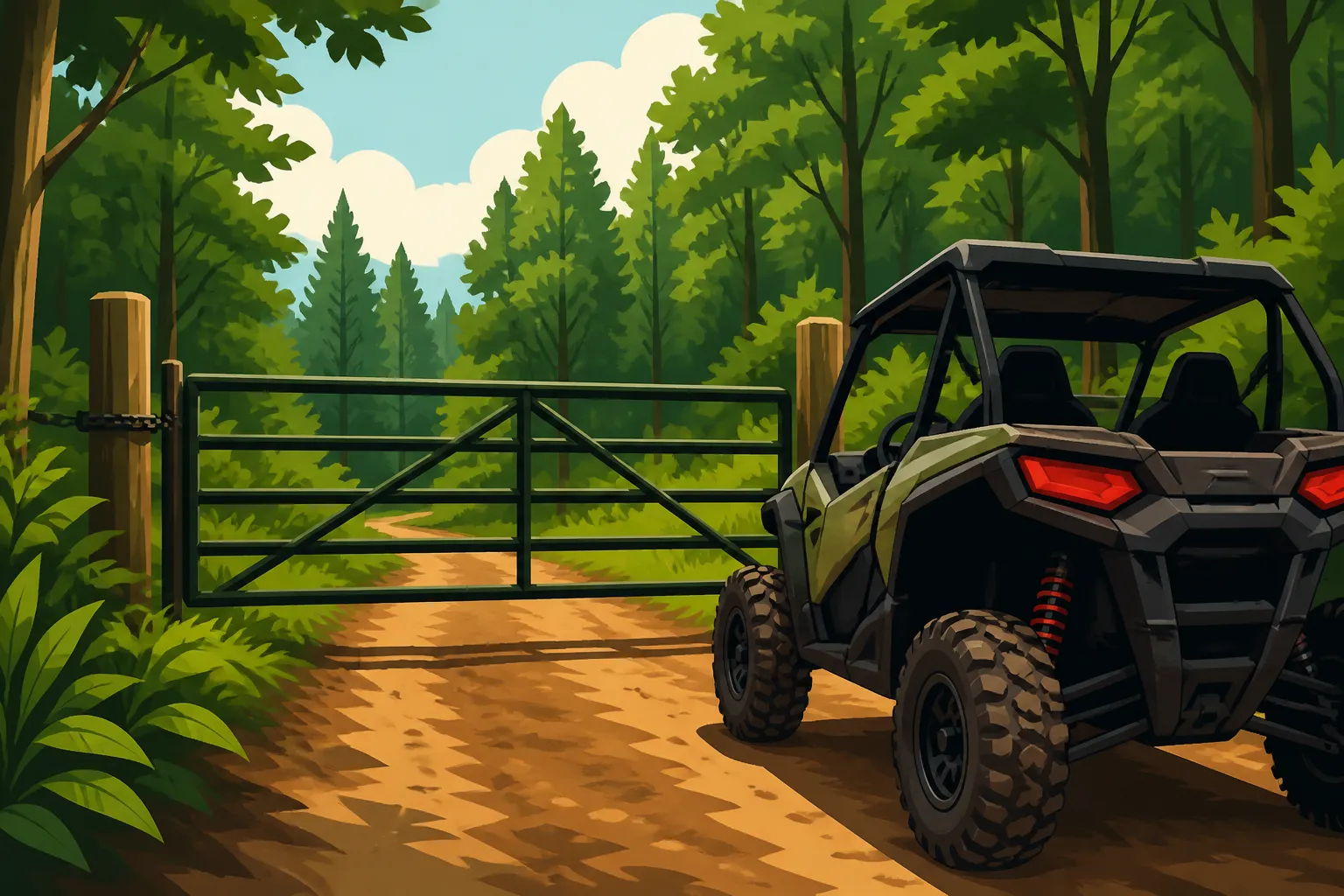
These are perhaps the most common types of gates you’ll encounter on official Forest Service roads within the Bankhead National Forest. They often signal a temporary or long-term closure of a specific road or area for a variety of management purposes. These gates are typically chain or cable gates, sometimes with a simple padlock, and often accompanied by official yellow, green, or white signs from the U.S. Forest Service. The signs might explicitly state "Road Closed," "Area Closed," or "Seasonal Closure."
The reasons for seasonal closures are varied but always rooted in resource protection or public safety. For instance, many forest roads are closed during the wetter months of winter and spring to prevent deep rutting and erosion from vehicle traffic, which can damage the road surface and impact water quality in nearby streams. Other times, closures might align with [Hunting Season and Forest Access] to minimize disturbances to wildlife or to separate hunters from recreational riders in specific areas. It’s always a good idea to check with the local ranger district for specific seasonal closures.
Administrative closures are another category, and these can occur at any time. They might be implemented due to active logging operations, where heavy machinery makes the road unsafe for public use. Fire danger is another common reason, especially during dry periods, where restricting access reduces the risk of accidental wildfires. Construction or maintenance activities on a bridge or road section can also lead to an administrative closure. While frustrating, these closures are for your safety and the long-term health of the forest. Knowing to [Calling the National Forest District Office Before You Ride] can save you a lot of wasted time at a closed gate.
Private Land and Timber Company Gates
While the Bankhead National Forest covers a vast area, it's not a single, unbroken block of public land. There are numerous private properties, large and small, interspersed throughout the forest boundaries. Timber companies also own significant tracts of land that may be adjacent to or even surrounded by national forest land. When you encounter a gate on what appears to be a "forest road" that looks different from typical Forest Service gates, it’s often a sign that you’ve reached private land.
These gates are typically more robust, often heavy-duty metal gates, sometimes with multiple locks or elaborate chains. Crucially, they will almost always be accompanied by "No Trespassing," "Private Property," or "Keep Out" signs. These gates are not managed by the Forest Service, and attempting to go around, over, or through them is a direct violation of [Alabama Trespass Law for Riders]. This is a serious offense that can lead to legal penalties, not just a simple warning.
Timber companies actively manage their forests for wood production. Their roads are for their equipment and personnel, ensuring safe and efficient operations. Public access is generally not permitted, and for good reason – active logging sites can be extremely dangerous. Respecting these gates is paramount, not just for legal reasons, but for personal safety. If you're exploring, be mindful that [Alabama Rules for Riding a Timber Road] generally refer to designated public roads that pass through timber lands, not the private logging roads themselves. Always err on the side of caution and turn around if there's any doubt about private property.
Gates for Specialized Access or Maintenance
Less frequently, but still possible, you might encounter gates on Bankhead roads that are specifically for specialized access or maintenance purposes. These aren't always about general public access or private ownership, but rather to control entry for specific official or permitted activities. While they might resemble Forest Service closure gates, they often have additional signage detailing their particular purpose.
For example, a gate might be installed to restrict access to a particular wildlife management area (WMA) or a research plot within the forest, where sensitive studies are ongoing or specific wildlife populations are being protected. You might also find gates leading to critical infrastructure, such as cellular towers, weather stations, or even [Alabama Rules for Riding a Power Line Cut] areas, where utility companies need secure access for maintenance but prohibit general public traffic.
These gates are usually clearly marked with official signs indicating the authorized personnel or purpose. The key takeaway is that if a gate is closed, regardless of the specific reason or who it is for, it means "no public entry." It's not an invitation to explore further, even if the signs seem less restrictive than a "No Trespassing" notice. Your best bet is always to respect the barrier and find an alternative, legally accessible route for your ride.
Navigating Gated Roads: Rules and Best Practices
Encountering a gate in the middle of a ride can be disorienting, but with the right knowledge and approach, you can navigate these situations smoothly and legally. The worst thing you can do is react impulsively or attempt to bypass a closed gate. Understanding the rules and adopting best practices ensures your safety, protects the forest, and keeps you within the bounds of the law.
Always Check Official Maps and Resources First
The single most important piece of advice for riding in the Bankhead National Forest, or any national forest, is to always consult official maps and resources before you even leave your driveway. This step is non-negotiable and can prevent countless frustrating encounters with closed gates. Think of it as your pre-flight checklist for a safe and legal journey into the woods.
The absolute hero of these resources is the Motor Vehicle Use Map (MVUM). These maps are produced by the Forest Service and are specifically designed to show you exactly where you can and cannot ride your motorized vehicle. They clearly mark designated roads and trails that are open to ATVs and UTVs, as well as those that are closed, restricted, or private. If a road isn't marked on the MVUM as open for your vehicle type, then you should assume it's closed. You can usually find these maps online on the National Forest Service website, or pick up a physical copy at a local ranger district office. Don't rely on general GPS apps or outdated information from a friend; always go to the source. Remember to check [Checking a Forest Map Before You Go] as part of your planning.
Beyond the MVUM, it's wise to call the local Bankhead National Forest Ranger District office a day or two before your trip. They can provide real-time updates on seasonal closures, temporary administrative closures due to logging or fire danger, and any other conditions that might impact your ride. This proactive approach ensures you're riding on [Alabama Public Use Designated Areas] and not accidentally stumbling onto restricted territory. Planning ahead is the best defense against unexpected gates.
Never Bypass, Damage, or Force a Gate
This point cannot be stressed enough: under no circumstances should you ever attempt to bypass, damage, or force open a closed gate in the Bankhead National Forest. Regardless of whether it’s a Forest Service gate or a private landowner’s barrier, interfering with it is illegal, dangerous, and incredibly disrespectful to the land and its managers. The consequences for these actions can be far more severe than a simple warning.
Legally, tampering with a gate can lead to charges of trespassing, property damage, or even theft of government property if a lock is cut. Fines can be substantial, and you could face having your ATV or UTV impounded. Beyond the legal troubles, there are serious safety implications. A seemingly benign closed road might be actively used by logging trucks, heavy equipment, or even emergency vehicles that you won't be expecting. If you were to encounter a fully loaded log truck around a blind corner, the outcome could be catastrophic.
Environmentally, bypassing a gate often involves driving off the established road, which leads to damaging fragile ecosystems, creating new "rogue" trails, and causing significant erosion, especially on Alabama’s infamous red clay. Such actions jeopardize continued access for all responsible riders. It paints the entire off-road community in a bad light and gives land managers more reasons to increase restrictions. While a strong SuperATV winch might be invaluable for recovering a stuck machine, it should never, ever be used to force open a closed gate. Using equipment for anything other than its intended, legal purpose only serves to harm the reputation of ethical riders.
What to Do When You Encounter a Closed Gate Legally
So, you’ve done your planning, but you still hit an unexpected closed gate. It happens to the best of us! The most important thing is to react calmly and correctly. Your first and primary action should always be to turn around. There’s no secret handshake or hidden bypass for a closed gate; if it’s shut, it means "no entry."
Take a moment to consult your MVUM or a detailed GPS map. Can you identify why this gate might be here? Is it a seasonal closure you missed, or perhaps the map shows this segment as private? Look for alternative routes that are clearly marked as open for your vehicle type. Sometimes, a different spur road just a short distance back might lead you to your intended destination. Trying to find a way around a gate by riding off-road is not only illegal but also dangerous and damaging to the environment.
If you are ever stopped by an Alabama Deputy or Forest Service Ranger near a closed gate, be polite and cooperative. They are performing their duty, and knowing [What an Alabama Officer Can Ask to See] can help you respond appropriately. Always have your identification and any necessary permits ready. Explain your intentions honestly, demonstrating that you understand the rules and are committed to riding responsibly. Remember, a closed gate is a clear boundary, and respecting it is paramount.
Planning Your Ride: Avoiding Unexpected Gate Encounters
Nobody wants their adventure cut short by an impassable barrier. While you can't control every variable, diligent pre-trip planning can dramatically reduce the chances of encountering an unexpected, ride-ending gate. It’s all about preparation, awareness, and equipping yourself with the right knowledge and gear to handle whatever the Bankhead National Forest throws your way.
Pre-Trip Planning with Maps and Contacts
The key to a smooth and gate-free ride begins long before you load your machine onto the trailer. Comprehensive pre-trip planning is your best defense against surprises. Start by obtaining the most current Motor Vehicle Use Maps (MVUMs) for the Bankhead National Forest. These are available for free from the U.S. Forest Service website or at any local ranger district office. Take the time to study them. Identify your desired routes, note any sections marked as seasonally closed, and pay close attention to boundaries that indicate private land. [Checking a Forest Map Before You Go] should be the first item on your planning checklist.
Beyond the maps, make a phone call. Contact the local Forest Service Ranger District office directly, preferably a few days before your planned trip. Ask about current conditions, any temporary closures due to weather, logging operations, or fire danger. This personalized, up-to-the-minute information can be invaluable. Sometimes, recent heavy rains might have closed roads that are otherwise open, or an unexpected timber operation might have erected a temporary gate. [Calling the National Forest District Office Before You Ride] can clarify these ambiguities and prevent a wasted trip.
Finally, consider the weather. Alabama weather can be fickle, especially in the national forests. Heavy rains can make previously rideable dirt roads impassable and lead to new erosion closures. Plan your trips for drier periods if possible, or be prepared for significantly different conditions. A little homework upfront makes all the difference for a stress-free adventure.
Carrying the Right Gear for Unexpected Turns
Even the most meticulously planned trip can sometimes throw you a curveball. A gate that was open last week might be closed today, or a detour might lead you down an unfamiliar path. This is why carrying the right gear, both for navigation and preparedness, is absolutely essential when exploring the Bankhead National Forest. Don't rely solely on technology that might fail you in remote areas.
A reliable GPS unit loaded with detailed topographical maps and your MVUM is a must-have. Many modern GPS units offer off-road specific mapping that can be invaluable. Products from companies like SuperATV often integrate with robust GPS systems that can help you track your progress and navigate back to your starting point even if you hit a dead end. However, always have a physical paper map of the area and a compass as a backup. Batteries die, signals drop, and electronics can fail in the rugged outdoors.
Beyond navigation, pack essentials for any unexpected turns of events. This includes plenty of water, high-energy snacks, a comprehensive first-aid kit, and basic tools for minor machine repairs. Recovery gear, like a tow strap or a SuperATV recovery kit, is always smart to have, though, as mentioned, never to be used for forcing gates! A reliable communication device, such as a satellite messenger or a two-way radio with good range, is crucial, as cell service can be spotty to non-existent in many parts of the Bankhead. Being prepared means you can adapt to unexpected gate closures or detours without compromising your safety.
Respecting the Rules and Preserving Access for Everyone
Ultimately, every gate you encounter in the Bankhead National Forest, whether open or closed, serves as a reminder of our responsibility as off-road enthusiasts. The rules, the designations, and the closures are all in place for a reason: to manage a complex ecosystem, ensure public safety, and protect the resources for future generations. Your actions directly impact the kind of access all riders will have going forward.
A closed gate is not a challenge to be overcome, but a boundary to be respected. By never bypassing, damaging, or forcing gates, you are actively demonstrating responsible recreation. This helps foster a positive relationship between the riding community and land managers, which is vital for maintaining existing [Alabama Public Use Designated Areas] and potentially opening new ones. Every instance of illegal riding, unfortunately, chips away at the trust and makes it harder for everyone else.
Remember that most ATVs and UTVs are [Alabama Machines That Cannot Be Plated], meaning they are strictly off-road vehicles. This classification means they have specific limitations on where they can be ridden, primarily designated trails and roads within areas like the Bankhead. By adhering to these limitations, we collectively ensure that the beauty and ruggedness of places like the Bankhead National Forest remain accessible for all who wish to explore them responsibly. Be an ambassador for safe and legal riding, and let's work together to preserve these incredible opportunities.
| Gate Type | Typical Appearance | What It Means for Riders | Action to Take |
|---|---|---|---|
| Forest Service Closure | Chain/cable, yellow/green signs, "Closed" posters | Seasonal, administrative, or long-term closure | Do not enter. Turn around. Check MVUM for alternatives. |
| Private/Timber Land | Heavier, often metal, "No Trespassing" signs | Private property, active logging, absolute no entry | Do not enter. Turn around. This is private land. |
| Special Use/Maintenance | Similar to FS gates, specific purpose signs | Restricted access for official use, not public passage | Do not enter. Turn around. |
| Open Gate | Fully open, no chain, sometimes "Open" sign | Road is currently accessible (always check MVUM for status) | Proceed with caution, follow all forest rules. |
Disclaimer
This article is for general informational purposes only and does not constitute professional advice. Laws, prices and regulations vary by location and change over time. Consult a qualified professional for guidance on your specific situation.