Alabama Equipment Checks by Deputies
The sudden flash of blue lights when you're just trying to enjoy a ride or get some work done on your ATV or UTV can be jarring. It can turn a peaceful afternoon into a stressful encounter, leaving you wondering what exactly an Alabama deputy can check on your off-road machine, and what it all means for you. This guide will walk you through what to expect when a deputy pulls you over or stops you for an equipment check in Alabama, helping you understand your rights and responsibilities.
Understanding Why Deputies Perform Equipment Checks on ATVs and UTVs
It's easy to feel targeted when a deputy stops you on your ATV or UTV. However, law enforcement officers have a duty to ensure public safety and enforce laws, and sometimes that extends to off-road vehicles. Understanding the context of why they might stop you can help alleviate some of that initial stress and prepare you for the interaction.
Public Roads Versus Private Property Stops
One of the biggest distinctions a deputy's authority depends on is where you're riding. If you're operating your ATV or UTV on a public road, even if it's just to cross from one side to another, you're entering a realm where traffic laws apply. Law enforcement has broad authority to conduct stops and checks on public thoroughfares to ensure vehicles are safe and operators are compliant. This is typically where equipment checks become more stringent, as the machine's interaction with other traffic is a primary concern. [Alabama Rules for Riding a County Road]
However, if you're riding exclusively on private land, the situation changes quite a bit. A deputy generally cannot just pull you over on private property without a very specific reason, such as responding to a report of trespassing, reckless endangerment, or suspected impaired driving. They need "probable cause" or an explicit invitation from the landowner to enter and investigate. If they stop you on private land, they likely have a specific complaint or observation that prompted their action. It's not about the machine's equipment in the same way it would be on a public road; it's usually about your conduct or presence.
Common Reasons for a Stop Beyond Just Equipment
While equipment checks are the focus here, it’s important to remember that a deputy might stop you for other reasons entirely, and then an equipment check might become part of that interaction. The most common reason ATVs and UTVs get stopped by law enforcement in Alabama is simply illegal road riding. Many riders either aren't aware of the strict laws against operating these machines on public roads, or they choose to disregard them. This instantly puts you in a position where a deputy will want to assess not only your compliance with road laws but also the condition of your machine. [Alabama Penalties for Illegal Road Riding]
Other reasons might include noise complaints from neighbors if your machine is particularly loud, especially in residential areas. [Alabama Noise Complaints About Quads] Deputies are also on the lookout for signs of impaired riding; operating any vehicle, including an ATV or UTV, under the influence of alcohol or drugs is illegal, regardless of whether you're on public or private land. [Alabama DUI Law and Off-Road Machines] Lastly, if you're riding on land that isn't yours and you don't have permission, a deputy might be called out to investigate potential trespassing concerns. [Alabama Trespass Law for Riders] In these scenarios, while the initial stop isn't about equipment, once contact is made, the deputy may conduct a visual inspection of your machine's condition and require you to present documentation.
Key Equipment Deputies Look For on Your Machine
When a deputy stops you for an equipment check, they're not just looking for anything and everything. They're generally focused on specific items that impact safety, compliance with state or local statutes, and proof of legal operation. Knowing what they're likely to scrutinize can help you be prepared.
Lighting and Visibility Requirements
If you find yourself on a public road, even for a brief crossing, your machine's lighting instantly becomes a point of interest for a deputy. Most ATVs and UTVs are simply not built to meet the rigorous federal motor vehicle safety standards (FMVSS) required for road-legal vehicles. This means they often lack adequate headlights, taillights, brake lights, and especially turn signals, which are critical for safe operation among other traffic. [Alabama's Federal Standard Barrier to Road Use]
Deputies understand this, and if you're caught on a road, they'll often point out these deficiencies. While many riders add aftermarket lights, like light bars or upgraded headlights often found from companies like SuperATV, it's crucial to understand that merely having bright lights doesn't make your off-road machine street legal. These are fantastic for trail riding after dark but don't satisfy the complex requirements for public road use. Imagine you're crossing a county road at dusk, and a deputy pulls you over, saying, "Sir, did you know your taillight isn't working, and you don't have turn signals required for public road operation?" This scenario highlights the immediate focus on road-specific safety equipment.
Safety Gear and Rider Equipment
Beyond the machine itself, deputies are also concerned with the safety of the operator and any passengers. While Alabama's statewide helmet law primarily mandates helmets for motorcyclists, and there isn't a blanket state law requiring helmets for ATV riders, deputies may still inquire, particularly when interacting with younger riders. [Does Alabama's Motorcycle Helmet Law Cover ATV Riders?] Some private OHV parks and local ordinances do have their own helmet requirements, so it’s always best to check the rules of your specific riding area.
Deputies might also look for basic safety practices: Are passengers riding appropriately (e.g., not two people on a single-seat quad)? Are UTV occupants wearing their seatbelts? Is the operator wearing eye protection, especially if conditions warrant it (like dusty trails)? And are young riders operating machines appropriate for their size and age? [Matching Machine Size to a Child in Alabama] While they might not be able to issue a state-level citation for every perceived safety lapse, they can certainly offer strong warnings or enforce local rules.
Spark Arrestors and Exhaust Modifications
Environmental concerns and fire prevention are taken seriously in Alabama, especially during dry seasons or when riding on public lands. A deputy, particularly one patrolling areas like national forests or designated OHV parks, may check your machine for an intact and functional spark arrestor. This device is designed to prevent hot carbon particles from exiting your exhaust and potentially starting a wildfire. [Alabama Spark Arrestor Requirements]
Modified, overly loud exhaust systems can also attract unwanted attention. While there isn't a specific decibel limit widely enforced for off-road machines on private property, excessively loud exhausts can lead to noise complaints, which might be the initial reason for a deputy's stop. If your machine is producing an unreasonable amount of noise, it could be seen as a nuisance and lead to a warning or even a citation under local ordinances.
Proof of Ownership and Registration
While Alabama's statewide ATV registration remains voluntary for most machines, if you have registered your machine with the Alabama Law Enforcement Agency (ALEA), a deputy might ask to see your registration card and verify the decal. More critically, deputies will absolutely want to verify proof of ownership if there is any suspicion that the machine might be stolen. This is why having a bill of sale, a certificate of origin, or for newer machines, an official title (starting with 2026 model year machines), is incredibly important. [Alabama ATV Titling Starts With Model Year 2026]
It's common for owners of older machines to only have a bill of sale, and that's perfectly acceptable for proving ownership. [Proving You Own an Untitled Machine] Regardless of whether your machine has the latest lift kit from SuperATV or is completely stock, carrying documentation that proves you lawfully own it is non-negotiable in the event of an equipment check or any other stop.
What Happens During an Equipment Check and Potential Consequences
So, the blue lights are flashing, and you've pulled over. What exactly does the interaction entail, and what are the potential outcomes if your machine isn't up to snuff? Understanding the process can help you manage the situation effectively.
The Interaction: What an Officer Can Ask to See
When a deputy stops you, the first thing they'll typically ask for is your identification. This is standard procedure to confirm who you are. Beyond that, they may request proof of ownership, which could be your bill of sale, a certificate of origin, or if applicable for newer models, your ATV title. If you've chosen to register your machine, they'll also likely ask for your registration card.
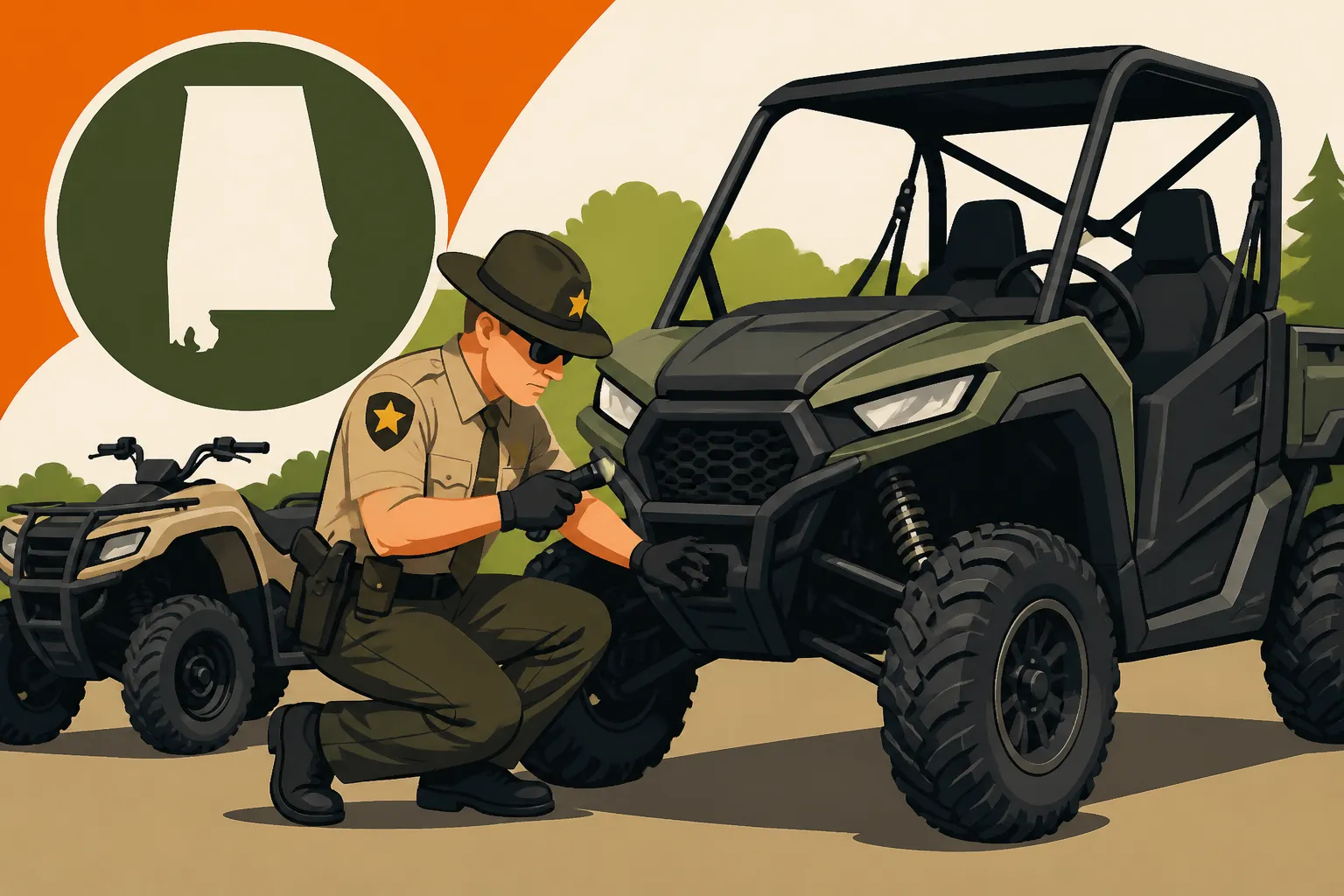
During the stop, the deputy will perform a visual inspection of your ATV or UTV. If the stop was due to suspected illegal road riding, they will certainly be checking for appropriate lighting, mirrors, and other features required for highway use. If you have custom accessories, like a sturdy bumper or rock sliders from SuperATV, they might ask about them, but generally, their focus is on legal compliance and safety features. For example, a deputy might note a large aftermarket tire kit and ask if it affects your machine's stability, though such an observation is less about immediate legality and more about the deputy's assessment of safety. [What an Alabama Officer Can Ask to See] Remain calm, cooperative, and answer their questions truthfully.
Warnings, Citations, and Impoundment
The outcome of an equipment check can vary widely. For minor infractions or if the deputy believes you were simply unaware of a rule, you might receive a verbal warning. This is a chance to correct the issue and move on. However, for more serious violations, such as operating without a spark arrestor in a protected area or, most commonly, riding illegally on a public road, you can expect a citation. [Alabama Penalties for Illegal Road Riding]
A citation typically involves a fine and may require a court appearance. The cost of fines and court costs can add up quickly. In the most severe cases, especially if your machine is involved in a serious incident, suspected of being stolen, or is being operated in a grossly unsafe or illegal manner (like a DUI), your ATV or UTV could be impounded. Impoundment means your machine is towed and stored at your expense, and recovering it involves paying towing fees, storage fees, and potentially any fines or bond amounts. This can be a very costly and inconvenient experience, highlighting the importance of understanding and following the rules. Also, local city and county ordinances can have their own specific rules and penalties that might differ from state law. [Alabama Local Ordinances on ATV Riding]
Disputing a Citation or Recovering Your Machine
If you receive a citation and believe it was issued in error, you have the right to dispute it in court. This usually involves appearing before a judge on the date specified on your ticket. It's wise to gather any evidence you have, such as photos of your equipment, witness statements, or documentation, to support your case. [Disputing an ATV Citation in Alabama] Understanding the specific charge against you is the first step in preparing a defense.
If your machine is impounded, the process to recover it generally involves contacting the impounding agency (e.g., the sheriff's office or police department) to understand the requirements. You'll likely need to provide proof of ownership, pay any outstanding fines or fees, and arrange for transport. This process can be frustrating and expensive, but clear communication and prompt action can help minimize the hassle.
Proactive Steps to Ensure You're Ready for a Stop
No one wants a run-in with law enforcement, especially when you're trying to enjoy your ATV or UTV. But by being proactive and prepared, you can significantly reduce the chances of a negative experience during an equipment check. It's all about responsible ownership and informed riding.
Pre-Ride Checks and Maintenance
Before every ride, especially if you're venturing far from home or planning to ride on public access land, perform a quick pre-ride inspection. Check that all your lights (headlights, taillights, brake lights) are functioning correctly. Test your brakes for proper operation and ensure your tires are in good condition and properly inflated. Make sure your spark arrestor is intact and not clogged. Keeping your machine well-maintained, perhaps with quality aftermarket parts or upgrades from SuperATV, not only ensures safer riding but also shows a level of responsibility that deputies often appreciate.
Think of it as routine care for your machine. A well-maintained ATV or UTV is less likely to break down and is more likely to pass any impromptu inspection. Carrying a small tool kit with essentials for basic trailside repairs can also be a lifesaver. This simple habit can prevent a minor issue, like a burnt-out bulb, from escalating into a citation or a lengthy roadside stop.
Carrying Necessary Documentation
This is perhaps one of the easiest and most crucial steps you can take. Always carry your personal identification, such as your driver's license or state ID. Equally important is carrying documentation for your ATV or UTV. This means having a copy of your bill of sale or, for 2026 model year machines and newer, your official title. If you've chosen to voluntarily register your machine with ALEA, keep your registration card with you.
While Alabama does not mandate insurance for off-road ATVs, carrying proof of insurance (if you have it) is still a good idea. It demonstrates financial responsibility and can be helpful in the event of an accident. [Does Alabama Require Insurance on an ATV?] Keep these documents in a waterproof bag or container, perhaps in a storage compartment on your machine or in your riding pack, so they are readily accessible and protected from the elements.
Knowing the Rules for Your Riding Area
The rules for ATVs and UTVs can vary significantly depending on where you are riding. Before you even load up your machine, take the time to understand the regulations specific to your intended riding area. Is it private land, a designated OHV park, a Wildlife Management Area (WMA), or are you planning to cross a county road? Each of these scenarios has different rules and expectations. [Alabama WMA Riding Rules]
Familiarize yourself with state laws regarding off-road vehicles, but don't stop there. Check for local city and county ordinances, as these can impose additional restrictions, particularly concerning noise or road access. [Alabama City Ordinance Lookups] Ignorance of the law is rarely accepted as an excuse. A quick phone call to a county sheriff's office or checking a local government website can save you a lot of trouble. Being informed not only keeps you compliant but also allows you to educate others, fostering a more responsible riding community.
Here's a quick guide to what deputies might check based on where you're riding:
| Location of Stop | Common Deputy Checks | Potential Consequences |
|---|---|---|
| Public Road/Crossing | Personal ID, proof of ownership, lighting (head/tail/brake), turn signals, mirrors, illegal road use. | Warning, citation, fines, impoundment |
| Public OHV Park | Personal ID, park permit/fee receipt, spark arrestor, sound limits, machine width, designated trail use. | Warning, park ejection, citation (if state law violated) |
| Private Land (Specific Complaint) | Personal ID, proof of ownership, sobriety, permission to be on land (for trespass). | Warning, citation (for DUI/trespass), arrest, machine impoundment |
| WMA or National Forest | Personal ID, WMA permit (if applicable), hunting license (if hunting), spark arrestor, designated road/trail use. | Warning, citation, permit revocation |
Remember, being prepared and respectful goes a long way. Happy and safe riding!
Disclaimer
This article is for general informational purposes only and does not constitute professional advice. Laws, prices and regulations vary by location and change over time. Consult a qualified professional for guidance on your specific situation.