Alabama City Ordinance Lookups
Navigating the rules for riding your ATV or UTV on the roads in Alabama can feel like trying to solve a puzzle with missing pieces, especially when you hit city limits. What might be perfectly acceptable on a county road or private land can instantly become a violation the moment you cross into an incorporated town. This guide is here to cut through that confusion, helping you understand why local city ordinances are so critical and, more importantly, how to actually find out what they say for your specific area.
The Layered Reality of Alabama ATV Laws
The legal landscape for ATVs and UTVs in Alabama isn't a single, straightforward set of rules. Instead, it's like a multi-layered cake, with each layer representing a different level of government. You've got state laws, which provide a broad framework, but then, individual counties and cities often bake in their own specific ingredients, which can drastically change the flavor of what's legal and what's not. This is where most riders get caught off guard, assuming state law covers everything, only to find themselves facing a local citation.
State Law as a Starting Point, Not the Whole Story
Alabama state law provides a foundational understanding of what ATVs and UTVs are, how they should generally be registered for different uses, and some overarching principles about public road use. For instance, the state defines off-road vehicles and specifies conditions for their voluntary registration. It also clearly outlines that, with very few exceptions, these machines are generally not designed or permitted for public road use due to federal safety standards. You'll find a lot of detail in topics like [Alabama ATV Road Rules Explained] and [Can You Drive an ATV on the Road in Alabama?]. This statewide perspective is crucial, as it sets the baseline. However, thinking that the state's silence on a particular local matter means it's allowed is a common pitfall. The state often leaves room for local jurisdictions to enact stricter, more specific regulations tailored to their unique communities.
Imagine you're driving your side-by-side to a friend's hunting camp just outside a small town. The county road you're on might be permissible under state guidelines for certain types of crossings or limited farm use, but the moment you enter the city limits – signaled by a simple "Welcome to [Town Name]" sign – an entirely different set of rules can snap into place. Suddenly, that short stretch of paved road becomes a no-go zone, not because state law changed, but because the town has its own ordinance. This is why solely relying on what you've heard about state law or what applies in unincorporated areas can lead to unexpected trouble.
The Overriding Power of Local Jurisdictions
Here's the often-frustrating truth: cities and towns in Alabama have significant authority to regulate traffic and public safety within their corporate limits. This power extends to dictating where and when off-road vehicles can operate on streets, even if those streets are technically public roads. A municipality can, and often does, enact an ordinance that completely prohibits ATVs and UTVs on any public street within its boundaries, regardless of state registration status. They might argue it's for pedestrian safety, traffic flow, or noise control.
Consider a scenario in a bustling resort town along the coast or a historic downtown area. The city council might decide that the presence of ATVs and UTVs, with their specific design and noise profile, simply isn't compatible with the local atmosphere or traffic patterns. They can pass an ordinance making it illegal to ride anything other than a street-legal, federally compliant vehicle on their roads. This means your perfectly registered UTV, equipped with lights and a horn (perhaps even some aftermarket parts from a company like SuperATV that enhance visibility), could still be deemed illegal for road use within those city limits if it doesn't meet the full Federal Motor Vehicle Safety Standards for on-road vehicles. This power to supersede general state guidelines for public road use makes checking local ordinances absolutely non-negotiable for any rider venturing into or through a town.
Why Local Ordinances Are a Big Deal for Riders
The existence of local ordinances creates a patchwork quilt of rules across Alabama, turning what seems like a simple ride into a potential legal minefield. For riders, ignoring these local regulations isn't just a minor oversight; it can lead to significant headaches, from frustrating encounters with law enforcement to costly fines and even impoundment of your machine. It’s all about understanding that a small sign can signify a huge legal shift.
The Unpredictability from Town to Town
One of the most challenging aspects of local ordinances is their sheer unpredictability. What's permitted in one small town in rural Alabama might be strictly prohibited in a neighboring municipality just a few miles down the road. There's no statewide standard for what cities must or can't do regarding ATVs and UTVs on their streets. This means you can't assume that because you rode your UTV on the streets of town A, you can do the same in town B. Each city council or town board makes its own decisions based on local priorities, population density, traffic volume, and even historical incidents.
Imagine planning a multi-day trail ride that involves passing through several small communities. You might have checked the rules for your starting point and destination, but what about the three towns in between? One might have a golf cart ordinance that confusingly overlaps with ATV rules (see [Alabama Golf Cart Rules Compared to ATVs]), another might allow farm-plated machines to cross main roads, and yet another could have a blanket ban on all off-road vehicles on public streets. This creates a logistical nightmare for riders trying to stay compliant, and it's a prime reason why thorough research before you ever put a tire on pavement within city limits is so vital. Without this research, you're essentially gambling on the local law, and the stakes can be higher than you'd like.
Avoiding Costly Mistakes and Citations
The consequences of violating a local ATV or UTV ordinance can range from a stern warning to a significant financial penalty. Police officers in Alabama cities are authorized to enforce these local laws, and they often do. Getting pulled over for illegal road use can result in a citation with a fine, and those fines can add up quickly, especially when combined with court costs. Beyond the immediate financial hit, there's the inconvenience: time spent in court, potential impoundment fees if your machine is towed, and the sheer frustration of dealing with the legal system. For a comprehensive look at the financial side, you might want to read [Alabama Ticket Costs for Road Riding].
Think about a rider who just installed a new light bar and turn signals from a company like SuperATV, thinking these modifications would make their machine "street legal." They might confidently drive into a town, only to be stopped and ticketed because the local ordinance prohibits all ATVs, regardless of their equipment. The cost of that ticket, plus potential court fees and the hassle of retrieving an impounded vehicle, could easily exceed the cost of the accessories. This scenario highlights why understanding local ordinances isn't just about following the law; it's about protecting your wallet and your valuable machine from unforeseen legal troubles. A little bit of research upfront can save you a lot of grief and money later on.
Practical Steps to Track Down Your City's Rules
So, you're convinced that checking local ordinances is essential. But how do you actually go about it? It can feel a bit daunting, especially if you're not used to digging into municipal code. Don't worry, there are clear, effective ways to find the information you need, and a little persistence goes a long way here.
Starting with the City or Town Clerk's Office
The most reliable, definitive source for local ordinances is always the city or town clerk's office. This is the official custodian of all municipal records, including the local code of ordinances. You can typically find their contact information on the city's official website or by calling the main municipal number. When you contact them, clearly state that you are looking for ordinances pertaining to "all-terrain vehicles," "utility terrain vehicles," "off-road vehicles," or "motorized vehicles" on public streets or rights-of-way. Be specific about your concern – are you asking about crossing a road, riding on a specific type of road, or general use?
It's helpful to be polite and patient, as these offices can be busy. You might be able to request a copy of the relevant section of the code, or they might direct you to an online portal if one exists. Some smaller towns might even have physical binders they refer to. Taking a specific name and contact number for the person you speak with can be invaluable if you need to follow up or reference the conversation later. Remember, obtaining this information directly from the source minimizes the chance of misinterpretation or relying on outdated information, which is a common problem when seeking legal advice from casual conversations.
Leveraging Online Resources and Municipal Websites
Many Alabama cities and towns have recognized the need for transparency and accessibility when it comes to their legal code. As such, a growing number of municipalities publish their full code of ordinances online. This is often accessible directly through the city's official website, usually under sections like "City Clerk," "Departments," "Government," or "Code of Ordinances." Some cities use third-party online platforms, like Municode or Code Publishing, to host their searchable legal databases. A quick search on Google for "[City Name] code of ordinances" or "[City Name] ATV rules" will often lead you to the right place.
Once you're on the city's online code, use the search function with keywords like "ATV," "UTV," "off-road vehicle," "all-terrain vehicle," "motor vehicle," or "street." Be sure to read the specific chapter or section that appears in your search results carefully. Pay attention to the date the ordinance was last updated, as laws can change. While these online resources are incredibly convenient, always cross-reference with the city clerk's office if you find conflicting information or if the online code seems incomplete or out of date. This due diligence ensures you're working with the most current and accurate information available.
Consulting Law Enforcement Directly
Another valuable resource, especially for understanding the practical application and enforcement of ordinances, is your local law enforcement agency. This could be the city police department or the county sheriff's office if the area is unincorporated but still policed by a town agreement. You can call their non-emergency line and ask to speak with an officer or deputy about the specific regulations concerning ATVs and UTVs on city streets. While they might not be able to quote chapter and verse of the municipal code, they can certainly tell you what they enforce and what the local stance is.
When you call, again, be clear and concise. Explain where you plan to ride (e.g., "I live in this neighborhood and want to know if I can ride my side-by-side to the corner store," or "I'm passing through your town on a county road and need to know if I can legally cross Main Street on my ATV"). The officers are on the front lines of enforcement and can often provide practical insight into how the rules are applied, or perhaps even tell you if there are designated routes or exceptions you weren't aware of. For more on this, check out [Calling an Alabama Sheriff Before You Ride]. It's crucial to remember that while a law enforcement officer's guidance is helpful, the written ordinance is the final legal authority. Documenting who you spoke with and when can be useful if any confusion arises later.
Here's a quick comparison of resources:
| Resource Type | Best For | Pros | Cons |
|---|---|---|---|
| City/Town Clerk's Office | Official, definitive code copy | Most accurate, legally binding information | May require a visit, office hours, slower process |
| Municipal Websites (Online Code) | Quick searches, general overview | Convenient, accessible 24/7, often searchable | May be outdated, might not be fully comprehensive or easily interpreted |
| Local Law Enforcement (Police/Sheriff) | Enforcement perspective, practical advice | Real-world context, current enforcement practices | Not the official legal text, interpretation can vary slightly |
Deciphering the Legal Language in Ordinances
Once you get your hands on a copy of a local ordinance, whether online or from the clerk's office, you might find the language a bit dense and technical. Legal texts are not always written for easy comprehension by the general public. However, knowing what to look for and understanding key terms can help you cut through the legalese and grasp the actual implications for your riding.
Keywords and Definitions to Look For
When reading an ordinance, pay close attention to the definitions section, which is usually at the beginning of the relevant chapter. Look for terms like "all-terrain vehicle," "ATV," "utility terrain vehicle," "UTV," "off-road vehicle," "ORV," "motor vehicle," or even broader terms like "non-highway vehicle." How the city defines these terms is crucial, as it determines which machines the ordinance applies to. Sometimes, a city might explicitly group ATVs with motorcycles or classify them distinctly from golf carts, which often have different regulations. [Alabama's ATV and ROV Legal Definitions] can help you understand the state-level terms, but local definitions always take precedence within that jurisdiction.
Beyond definitions, search for verbs like "prohibit," "allow," "permit," and "restrict." Look for phrases such as "on any public street," "on the public right-of-way," "within city limits," or "on public property." These words tell you where and what is regulated. For example, an ordinance might state, "It shall be unlawful for any person to operate an all-terrain vehicle on any public street or highway within the corporate limits of the City of [X]." This would be a clear and unambiguous ban. If you find language about "designated routes" or "special permits," dig deeper into those sections. The goal is to identify exactly what vehicles are covered, where they are restricted, and if any exceptions exist.
Understanding "Designated Areas" and Exceptions
Not all local ordinances are outright bans. Some cities or towns might have specific provisions for "designated areas," "special events," or "farm use" exceptions. These are often the clauses that can save your ride, but they come with strict conditions. A "designated area" might refer to a specific street, a particular time of day, or a defined route that connects private properties to a trail system. For instance, a small town might allow ATVs to cross a main highway at a specific intersection to access hunting land, but only during daylight hours.
You might also encounter exceptions for agricultural purposes, similar to how [Alabama Rules for Farm Machines on Roads] might apply at the state level. A city ordinance could allow a farmer to operate a UTV on city streets for short distances to tend to fields that straddle municipal boundaries. Another common exception pertains to municipal or emergency services, where city-owned ATVs and UTVs are permitted for specific tasks. When you find these exceptions, scrutinize them closely. Do you meet the criteria? Is there a specific permit required? Are there limitations on speed, time of day, or required equipment? Never assume an exception applies to you without verifying that you meet every single condition outlined in the ordinance. These details are what separate a legal ride from a potential citation.
Common Themes You'll Find in Alabama City Ordinances
When you start looking through local ordinances across Alabama, you'll quickly notice some recurring themes. While the exact wording and specific details vary, the underlying intentions and regulatory approaches tend to fall into a few general categories. Understanding these common themes can help you anticipate what you'll find even before you look up a specific city's code.
Outright Bans and Strict Prohibitions
By far, the most common type of ordinance concerning ATVs and UTVs on public roads in Alabama cities is an outright ban. Many municipalities, especially those with higher traffic volumes, dense populations, or a desire to maintain a certain aesthetic, simply prohibit the operation of these machines on any public street, highway, alley, or right-of-way within their corporate limits. These ordinances are often straightforward, stating clearly that it is unlawful to operate an ATV or UTV on public roads, full stop. The reasoning often cites safety concerns due to the lack of traditional road-vehicle safety features, potential for accidents, and interference with regular traffic flow.
For example, a city might have an ordinance that reads, "No person shall operate an all-terrain vehicle or utility terrain vehicle on any portion of the public street system or sidewalks within the city limits of [City Name]." This leaves very little room for interpretation. Even if you've installed mirrors, turn signals, and a horn from SuperATV, the core issue is the type of vehicle itself and its fundamental design, which typically doesn't meet federal safety standards for on-road use. These blanket prohibitions mean that even crossing a street can be a violation, making it crucial to know exactly where a city's boundaries begin and end. This is precisely why [Alabama Machines That Cannot Be Plated] highlights the core challenge many riders face.
Limited Use Provisions (e.g., specific hours, farm use)
While outright bans are common, some towns adopt more nuanced approaches through limited use provisions. These ordinances don't necessarily prohibit ATVs and UTVs entirely but place strict conditions on their operation on public roads. These conditions often revolve around specific purposes, times, or locations. For instance, an ordinance might permit the use of ATVs or UTVs on public streets only for bona fide agricultural purposes, such as moving equipment between fields or accessing remote parts of a farm that border a public road. This aligns with state-level considerations for [Alabama Farm Use and Road Riding]. However, even these farm-use exceptions usually come with requirements like specific signage, daylight-only operation, or direct travel only.
Other limited use provisions might include allowing ATVs on certain unpaved county roads that fall within city limits, but only during daylight hours and with specific safety equipment. Or, a city might designate certain low-traffic side streets for use by property owners to access trails, but strictly prohibit their use on main arteries. It's rare, but some towns might even permit special events, like parades or charity rides, with a specific permit. These provisions are the exceptions, not the rule, and they are typically very narrowly defined. If you believe such a provision applies to you, you must ensure you meet all the stated conditions perfectly.
Golf Cart Ordinances vs. ATV/UTV Rules
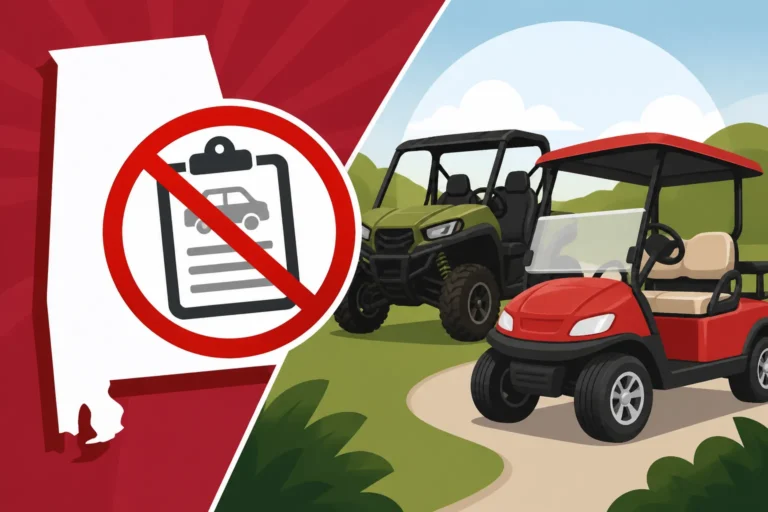
A common area of confusion arises when cities have specific ordinances for golf carts. Many Alabama cities have adopted ordinances to regulate golf cart use on public streets, especially in retirement communities, lake towns, or areas with extensive golf courses. These ordinances often allow golf carts to be operated on certain streets, usually those with lower speed limits, and require them to have specific safety equipment like lights, mirrors, and sometimes even a slow-moving vehicle sign. Riders often mistakenly assume that because golf carts are allowed, ATVs and UTVs (especially side-by-sides) are also permitted under the same rules.
However, almost universally, a city's golf cart ordinance does not apply to ATVs or UTVs. State law and most local ordinances define ATVs and UTVs separately from golf carts. While a side-by-side might superficially resemble a larger, more robust golf cart, their intended design, speed capabilities, and federal classifications are fundamentally different. A golf cart ordinance is written specifically for golf carts, which are typically restricted to much lower speeds and have different safety profiles. Unless an ordinance explicitly includes ATVs or UTVs within its golf cart provisions (which is exceptionally rare), you should assume they are treated as distinct categories, with ATVs and UTVs generally facing stricter prohibitions. For a deeper dive into this distinction, refer to [Alabama Golf Cart Rules Compared to ATVs].
Navigating Enforcement and the Consequences of Non-Compliance
Even with the best intentions, it's possible to misinterpret an ordinance or accidentally venture onto a prohibited street. Understanding what happens when you're pulled over and the potential repercussions can help you prepare and, ideally, avoid such situations entirely. Ignorance of the law is rarely an excuse that holds up.
What Happens When You're Pulled Over
If you're operating your ATV or UTV on a public street in an Alabama city and an officer believes you're violating an ordinance, you will likely be pulled over. The officer will typically ask for your identification, registration (if applicable), and proof of ownership. They'll also inquire about where you're coming from and where you're going. It's vital to remain calm, cooperative, and respectful. Arguing with the officer on the side of the road will almost never help your situation and can potentially lead to additional charges.
The officer will assess the situation based on the local ordinance and their training. If a clear violation has occurred, you will likely receive a citation. This citation will specify the ordinance you allegedly violated and the associated fine. In some cases, especially if there's a safety concern, repeat offense, or if the machine is unregistered (even if voluntary for private use), the officer may have the authority to have your ATV or UTV impounded. This is a significant inconvenience and expense. Remember, the goal of an officer enforcing these laws is typically public safety and adherence to local regulations, not to ruin your day. However, their job is to enforce the law as it is written in their jurisdiction.
The Financial and Practical Repercussions
The financial implications of an ATV or UTV citation can be substantial. Beyond the fine itself, you'll likely incur court costs, which can add a significant amount to the total bill. If your machine is impounded, you'll face towing fees and daily storage fees, which can quickly accumulate, sometimes costing hundreds of dollars just to get your machine back. In some extreme cases, repeated violations or dangerous operation might even lead to more severe penalties, though these are less common for a first-time offense of simply being on a prohibited road. For insights into the financial impact, explore [Alabama Penalties for Illegal Road Riding].
Beyond the money, there are practical repercussions. Dealing with a citation means taking time off work or other activities to attend court dates, potentially hiring legal counsel, and the stress of navigating the legal system. If your machine is impounded, retrieving it can be a hassle, requiring specific paperwork, payment of fees, and arranging transport for your ATV or UTV, as you certainly won't be allowed to drive it off the impound lot if it's illegal for road use. This entire process can turn what was supposed to be a fun ride into a nightmare scenario, reinforcing why proactive research into [Alabama Local Ordinances on ATV Riding] is not just a good idea, but a necessary one for any rider wanting to avoid trouble in the state's cities and towns.
Disclaimer
This article is for general informational purposes only and does not constitute professional advice. Laws, prices and regulations vary by location and change over time. Consult a qualified professional for guidance on your specific situation.