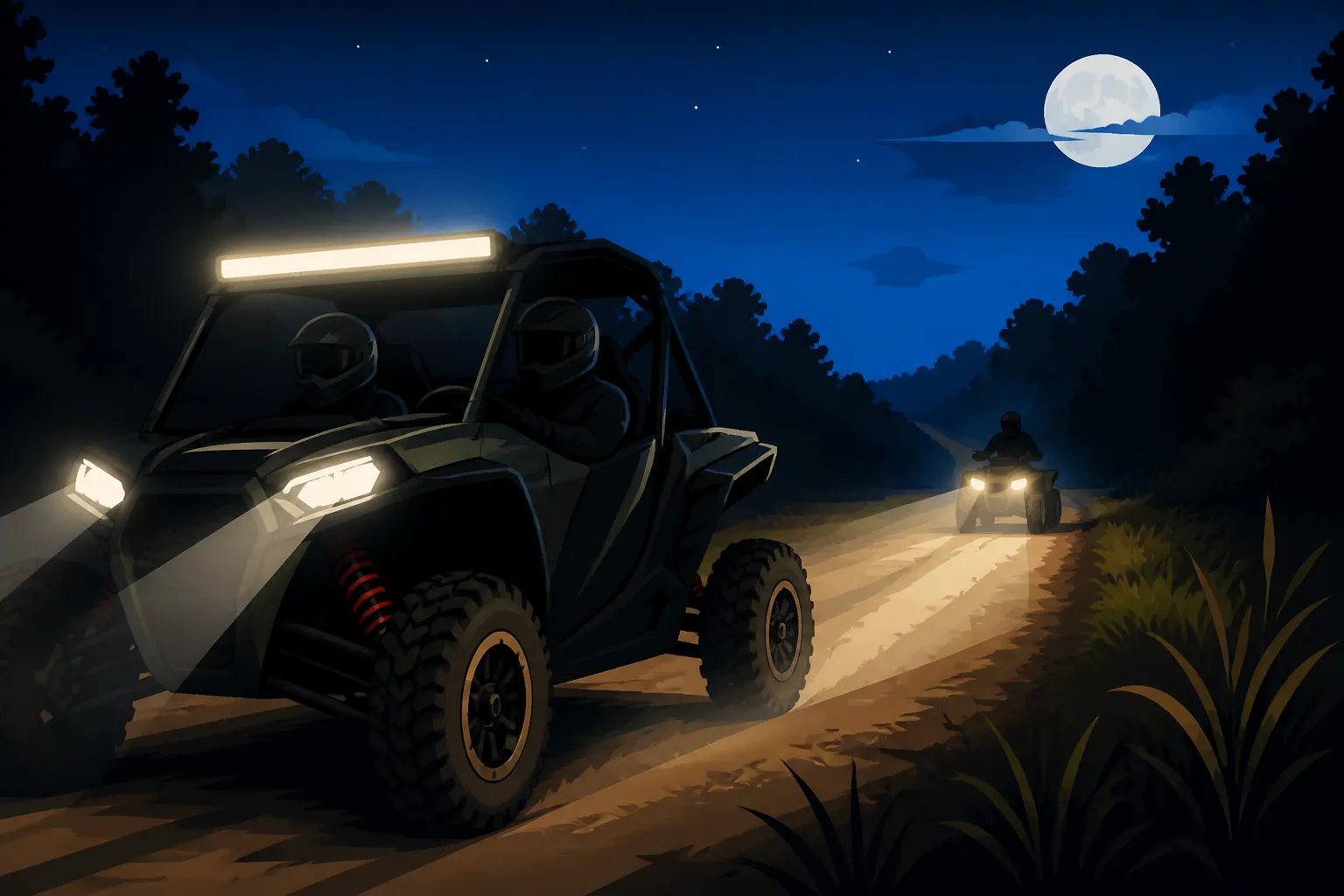
Night Visibility on an Alabama Back Road
There's nothing quite like the freedom of hopping on your ATV or UTV after a long day, especially when the sun starts to dip below the tree line. The air cools, the woods get quiet, and those familiar back roads take on a whole new feel. But let's be real, riding in Alabama after dark, especially on unlit county roads or rural tracts, brings a whole host of visibility challenges that can quickly turn a peaceful ride into a nerve-wracking experience. This guide is all about helping you understand the legal landscape, gear up for safety, and adopt smart practices to navigate Alabama's dark roads with confidence and keep yourself and others safe.
The Tricky Terrain of Night Riding Laws in Alabama
When it comes to riding your ATV or UTV on Alabama's roads, things get complicated, and often, what you want to do clashes with what you can do, especially after dark. The state generally restricts off-road vehicles from public roads, but those rural county and dirt roads often feel like a grey area. It’s a common frustration for riders who use their machines for everything from checking on livestock to simply enjoying the countryside.
Understanding Alabama's Road Use Restrictions for ATVs and UTVs
Alabama's laws are pretty clear that ATVs and UTVs are primarily designed for off-road use. This means that, unlike cars or trucks, they aren't generally allowed on public highways or paved county roads. Many riders assume that "back roads" or "dirt roads" are automatically exempt from these rules, but that's often not the case. If a road is maintained by the county or state, it's typically considered a public thoroughfare, regardless of its surface. This often leads to a lot of confusion and potential tickets for riders who are just trying to get from one section of their property to another, or to a nearby hunting lease. You might think, "It's just a mile down the road, who's going to care?" but a deputy might have a very different perspective, particularly if you're out there after dark with limited visibility. [Alabama ATV Road Rules Explained] delves deeper into these specific regulations.
The law aims to keep everyone safe, but it can feel restrictive when you’re facing a long detour on private land just to avoid a short stretch of public road. The primary concern is that these machines don't meet the federal safety standards required for on-road vehicles. They lack things like proper turn signals, DOT-approved tires, and often, the sophisticated lighting systems that make cars visible at night. This becomes doubly important when you consider that a car or truck driver might not be expecting a low-slung, relatively quiet ATV to suddenly appear out of the darkness on a curving rural road.
Legal Requirements for Night Riding Equipment
Even if you find yourself on a road segment where an ATV or UTV might be legally permissible (perhaps a designated crossing point or a truly private road), Alabama still has expectations for visibility after dark. While the state doesn't have a specific "street legal kit" for ATVs that magically makes them road-legal everywhere, any machine operating at night is expected to have adequate lighting. This usually means a headlight visible from 500 feet and a taillight visible from 100 feet. For a side-by-side, this might seem sufficient with factory equipment, but a standard quad's single headlight and small taillight might not cut it in the truly dark corners of a county road.
The problem is, factory lights are often designed for illuminating trails, not for making you highly conspicuous to oncoming traffic. They cast a beam forward, which is great for seeing where you're going, but they don't always offer the wide-angle, all-around visibility needed to alert others to your presence. Many riders have been caught off guard by the sheer lack of peripheral light that their stock system provides, especially when making a turn or coming out of a hidden driveway. This is where the gap between minimal legal requirements and actual safety needs really becomes apparent. [Alabama Lighting on a Machine at Night] discusses these requirements in more detail, highlighting the minimal nature of factory lights compared to the demands of road use.
Penalties for Insufficient Visibility
Getting caught riding on a public road where you shouldn't be is one thing, but getting caught after dark with inadequate lighting can compound the issue. Penalties can range from fines to, in more serious cases, impoundment of your machine. A deputy's primary concern is safety, and if your machine isn't clearly visible, you're putting yourself and other motorists at severe risk. Imagine driving your truck down a dark country road at 50 MPH, and suddenly a small, dimly lit object appears just ahead – it's a recipe for disaster.
Beyond the legal ramifications, there's the very real and personal cost of an accident. An injury or worse, caused by poor visibility, far outweighs any fine. Many riders have shared stories of near-misses on dark roads, often involving large vehicles like logging trucks or farm equipment that simply didn't see them until the last second. It's not just about what the law says; it's about making sure you can go home safe after every ride. Understanding [Alabama Penalties for Illegal Road Riding] is crucial for any rider venturing onto public ways, especially after dark.
Boosting Your Visibility: Essential Lighting and Reflective Gear
Since factory lighting on most ATVs and UTVs is designed more for trail illumination than for making you seen by others on a dark road, upgrading your setup is critical for night riding safety. You want to make yourself as conspicuous as possible, mimicking, to some extent, the visibility of a street-legal vehicle.
Upgrading Your Machine's Lighting System
The single biggest improvement you can make is to enhance your machine's lighting. Factory headlights are often sufficient for seeing obstacles directly in front of you on a trail, but they typically don't offer the spread or intensity needed to stand out against the backdrop of a dark Alabama night.
Here are some upgrades to consider:
- LED Light Bars: These are incredibly popular for a reason. They throw a massive amount of light forward, making it much easier for you to see the road ahead, but just as importantly, they make your machine a beacon for oncoming traffic. A good quality LED light bar, perhaps from a brand like SuperATV, can transform your night riding experience, turning dim pathways into clearly visible routes. Mounting one across the front bumper or roof of your side-by-side will significantly improve your presence.
- Auxiliary Headlights/Fog Lights: Adding smaller, focused LED pods as auxiliary lights can fill in gaps left by your stock headlights, especially to the sides of your machine. These can be particularly helpful for illuminating ditches or the shoulders of narrow roads.
- Tail Lights and Brake Lights: Your taillight is arguably even more important than your headlight for preventing rear-end collisions. Ensure your taillight is bright, works reliably, and is clearly visible. Many aftermarket options offer brighter LEDs or even additional brake lights that flash when applied, grabbing the attention of following vehicles.
- Turn Signals: While not typically stock on ATVs, adding aftermarket turn signals is a huge step towards road-like visibility. It allows you to communicate your intentions to other drivers, which is critical on any road, even a seldom-used dirt track. You can find kits that integrate easily, often with small, bright LED indicators.
- Whip Lights/Beacon Lights: For UTVs, especially taller ones, a brightly lit whip light can extend your vertical visibility, making you noticeable over hills or around bends where a lower-mounted headlight might not be seen until the last second. These can also be invaluable in dusty conditions.
| Lighting Type | Primary Function | Visibility Impact for Others | Illumination for Rider | Common Placement |
|---|---|---|---|---|
| Stock Headlights | Basic forward illumination | Minimal, often dim and narrow | Decent for trails, poor for speed | Front of machine |
| LED Light Bars | Broad, intense forward illumination | Excellent, high visibility | Excellent, wide and far-reaching | Front bumper, roof rack |
| Auxiliary Spot/Flood | Targeted illumination, fill in gaps | Good, adds to machine outline | Good, complements main lights | A-pillars, lower bumper |
| Upgraded Tail/Brake | Rear visibility, braking indication | Critical, prevents rear-end collisions | N/A | Rear of machine |
| Turn Signals | Indicating directional changes | Excellent, communicates intent | N/A | Front/rear corners of machine |
| Whip Lights/Beacons | Vertical visibility, all-around presence | Good, especially over terrain | N/A | Rear roll cage (UTV), cargo rack (ATV) |
Enhancing Rider and Machine Conspicuity with Reflective Materials
Lighting is paramount, but supplementing it with reflective materials adds another layer of safety, especially if your electrical system fails or if other vehicles' headlights sweep across you from an unexpected angle.
- Reflective Tape: This is a simple, cost-effective, and highly effective way to make your machine more visible. Apply reflective tape to the front, rear, and sides of your ATV or UTV. Think about outlines: the edges of your fenders, the roll cage of your UTV, or even the spokes of your wheels. The brighter the color (white, yellow, orange, red), the better. [Reflective Tape for an Alabama County Road] covers the best practices for using this essential safety item.
- High-Visibility Riding Gear: Don't forget yourself! Wear a jacket or vest with reflective stripes, especially if you plan to get off your machine on the road. A bright, neon-colored helmet with reflective decals can also make a huge difference. Imagine your buddy riding ahead of you in a dark jacket versus one wearing a bright yellow, reflective vest – the difference is startlingly clear. This isn't just for looking good; it's about being seen.
- Helmet-Mounted Lights: Small, rechargeable LED lights that attach to your helmet can provide an extra moving point of light, making you more noticeable and also allowing you to see objects as you turn your head, independent of your machine's fixed lights.
By combining robust lighting upgrades with smart use of reflective gear, you're not just hoping to be seen; you're actively ensuring it.
Navigating Alabama's Dark Back Roads Safely
Even with the best lighting and reflective gear, night riding on Alabama's back roads demands a heightened level of caution and specific riding techniques. These aren't city streets with streetlights, and they present unique challenges that can catch even experienced riders off guard.
Adjusting Your Riding Style for Low Light Conditions
The darkness itself changes everything about how you perceive your surroundings and how quickly you can react. You need to compensate for this reduced visibility in every aspect of your ride.
- Reduce Speed: This is non-negotiable. Your reaction time diminishes in the dark, and your effective stopping distance increases. Even if your lights illuminate hundreds of feet ahead, that doesn't mean you can react to a deer, a fallen tree, or an unexpected pothole at daytime speeds. Slow down significantly, especially on unfamiliar roads or around blind corners. On dirt roads, dust can be a major problem, further reducing visibility. Driving slower helps you stay out of the dust cloud of a machine ahead or minimizes the dust you kick up for those behind you.
- Increase Following Distance: If you're riding with a group, leave much more space between machines than you would in daylight. Dust, shadows, and the glare from other riders' lights can create disorienting conditions. A larger gap gives everyone more time to react.
- Focus on the Road Ahead: Avoid distractions. Your eyes should be constantly scanning for hazards, not just directly in front of your machine, but also to the sides for approaching wildlife or unexpected turns.
- Anticipate Hazards: On these back roads, you need to ride defensively. Assume there might be other vehicles, pedestrians, or animals around every bend. Be particularly wary near driveways, fields, or intersecting paths. [Alabama Rules for Riding After Dark] really emphasizes the need for this proactive approach to safety.
Dealing with Wildlife and Road Hazards at Night
Alabama's rural areas are teeming with wildlife, and many animals become more active at night. Deer, raccoons, opossums, and even larger animals like wild hogs can dart into your path with little to no warning.
- Scan for Eye Shine: Your lights will often pick up the reflective eyes of animals before you see the animal itself. Look for small, glowing dots in the ditches or fields beside the road. If you see them, slow down immediately and be prepared to stop.
- Be Aware of Common Crossings: If you frequently ride a particular road, you'll start to learn where animals tend to cross. Use extra caution in those areas.
- Road Debris: Unlike well-maintained highways, Alabama's back roads can have unexpected debris: fallen tree limbs, rocks, farm implements, or even trash. These are much harder to spot in the dark. Your upgraded lighting system will help, but vigilance is key.
- Potholes and Washouts: Dirt and gravel roads are notorious for developing potholes, ruts, and washouts, especially after heavy rains. These can be invisible in the dark until you're right on top of them. Again, reducing speed gives you precious seconds to react.
Emergency Preparedness for Night Riding
Even the most careful rider can encounter an unexpected situation. Being prepared for emergencies is crucial, especially when you're out in remote areas after dark.
- Carry a Communication Device: Your cell phone is essential, but be aware that many rural areas in Alabama have spotty or non-existent cell service. Consider carrying a satellite messenger or a two-way radio if you frequently ride in very remote areas, or if riding with a group.
- First-Aid Kit: A well-stocked first-aid kit, suitable for outdoor use, should always be with you.
- Basic Repair Tools: A small tool kit for common roadside repairs (tire plug kit, spare belt for a UTV, basic wrenches) can save you a long walk.
- Extra Light Source: Always carry a powerful flashlight or headlamp. If your machine's lights fail, you'll need a way to see and signal for help.
- Emergency Contact Information: Have a list of emergency contacts readily available, perhaps laminated and stored in a waterproof bag.
- Tell Someone Your Route: Before you leave, let someone know where you're going and when you expect to be back. This simple step can be a lifesaver if something goes wrong and you become stranded. This practice is also smart when planning [Alabama Group Ride Planning].
By understanding the unique challenges of night riding, equipping your machine and yourself with proper visibility tools, and adopting a cautious, prepared riding style, you can enjoy the serenity and adventure of Alabama's back roads after dark, while drastically reducing your risks.
Disclaimer
This article is for general informational purposes only and does not constitute professional advice. Laws, prices and regulations vary by location and change over time. Consult a qualified professional for guidance on your specific situation.