Farm Equipment and the Exclusion
It can be incredibly confusing to figure out where your trusty ATV or UTV fits into Alabama's rules and regulations, especially if you primarily use it for work around the farm. Many folks assume their off-road vehicle is just "farm equipment" and therefore exempt from everything, but the reality can be a bit more nuanced. This guide will help you understand Alabama's specific exclusion for farm equipment when it comes to ATVs and UTVs, giving you a clearer picture of when your machine truly falls under that category and what it means for you.
Understanding Alabama's Off-Road Vehicle Statute
Navigating the legal landscape for off-road vehicles in Alabama can feel like trying to find your way through a thick kudzu patch – dense and full of unexpected twists. When we talk about the state's statutes, it's important to remember that they're generally designed to regulate machines used for recreation or general transportation, setting boundaries for public safety and order. However, lawmakers often recognize that certain tools, even if they resemble recreational vehicles, serve a vital purpose in specific industries, like agriculture. This recognition leads to important exceptions that can save farmers a lot of headaches and unnecessary paperwork.
What the Statute Generally Covers
Typically, Alabama's off-road vehicle statute casts a wide net, defining what an all-terrain vehicle (ATV) and a recreational off-highway vehicle (ROV), often called a UTV or side-by-side, actually are. These definitions usually include specifics about width, weight, non-highway tires, and seating. Once a machine fits these descriptions, it generally falls under the purview of regulations concerning things like [Alabama's Voluntary ATV Registration Through ALEA], potential future titling requirements, and rules for operating on public lands or crossing roads. The goal is to ensure that these powerful machines are operated safely and that their owners are identifiable. For instance, if you're taking your quad out for a weekend ride at Stony Lonesome OHV Park in Alabama, you'll definitely be operating under the full weight of these regulations.
The Specific Exclusion for Farm Equipment
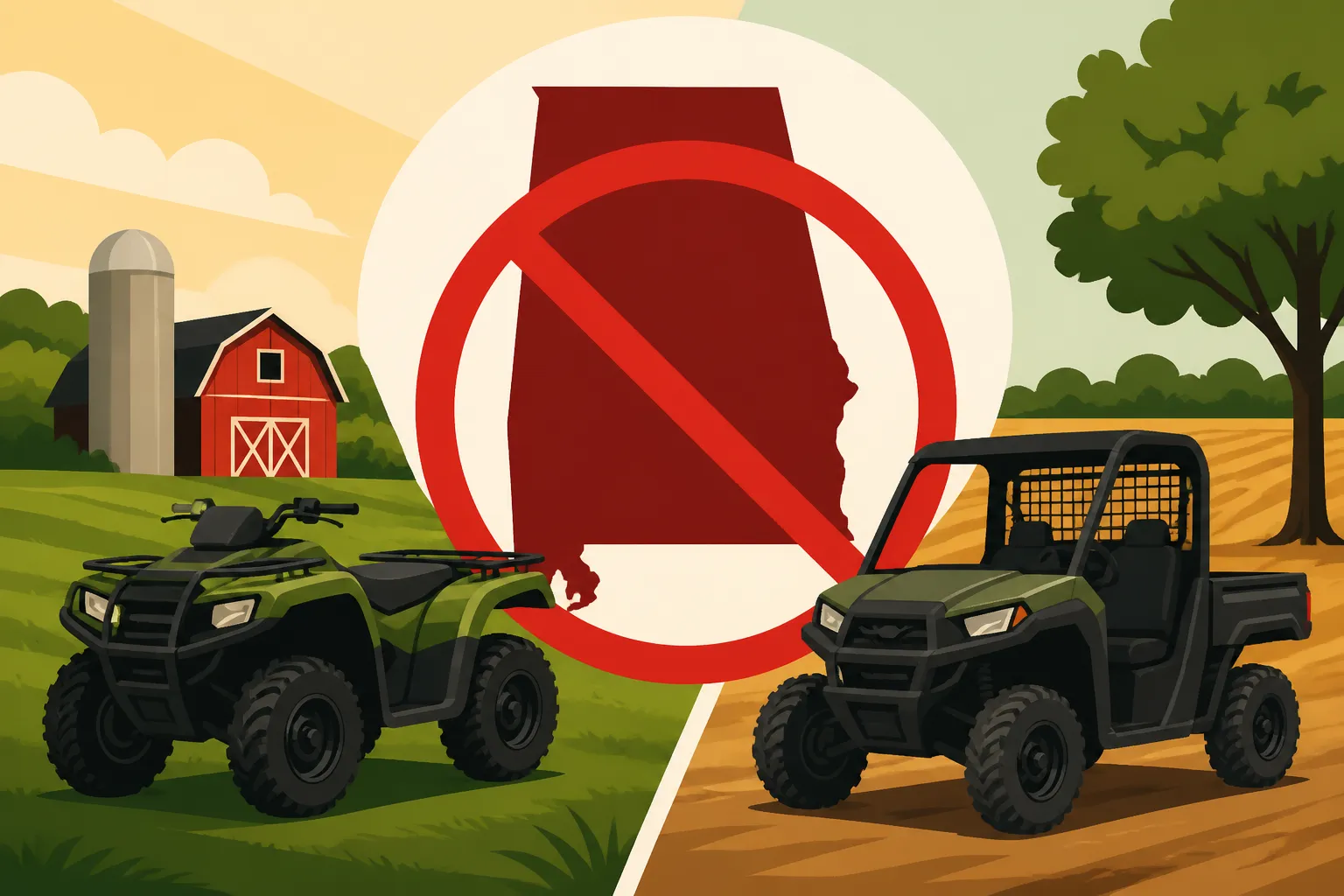
Here's where it gets interesting for those of you working the land. Alabama's off-road vehicle statute, specifically Section 32-20-1, carves out a very important exception. It states that the chapter does not apply to any "all-terrain vehicle or recreational off-highway vehicle used exclusively for farming or agricultural purposes." This means that if your ATV or UTV is genuinely and solely dedicated to agricultural tasks, many of the rules that apply to recreational machines simply don't touch your equipment. This exclusion acknowledges that a farmer moving feed, inspecting fences, or hauling tools across their private property is engaged in a distinct activity from someone tearing up trails for sport.
Why This Exclusion Matters to Farmers
For farmers and those in agricultural pursuits, this exclusion is a huge relief. It means less red tape, fewer fees, and a clearer understanding of how their essential tools fit into the state's legal framework. Imagine having to voluntarily register every single quad and side-by-side you use to manage your cattle, inspect irrigation lines, or haul equipment across vast acreage. The administrative burden alone would be immense, not to mention the cumulative cost of [Alabama Registration Applications by Mail] or the time spent at the county office. This exclusion helps keep farming operations efficient by not imposing regulations designed for recreational use onto production-focused machinery. It recognizes the fundamental difference in how these machines are utilized in an agricultural context.
Defining "Farm Equipment" in Alabama
So, what exactly is "farm equipment" in the eyes of Alabama law when it comes to ATVs and UTVs? This isn't just a philosophical question; it has real-world consequences for whether your machine is subject to registration, titling, and road-use rules. It's not enough to simply own a farm; the use of the vehicle is the key. You wouldn't call your pickup truck "farm equipment" just because you drive it to the feed store, right? The same logic, albeit with different specifics, applies here.
What Qualifies as Agricultural Use
When the statute says "used exclusively for farming or agricultural purposes," it's generally referring to activities directly related to the production of crops, livestock, or other agricultural products. Think about the daily grind on a working farm:
- Checking livestock: Riding out to pastures to monitor cattle, sheep, or other animals.
- Hauling feed or supplies: Transporting bags of feed, tools, fencing materials, or small equipment across fields.
- Inspecting crops or land: Driving through fields to check on crop health, irrigation systems, or property boundaries.
- Farm maintenance: Using the machine to reach remote areas for fence repair, clearing brush, or maintaining outbuildings.
- Harvesting: Small-scale hauling of harvested goods or using the machine to access specific areas during harvest.
Essentially, if the machine is performing a task that is an integral part of your agricultural operation, it likely qualifies. This also extends to timber operations on your own land, such as inspecting stands or managing fire breaks, as it falls under the broader umbrella of "agricultural pursuits."
When a Machine Crosses the Line
The "exclusively" part of the definition is critical and often where confusion arises. If your "farm" ATV also doubles as your weekend trail machine, or if your kids take it out for joyrides around the property after chores are done, it might no longer strictly qualify as "farm equipment" under the exclusion. Here are some scenarios where a machine might "cross the line":
- Recreational riding: Taking the machine to an off-road park or simply using it for fun on private land (even your own farm) when not directly performing a farming task.
- Commuting: Using the ATV/UTV for personal transportation that isn't directly farm-related, even if it's just to the mailbox down a private road.
- Non-farm business use: Using the machine for a landscaping business that isn't part of your farm's agricultural production, or for general contracting.
In these situations, the "exclusive" nature of the farm use is compromised, and the machine might then fall under the general ATV/UTV regulations.
The "Primary Purpose" Test
While the statute uses "exclusively," common sense and enforcement often lean towards a "primary purpose" test. This means looking at what the machine is mostly and fundamentally used for. If 95% of its operating hours are spent checking fences and hauling hay, and only occasionally is it used to take a visitor for a quick spin around the property, an argument could be made for its farm equipment status. However, if it's truly a mixed-use machine, regularly switching between farm duties and recreational outings, it's safer to assume it's subject to the general rules. This is where documentation can be helpful – keeping a log of usage or maintaining it clearly as a farm vehicle could support your claim if ever questioned. Think of it this way: is it a tool for your livelihood, or is it primarily a toy that occasionally helps with chores? [Alabama Registration for a Farm Machine] further clarifies that even if registered for farm use, limitations exist on its broader applications.
Practical Implications of the Farm Equipment Exclusion
Understanding the definition of farm equipment is one thing; knowing what that means for your daily operations is another. The exclusion from the ATV/UTV chapter brings several practical benefits and considerations that are distinct from those faced by recreational riders. These implications touch upon everything from whether you need to bother with paperwork to how you can legally move your machine from one field to another.
Registration Exemptions for Farm Use
One of the most significant benefits of your ATV or UTV qualifying as "farm equipment" is the exemption from Alabama's voluntary registration scheme. If your machine is exclusively used for farming or agricultural purposes, you are generally not required to go through the process with the Alabama Law Enforcement Agency (ALEA) to get a three-year registration decal. This bypasses the need for completing applications, paying fees, and keeping up with renewal cycles every few years. It's important to remember, however, that while you don't have to register it, you also won't get the benefits that come with registration, such as the ability to ride in [Alabama Public Use Designated Areas] (if those areas permit farm equipment) or the official documentation of your ownership through the state system that registration provides.
Titling Considerations for Farm-Use Machines
The new titling law in Alabama, which takes effect for model year 2026 and newer machines, introduces another layer of complexity. However, the same exclusion that applies to registration generally applies to titling. If your 2026 model year side-by-side is used exclusively for farm work – say, managing a catfish farm or a vast timber tract – it would likely be exempt from the titling requirements, similar to how [Alabama Excludes Farm Equipment] from the older statutes. This means you wouldn't need to apply for a title at your county office, pay the associated fees, or worry about [Alabama Title Requirements for 2026]. For older machines, those pre-2026 model years, the titling law doesn't apply anyway, so the farm exclusion is less of a concern there, as [Why Pre-2026 Owners Do Nothing] is already the rule.
Road Use and the Farm Equipment Exemption
This is perhaps one of the most common areas of confusion. Recreational ATVs and UTVs are generally not street legal in Alabama and face strict limitations on road use. However, machines that qualify as farm equipment often have a specific allowance for limited road use for agricultural purposes. This typically means you can cross a road or drive short distances on a public road to get from one part of your farm to another, or to access fields. This isn't a free pass for joyriding on county roads, but rather a functional exception to facilitate agricultural operations. The critical distinction is that the road use must be incidental and directly related to farm work, not for general transportation or recreation. You still need to operate safely, yield to traffic, and potentially consider visibility if you're on the road during dawn or dusk.
Insurance and Liability for Farm ATVs/UTVs
While the state might exempt farm equipment from certain registration and titling requirements, this doesn't mean you're exempt from liability if something goes wrong. Insurance is always a good idea, regardless of whether your machine is titled or registered. For farm equipment, your existing farm liability policy might offer some coverage for your ATV or UTV if it's truly being used for agricultural purposes. However, it's absolutely crucial to talk to your insurance agent. They can clarify what your current policy covers and whether you need specific endorsements or a separate policy for your off-road vehicles. Never assume coverage; always verify. An incident on your property, or even a brief road crossing, could lead to significant financial implications if you're not properly insured. [Does Alabama Require Insurance on an ATV?] generally says no, but prudence always dictates it.
Common Misconceptions and Gray Areas
The "farm equipment" exclusion, while beneficial, isn't a blanket rule that covers every ATV or UTV on a property that happens to have some cows or crops. There are frequently misunderstood aspects and gray areas that can lead to confusion or, worse, unintended legal issues. It's essential to dissect these to ensure you're operating within the spirit and letter of the law.
Recreational Use on Farm Property
This is probably the biggest misconception: "It's on my farm, so it's farm equipment." Not necessarily! If you take your side-by-side out to check fences in the morning and then spend the afternoon riding trails on your own property with your friends for pure enjoyment, the "exclusively for farming" part of the exclusion might be challenged. The statute is quite specific. The purpose of the use at any given time is what matters. While law enforcement typically isn't patrolling private farm roads looking for recreational riders, the legal definition hinges on that "exclusive" use. If you have a dedicated "workhorse" quad for chores and a separate "fun" quad for trails, the distinction is much clearer. If you only have one machine and it serves both purposes, you might want to err on the side of caution and treat it as a general ATV/UTV subject to potential registration, or at least be very clear about its primary use.
Business Use Beyond Traditional Farming
What about other rural businesses that aren't strictly "farming" or "agriculture"? For example, a gravel pit, a construction company, or a rural land management service that isn't producing crops or livestock. While these businesses might use ATVs or UTVs extensively on private land, they generally would not qualify for the "farm equipment" exclusion. The statutory language is focused specifically on "farming or agricultural purposes." So, if you're using a UTV to inspect land for a real estate development or to haul tools for a logging operation that isn't part of your own farm's timber production, those machines would likely be treated as regular off-road vehicles. This means they would fall under the standard rules for [Alabama ATV Registration Cost] and, if new enough, [Alabama ATV Title Cost].
The Challenge of Proving Farm Use
If an Alabama deputy or ALEA agent were to question the status of your machine, how would you prove it's "exclusively for farming"? This can be a tricky proposition. While there isn't a formal "farm equipment registration," having clear evidence of its primary use can be helpful:
- Farm registration or tax records: Proof that you operate a legitimate farm or agricultural business.
- Specific modifications: Does your UTV have a spray rig, a feed spreader, or other farm-specific attachments that make its purpose clear?
- No recreational modifications: Does it lack elements typically associated with recreational riding, like lift kits for extreme trails or elaborate sound systems?
- Usage logs: For larger operations, a simple logbook detailing when and how the machine is used.
- Documentation: A simple declaration of purpose or a written policy for machine use on your farm. Services like LawDepot could help you create formal documents if you're looking for structured agreements or policies, though this specific scenario might be more informal.
Ultimately, while the exclusion is there to protect genuine agricultural operations from undue burdens, it's up to the owner to ensure their machine truly fits the "exclusively for farming" criteria. When in doubt, it's always best to contact your local county probate office or ALEA for specific clarification related to your situation.
Here's a quick comparison of how things generally stack up:
| Feature | Recreational ATV/UTV | Farm Equipment ATV/UTV (Exclusively for Farming) |
|---|---|---|
| Registration | Voluntary with ALEA; requires decal. | Generally exempt from voluntary registration. |
| Titling | Required for 2026+ model years. | Generally exempt for 2026+ model years. |
| Road Use | Highly restricted; generally illegal except crossing. | Limited road use allowed for agricultural purposes. |
| Primary Purpose | Leisure, sport, general transportation. | Direct support of agricultural or farming operations. |
| Insurance | Recommended, specific off-road policy. | May be covered under farm liability; verify with agent. |
Disclaimer
This article is for general informational purposes only and does not constitute professional advice. Laws, prices and regulations vary by location and change over time. Consult a qualified professional for guidance on your specific situation.