Military and Emergency Machines
It’s a common misconception that all off-road vehicles in Alabama follow the same rules for registration and titling. For most folks, their quad or side-by-side is a recreational machine, and the rules are pretty straightforward. But what about the ATVs and UTVs used by our military, sheriff’s departments, fire rescue, or other emergency services? Do these machines, often seen roaring through tough terrain during critical operations, need to be titled and registered just like your weekend trail rider? The truth is, these machines operate under a very different set of circumstances, and the regulations in Alabama reflect their essential and official use. This guide will walk you through the unique status of military and emergency ATVs and UTVs in Alabama, from their exemptions to the sometimes-tricky situation of what happens when one of these specialized machines ends up in civilian hands.
Understanding the Special Status of Military and Emergency ATVs and UTVs in Alabama
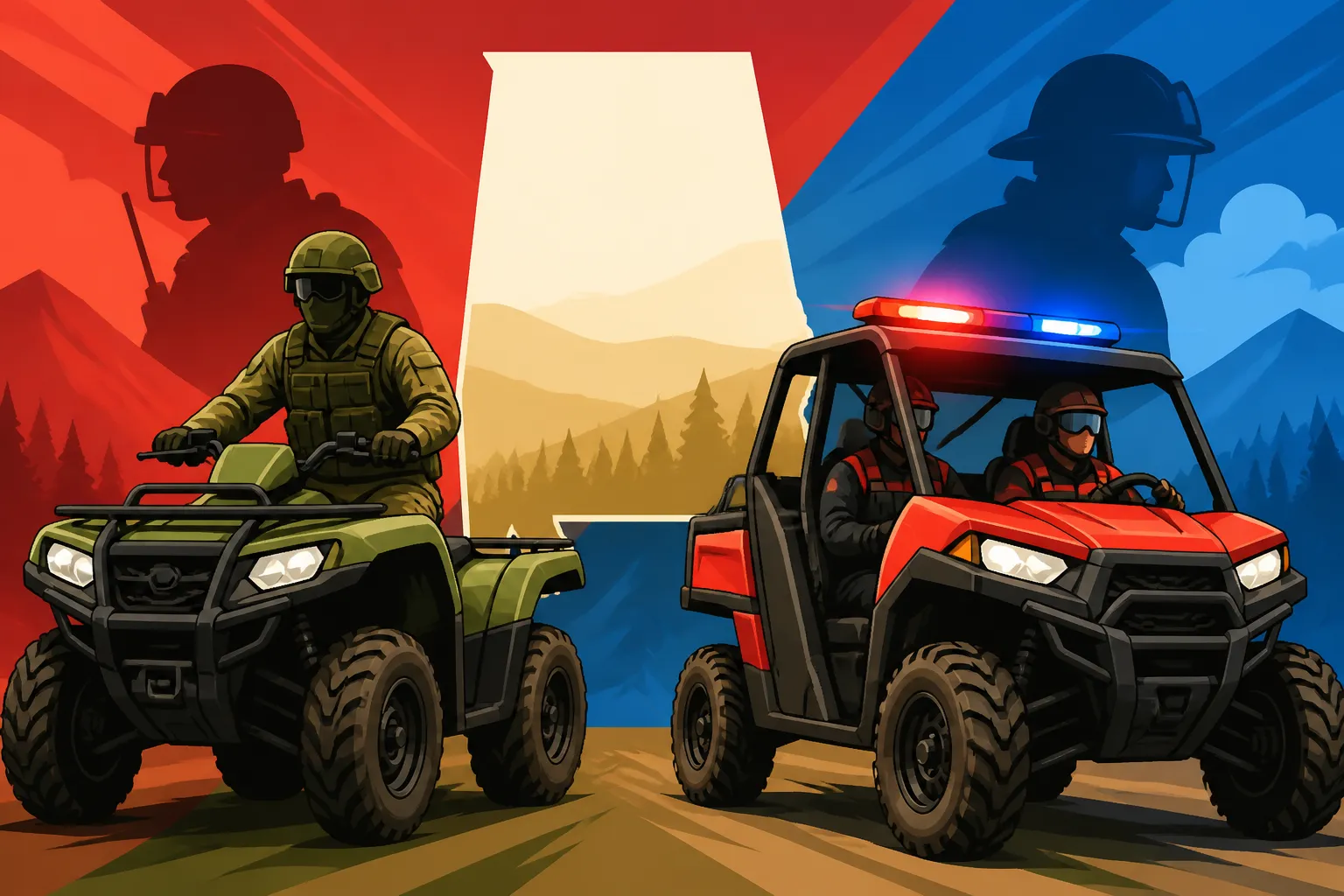
When you see a camouflage-painted ATV or a brightly colored UTV with emergency lights, your first thought probably isn't about its registration decal. And for good reason! These machines are inherently different from the ones you’d buy at a dealership for weekend fun or farm chores. Alabama law makes important distinctions for these types of vehicles, primarily due to their ownership and operational purpose.
Defining What Qualifies as "Military and Emergency" Off-Road Vehicles
In Alabama, the definition of what constitutes an "off-road vehicle" or "all-terrain vehicle" is quite broad, but the application of registration and titling laws often hinges on who owns the machine and what it's being used for. When we talk about "military and emergency machines," we're generally referring to ATVs, UTVs, or similar off-road vehicles that are owned by and operated on behalf of a governmental entity. This could include:
- Military Branches: Machines used by units like the Alabama National Guard for training, reconnaissance, or logistics support on military installations or during disaster response.
- Law Enforcement Agencies: ATVs and UTVs deployed by county sheriff's offices, municipal police departments, or state agencies (like ALEA or Conservation) for patrol, search and rescue, or accessing remote areas.
- Fire and Rescue Services: Vehicles used by volunteer fire departments, professional fire rescue, or emergency medical services (EMS) for reaching accident scenes in difficult terrain, wildfire suppression, or medical transport where traditional ambulances can't go.
- Other Government Entities: This might extend to machines used by state or federal agencies for park maintenance, wildlife management, or surveying purposes.
The critical element here is not just the type of machine, but its official capacity. These aren't private machines borrowed for a public cause; they are assets of the state or federal government, acquired and maintained with public funds for specific governmental functions. This distinction is paramount because it directly impacts whether standard civilian registration and titling requirements apply.
The Rationale Behind Exemptions from Standard Titling and Registration
You might wonder why these machines wouldn't be registered, especially if they're used on public land. The core reason lies in the concept of governmental immunity and the practicalities of public service. Generally, governmental entities are often exempt from certain taxes, fees, and administrative processes that apply to private citizens or commercial enterprises. It’s not about avoiding accountability, but rather acknowledging their unique role and ensuring resources are directed where they're most needed.
Think about it: forcing a county sheriff's department to pay a [Alabama Registration Cost] for every patrol quad, or requiring the National Guard to obtain a [How to Title an ATV in Alabama] for each utility vehicle used in a disaster zone, would create unnecessary administrative burdens and divert taxpayer money from essential services. These machines aren't for recreational enjoyment or personal use; they are tools of the state, directly employed to protect and serve the public. Their operational needs often involve rapid deployment, specialized modifications, and a chain of command for tracking that differs significantly from how a private citizen tracks their personal property. The state's interest is in managing its assets for public good, not collecting fees from itself for doing so.
Navigating Alabama's Exclusions for Official-Use Off-Road Machines
Alabama's laws, like those in many other states, recognize that governmental vehicles operate under a different umbrella. The specific chapter governing off-road vehicles often contains clauses that implicitly or explicitly exclude government-owned machines from the standard titling and registration requirements that apply to private owners.
How Alabama's Off-Road Vehicle Statute Addresses Government-Owned Equipment
While the statute meticulously defines ATVs and UTVs, and outlines registration tiers like [Alabama Private Use ATV Registration Explained] and [Alabama Public Use ATV Registration Explained], it also typically includes exemptions for machines operating in an official governmental capacity. This is consistent with how many other types of government vehicles, like police cars or fire trucks, are handled; they aren't issued standard license plates or titles in the same way your personal car is. Instead, they often carry distinct government tags or are simply identified by agency markings.
The effect of these statutory carve-outs is that a military UTV or a search-and-rescue quad owned by a county does not typically go through the same titling process at a county office that a civilian machine would starting in 2026. Nor does it receive a voluntary three-year registration decal from ALEA. Instead, these machines are tracked internally by the agencies that own them. They have VINs, of course, and are cataloged as agency assets, often with specific identification numbers or markings that denote their official status. While they may not be in the [Alabama's ALVIN System and Off-Road Titles] for civilian titling purposes, they are certainly not untraceable; they're just accounted for in a different, agency-specific system. This approach ensures accountability without adding redundant layers of state bureaucracy. These are among the [Machines Excluded From the Chapter] that outline typical ATV/UTV rules.
Practical Implications for Government Agencies
For agencies operating these critical off-road machines, the exemptions simplify the process of acquisition and deployment. Instead of navigating the standard titling and registration hurdles, they focus on procurement, maintenance, and operational readiness.
- Asset Management: Agencies maintain their own robust internal systems for tracking their off-road fleets. This includes serial numbers, service records, and assignment details, ensuring that every machine is accounted for.
- Procurement: When a sheriff's department or fire rescue unit purchases a new ATV or UTV, they don't apply for a title or registration with the state. Their purchase orders and internal documentation serve as proof of ownership.
- Operational Focus: The lack of state-mandated civilian paperwork means more time and resources can be dedicated to training personnel, maintaining the vehicles, and preparing for emergency situations. There's no concern about expired decals or waiting for paperwork to clear before a mission.
- Identification: These machines are typically marked with official agency logos, vehicle numbers, and sometimes specific "official use only" designations. This clearly differentiates them from civilian vehicles and demonstrates their governmental purpose without needing a standard registration plate or decal.
This streamlined process allows essential services to acquire and utilize the equipment they need without being bogged down by civilian administrative requirements. Just as [Alabama Excludes Farm Equipment] from certain recreational rules because of its utility, so too are emergency machines treated specially due to their vital governmental function.
The Complexities of Private Ownership for Former Military and Emergency Vehicles
Here's where things can get a bit muddy for the average Alabamian. While military and emergency machines are exempt during their official service, what happens when they are decommissioned and sold to the public? Many enthusiasts or individuals looking for a rugged, affordable off-road vehicle might find themselves at a government surplus auction, eyeing a former sheriff's quad or a military-grade UTV. This transition from public asset to private property changes everything regarding its legal status.
When a Surplus Machine Enters Civilian Hands: The Titling Question
Imagine you've just won a bid on a sturdy UTV that once belonged to a state agency. It's built tough, has low hours, and the price was right. You tow it home, excited to put it to use on your land or hit some trails. But then the question arises: how do you prove you own it, and does it need to be titled or registered now? The answer is a resounding yes, but the path to getting that paperwork can be fraught with unique challenges.
The biggest hurdle is that these machines, never having been subject to Alabama's civilian titling laws because of their exemption, often don't come with a traditional Certificate of Title. The governmental agency didn't get one when they bought it, so they can't give one to you. What you typically receive is a bill of sale or an auction receipt, sometimes accompanied by a certificate of release or a transfer of ownership form from the selling agency. This is a far cry from the official state title most private sellers would hand over. The confusion often stems from the fact that the machine looks like any other ATV, but its ownership history is entirely different. This situation can be frustrating, leaving new owners wondering if they've bought a machine that will forever be stuck in a legal gray area.
Registering and Titling a Decommissioned Off-Road Vehicle
Once a military or emergency machine is sold to a private citizen, it immediately loses its exempt status. It then becomes subject to the same titling and registration laws as any other privately owned off-road vehicle in Alabama. This means that if it's a model year 2026 or newer, it will require a title. Even if it's older, and thus not eligible for a title under [Why Older Alabama ATVs Cannot Be Titled], you still need to establish clear proof of ownership.
Here's generally how you'd tackle this:
- Gather All Documentation: Every single piece of paper you received from the auction or selling agency is vital. This includes the bill of sale, auction manifest, any transfer forms, and receipts. Ensure the [Alabama Bill of Sale Requirements] are met, specifically that it includes the machine's full Vehicle Identification Number (VIN) and the names and addresses of both the seller (the agency) and the buyer (you).
- Verify the Serial Number: Make sure the VIN on your paperwork exactly matches the physical VIN stamped on the machine. This is crucial for establishing identity and for [Alabama Stolen Machine Checks].
- Contact Your County Tag Office: This is your first official point of contact. Explain that you've purchased a former government surplus machine that has never had an Alabama title. They will be the ones to guide you through the process of establishing ownership and, if applicable, applying for a title.
- Proof of Ownership: Since there's no original state title, you'll need to use your bill of sale and other documents to establish [Alabama Proof of Ownership Without a Title]. The county office might require additional affidavits or statements confirming how you acquired the machine. Sometimes, a [What a Purchaser's Certificate Does in Alabama] can be a helpful document if issued by the selling entity. If your initial auction paperwork is sparse, a generic bill of sale form or affidavit from a service like LawDepot might be useful to formalize your ownership details, though always confirm with your county office what specific documents they will accept.
- Titling (if applicable): For model year 2026 and newer machines, you'll submit a [Alabama Title Applications From January 2026] along with your proof of ownership documents. The county will process this through the ALVIN system, treating it as an initial title application.
- Registration: Once ownership is established, you can apply for voluntary registration with ALEA, choosing either the private or public use tier, depending on your intended use. Remember, [Alabama Registration Paperwork Explained] clarifies what you’ll need for this process.
It can feel like a bureaucratic maze, especially when clerks might not be familiar with this specific scenario. Be patient, bring all your paperwork, and be prepared to explain the machine's history. The goal is to get your ownership documented officially so that you are legitimately the machine's owner in the eyes of the state.
Ensuring Legal Compliance and Resale Value
Navigating the complexities of bringing a former government machine into civilian registration and titling is not just about avoiding trouble; it's also about protecting your investment and ensuring the machine's future value.
Without clear documentation and, where required, an Alabama title, you could face significant headaches down the road. Selling the machine in the future would be incredibly difficult, as most buyers would (rightly) be suspicious of a valuable off-road vehicle with no official proof of ownership. You'd find its [Alabama Resale Value by Brand] severely impacted, regardless of its condition. Furthermore, obtaining [Insuring a Machine With No Title] can be a challenge. Insurance companies prefer clear ownership records, as it helps prevent fraud and simplifies claims processing. Having your ownership properly recorded, even if it's an "initial" title application based on your auction papers, gives you peace of mind and simplifies many future transactions.
Always keep your documentation meticulously organized. Treat your bill of sale, the official title (once you get it), and any registration documents as gold. These papers are your legal connection to your off-road machine, proving that it rightfully belongs to you and can be operated legally within Alabama's framework. Having the correct [Alabama Serial Numbers on the Application] and ensuring all information is accurate is crucial for establishing this unbroken chain of ownership.
Here’s a quick comparison of how military/emergency machines differ from civilian ones in terms of official paperwork:
| Feature | Military/Emergency Machines (in active service) | Privately Owned Civilian Machines (after purchase) |
|---|---|---|
| Title | Typically no state-issued title (internal tracking) | Required for Model Year 2026+; optional for older models |
| Registration | No state-issued registration (internal identification) | Voluntary with ALEA (private or public use tiers) |
| Proof of Ownership | Internal agency records, procurement documents | State-issued Certificate of Title, Bill of Sale |
| ID on Machine | Agency markings, government asset tags | VIN, state registration decal (if registered) |
| Primary Purpose | Official government duties, public service | Recreation, utility, farm work |
| Governing Authority | Agency protocols, federal/state government statutes | Alabama ATV/UTV statutes, county offices, ALEA |
Disclaimer
This article is for general informational purposes only and does not constitute professional advice. Laws, prices and regulations vary by location and change over time. Consult a qualified professional for guidance on your specific situation.