Checking In and Out of a Tract
A WMA permit can look complete while a tract still has a separate check-in rule. For Alabama ATV and UTV riders, that distinction matters: the right permit does not automatically make every road or riding time open. Here’s how to check in and out, what to confirm before unloading, and what to do when the process is unclear.
What checking in and out means on an Alabama WMA
A Wildlife Management Area, or WMA, is public land with rules that can vary by area, season, and activity. Checking in usually means recording that you are entering a particular tract for an authorized purpose. Checking out records that you have left. The check-in process may also give managers a record of who is using the area, support compliance with permit conditions, or help with public-safety and land-management needs.
For a rider, the key point is that check-in is an administrative step, not permission to ride anywhere. You still need to confirm that ATV or UTV use is allowed on that tract, on that date, and on the route you plan to use. A road marked on a map may be open to some vehicles or activities but not to recreational riding. Gates, seasonal closures, hunting activity, and temporary restrictions can change what is accessible.
Do not assume that every WMA uses one statewide check-in procedure. Some areas may use an electronic permit process; others may direct visitors to an on-site kiosk or posted instructions. Some may require riders to check in and out for a specific activity, while others may have different access conditions. The current area map and instructions are the best starting point. If they do not answer your question, ask the area office or biologist before riding.
It also helps to distinguish a WMA license from an area or daily permit. A license or permit may satisfy one part of the access requirement without covering every condition for a particular tract. The requirements can depend on whether you are hunting, scouting, riding, or visiting for another allowed purpose. See Alabama WMA Licenses Explained, Alabama WMA Area Permits, and Alabama WMA Daily Permits for related permit details.
| Before you ride | What to verify |
|---|---|
| Your permit | That it is valid for the activity and dates you have planned |
| The tract | That the specific WMA or tract allows your planned use |
| Check-in method | Whether to use an electronic process, a kiosk, or another posted procedure |
| Routes | Which roads or trails are open to your machine |
| Timing | When you may enter, ride, and leave |
| Check-out | Whether the area requires an exit record and how to submit it |
If an instruction says to check in and out, treat both steps as required. Completing only the entry step can leave the record incomplete, even if you followed the riding rules. Likewise, a check-in confirmation should not be treated as proof that a closed road or restricted tract is open.
A practical check-in and check-out routine
The safest approach is to do the administrative work before unloading. Phone service can be unreliable in remote areas, and a kiosk may be away from the trailhead. A little preparation helps avoid having to search for instructions once you are at the gate.
-
Identify the exact tract. Use the area name and map, not just a nearby town or the general name of the WMA. Large areas may contain separate tracts, gates, or access points with different conditions.
-
Read the current rules for that area. Check the map, signs, permit conditions, and any notices about closures or seasonal access. Look specifically for rules about ATV or UTV use, open roads, check-in and check-out, and hours of access. Information about one WMA should not be assumed to apply to another.
-
Confirm which permit applies to your activity. If you are riding rather than hunting, make sure you are following the rules for riding. A hunting license, WMA license, area permit, and daily permit are not interchangeable simply because they all relate to public-land access. The requirements may also differ for adults, minors, and visitors from out of state. Related details are covered in Which Permits to Carry on an Alabama WMA and Alabama WMA Riding Rules for Quads.
-
Complete the check-in before entering the tract. Follow the posted or electronic instructions exactly. If using a kiosk, check that you are using the right form or option for your activity. If checking in electronically, save the confirmation where you can show it without needing a strong signal.
-
Keep the proof with you. Carry the permit or confirmation in the format the area accepts. Keep a copy on your phone, but do not depend on phone access as the only way to show it. A screenshot or downloaded document may help when reception drops, provided the area accepts that form of proof.
-
Ride only where access is allowed. Stay on authorized routes, respect gates and closure signs, and do not treat a check-in record as permission to cross private land or use an unmarked route. A map can show boundaries and open roads, but the area’s current instructions control if they identify a closure.
-
Check out when the rules call for it. Use the same area-specific process described for check-in. Complete the exit step promptly after leaving, rather than waiting until later when you may forget or lose connectivity. If the process asks for details such as the tract or activity, make sure those entries match your visit.
This routine is useful even when a check-in seems simple. Keep your confirmation, note the tract name, and make sure everyone in your group understands the boundary and route rules. If the process is unfamiliar, pause before riding and ask an official rather than guessing.
When a tract’s instructions are unclear
WMA rules can be easy to misread when a general map, a permit screen, and a sign at the access point appear to say different things. Do not choose whichever instruction seems easiest. Check the exact tract and activity, then seek clarification from the area contact or agency office.
A sign at a gate may describe a temporary closure that is not reflected on a map you downloaded earlier. An online permit may confirm your entry but say nothing about machine access. A route marked for vehicles may be limited to agency, maintenance, or other authorized use. If two sources conflict, treat the restriction as a reason to stop and ask before proceeding.
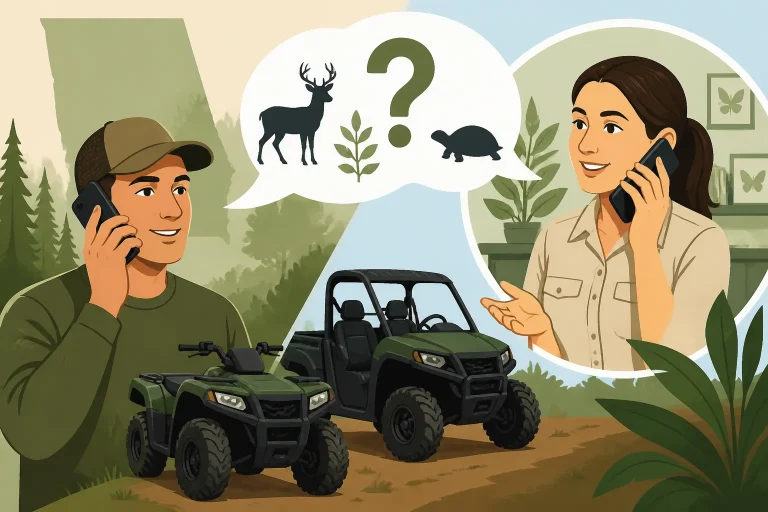
When contacting an area office or biologist, give enough detail for a useful answer:
- The WMA and tract name
- The date and time you intend to visit
- Whether you plan to ride an ATV or UTV
- The access point or route you are considering
- The permit or check-in instruction you have already seen
- The exact wording on any sign that seems unclear
Ask direct questions: Is recreational riding allowed on this tract? Which roads are open to my machine? Do I need to check in and out for this activity? Is there a closure or special season rule for my planned date? If the answer is that riding is allowed, ask where the permitted route begins and ends.
For more context on interpreting area information, see Alabama WMA Rules Vary by Area, Alabama Area Biologists and Their Maps, and [Rules Printed on an Area Map]. These distinctions matter because a permit is only one part of lawful access. A tract may be open for one activity while closed to another, or access may be limited to certain roads and periods.
If you cannot get a clear answer before the trip, the cautious choice is not to ride that tract until the rule is confirmed. Do not rely solely on another rider’s memory, an old social media post, or a map saved from a previous season. Conditions and instructions can change.
Common mistakes to avoid
The most common problem is treating check-in as a blanket authorization. It is better understood as a record or required step within the area’s access rules. You still need to obey restrictions on routes, dates, machine use, and land boundaries.
Another mistake is assuming check-out is optional because no one is waiting at the kiosk. If the rules require an exit record, complete it even when the process is unattended. Forgetting to check out can create an inaccurate visit record and may complicate questions about your permit later.
Avoid these other assumptions:
- “I have a permit, so the whole WMA is open.” A permit does not necessarily open every tract, road, or season.
- “A road is visible on the map, so I can ride it.” A mapped road may have vehicle restrictions or a current closure.
- “My group leader checked in, so everyone is covered.” Confirm whether each rider needs an individual permit or record.
- “I checked in at the entrance, so I do not need to check out.” Follow the specific exit instructions for that area.
- “The process worked last time, so it has not changed.” Recheck current instructions before each visit.
- “No cell service means I can skip the electronic step.” Look for an approved alternative or contact the area office before entering.
Groups should settle the process before arrival. Decide who will verify the tract, how each rider will carry proof, and who will confirm that everyone has checked out. A simple head count at the end of a ride can catch a missed step, but it does not replace a required individual check-out.
If you discover after leaving that you missed a required step, do not make up information or submit a false time. Follow the agency’s instructions for correcting an incomplete record. Keep any permit confirmation and note when you entered and left, in case staff ask for details. For a broader overview of the process, see Getting an Area Permit for a Single Tract and Pulling a Daily Permit Every Morning You Ride.
The practical rule is straightforward: identify the tract, verify riding is allowed, complete the required check-in, stay on authorized routes, and check out as instructed. When a detail is uncertain, confirm it with the area contact before unloading rather than relying on assumptions.
Disclaimer
This article is for general informational purposes only and does not constitute professional advice. Laws, prices and regulations vary by location and change over time. Consult a qualified professional for guidance on your specific situation.