Calling a Biologist With a Question
Calling a Biologist With a Question
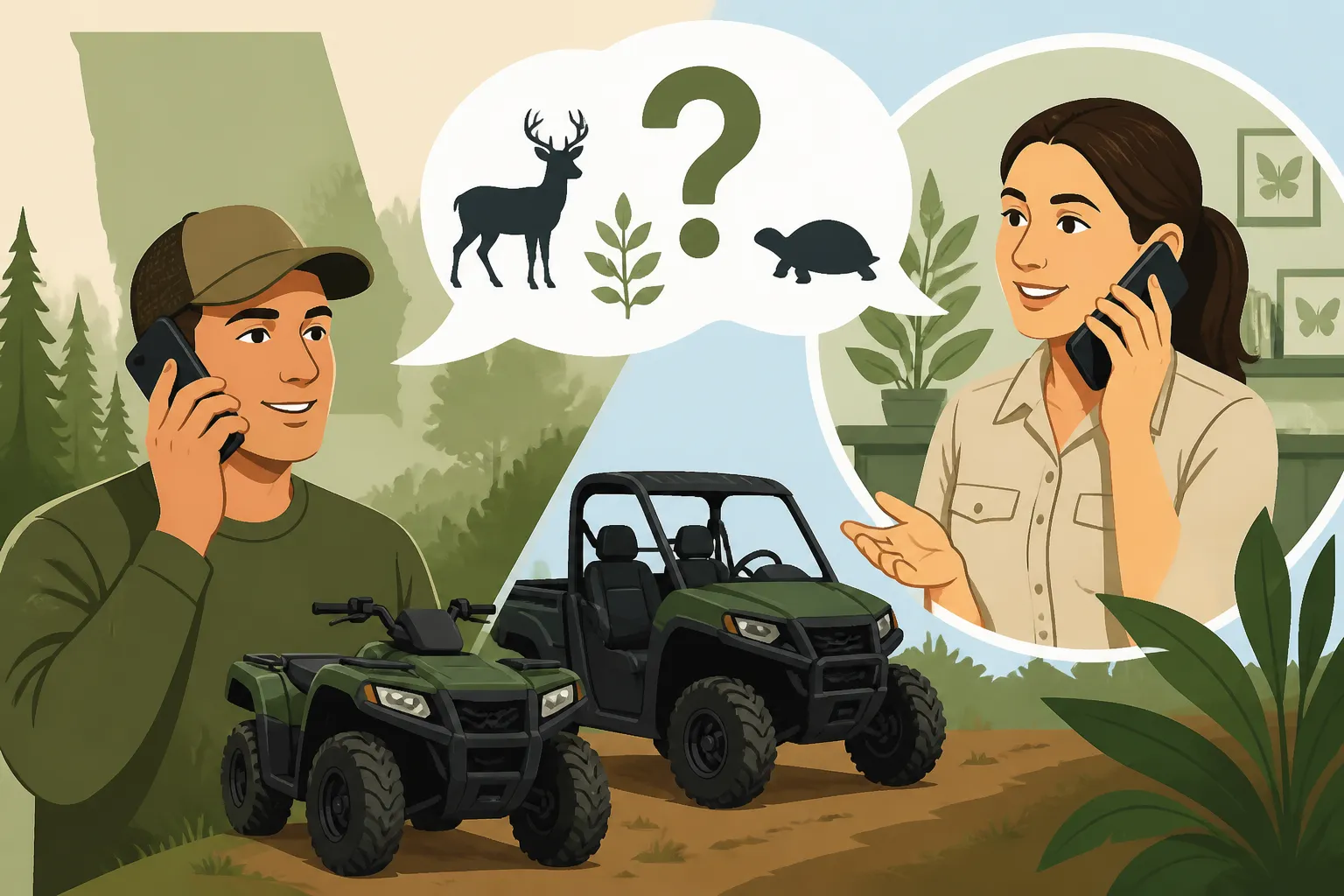
A WMA map can leave practical questions unanswered: Is this road open to ATVs? Does your permit cover the ride, or only another activity? Calling an area biologist can help you check how rules apply to a specific tract and date. The key is to give enough detail, ask focused questions, and treat the written rules as the final reference.
When a Call Can Help
Alabama Wildlife Management Area rules can depend on the specific area, season, activity, and route. An area biologist may be able to explain how the current map, permit instructions, or posted rules apply to your plan. That can be especially useful when a boundary, gate, seasonal closure, or machine restriction is not clear from the information you have.
A call is most useful for questions tied to a particular place and time. For example, you might need to know whether a named tract has an open route for an off-road machine, whether a seasonal restriction affects access, or where to find the current permit instructions. These are more answerable than a broad question such as, “Can I ride on a WMA?”
A biologist’s answer is not a substitute for checking the area’s current rules. Maps, closures, and access conditions can change. A verbal answer also may not be the same as written permission to use a route that is closed or restricted. If the official map, posted notice, or permit terms say something different from what you understood on the phone, pause and ask for clarification before riding.
Questions worth asking
A call can help clarify:
- Whether the route or tract you identified is open to the type of machine you plan to ride.
- Whether the rules differ by season, day, or the activity you are doing.
- Which permit or license requirements apply to your planned access.
- Whether you need to stay on open roads or may use another marked route.
- How to interpret a gate, boundary, or closure shown on the map.
- Where to find the current written rules for that area.
- Whether a route has a temporary closure or access condition you should verify before leaving.
For a fuller overview of permits, see Alabama WMA Rules Vary by Area and Which Permits to Carry on an Alabama WMA. If you are not sure whether you need a wildlife area permit, a hunting license, or both for your activity, review Three Things You Need Before Riding a WMA and ask the biologist to confirm how the current requirements apply to your specific plan.
Questions a biologist may not be the right contact for
Some issues belong with a different office or authority. A biologist may not be able to resolve a dispute about a private hunting lease, grant permission to cross private property, interpret a local ordinance, or guarantee that a public road is open to your machine. Questions about a private park’s admission rules should go to the park. Questions about a legal citation or road-use rule may require a different authority.
If your route crosses land managed by more than one owner or agency, ask who controls each part. Permission for one tract does not necessarily extend to an adjoining property, a county road, a timber company road, or a private access lane. For timber property, see Alabama Timber Land Access Rules; for leased hunting property, see [Alabama Hunting Club Riding Rules].
Prepare Before You Call
A short preparation step can make the call faster and the answer more useful. The biologist needs to know where you plan to go, what you plan to do, and when. “I’m going to ride near the north end of the WMA” may not identify a specific route. A tract name, road name, map label, nearby entrance, or clear description of the boundary is more helpful.
Gather the information you can before calling:
- Identify the exact area. Write down the WMA name and, if possible, the tract, unit, road, or map label. If you are looking at an online map, note the names shown there rather than relying only on a screen location.
- Describe the machine. Say whether it is an ATV, side-by-side, or another off-road machine. Mention details such as width if they could affect a route or access restriction.
- State what you want to do. Explain whether you are riding for recreation, accessing a hunting location, retrieving game, or traveling to another permitted destination. Rules can depend on the activity.
- Give the date or season. A rule that applies at one time may not apply during another season. If you plan to ride over several days, give the full period.
- Explain the route. Identify where you intend to enter, which marked roads or routes you plan to use, and where you expect to exit.
- Have your documents nearby. Keep the current area map, permit instructions, and any relevant license information available so you can point to the wording that is unclear.
- Write down the answer. Record the date of the call, the area discussed, and the main guidance. If a detail is important, ask where it appears in writing.
It helps to read the exact map note or permit language aloud. A general description can hide the source of confusion. For instance, if a route looks open on your map but a nearby notice appears to close access during a certain season, say exactly that and ask which current instruction controls.
Do not assume that a map downloaded earlier is still current. Check the official information for the area before calling, and ask whether there is a more recent map or notice. Guidance on finding and interpreting area information is available in Alabama Area Biologists and Their Maps and [Rules Printed on an Area Map].
How to Ask a Clear, Useful Question
The most effective call is specific, neutral, and limited to the decision you need to make. Start with the place, date, machine, and activity. Then describe the uncertainty. This gives the biologist a practical question to answer instead of requiring them to reconstruct your plan from several vague details.
A useful opening might sound like this:
“I’m planning to ride an ATV on the named WMA tract on a particular date. I’m looking at the current area map, and I’m unsure whether the marked route near the entrance is open to that use during this season. Can you tell me which written rule or map note applies?”
That is more productive than asking whether ATVs are “allowed on the WMA,” because a broad yes-or-no answer may not cover the route, season, or type of access you have in mind.
Ask one question at a time
If you have several uncertainties, list them in priority order. Begin with the one that determines whether the trip can go ahead: whether the area and route are open to your planned use. Then ask about permits, boundaries, or seasonal details. When related questions are mixed together, it is easy to leave the call with an answer to only one of them.
A simple sequence is:
- Is this specific tract open to my planned activity on my planned date?
- Is the route I identified open to this type of machine?
- What permit or license requirements apply to this access?
- Are there seasonal, daily, or temporary restrictions I should check?
- Where can I confirm the answer in the current written instructions?
If your plan includes retrieving game, riding during a hunting season, or using a route for access rather than recreation, state that clearly. The rules may depend on the reason for entering the area. See Alabama Game Retrieval Rules for issues specific to retrieving game by machine.
Clarify what “open” means
“Open” can mean different things: open to the public, open for hunting, open to a certain vehicle, or open only on specific roads. If the biologist says an area is open, follow up with the precise question: open to what activity, on which route, during what dates, and for what type of machine?
Likewise, do not treat an open gate as proof that riding is permitted. A gate may be open for another purpose, or the route may have restrictions that are posted elsewhere. Ask whether the route itself is authorized for your planned use, and confirm the answer against the current map or posted instructions.
Ask where the answer is written
If the answer affects whether you can ride, ask for the source you should check again before the trip. That might be the current area map, a posted notice, permit instructions, or another official rule for that tract. The goal is not to challenge the person on the phone; it is to make sure you can recognize the applicable rule if conditions or notices change.
If the answer is not available in writing, ask what conditions or limits apply and whether there is a more appropriate office to contact. Do not interpret a general explanation as permission to ignore a posted closure, enter private land, or leave an authorized route.
Permits, Routes, and Conditions to Confirm
A biologist’s explanation is most useful when you keep separate questions that are often bundled together: whether you may enter the area, whether your documents cover that access, and whether your machine may use the route you have in mind. One answer does not automatically settle the others.
| What you need to confirm | What to ask | What to check before riding |
|---|---|---|
| Area access | Is this tract open to my activity on the planned date? | Current area rules and notices |
| Route access | May this type of machine use this specific marked route? | Current map, signs, and route restrictions |
| Permit or license | Which documents apply to this activity and access? | Current permit instructions and license requirements |
| Seasonal limits | Does the date or season change access? | Current seasonal notices and area rules |
| Temporary conditions | Is there a closure or restriction I should know about? | Recent official updates and posted notices |
| Boundary or gate | Who manages the land or route on the other side? | Map boundaries and the relevant land manager’s rules |
Permits are not the same as route permission
Having a permit or license does not necessarily authorize every kind of travel within an area. The document may cover a particular purpose or access requirement, while the map and area rules set limits on where and how you may travel. Ask what your permit covers rather than assuming it gives unrestricted use of roads and trails.
If you are unsure which document applies, explain your activity and ask the biologist to identify the current instructions. You can also review How an Area Permit Differs From a Daily Permit and Buying a WMA License in Addition to a Hunting License. The exact requirements should be confirmed for the relevant area and activity, because rules may vary.
Routes and machine types matter
A route shown on a map is not automatically open to every machine. There may be restrictions by vehicle type, route, season, or purpose. Give the biologist an accurate description of your machine. If your ATV or side-by-side has unusual dimensions, or you are unsure whether its classification matters, say so rather than assuming it is covered by a general answer.
Ask whether you must stay on designated roads or routes and whether the same rule applies to the section near your planned destination. A route can cross different management boundaries, so permission for one section does not guarantee access to the next. For a broader explanation of federal land routes, see Which Forest Roads in Alabama Are Open to ATVs; forest rules are separate from WMA rules.
Temporary closures and changing conditions
A call can help you ask about current access, but do not rely on a past answer for a later trip. A seasonal opening, closure, emergency condition, or posted restriction can change what is available. Recheck official information close to your departure date, especially if you are traveling a long distance or planning a group ride.
Weather and trail conditions are separate from legal access. A road may be open but unsuitable after heavy rain, or a route may be temporarily blocked. Ask whether there are current access notices, and use sound judgment about conditions. Do not bypass a gate, barrier, or closure because the route appears passable.
After the Call: Confirm and Carry the Right Information
As soon as the call ends, summarize what you heard in your own words. Include the tract, route, activity, machine, and date. If any of those details are missing, call back or send a follow-up through an official channel rather than filling in the gaps with assumptions.
Then compare your notes with the written information:
- Check that the map or notice is for the correct WMA and tract.
- Confirm the date, season, and activity match your plan.
- Look for route-specific restrictions, not just general statements about access.
- Verify permit or license instructions independently.
- Check for updated notices before leaving.
- Tell everyone in your group about the restrictions that apply.
A brief note on your phone can help, but it should supplement—not replace—the official map and permit materials. Keep the information easy to access if a question comes up at the entrance or on the route. If the answer depends on a temporary notice, save or print that notice when possible, and check again before the ride in case it has changed.
If the biologist cannot answer, ask who manages the route or which office handles that question. If the issue is a private road, lease, or adjoining property, contact the landowner or manager rather than treating WMA access as permission to cross. If the issue is a local road rule, seek the relevant local authority. For general preparation, Alabama Public Land Rules Compared to Private explains why access rules can differ by land type.
A careful call is a planning tool, not a guarantee that every condition will remain unchanged. The safest approach is to use the biologist’s explanation to locate the right rule, verify it in the current written information, and stay within the limits posted for the area.
Frequently Asked Questions
Can an area biologist give permission to ride anywhere on a WMA?
Do not assume so. A biologist can help explain rules and access for a specific area, but a general answer does not override posted restrictions or authorize travel beyond permitted routes. Ask what written rule applies.
What should I have ready before calling?
Have the WMA and tract name, planned date, type of machine, activity, intended entrance, and route details. Keep the current map and permit instructions nearby so you can describe the exact wording that is unclear.
Does a WMA permit automatically allow ATV or UTV use?
Not necessarily. Permit or license requirements and route access are separate questions. Confirm which documents apply to your activity and whether your machine may use the specific route.
Should I rely on an answer from a previous call?
Use it as a reference, not as a substitute for checking current rules. Seasonal access and temporary conditions can change. Verify the latest official map, notices, and permit instructions before riding.
Disclaimer
This article is for general informational purposes only and does not constitute professional advice. Laws, prices and regulations vary by location and change over time. Consult a qualified professional for guidance on your specific situation.