Alabama Timber Land Access Rules
Alabama timber land can look like a network of open riding roads, but a gate, a familiar trail, or an out-of-state registration does not establish permission to ride. Access depends on who controls the property and what that person or organization allows. Here’s how to check before taking an ATV or UTV onto timberland, and what to confirm when access is tied to a hunting lease or permit.
Who controls the timberland and its roads
Timberland is usually privately owned or managed, even when it has miles of gravel roads and appears remote. A road that looks public may be on private property, and a route that has been open in the past may be closed now. The owner, timber company, leaseholder, or another authorized manager may control access. Their permission—not the fact that a road is physically passable—is what matters.
A timber company may own the land, manage it for an owner, or set access conditions through a contract. A hunting club may have permission to use a tract without having authority to let other riders in. Before riding, find out who can actually authorize your visit. If a club member invites you, ask whether that person can approve ATV or UTV use, not just hunting access.
Timber operations can also change conditions quickly. Logging, road work, fire activity, weather damage, or a temporary closure may affect a route. A road that was open when permission was granted may not be usable on the day of your ride. Ask about current closures, gates, work zones, and any restrictions on where machines may travel.
| Land or access situation | What to confirm before riding |
|---|---|
| Timber company property | Who can grant permission, approved routes, current closures, and whether riding is allowed |
| Hunting club lease | Whether the lease allows riding and whether guests need separate approval |
| Public wildlife management area | The current area rules, required permits, open routes, and dates |
| National forest land | Whether the specific road or route is designated for your machine |
| Private riding park | Admission, waiver, machine, passenger, and operating rules |
Do not assume a hunting invitation includes permission to bring a machine. A club may allow members to reach a stand by ATV but prohibit recreational trail riding, guest machines, or use outside certain dates. Read the lease or written rules, or ask an authorized club officer or land manager. For related questions, see Alabama Hunting Club Riding Rules and Reading a Timber Company’s Written Riding Policy.
It also helps to distinguish timberland from public land. A timber road does not become a public trail just because it connects to a county road or passes through a large tract. Wildlife management areas and national forests have their own access rules, and those rules do not apply automatically to nearby private timber property. If your ride includes more than one type of land, confirm permission and requirements for each part of the route.
Get clear permission before you unload
The safest approach is to get permission directly from someone with authority over the land and to make the scope of that permission specific. A casual “you can come out” can leave important details unresolved: whether you can ride at all, which roads you can use, whether guests are allowed, and whether access covers the date you have planned.
Ask about the following before setting out:
- Who is granting permission? Confirm the person has authority to approve riding, especially if the invitation comes through a club member, tenant, or employee.
- What property and routes are included? Ask for a map, tract name, road names, or clear boundaries. Do not assume permission for one parcel includes neighboring land.
- What kind of use is allowed? Clarify whether permission is for travel to a work site or hunting location, or for recreational riding on approved roads.
- When may you ride? Check dates, hours, seasonal restrictions, hunting activity, and whether access may be suspended on short notice.
- Who may come with you? Ask whether guests, children, passengers, or a group ride are allowed, and whether every rider needs separate authorization.
- What machines are permitted? Confirm that the permission covers your ATV or UTV and ask about width, weight, or other limits the land manager applies.
- Are there conditions? Ask about speed, noise, road surfaces, water crossings, gates, parking, fires, camping, and hauling or recovering a disabled machine.
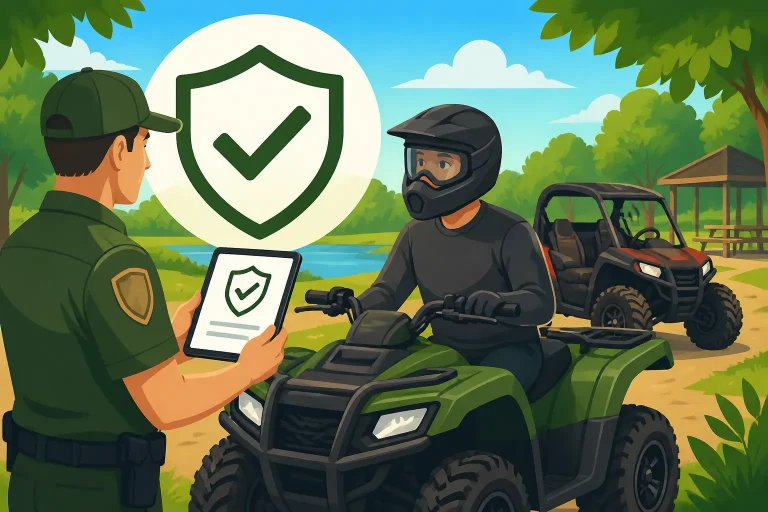
When permission is given in writing, keep a copy accessible during the ride. A useful permission record identifies the person authorizing access, the tract or route, the date or period covered, and any restrictions. A written note does not override a posted closure or a later instruction from an authorized manager, but it can help prevent confusion about what was approved. Alabama Landowner Permission Forms and Carrying a Landowner’s Written Permission on a Ride cover ways to document authorization.
A text or email may be more useful than relying on a verbal conversation, but make sure it comes from someone who can grant permission. Ask what to do if you arrive and find a closed gate or a new sign. Do not force a gate, go around a barrier, or continue onto another tract because the route appears to be part of the same road network.
Check the property boundary before turning off an approved route. Roads, firebreaks, and trails can cross ownership lines without an obvious change in the landscape. A map supplied by the land manager is more reliable than a phone map that shows only a road. If you cannot tell whether a road is included, stop and ask rather than treating uncertainty as permission.
Posted signs and boundary markings should be taken seriously. They may identify restrictions that apply even when you have been given access to a different part of the property. Do not assume that a missing sign means an area is open, or that a familiar access point gives you permission to enter. For additional context, see Alabama Posted Land Rules for Riders and What a Posted Sign on a Fence Actually Means.
Permits and leases do not automatically grant timber access
A permit or registration can satisfy a particular requirement without giving you the right to use private land. These are separate questions:
- Is your machine permitted or registered where required?
- Are you authorized to enter this property and ride this route?
Having paperwork for the first question does not answer the second. An out-of-state registration or decal is not a substitute for landowner permission. The same is true of insurance, a hunting license, a club membership, or a permit issued for a different type of public property. If you are visiting from another state, check the rules for the machine separately from access permission; Alabama Rules for an Out-of-State Machine addresses the vehicle-rule side.
A hunting lease can create a right to use the land for certain purposes, but its terms decide whether riding is included. The lease may limit machines to specific access roads, allow them only for particular activities, or require approval for guests. It may also give a club access without giving individual members authority to invite the public. Read the agreement and ask the person responsible for administering it when the language is unclear.
Do not treat a wildlife management area permit as authorization to ride on a neighboring timber tract. WMA access and riding conditions are tied to the specific area and its rules. Requirements can vary by area and activity, so check the official information for the tract you plan to use. See What a Wildlife Management Area Permit Covers and Alabama WMA Riding Rules for Quads before planning a route that crosses or borders a WMA.
National forest land is another distinct category. A forest road or trail may be open to some users and closed to others, and a general map does not prove that a particular route is open to your machine. Confirm the designated routes and current restrictions for the specific forest area. Do not carry a private timberland permission letter onto public land as if it were a public-land permit, or assume a public-land permit extends onto private property.
A practical route plan should mark each transition between land types: private timberland, leased hunting property, WMA, national forest, and public road. For every segment, identify the party that controls access and the applicable rules. If any portion of the route is unclear, choose a route you can verify instead.
A pre-ride check for timber roads
Once permission is confirmed, a short pre-ride check can prevent avoidable disputes and unsafe surprises. Contact the land manager close to the ride date, especially if the property is actively logged or if conditions have changed after rain or storms.
Use this checklist:
- Confirm the date and route again. Ask whether any road, gate, work area, or tract has been closed since permission was granted.
- Save contact details. Keep the name and number of the person who authorized the ride, along with the written permission and any map.
- Share the boundaries with the group. Make sure each rider understands which roads are allowed and where to turn around.
- Follow gates and signs. Leave gates as directed, do not bypass barriers, and obey new closure instructions.
- Stay on approved routes. Do not cut across a work area, field, streamside buffer, or neighboring parcel to make a shorter loop.
- Keep the ride consistent with the permission. If access was granted for travel to a hunting location, do not turn it into unrestricted recreational riding.
- Have a plan for a change in conditions. Know whom to contact if logging begins, a road becomes blocked, or the group is unsure about a boundary.
Road conditions can be different from what a map suggests. Timber roads may be soft, rutted, steep, or narrowed by equipment. A UTV can be too wide for a route that an ATV can use, and a machine that fits physically may still be prohibited by the land manager. Avoid driving around a muddy section or gate onto unapproved ground; that can cause property damage and turn a permitted ride into an unauthorized one.
Be considerate of work crews, hunters, neighbors, and other authorized users. Keep speed controlled, avoid unnecessary noise, and give logging equipment room to operate. If you encounter workers or another person responsible for the property, follow instructions and be prepared to stop or leave. Permission to use a road does not mean you have priority over active work or the right to continue during a closure.
If permission is denied or cannot be verified, do not ride there. Look for a public riding area or a route where access is clearly authorized. A little confirmation before loading the machine is simpler than dealing with a trespass complaint, damaged property, or a confrontation after entering land without permission.
Disclaimer
This article is for general informational purposes only and does not constitute professional advice. Laws, prices and regulations vary by location and change over time. Consult a qualified professional for guidance on your specific situation.